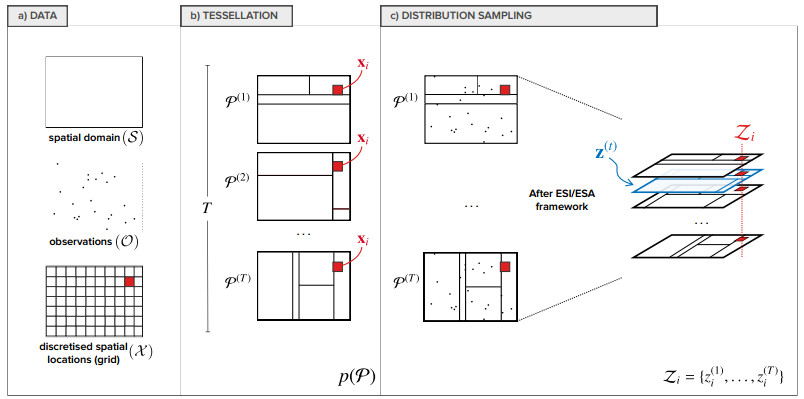
This paper introduces a novel data-driven methodology for estimating the full random field (random function) of a regionalized variable, building upon and extending the concepts of ensemble spatial interpolation and adaptive ensemble spatial analysis. The core contribution is the development of a rigorous theoretical framework that proves how the method implicitly learns the underlying spatial dependence structure. By inferring local predictive distributions through adaptively defined, overlapping spatial partitions, the approach ensures that spatial coherence is governed by a learned statistical copula. Formal proof is provided demonstrating that this dependency structure converges to the actual structure of the regionalized variable. Therefore, the resulting spatial distributional estimator is consistent, captures all the uncertainty of the random field, and naturally allows for the generation of multiple equally probable realizations. This non-parametric strategy offers a flexible alternative, inherently preserving spatial patterns and capturing fine-scale variability without requiring prior model specification. Experiments conducted in a detailed case study applied to geostatistical simulation, using both synthetic and real datasets, confirm the effectiveness and computational efficiency of the method, demonstrating its ability to recover local statistics and spatial structure with greater robustness compared to conventional techniques.
Citation: Alvaro F. Egaña, Gonzalo Díaz, Felipe Navarro, Mohammad Maleki, Juan F. Sánchez-Pérez. Spatial distributional estimation via ensemble spatial analysis[J]. AIMS Mathematics, 2025, 10(11): 26351-26388. doi: 10.3934/math.20251159
This paper introduces a novel data-driven methodology for estimating the full random field (random function) of a regionalized variable, building upon and extending the concepts of ensemble spatial interpolation and adaptive ensemble spatial analysis. The core contribution is the development of a rigorous theoretical framework that proves how the method implicitly learns the underlying spatial dependence structure. By inferring local predictive distributions through adaptively defined, overlapping spatial partitions, the approach ensures that spatial coherence is governed by a learned statistical copula. Formal proof is provided demonstrating that this dependency structure converges to the actual structure of the regionalized variable. Therefore, the resulting spatial distributional estimator is consistent, captures all the uncertainty of the random field, and naturally allows for the generation of multiple equally probable realizations. This non-parametric strategy offers a flexible alternative, inherently preserving spatial patterns and capturing fine-scale variability without requiring prior model specification. Experiments conducted in a detailed case study applied to geostatistical simulation, using both synthetic and real datasets, confirm the effectiveness and computational efficiency of the method, demonstrating its ability to recover local statistics and spatial structure with greater robustness compared to conventional techniques.

| [1] |
X. Emery, C. Lantuéjoul, Tbsim: A computer program for conditional simulation of three-dimensional Gaussian random fields via the turning bands method, Comput. Geosci., 32 (2006), 1615–1628. https://doi.org/10.1016/j.cageo.2006.03.001 doi: 10.1016/j.cageo.2006.03.001

|
| [2] |
X. Emery, A turning bands program for conditional co-simulation of cross-correlated Gaussian random fields, Comput. Geosci., 34 (2008), 1850–1862. https://doi.org/10.1016/j.cageo.2007.10.007 doi: 10.1016/j.cageo.2007.10.007
|
| [3] | M. Nowak, G. Verly, The practice of sequential Gaussian simulation, In: Geostatistics Banff 2004, Dordrecht: Springer, 2005,387–398. https://doi.org/10.1007/978-1-4020-3610-1 |
| [4] |
C. V. Deutsch, A sequential indicator simulation program for categorical variables with point and block data: BlockSIS, Comput. Geosci., 32 (2006), 1669–1681. https://doi.org/10.1016/j.cageo.2006.03.005 doi: 10.1016/j.cageo.2006.03.005
|
| [5] |
J. G. Manchuk, C. V. Deutsch, A flexible sequential Gaussian simulation program: USGSIM, Comput. Geosci., 41 (2012), 208–216. https://doi.org/10.1016/j.cageo.2011.08.013 doi: 10.1016/j.cageo.2011.08.013
|
| [6] |
P. D. Sampson, P. Guttorp, Nonparametric estimation of nonstationary spatial covariance structure, J. Amer. Stat. Assoc., 87 (1992), 417,108–119. https://doi.org/10.1080/01621459.1992.10475181 doi: 10.1080/01621459.1992.10475181
|
| [7] |
E. Pardo-Igúzquiza, P. A. Dowd, Comparison of inference methods for estimating semivariogram model parameters and their uncertainty: The case of small data sets, Comput. Geosci., 50 (2013), 154–164. https://doi.org/10.1016/j.cageo.2012.06.002 doi: 10.1016/j.cageo.2012.06.002
|
| [8] |
G. De Marsily, F. Delay, J. Gonçalvès, Ph. Renard, V. Teles, S. Violette, Dealing with spatial heterogeneity, Hydrogeol. J., 13 (2005), 161–183. https://doi.org/10.1007/s10040-004-0432-3 doi: 10.1007/s10040-004-0432-3
|
| [9] | L. Keeney, The development of a novel method for integrating geometallurgical mapping and orebody modelling, PhD thesis, University of Queensland, 2010. |
| [10] | J.-P. Chiles, P. Delfiner, Geostatistics: Modeling Spatial Uncertainty, John Wiley & Sons, 2012. https://doi.org/10.1007/s11004-012-9429-y |
| [11] |
M. Maleki, X. Emery, Joint simulation of stationary grade and non-stationary rock type for quantifying geological uncertainty in a copper deposit, Comput. Geosci., 109 (2017), 258–267. https://doi.org/10.1016/j.cageo.2017.08.015 doi: 10.1016/j.cageo.2017.08.015
|
| [12] |
R. Ferrer, X. Emery, M. Maleki, F. Navarro, Modeling the uncertainty in the layout of geological units by implicit boundary simulation accounting for a preexisting interpretive geological model, Natural Resour. Res., 30 (2021), 4123–4145. https://doi.org/10.1007/s11053-021-09964-9 doi: 10.1007/s11053-021-09964-9
|
| [13] |
J. B. Boisvert, J. G. Manchuk, C. V. Deutsch, Kriging in the presence of locally varying anisotropy using non-Euclidean distances, Math. Geosci., 41 (2009), 585–601. https://doi.org/10.1007/s11004-009-9229-1 doi: 10.1007/s11004-009-9229-1
|
| [14] |
P. A. Bostan, G. B. Heuvelink, S. Z. Akyurek, Comparison of regression and kriging techniques for mapping the average annual precipitation of Turkey, Int. J. Appl. Earth Obser. Geoinf., 19 (2012), 115–126. https://doi.org/10.1016/j.jag.2012.04.010 doi: 10.1016/j.jag.2012.04.010
|
| [15] |
D. Arroyo, X. Emery, Simulation of intrinsic random fields of order k with a continuous spectral algorithm, Stochastic Environ. Res. Risk Assess., 32 (2018), 3245–3255. https://doi.org/10.1007/s00477-018-1516-2 doi: 10.1007/s00477-018-1516-2
|
| [16] | S. Dunham, J. Vann, Geometallurgy, Geostatistics and project value—does your block model tell you what you need to know, Proceedings of the Project Evaluation Conference, 2007, 19–20. |
| [17] | P. Carrasco, J.-P. Chilès, S. A. Séguret, Additivity, metallurgical recovery, and grade, Proceedings of the 8th International Geostatistics Congress, 2008. |
| [18] |
P. H. A. Campos, J. F. C. Leite Costa, V. C. Koppe, M. A. Arcari Bassani, Geometallurgy-oriented mine scheduling considering volume support and non-additivity, Min. Tech., 131 (2022), 1–11. https://doi.org/10.1080/25726668.2021.1963607 doi: 10.1080/25726668.2021.1963607
|
| [19] |
J. L. Deutsch, K. Palmer, C. V. Deutsch, J. Szymanski, T. H. Etsell, Spatial modeling of geometallurgical properties: Techniques and a case study, Nat. Resour. Res., 25 (2016), 161–181. https://doi.org/10.1007/s11053-015-9276-x doi: 10.1007/s11053-015-9276-x
|
| [20] |
U. E. Kaplan, Y. Dagasan, E. Topal, Mineral grade estimation using gradient boosting regression trees, Int. J. Min., Reclam. Environ., 35 (2021), 728–742. https://doi.org/10.1080/17480930.2021.1949863 doi: 10.1080/17480930.2021.1949863
|
| [21] |
N. K. Dumakor-Dupey, S. Arya, Machine learning—a review of applications in mineral resource estimation, Energies, 14 (2021), 4079. https://doi.org/10.3390/en1414407 doi: 10.3390/en1414407
|
| [22] | S. I. Cevik, J. M. Ortiz, Machine learning in the mineral resource sector: An overview, Technical report, Queen's University, 2020. Available from: https://qspace.library.queensu.ca/server/api/core/bitstreams/afc8a395-c84e-45ff-9dc8-7970c131d2aa/content. |
| [23] |
K. Dachri, M. Bouabidi, K. Naji, K. Nouar, I. Benzakour, A. Oummouch, et al., Predictive insights for copper recovery: A synergistic approach integrating variability data and machine learning in the geometallurgical study of the Tizert deposit, Morocco, J. Afr. Earth Sci., 212 (2024), 105208. https://doi.org/10.1016/j.jafrearsci.2024.105208 doi: 10.1016/j.jafrearsci.2024.105208
|
| [24] | M. Kanevski, V. Timonin, A. Pozdnukhov, Machine Learning for Spatial Environmental Data: Theory, Applications, and Software, New York: EPFL Press, 2009. |
| [25] | A. Burkov, The Hundred-Page Machine Learning Book, Andriy Burkov, Quebec City, QC, Canada, 2019. Available from: http://ema.cri-info.cm/wp-content/uploads/2019/07/2019BurkovTheHundred-pageMachineLearning.pdf. |
| [26] |
A. Egaña, F. Navarro, M. Maleki, F. Grandon, F. Carter, F. Soto, Ensemble spatial interpolation: A new approach to natural or anthropogenic variable assessment, Nat. Resour. Res., 30 (2021), 3777–3793. https://doi.org/10.1007/s11053-021-09860-2 doi: 10.1007/s11053-021-09860-2
|
| [27] |
A. Menafoglio, G. Gaetani, P. Secchi, Random domain decompositions for object-oriented kriging over complex domains, Stochastic Environ. Res. Risk Assess., 32 (2018), 3421–3437. https://doi.org/10.1007/s00477-018-1596-z doi: 10.1007/s00477-018-1596-z
|
| [28] |
A. F. Egaña, M. J. Valenzuela, M. Maleki, J. F. Sánchez-Pérez, G. Díaz, Adaptive ensemble spatial analysis, Sci. Rep., 15 (2025), 26599. https://doi.org/10.1038/s41598-025-08844-z doi: 10.1038/s41598-025-08844-z
|
| [29] | T. Hastie, R. Tibshirani, J. Friedman, The Elements of Statistical Learning: Data Mining, Inference, and Prediction, 2 Eds., New York: Springer, 2009. https://doi.org/10.1007/978-0-387-84858-7 |
| [30] | R. B. Nelsen, An Introduction to Copulas, 2 Eds., New York: Springer, 2006. https://doi.org/10.1007/0-387-28678-0 |
| [31] | D. Koller, N. Friedman, Probabilistic Graphical Models: Principles and Techniques, MIT Press, 2009. |
| [32] | J. M. Hammersley, P. Clifford, Markov fields on finite graphs and lattices, Oxford University, 1971. Available from: https://ora.ox.ac.uk/objects/uuid: 4ea849da-1511-4578-bb88-6a8d02f457a6. |
| [33] | S. L. Lauritzen, D. J. Spiegelhalter, Local computations with probabilities on graphical structures and their application to expert systems, J. R. Stat. Soc.: Ser. B, 50 (1988), 157–224. |
| [34] | P. Spirtes, C. Glymour, R. Scheines, Causation, Prediction, and Search, MIT Press, 2 Eds., 2000. |
| [35] | J. Pearl, Causality: Models, Reasoning, and Inference, Cambridge University Press, 2 Eds., 2009. |
| [36] | P. Deheuvels, La fonction de dépendance empirique et ses propriétés. Un test non paramétrique d'indépendance, Bulletins de l'Académie Royale de Belgique, 65 (1979), 274–292. |
| [37] | A. W. van der Vaart, J. A. Wellner, Weak Convergence and Empirical Processes: With Applications to Statistics, New York: Springer, 1996. https://doi.org/10.1007/978-1-4757-2545-2 |
| [38] | P. Billingsley, Convergence of Probability Measures, 2 Eds., New York: Wiley, 1999. https://doi.org/10.1002/9780470316962 |
| [39] |
Z. Wang, A. C. Bovik, H. R. Sheikh, E. P. Simoncelli, Image quality assessment: From error visibility to structural similarity, IEEE Trans. Image Process., 13 (2004), 600–612. https://doi.org/10.1109/TIP.2003.819861 doi: 10.1109/TIP.2003.819861
|


Figures(18) / Tables(1)

Alvaro F. Egaña, Gonzalo Díaz, Felipe Navarro, Mohammad Maleki, Juan F. Sánchez-Pérez. Spatial distributional estimation via ensemble spatial analysis[J]. AIMS Mathematics, 2025, 10(11): 26351-26388. doi: 10.3934/math.20251159





 DownLoad: