We present a dynamic analysis of the Gnedenko repairable system with multiple working vacations, which is comprised of $ N $ operating units and one warm standby unit. The system dynamics are governed by partial differential equations with integral boundary conditions. By applying the $ C_0- $semigroup theory, we establish the well-posedness of the system and the strong convergence of the time-dependent solution to its steady-state solution. Numerical examples illustrate the effect of key parameters on time-dependnet reliability indices, providing practical insights into the system performance.
Citation: Ehmet Kasim, Rena Eskar. Dynamic analysis of Gnedenko system with multiple working vacations[J]. Networks and Heterogeneous Media, 2026, 21(6): 2246-2285. doi: 10.3934/nhm.2026084
We present a dynamic analysis of the Gnedenko repairable system with multiple working vacations, which is comprised of $ N $ operating units and one warm standby unit. The system dynamics are governed by partial differential equations with integral boundary conditions. By applying the $ C_0- $semigroup theory, we establish the well-posedness of the system and the strong convergence of the time-dependent solution to its steady-state solution. Numerical examples illustrate the effect of key parameters on time-dependnet reliability indices, providing practical insights into the system performance.

| [1] |
L. D. Servi, S. G. Finn, M/M/1 queues with working vacations (M/M/1/WV), Perform. Eval., 50 (2002), 41–52. https://doi.org/10.1016/S0166-5316(02)00057-3 doi: 10.1016/S0166-5316(02)00057-3
|
| [2] |
D. A. Wu, H. Takagi, M/G/1 queue with multiple working vacations, Perform. Eval., 63 (2006), 654–681. https://doi.org/10.1016/j.peva.2005.05.005 doi: 10.1016/j.peva.2005.05.005
|
| [3] |
M. Zhang, Z. Hou, M/G/1 queue with single working vacation, J. Appl. Math. Comput., 39 (2012), 221–234. https://doi.org/10.1007/s12190-011-0532-x doi: 10.1007/s12190-011-0532-x
|
| [4] |
S. Gao, Z. Liu, An M/G/1 queue with single working vacation and vacation interruption under Bernoulli schedule, Appl. Math. Model., 37 (2013), 1564–1579. https://doi.org/10.1016/j.apm.2012.04.045 doi: 10.1016/j.apm.2012.04.045
|
| [5] |
B. Liu, L. Cui, Y. Wen, J. Shen, A cold standby repairable system with working vacations and vacation interruption following Markovian arrival process, Reliab. Eng. Syst. Saf., 142 (2015), 1–8. https://doi.org/10.1016/j.ress.2015.04.010 doi: 10.1016/j.ress.2015.04.010
|
| [6] |
C. H. Wu, D. Y. Yang, M. H. Ko, Performance sensitivity analysis for machine repair problem with two failure modes and working vacation, Int. J. Reliab. Qual. Saf. Eng., 31 (2024), 2350040. https://doi.org/10.1142/s0218539323500407 doi: 10.1142/s0218539323500407
|
| [7] |
E. Kasim, G. Gupur, Dynamic analysis of the M/G/1 queueing model with single working vacation, Int. J. Appl. Comput. Math., 3 (2017), 2803–2833. https://doi.org/10.1007/s40819-016-0274-4 doi: 10.1007/s40819-016-0274-4
|
| [8] |
E. Kasim, G. Gupur, Functional analysis method for the M/G/1 queueing model with single working vacation, Open Math., 16 (2018), 767–791. https://doi.org/10.1515/math-2018-0074 doi: 10.1515/math-2018-0074
|
| [9] |
C. Lai, R. Eskar, E. Kasim, Analysis of a k/n(G) retrial system with multiple working vacations, Axioms, 14 (2025), 853. https://doi.org/10.3390/axioms14110853 doi: 10.3390/axioms14110853
|
| [10] |
M. N. Juybari, A. Z. Hamadani, M. A. Ardakan, Availability analysis and cost optimization of a repairable system with a mix of active and warm-standby components in a shock environment, Reliab. Eng. Sys. Saf., 237 (2023), 109375. https://doi.org/10.1016/j.ress.2023.109375 doi: 10.1016/j.ress.2023.109375
|
| [11] |
Q. Shao, L. Hu, F. Xu, Reliability and optimization for $k$-out-of-$n$: $G$ mixed standby retrial system with dependency and J-vacation, Methodol. Comput. Appl. Probab., 26 (2024), 8. https://doi.org/10.1007/s11009-024-10078-x doi: 10.1007/s11009-024-10078-x
|
| [12] |
W. Wu, H. Xu, K. Zheng, M. Yu, Y. He, Reliability analysis of a two identical components cold standby system with multiple failure modes, Commun. Stat. Theory Methods, 55 (2026), 549–569. https://doi.org/10.1080/03610926.2025.2501281 doi: 10.1080/03610926.2025.2501281
|
| [13] |
Y. Wen, B. Liu, Q. Qiu, L. Shang, Y. Gao, Matrix-analytic reliability modeling of k-out-of-n: G repairable systems with K-mixed redundancy and repairman's multiple vacations, Reliab. Eng. Syst. Saf., 275 (2026), 112781. https://doi.org/10.1016/j.ress.2026.112781 doi: 10.1016/j.ress.2026.112781
|
| [14] |
B. V. Gnedenko, Some theorems on standbys, in Proceedings of the Fifth Berkeley Symposium on Mathematical Statistics and Probability, 3 (1967), 285–291. |
| [15] |
R. Subramanian, Availability of a Gnedenko system, IEEE Trans. Reliab., 26 (1977), 302–303. https://doi.org/10.1109/tr.1977.5220169 doi: 10.1109/tr.1977.5220169
|
| [16] |
J. Cao, Availability of a Gnedenko system, Ann. Oper. Res., 24 (1990), 55–68. https://doi.org/10.1007/bf02216816 doi: 10.1007/bf02216816
|
| [17] |
L. Takács, Introduction to the Theory of Queues, Oxford University Press, New York, 1962. |
| [18] |
N. Tian, Z. Zhang, Vacation Queueing Models: Theory and Applications, Springer: Cham, Switzerland, 2006. https://doi.org/10.1007/978-0-387-33723-4 |
| [19] |
X. Liu, E. Kasim, Reliability analysis of Gnedenko system with multiple working vacations, J. Phys.: Conf. Ser., 3004 (2025), 012065. https://doi.org/10.1088/1742-6596/3004/1/012065 doi: 10.1088/1742-6596/3004/1/012065
|
| [20] |
G. Gupur, Functional Analysis Methods for Reliability Models, Springer Science & Business Media, Basel, 2011. https://doi.org/10.1007/978-3-0348-0101-0 |
| [21] |
B. El Habil, Asymptotic behavior of repairable device systems under warranty and beyond warranty periods, Positivity, 23 (2019), 875–889. https://doi.org/10.1007/s11117-019-00642-y doi: 10.1007/s11117-019-00642-y
|
| [22] |
Z. Xu, G. Gupur, Application of functional analysis in research of an M/G/1 retrial queueing model, J. Pseudo-Differ. Oper. Appl., 16 (2025), 14. https://doi.org/10.1007/s11868-024-00672-5 doi: 10.1007/s11868-024-00672-5
|
| [23] |
N. Yiming, Optimal control of queuing systems governed by integro-differential equations, Networks Heterogen. Media, 20 (2025), 1269–1291. https://doi.org/10.3934/nhm.2025055 doi: 10.3934/nhm.2025055
|
| [24] |
A. Haji, A. Radl, A semigroup approach to the Gnedenko system with single vacation of a repairman, Semigroup Forum, 86 (2012), 41–58. https://doi.org/10.1007/s00233-012-9386-2 doi: 10.1007/s00233-012-9386-2
|
| [25] |
H. X. Wang, G. Q. Xu, A cold system with two different components and a single vacation of the repairman, Appl. Math. Comput., 219 (2012), 2634–2657. https://doi.org/10.1016/j.amc.2012.08.097 doi: 10.1016/j.amc.2012.08.097
|
| [26] |
E. Kasim, A. Yumaier, Dynamic analysis of the multi-state reliability system with priority repair discipline, Acta Math. Appl. Sin. Engl. Ser., 40 (2024), 665–694. https://doi.org/10.1007/s10255-023-1079-y doi: 10.1007/s10255-023-1079-y
|
| [27] |
H. Wu, E. Kasim, B. Nurmamat, C. Li, Dynamic analysis of one-unit repairable systems with imperfect repairs, Networks Heterogen. Media, 20 (2025), 500–531. https://doi.org/10.3934/nhm.2025023 doi: 10.3934/nhm.2025023
|
| [28] |
H. O. Fattorini, The Cauchy Problem, Cambridge University Press, Cambridge, 1984. https://doi.org/10.1017/CBO9780511662799 |
| [29] |
B. Yunus, A. Haji, Well-posedness of the Gnedenko system with multiple vacations, Key Eng. Mater., 522 (2012), 902–909. https://doi.org/10.4028/www.scientific.net/KEM.522.902 doi: 10.4028/www.scientific.net/KEM.522.902
|
| [30] |
A. Hoxur, A. Haji, A. Osman, A. Abdurixit, R. Mamat, K. Nadir, Stability analysis of the Gnedenko system with multiple vacations of a repairman, in 2013 International Conference on Frontiers of Energy, Environmental Materials and Civil Engineering (FEEMCE 2013), 2013,526–531. |
Figures(5) / Tables(1)
Ehmet Kasim, Rena Eskar. Dynamic analysis of Gnedenko system with multiple working vacations[J]. Networks and Heterogeneous Media, 2026, 21(6): 2246-2285. doi: 10.3934/nhm.2026084

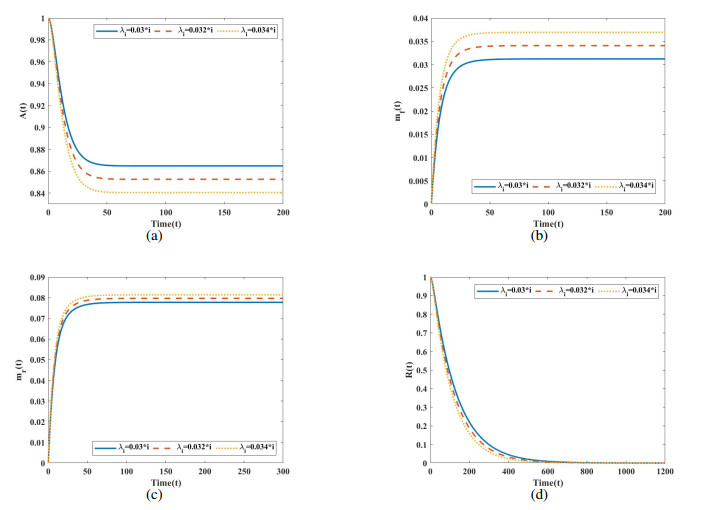
T-DRI for various values of $ \lambda_i(i = 1, 2) $. (a) Availability for various $ \lambda_i(i = 1, 2) $; (b) Failure frequency for various $ \lambda_i(i = 1, 2) $; (c) Renewal frequency for various $ \lambda_i(i = 1, 2) $; (d) Reliability for various $ \lambda_i(i = 1, 2) $
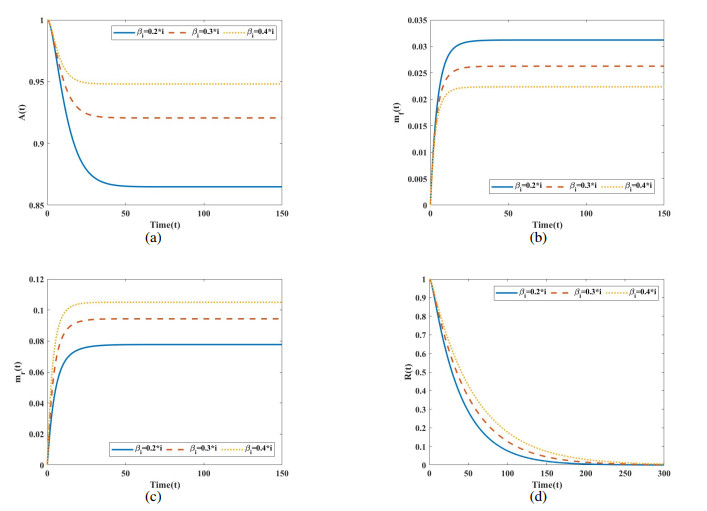
T-DRI for various values of $ \beta_i(i = 1, 2) $. (a) Availability for various $ \beta_i(i = 1, 2) $; (b) Failure frequency for various $ \beta_i(i = 1, 2) $; (c) Renewal frequency for various $ \beta_i(i = 1, 2) $; (d) Reliability for various $ \beta_i(i = 1, 2) $
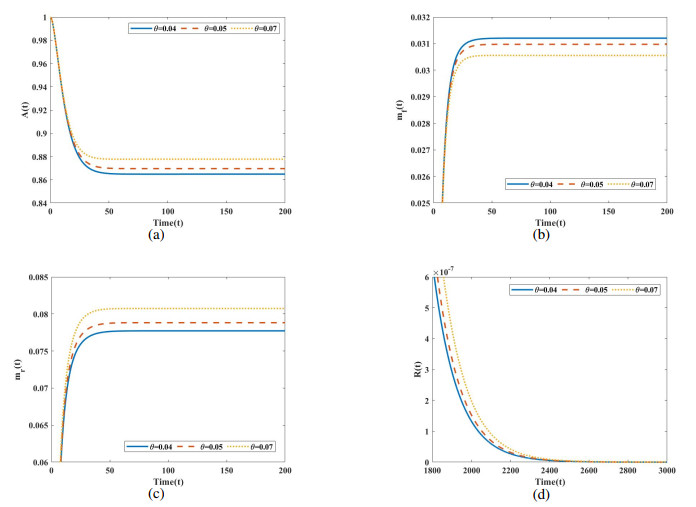
T-DRI for various values of $ \theta $. (a) Availability for various $ \theta $; (b) Failure frequency for various $ \theta $; (c) Renewal frequency for various $ \theta $; (d) Reliability for various $ \theta $
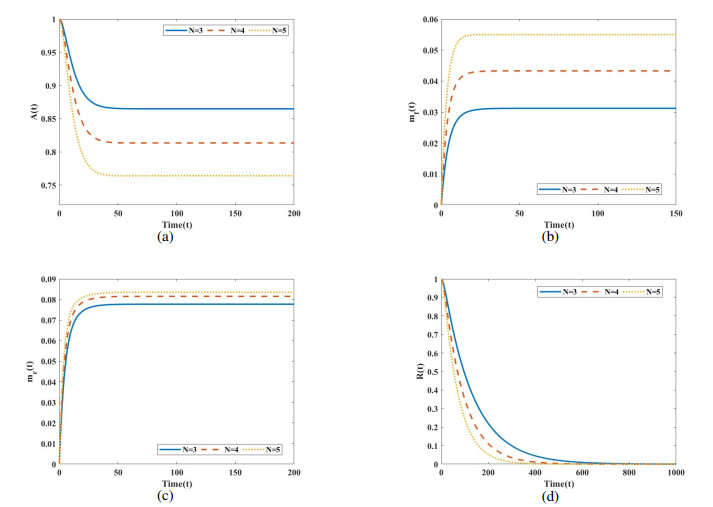
T-DRI for various values of $ N $. (a) Availability for various $ N $; (b) Failure frequency for various $ N $; (c) Renewal frequency for various $ N $; (d) Reliability for various $ N $
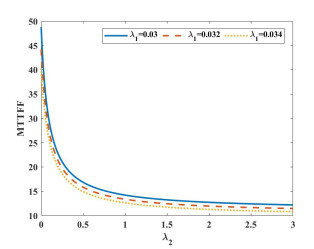
MTTFF with different $ \lambda_1 $



 DownLoad: