In this paper, we introduce a new class of polynomials called the mixed-type hypergeometric Bernoulli and Euler $ r $-Dowling polynomials. These polynomials extend the classical Bernoulli and Euler polynomials, together with their hypergeometric (level-$ m $) versions, while incorporating the combinatorial structure of the $ r $-Dowling framework within a single generating function. Using exponential generating functions, we derive their main properties such as explicit formulas, recurrence relations, differential identities, and integral representations. In addition, we examine the zeros of these polynomials numerically and graphically. The results show that the zeros follow symmetric and structured patterns in the complex plane and display regular behavior as the degree increases. Overall, this study provides a natural extension of classical polynomial families and offers new insights for further research in approximation theory and related areas.
Citation: William Ramírez, Can Kızılateş, Clemente Cesarano, Maria-Fernanda Heredia-Moyano, Talha Usman. Some properties of mixed-type hypergeometric Bernoulli/Euler $ r $-Dowling polynomials and their zero distribution patterns[J]. Networks and Heterogeneous Media, 2026, 21(6): 2223-2245. doi: 10.3934/nhm.2026083
In this paper, we introduce a new class of polynomials called the mixed-type hypergeometric Bernoulli and Euler $ r $-Dowling polynomials. These polynomials extend the classical Bernoulli and Euler polynomials, together with their hypergeometric (level-$ m $) versions, while incorporating the combinatorial structure of the $ r $-Dowling framework within a single generating function. Using exponential generating functions, we derive their main properties such as explicit formulas, recurrence relations, differential identities, and integral representations. In addition, we examine the zeros of these polynomials numerically and graphically. The results show that the zeros follow symmetric and structured patterns in the complex plane and display regular behavior as the degree increases. Overall, this study provides a natural extension of classical polynomial families and offers new insights for further research in approximation theory and related areas.

| [1] |
T. M. Apostol, An elementary view of Euler's summation formula, Am. Math. Mon., 106 (1999), 409–418. https://doi.org/10.2307/2589145 doi: 10.2307/2589145
|
| [2] |
N. E. Nørlund, Lectures on Differential Calculus, Springer, Berlin, Germany, 1924, reprinted 1954. https://doi.org/10.1007/978-3-642-50824-0 |
| [3] |
P. Natalini, A. Bernardini, A generalization of the Bernoulli polynomials, J. Appl. Math., 2003 (2003), 155–163. https://doi.org/10.1155/S1110757X03204101 doi: 10.1155/S1110757X03204101
|
| [4] |
A. Hassen, H. D. Nguyen, Hypergeometric Bernoulli polynomials and Appell sequences, Int. J. Number Theory, 4 (2008), 767–774. https://doi.org/10.1142/S1793042108001754 doi: 10.1142/S1793042108001754
|
| [5] |
Y. Quintana, W. Ramírez, A. Urieles, On an operational matrix method based on generalized Bernoulli polynomials of level $m$, Calcolo, 55 (2018), 30. https://doi.org/10.1007/s10092-018-0272-5 doi: 10.1007/s10092-018-0272-5
|
| [6] |
A. Golbabai, S. P. Ali Beik, An efficient method based on operational matrices of Bernoulli polynomials for solving matrix differential equations, Comput. Appl. Math., 34 (2015), 159–175. https://doi.org/10.1007/s40314-013-0110-y doi: 10.1007/s40314-013-0110-y
|
| [7] |
Y. Quintana, A. Urieles, Quadrature formulae of Euler–Maclaurin type based on generalized Euler polynomials of level $m$, Bull. Comput. Appl. Math., 6 (2018), 43–64. Available from: https://hdl.handle.net/10016/36408. |
| [8] |
Y. Quintana, H. Torres-Guzmán, Some relations between the Riemann zeta function and the generalized Bernoulli polynomials of level $m$, Univers. J. Math. Appl., 2 (2019), 188–201. https://doi.org/10.32323/ujma.602178 doi: 10.32323/ujma.602178
|
| [9] |
A. Z. Broder, The $r$-Stirling numbers, Discrete Math., 49 (1984), 241–259. https://doi.org/10.1016/0012-365X(84)90161-4 doi: 10.1016/0012-365X(84)90161-4
|
| [10] |
G.S. Cheon, J.H. Jung, $r$-Whitney numbers of Dowling lattices, Discrete Math., 312 (2012), 2337–2348. https://doi.org/10.1016/j.disc.2012.04.001 doi: 10.1016/j.disc.2012.04.001
|
| [11] |
E. Gyimesi, G. Nyul, A comprehensive study of $r$-Dowling polynomials, Aequationes Math., 92 (2018), 515–527. https://doi.org/10.1007/s00010-017-0538-z doi: 10.1007/s00010-017-0538-z
|
| [12] |
U. Duran, C. Kızılateş, W. Ramírez, C. Cesarano, A new class of degenerate unified Bernoulli–Euler Hermite polynomials of Apostol type, AIMS Math., 10 (2025), 16117–16138. https://doi.org/10.3934/math.2025722 doi: 10.3934/math.2025722
|
| [13] |
S. Díaz, W. Ramírez, C. Cesarano, J. Hernández, E. C. Pérez Rodríguez, The monomiality principle applied to extensions of Apostol-type Hermite polynomials, Eur. J. Pure Appl. Math., 18 (2025), 5656. https://doi.org/10.29020/nybg.ejpam.v18i1.5656 doi: 10.29020/nybg.ejpam.v18i1.5656
|
| [14] |
F. Mohammed, W. Ramírez, C. Cesarano, S. Díaz, $q$-Legendre based Gould–Hopper polynomials and $q$-operational methods, Ann. Univ. Ferrara, 71 (2025), 32. https://doi.org/10.1007/s11565-025-00587-z doi: 10.1007/s11565-025-00587-z
|
| [15] |
W. Ramírez, C. Cesarano, S. A. Wani, S. Yousuf, D. Bedoya, About properties and the monomiality principle of Bell-based Apostol–Bernoulli-type polynomials, Carpathian Math. Publ., 16 (2024), 379–390. https://doi.org/10.15330/cmp.16.2.379-390 doi: 10.15330/cmp.16.2.379-390
|
| [16] |
S. A. Wani, T. U. R. Shah, W. Ramírez, C. Cesarano, Exploring the properties of multivariable Hermite polynomials in relation to Apostol-type Frobenius–Genocchi polynomials, Georgian Math. J., 32 (2025), 515–528. https://doi.org/10.1515/gmj-2024-2071 doi: 10.1515/gmj-2024-2071
|
| [17] |
T. Liu, B. Ding, A radial basis function neural network approach for solving a diffusion partial differential equation efficiently, Appl. Math. Comput., 509 (2026), 129651. https://doi.org/10.1016/j.amc.2025.129651 doi: 10.1016/j.amc.2025.129651
|
| [18] |
Y. Liu, Y. Li, T. Liu, An RBF–FD method for pricing under the Bates model: Handling stochastic volatility and jump processes, Eng. Anal. Boundary Elem., 183 (2026), 106622. https://doi.org/10.1016/j.enganabound.2025.106622 doi: 10.1016/j.enganabound.2025.106622
|
| [19] |
T. Liu, R. Xue, M. Barfeie, A unified framework for high-order compact finite differences using infinitely- and piecewise-smooth RBFs with polynomials, Calcolo, 63 (2026), 18. https://doi.org/10.1007/s10092-026-00684-1 doi: 10.1007/s10092-026-00684-1
|
| [20] |
T. Liu, R. Xue, A convergent multi-step efficient iteration method to solve nonlinear equation systems, J. Appl. Math. Comput., 71 (2025), 2571–2588. https://doi.org/10.1007/s12190-024-02324-9 doi: 10.1007/s12190-024-02324-9
|
| [21] |
F. T. Howard, Some sequences of rational numbers related to the exponential function, Duke Math. J., 34 (1967), 701–716. https://doi.org/10.1215/S0012-7094-67-03473-4 doi: 10.1215/S0012-7094-67-03473-4
|
| [22] |
H. M. Srivastava, H. L. Manocha, A Treatise on Generating Functions, Ellis Horwood Ltd., West Sussex, UK, 1984. Available from: https://cir.nii.ac.jp/crid/1970867909801626544. |
Figures(3) / Tables(3)
William Ramírez, Can Kızılateş, Clemente Cesarano, Maria-Fernanda Heredia-Moyano, Talha Usman. Some properties of mixed-type hypergeometric Bernoulli/Euler $ r $-Dowling polynomials and their zero distribution patterns[J]. Networks and Heterogeneous Media, 2026, 21(6): 2223-2245. doi: 10.3934/nhm.2026083

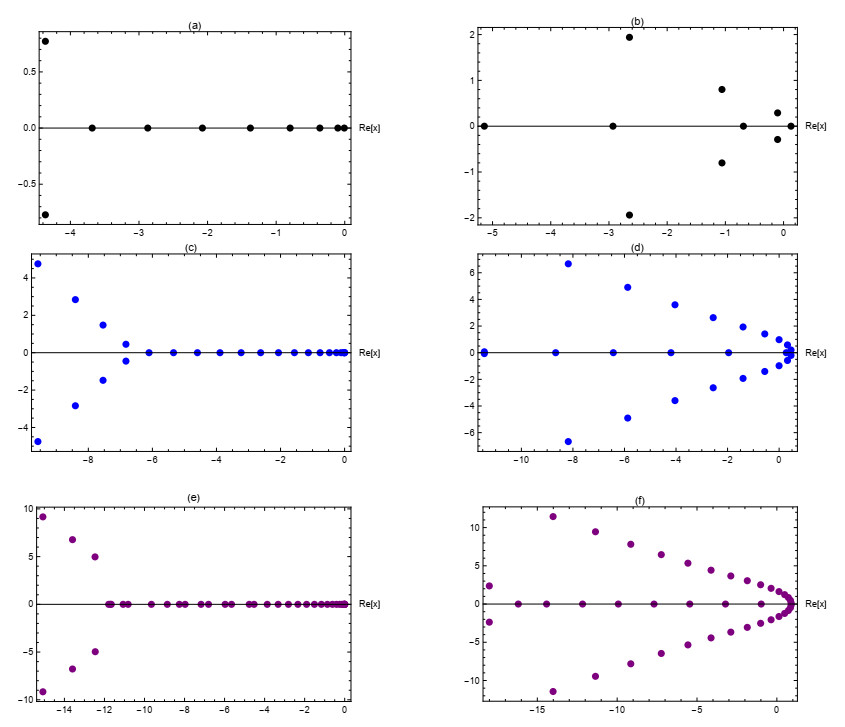
Distributions of the zeros of the mixed-type hypergeometric Bernoulli $ r $-Dowling polynomials $ {}_B \mathcal{D}_{n}^{[m-1]}(x; \mu, r) $ and the mixed-type hypergeometric Euler $ r $-Dowling polynomials $ {}_E \mathcal{D}_{n}^{[m-1]}(x; \mu, r) $ corresponding to $ n = 10 $, $ n = 25, $ and $ n = 40 $. (a) $ {}_B \mathcal{D}_{n}^{[m-1]}(x; \mu, r) $ for $ n = 10 $, (b) $ {}_E \mathcal{D}_{n}^{[m-1]}(x; \mu, r) $ for $ n = 10 $, (c) $ {}_B \mathcal{D}_{n}^{[m-1]}(x; \mu, r) $ for $ n = 25 $, (d) $ {}_E \mathcal{D}_{n}^{[m-1]}(x; \mu, r) $ for $ n = 25 $, (e) $ {}_B \mathcal{D}_{n}^{[m-1]}(x; \mu, r) $ for $ n = 40 $, and (f) $ {}_E \mathcal{D}_{n}^{[m-1]}(x; \mu, r) $ for $ n = 40 $
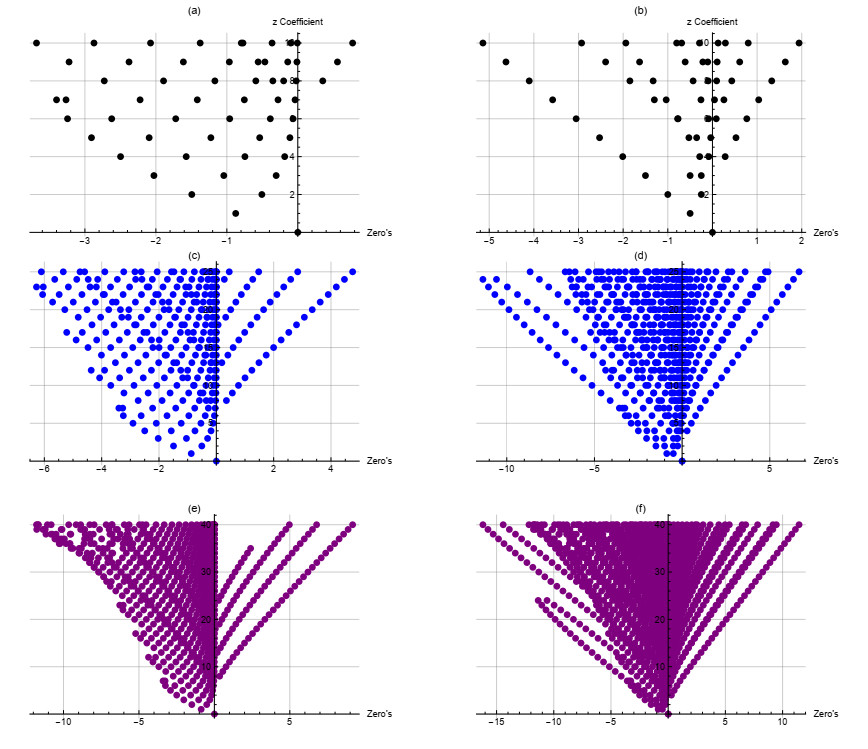
Mesh distributions of the zeros of the mixed-type hypergeometric Bernoulli $ r $-Dowling polynomials $ {}_B \mathcal{D}_{n}^{[m-1]}(x; \mu, r) $ and the mixed-type hypergeometric Euler $ r $-Dowling polynomials $ {}_E \mathcal{D}_{n}^{[m-1]}(x; \mu, r) $ corresponding to $ n = 10 $, $ n = 25 $, and $ n = 40 $. (a) $ {}_B \mathcal{D}_{n}^{[m-1]}(x; \mu, r) $ for $ n = 10 $, (b) $ {}_E \mathcal{D}_{n}^{[m-1]}(x; \mu, r) $ for $ n = 10 $, (c) $ {}_B \mathcal{D}_{n}^{[m-1]}(x; \mu, r) $ for $ n = 25 $, (d) $ {}_E \mathcal{D}_{n}^{[m-1]}(x; \mu, r) $ for $ n = 25 $, (e) $ {}_B \mathcal{D}_{n}^{[m-1]}(x; \mu, r) $ for $ n = 40 $, and (f) $ {}_E \mathcal{D}_{n}^{[m-1]}(x; \mu, r) $ for $ n = 40 $
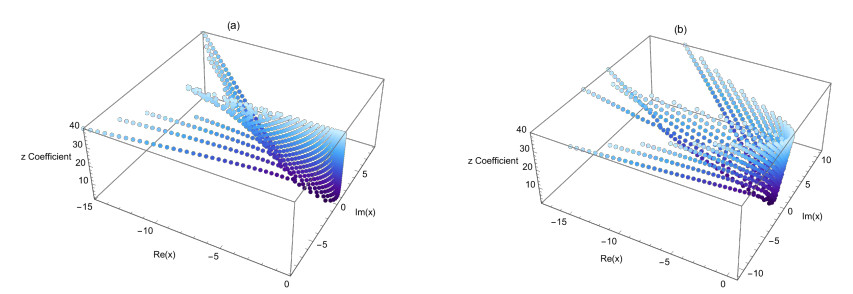
Three-dimensional mesh distribution of (a) the mixed-type hypergeometric Bernoulli $ r $-Dowling polynomials $ {}_B \mathcal{D}_{n}^{[m-1]}(x; \mu, r) $ and (b) the mixed-type hypergeometric Euler $ r $-Dowling polynomials $ {}_E \mathcal{D}_{n}^{[m-1]}(x; \mu, r) $, corresponding to $ n = 40 $



 DownLoad: