A robust multiscale finite element method is proposed for singularly perturbed convection–reaction–diffusion problems, featuring high accuracy, computational efficiency, and numerically observed parameter-uniform superconvergence. Within the multiscale finite element framework, multiscale basis functions are enriched with adequate local fine-scale information to enable global model reduction. The nontrivial relation between standard finite element basis functions and multiscale basis functions is analyzed and encoded in a global mapping matrix for practical implementation. By utilizing parameter-independent layer-adapted graded meshes, large errors induced by boundary layers are effectively suppressed. Numerical comparisons against existing approaches confirm the efficiency, reliability, and applicability of the presented scheme. Further numerical tests demonstrate this parameter-uniform superconvergence on graded meshes, as well as its promising capability for simulations in complex media and high-dimensional singularly perturbed systems.
Citation: Meiling Sun, Jin Zhang, Guoyun Zhang, Shan Jiang. Parameter-uniform superconvergence of multiscale simulation on layer-adapted meshes for singularly perturbed problems[J]. Networks and Heterogeneous Media, 2026, 21(6): 2286-2309. doi: 10.3934/nhm.2026085
A robust multiscale finite element method is proposed for singularly perturbed convection–reaction–diffusion problems, featuring high accuracy, computational efficiency, and numerically observed parameter-uniform superconvergence. Within the multiscale finite element framework, multiscale basis functions are enriched with adequate local fine-scale information to enable global model reduction. The nontrivial relation between standard finite element basis functions and multiscale basis functions is analyzed and encoded in a global mapping matrix for practical implementation. By utilizing parameter-independent layer-adapted graded meshes, large errors induced by boundary layers are effectively suppressed. Numerical comparisons against existing approaches confirm the efficiency, reliability, and applicability of the presented scheme. Further numerical tests demonstrate this parameter-uniform superconvergence on graded meshes, as well as its promising capability for simulations in complex media and high-dimensional singularly perturbed systems.

| [1] |
H. G. Roos, M. Stynes, L. Tobiska, Robust Numerical Methods for Singularly Perturbed Differential Equations: Convection-Diffusion-Reaction and Flow Problems, $2^nd$ edition, Springer Series in Computational Mathematics, Springer-Verlag, Berlin, 24 (2008). |
| [2] |
T. Linß, Layer-Adapted Meshes for Reaction-Convection-Diffusion Problems, Lecture Notes in Mathematics, Springer-Verlag, Berlin, 2009. |
| [3] |
C. Clavero, J. L. Gracia, E. O'riordan, A parameter robust numerical method for a two dimensional reaction-diffusion problem, Math. Comput., 74 (2005), 1743–1758. https://doi.org/10.1090/S0025-5718-05-01762-X doi: 10.1090/S0025-5718-05-01762-X
|
| [4] |
G. I. Shishkin, A finite difference scheme on a priori adapted meshes for a singularly perturbed parabolic convection-diffusion equation, Numer. Math. Theo. Meth. Appl., 1 (2008), 214–234. |
| [5] |
R. Shiromani, V. Shanthi, P. Das, A higher order hybrid-numerical approximation for a class of singularly perturbed two-dimensional convection-diffusion elliptic problem with non-smooth convection and source terms, Comput. Math. Appl., 142 (2023), 9–30. https://doi.org/10.1016/j.camwa.2023.04.004 doi: 10.1016/j.camwa.2023.04.004
|
| [6] |
S. J. Liu, L. B. Liu, X. B. Bao, Error analysis of a finite difference scheme on a modified graded mesh for a nonlocal-in-time parabolic equation, Networks Heterogen. Media, 20 (2025), 970–986. https://doi.org/10.3934/nhm.2025042 doi: 10.3934/nhm.2025042
|
| [7] |
Y. Sheng, T. Zhang, An analysis of the bilinear finite volume method for the singularly-perturbed convection-diffusion problems on Shishkin mesh, Comput. Math. Appl., 174 (2024), 84–96. https://doi.org/10.1016/j.camwa.2024.08.023 doi: 10.1016/j.camwa.2024.08.023
|
| [8] |
Y. Wang, Y. H. Li, X. Y. Meng, An upwind finite volume element method on a Shishkin mesh for singularly perturbed convection-diffusion problems, J. Comput. Appl. Math., 438 (2024), 115493. https://doi.org/10.1016/j.cam.2023.115493 doi: 10.1016/j.cam.2023.115493
|
| [9] |
R. G. Durán, A. L. Lombardi, Finite element approximation of convection diffusion problems using graded meshes, Appl. Numer. Math., 56 (2006), 1314–1325. https://doi.org/10.1016/j.apnum.2006.03.029 doi: 10.1016/j.apnum.2006.03.029
|
| [10] |
R. G. Durán, A. L. Lombardi, M. I. Prieto, Superconvergence for finite element approximation of a convection-diffusion equation using graded meshes, IMA J. Numer. Anal., 32 (2012), 511–533. https://doi.org/10.1093/imanum/drr005 doi: 10.1093/imanum/drr005
|
| [11] |
P. Constantinou, S. Franz, L. Ludwig, C. Xenophontos, Finite element approximation of reaction-diffusion problems using an exponentially graded mesh, Comput. Math. Appl., 76 (2018), 2523–2534. https://doi.org/10.1016/j.camwa.2018.08.051 doi: 10.1016/j.camwa.2018.08.051
|
| [12] |
M. Brdar, S. Franz, L. Ludwig, H. G. Roos, A balanced norm error estimation for the time-dependent reaction-diffusion problem with shift in space, Appl. Math. Comput., 437 (2023), 127507. https://doi.org/10.1016/j.amc.2022.127507 doi: 10.1016/j.amc.2022.127507
|
| [13] |
L. B. Liu, L. Xu, Y. Zhang, High-order finite element method on a Vulanovi-Bakhvalov mesh for a singularly perturbed convection-diffusion problem, Appl. Math. Letter., 136 (2023), 108457. https://doi.org/10.1016/j.aml.2022.108457 doi: 10.1016/j.aml.2022.108457
|
| [14] |
J. Zhang, C. X. Zhang, Uniform convergence of finite element method on Bakhvalov-type mesh for a 2-D singularly perturbed convection-diffusion problem with exponential layers, Math. Comput. Simul., 228 (2025), 39–51. https://doi.org/10.1016/j.matcom.2024.08.032 doi: 10.1016/j.matcom.2024.08.032
|
| [15] |
Y. H. Yin, P. Zhu, The streamline-diffusion finite element method on graded meshes for a convection-diffusion problem, Appl. Numer. Math., 138 (2019), 19–29. https://doi.org/10.1016/j.apnum.2018.12.012 doi: 10.1016/j.apnum.2018.12.012
|
| [16] |
M. Brdar, G. Radojev, H. G. Roos, L. Teofanov, Superconvergence analysis of FEM and SDFEM on graded meshes for a problem with characteristic layers, Comput. Math. Appl., 93 (2021), 50–57. https://doi.org/10.1016/j.camwa.2021.04.009 doi: 10.1016/j.camwa.2021.04.009
|
| [17] |
X. Q. Ma, J. Zhang, Supercloseness analysis of the nonsymmetric interior penalty Galerkin method for a singularly perturbed problem on Bakhvalov-type mesh, Appl. Math. Letter., 144 (2023), 108701. https://doi.org/10.1016/j.aml.2023.108701 doi: 10.1016/j.aml.2023.108701
|
| [18] |
Y. Cheng, S. Jiang, M. Stynes, Supercloseness of the local discontinuous Galerkin method for a singularly perturbed convection-diffusion problem, Math. Comput., 92 (2023), 2065–2095. https://doi.org/10.1090/mcom/3844 doi: 10.1090/mcom/3844
|
| [19] |
Y. Cheng, X. S. Wang, M. Stynes, Optimal balanced-norm error estimate of the LDG Method for reaction-diffusion problems Ⅱ: The two-dimensional case with layer-upwind flux, Math. Comput., 95 (2026), 73–103. https://doi.org/10.1090/mcom/4048 doi: 10.1090/mcom/4048
|
| [20] |
J. Kang, S. Jiang, Y. Cheng, Optimal balanced-norm error estimate of the LDG method using alternating numerical fluxes for 2D singularly perturbed reaction-diffusion problems, J. Sci. Comput., 106 (2026), 33. https://doi.org/10.1007/s10915-025-03159-7 doi: 10.1007/s10915-025-03159-7
|
| [21] |
P. Das, S. Rana, J. Vigo-Aguiar, Higher order accurate approximations on equidistributed meshes for boundary layer originated mixed type reaction diffusion systems with multiple scale nature, Appl. Numer. Math., 148 (2019), 79–97. https://doi.org/10.1016/j.apnum.2019.08.028 doi: 10.1016/j.apnum.2019.08.028
|
| [22] |
D. Sarkar, S. Kumar, P. Das, H. Ramos, Higher-order convergence analysis for interior and boundary layers in a semi-linear reaction-diffusion system networked by a $k$-star graph with non-smooth source terms, Networks Heterogen. Media, 19 (2024), 1085–1115. https://doi.org/10.3934/nhm.2024048 doi: 10.3934/nhm.2024048
|
| [23] |
L. P. Franca, A. L. Madureira, L. Tobiska, F. Valentin, Convergence analysis of a multiscale finite element method for singularly perturbed problems, Multiscale Model. Simul., 4 (2005), 839–866. https://doi.org/10.1137/040608490 doi: 10.1137/040608490
|
| [24] |
S. Jiang, M. Presho, Y. Q. Huang, An adapted Petrov-Galerkin multi-scale finite element for singularly perturbed reaction-diffusion problems, Int. J. Comput. Math., 93 (2016), 1200–1211. https://doi.org/10.1080/00207160.2015.1041935 doi: 10.1080/00207160.2015.1041935
|
| [25] |
S. Jiang, X. Ding, M. L. Sun, Parameter-uniform superconvergence of multiscale computation for singular perturbation exhibiting twin boundary layers, J. Appl. Anal. Comput., 13 (2023), 3330–3351. https://doi.org/10.11948/20230020 doi: 10.11948/20230020
|
| [26] |
M. L. Sun, S. Jiang, Y. P. Li, Singularly perturbed problem based on multiscale finite element scheme and its uniform super-convergence analyses, Math. Numer. Sinica, 45 (2023), 447–463. |
| [27] |
Y. F. Chen, T. Y. Hou, Y. X. Wang, Exponentially convergent multiscale finite element method, Commun. Appl. Math. Comput., 6 (2024), 862–878. https://doi.org/10.1007/s42967-023-00260-2 doi: 10.1007/s42967-023-00260-2
|
| [28] |
Q. Q. Li, L. L. Ma, P. W. Zhang, An iterative method based on generalized multiscale finite element methods for parameter-dependent dual continuum model, Multiscale Model. Simul., 23 (2025), 1551–1580. https://doi.org/10.1137/24M1695956 doi: 10.1137/24M1695956
|
| [29] |
S. Jiang, W. P. Miao, H. Y. Wei, N. Y. Yi, A superconvergent multiscale scheme for the Helmholtz equation in rapidly oscillating heterogeneous media, Networks Heterogen. Media, 21 (2026), 531–550. https://doi.org/10.3934/nhm.2026024 doi: 10.3934/nhm.2026024
|
Figures(13) / Tables(4)
Meiling Sun, Jin Zhang, Guoyun Zhang, Shan Jiang. Parameter-uniform superconvergence of multiscale simulation on layer-adapted meshes for singularly perturbed problems[J]. Networks and Heterogeneous Media, 2026, 21(6): 2286-2309. doi: 10.3934/nhm.2026085

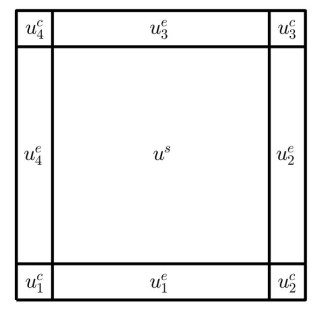
Domain decomposition and the associated solutions
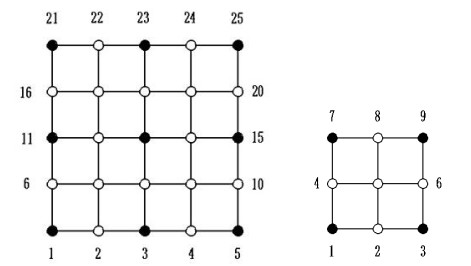
Global nodes and local nodes, with $ N = 2 $ and $ M = 2 $
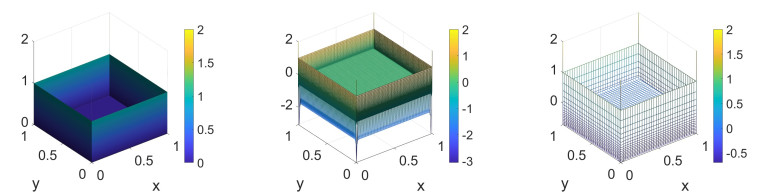
Exact solution, FEM(S) solution on the fine mesh ($ N^2M^2 = 256^2 $), and MsFEM(S) solution on the coarse mesh ($ N^2 = 64^2 $) (Example 1, $ \varepsilon = 10^{-4} $)
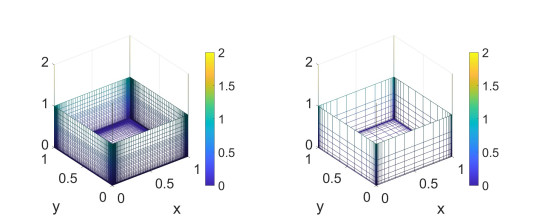
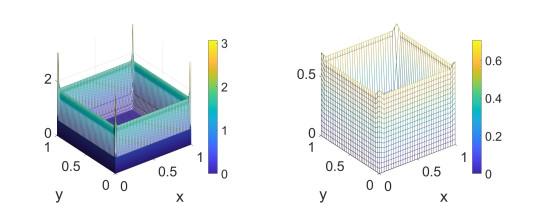
FEM(G) solution on the fine mesh ($ N^2M^2 = 192^2 $) and MsFEM(G) solution on the coarse mesh ($ N^2 = 48^2 $) (Example 1, $ \varepsilon = 10^{-4} $)
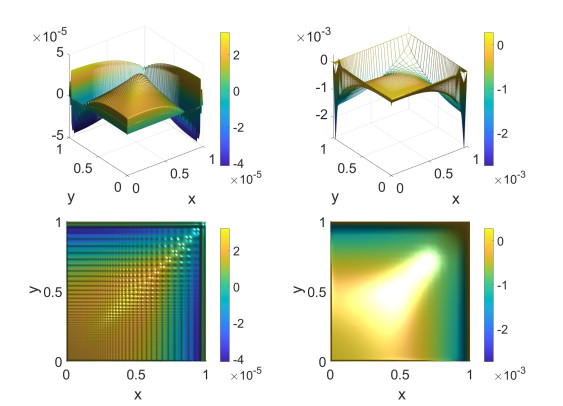
Pointwise errors of FEM(S) solution on the fine mesh ($ N^2M^2 = 256^2 $) and MsFEM(S) solution on the coarse mesh ($ N^2 = 64^2 $) (Example 1, $ \varepsilon = 10^{-4} $)
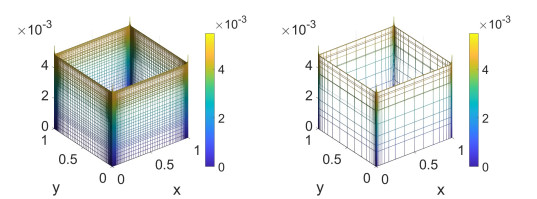
Pointwise errors of FEM(G) solution on the fine mesh ($ N^2M^2 = 192^2 $) and MsFEM(G) solution on the coarse mesh ($ N^2 = 48^2 $) (Example 1, $ \varepsilon = 10^{-4} $)
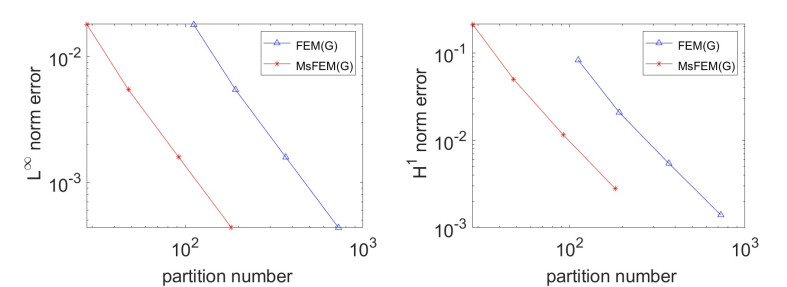
$ L^\infty $ and $ H^1 $ norms of FEM(G) error and MsFEM(G) error on a log-log scale (Example 1, $ \varepsilon = 10^{-4} $)
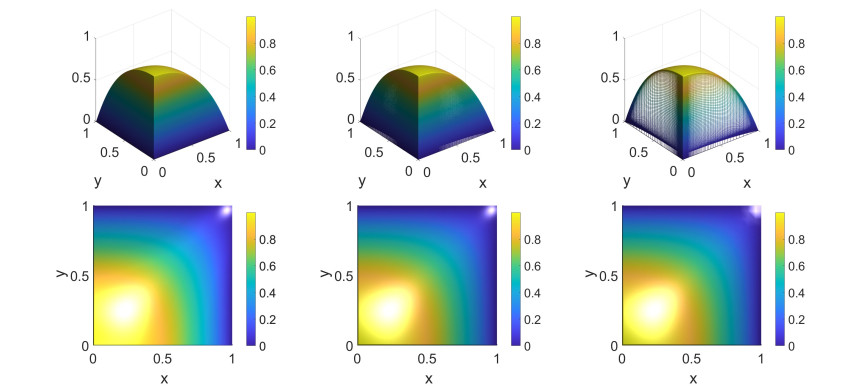
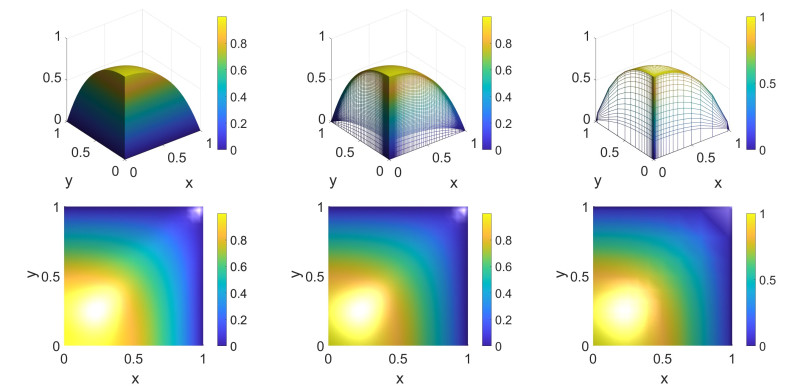
Exact solution, FEM(G) solution on the fine mesh ($ N^2M^2 = 644^2 $), and MsFEM(G) solution on the coarse mesh ($ N^2 = 161^2 $). (Example 2, $ \varepsilon = 10^{-3} $, top: 3D mesh figure, bottom: 2D surf contour)
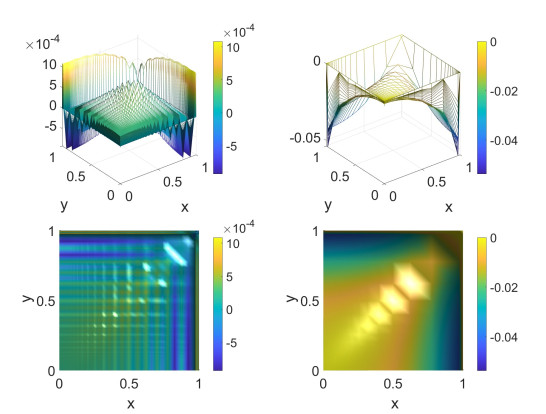
Pointwise errors of FEM(G) solution on the fine mesh ($ N^2M^2 = 644^2 $) and MsFEM(G) solution on the coarse mesh ($ N^2 = 161^2 $). (Example 2, $ \varepsilon = 10^{-3} $, top: 3D mesh figure, bottom: 2D surf contour)
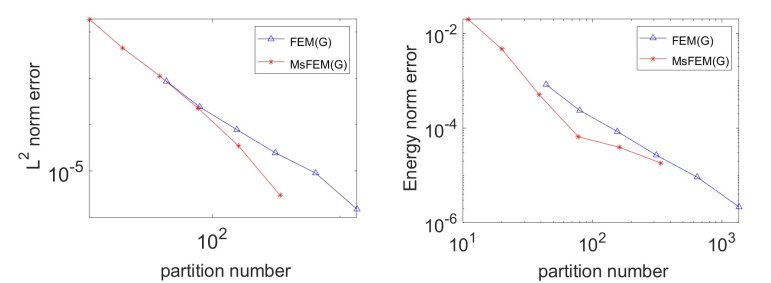
$ L^2 $ and energy norms of FEM(G) error and MsFEM(G) error on a log-log scale (Example 2, $ \varepsilon = 10^{-3} $)
Exact solution, FEM(G) solution on the fine mesh ($ N^2M^2 = 280^2 $), and MsFEM(G) solution on the coarse mesh ($ N^2 = 70^2 $). (Example 2, $ \varepsilon = 10^{-6} $, top: 3D mesh figure, bottom: 2D surf contour)
Pointwise errors of FEM(G) solution on the fine mesh ($ N^2M^2 = 280^2 $) and MsFEM(G) solution on the coarse mesh ($ N^2 = 70^2 $). (Example 2, $ \varepsilon = 10^{-6} $, top: 3D mesh figure, bottom: 2D surf contour)
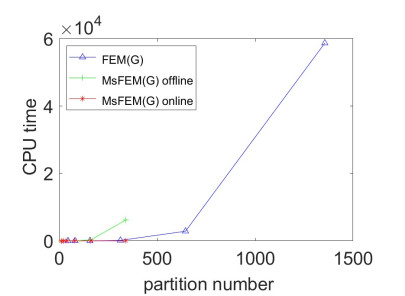
CPU time of FEM(G) and MsFEM(G) for Example 2, $ \varepsilon = 10^{-3} $



 DownLoad: