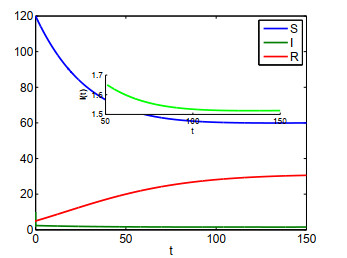
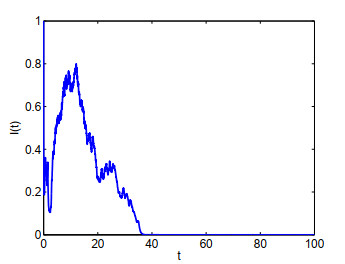
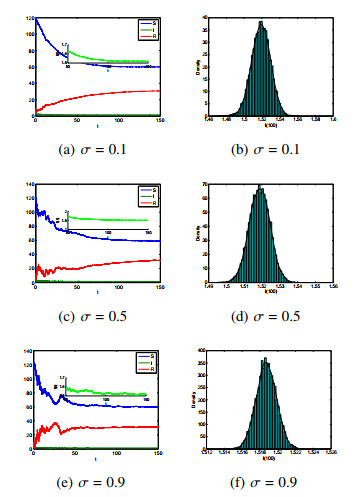
This paper investigates the dynamic behavior of a susceptible–infected–recovered–susceptible (SIRS) epidemic model, taking information intervention and vaccination measures into account. We find that, both in the deterministic model and the stochastic model, the basic reproduction number $ \mathcal{R} $ acts as a critical threshold for the disease's persistence and extinction. If $ \mathcal{R} < 1 $, the deterministic system has a disease–free equilibrium which is globally asymptotically stable. Moreover, the disease will eventually disappear with probability one in stochastic system, while if $ \mathcal{R} > 1 $, in deterministic model, the endemic equilibrium is globally asymptotically stable; similarly, within the stochastic system, a stationary distribution implies the disease will be prevailing.
Citation: Xiaoni Li, Qiang Li, Junxian Yang, Dongmei Fan, Hao Zhang. Threshold dynamics and global stability of a SIRS epidemic model with information intervention and vaccination[J]. Mathematical Modelling and Control, 2026, 6(3): 278-289. doi: 10.3934/mmc.2026021
This paper investigates the dynamic behavior of a susceptible–infected–recovered–susceptible (SIRS) epidemic model, taking information intervention and vaccination measures into account. We find that, both in the deterministic model and the stochastic model, the basic reproduction number $ \mathcal{R} $ acts as a critical threshold for the disease's persistence and extinction. If $ \mathcal{R} < 1 $, the deterministic system has a disease–free equilibrium which is globally asymptotically stable. Moreover, the disease will eventually disappear with probability one in stochastic system, while if $ \mathcal{R} > 1 $, in deterministic model, the endemic equilibrium is globally asymptotically stable; similarly, within the stochastic system, a stationary distribution implies the disease will be prevailing.

| [1] |
J. Chattopadhyay, O. Arino, A predator-prey model with disease in the prey, Nonlinear Anal. Theory, 36 (1999), 747–766. http://doi.org/10.1016/S0362-546X(98)00126-6 doi: 10.1016/S0362-546X(98)00126-6

|
| [2] |
R. Kar, S. Biswas, A. K. Pal, P. K. Tiwari, Dynamics of an eco-epidemiological model with mutual interference and nonlinear harvesting of predator, J. Appl. Math. Comput., 71 (2025), 4095–4120. http://doi.org/10.1007/s12190-025-02384-5 doi: 10.1007/s12190-025-02384-5
|
| [3] |
X. Li, X. Li, Q. Zhang, Time to extinction and stationary distribution of a stochastic susceptible-infected-recovered-susceptible model with vaccination under Markov switching, Math. Popul. Stud., 27 (2020), 259–274. http://doi.org/10.1080/08898480.2019.1626633 doi: 10.1080/08898480.2019.1626633
|
| [4] |
Y. Zhang, Q. Li, Y. Yao, L. Zhang, W. Wang, Y. Zheng, $H_\infty$ synchronization for semi-Markovian jumping CVNs subject to uncertain parameters and asynchronous modes: a dynamic event-triggered approach, J. Franklin Inst., 363 (2026), 108596. http://doi.org/10.1016/j.jfranklin.2026.108596 doi: 10.1016/j.jfranklin.2026.108596
|
| [5] |
Q. Li, H. Wei, D. Hua, J. Wang, Y. Zheng, Robust synchronization of stochastic Markovian jumping CVNs with randomly occurring nonlinearities and generally uncertain transition rates, Cogn Comput., 17 (2025), 17. http://doi.org/10.1007/s12559-024-10362-5 doi: 10.1007/s12559-024-10362-5
|
| [6] |
D. Greenhalgh, Hopf bifurcation in epidemic models with a latent preiod and nonpermanent immunity, Math. Comput. Model., 25 (1997), 85–107. http://doi.org/10.1016/S0895-7177(97)00009-5 doi: 10.1016/S0895-7177(97)00009-5
|
| [7] |
J. Li, Z. Ma, Qualitative analyses of SIS epidemic model with vaccination and varying total population size, Math. Comput. Model., 35 (2002), 1235–1243. https://doi.org/10.1016/S0895-7177(02)00082-1 doi: 10.1016/S0895-7177(02)00082-1
|
| [8] |
Q. Li, H. Wei, J. Yang, Stabilization of semi-Markovian jumping uncertain complex-valued networks with time-varying delay: a sliding-mode control approach, Neural Process. Lett., 56 (2024), 1–22. http://doi.org/10.1007/s11063-024-11585-1 doi: 10.1007/s11063-024-11585-1
|
| [9] |
F. H. Chen, A susceptible-infected epidemic models voluntary vaccinations, J. Math. Biol., 53 (2006), 253–272. http://doi.org/10.1007/s00285-006-0006-1 doi: 10.1007/s00285-006-0006-1
|
| [10] |
A. Lahrouz, L. Omari, D. Kiouach, A. Belmati, Complete global stability for an SIRS epidemic model with generalized non-linear incidence and vaccination, Appl. Math. Comput., 218 (2012), 6519–6525. http://doi.org/10.1016/j.amc.2011.12.024 doi: 10.1016/j.amc.2011.12.024
|
| [11] |
I. A. Moneim, D. Greenhalgh, Threshold and stability results for an sirs epidemic model with a general periodic vaccination strategy, J. Biol. Syst., 13 (2005), 131–150. http://doi.org/10.1142/S0218339005001446 doi: 10.1142/S0218339005001446
|
| [12] |
Y. Xiao, T. Zhao, S. Tang, Dynamics of an infectious disease with media/psychology induced non-smooth incidence, Math. Biosic. Eng., 10 (2013), 445–461. http://doi.org/10.3934/mbe.2013.10.445 doi: 10.3934/mbe.2013.10.445
|
| [13] |
J. M. Tchuenche, N. Dube, C. P. Bhunu, R. J. Smith, C. T. Bauch, The impact of media coverage on the transmission dynamics of human influenza, BMC Public Health, 11 (2011), S5. http://doi.org/10.1186/1471-2458-11-S1-S5 doi: 10.1186/1471-2458-11-S1-S5
|
| [14] |
J. M. Tchuenche, C. T. Bauch, Dynamics of an infectious disease where media coverage influences transmission, ISRN, 2012 (2012), 581274. http://doi.org/10.5402/2012/581274 doi: 10.5402/2012/581274
|
| [15] |
Y. Xiao, S. Tang, J. Wu, Media impact switching surface during an infectious disease outbreak, Sci. Rep., 5 (2015), 7838. http://doi.org/10.1038/srep07838 doi: 10.1038/srep07838
|
| [16] |
J. A. Cui, X. Tao, H. Zhu, An SIS infection model incorporating media coverage, Rocky Mountain J. Math., 38 (2008), 1323–1334. http://doi.org/10.1216/RMJ-2008-38-5-1323 doi: 10.1216/RMJ-2008-38-5-1323
|
| [17] |
Y. Liu, J. A. Cui, The impact of media coverage on the dynamics of infectious disease, Int. J. Biomath., 1 (2008), 65–74. http://doi.org/10.1142/S1793524508000023 doi: 10.1142/S1793524508000023
|
| [18] | C. Castillo-Chavez, Z. Feng, W. Huang, On the computation of $R_0$ and its role in global stability, In: Mathematical approaches for emerging and re-emerging infectious diseases: an introduction, New York: Springer, 2002,229–250. |
| [19] |
H. Wei, Q. Li, C. T. Zhang, Y. Yao, Y. Zheng, Event-triggered secure control for fuzzy switching CVNs under persistent dwell-time constraint, Neurocomputing, 695 (2026), 133922. http://doi.org/10.1016/j.neucom.2026.133922 doi: 10.1016/j.neucom.2026.133922
|
| [20] |
Q. Li, K. Zhang, H. Wei, F. Sun, J. Wang, Non-fragile asynchronous $H_\infty$ estimation for piecewise-homogeneous Markovian jumping neural networks with partly available transition rates: a dynamic event-triggered scheme, Neurocomputing, 640 (2025), 130292. http://doi.org/10.1016/j.neucom.2025.130292 doi: 10.1016/j.neucom.2025.130292
|
| [21] |
Q. Li, H. Wei, X. Guo, J. Wang, W. Tao, Y. Zheng, $H_\infty$ estimation for switched complex-valued networks with PDT switching mechanism and uncertain measurements: a delayed event-triggered scheme, Inf. Sci., 718 (2025), 122370. http://doi.org/10.1016/j.ins.2025.122370 doi: 10.1016/j.ins.2025.122370
|
| [22] |
H. Wei, Q. Li, S. Zhu, D. Fan, Y. Zheng, Event triggered resilient asynchronous estimation of stochastic Markovian jumping CVNs with missing measurements: a co-design control strategy, Inf. Sci., 712 (2025), 122167. http://doi.org/10.1016/j.ins.2025.122167 doi: 10.1016/j.ins.2025.122167
|
| [23] | R. M. May, Stability and complexity in model ecosystems, Princeton: Princeton University Press, 2001. https://doi.org/10.1515/9780691206912 |
| [24] |
N. Dalal, D. Greenhalgh, X. Mao, A stochastic model for internal HIV dynamics, J. Math. Anal. Appl., 341 (2008), 1084–1101. http://doi.org/10.1016/j.jmaa.2007.11.005 doi: 10.1016/j.jmaa.2007.11.005
|
| [25] |
E. Tornatore, S. M. Buccellato, P. Vetro, Stability of a stochastic SIR system, Phys. A, 354 (2005), 111–126. http://doi.org/10.1016/j.physa.2005.02.057 doi: 10.1016/j.physa.2005.02.057
|
| [26] |
B. Cao, M. Shan, Q. Zhang, W. Wang, A stochastic SIS epidemic model with vaccination, Phys. A, 486 (2017), 127–143. http://doi.org/10.1016/j.physa.2017.05.083 doi: 10.1016/j.physa.2017.05.083
|
| [27] |
P. Van den Driessche, J. Watmough, Reproduction numbers and sub-threshold endemic equilibria for compartmental models of disease transmission, Math. Biosci., 180 (2002), 29–48. http://doi.org/10.1016/S0025-5564(02)00108-6 doi: 10.1016/S0025-5564(02)00108-6
|
| [28] | B. Zhang, Stochastic dierential equations and their applications, Handbook of Stochastic Analysis and Applications, 1997. |
| [29] | L. Perko, Differential equations and dynamical systems, Springer-Verlag, 1991. http://doi.org/10.1007/978-1-4684-0392-3 |
| [30] |
C. Castillo-Chavez, B. Song, Dynamical models of tuberculosis and their applications, Math. Biosci. Eng., 1 (2004), 361–404. http://doi.org/10.3934/mbe.2004.1.361 doi: 10.3934/mbe.2004.1.361
|
| [31] |
A. Kumar, P. K. Srivastava, Y. Takeuchi, Modeling the role of information and limited optimal treatment on disease prevalence, J. Theor. Biol., 414 (2017), 103–119. http://doi.org/10.1016/j.jtbi.2016.11.016 doi: 10.1016/j.jtbi.2016.11.016
|
| [32] | J. P. La Salle, The stability of dynamical systems, Philadelphia: SIAM, 1976. http://doi.org/10.1137/1.9781611970432 |
| [33] | B. Ksendal, Stochastic dierential equations, IEEE Trans. Autom. Control, 2006. http://doi.org/10.1109/TAC.2006.882767 |
| [34] |
C. Ji, D. Jiang, N. Shi, Multigroup SIR epidemic model with stochastic perturbation, Phys. A, 390 (2011), 1747–1762. http://doi.org/10.1016/j.physa.2010.12.042 doi: 10.1016/j.physa.2010.12.042
|
Figures(3)
Xiaoni Li, Qiang Li, Junxian Yang, Dongmei Fan, Hao Zhang. Threshold dynamics and global stability of a SIRS epidemic model with information intervention and vaccination[J]. Mathematical Modelling and Control, 2026, 6(3): 278-289. doi: 10.3934/mmc.2026021




 DownLoad: