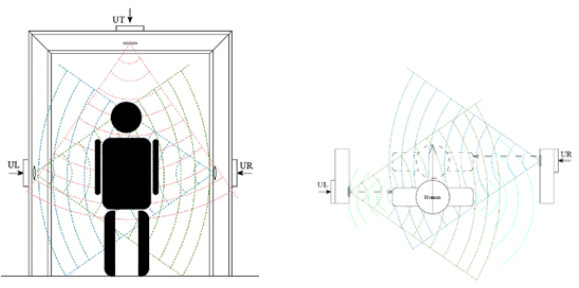
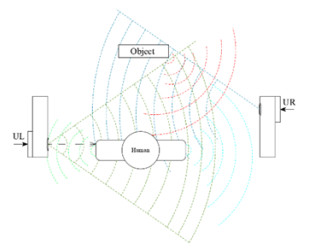
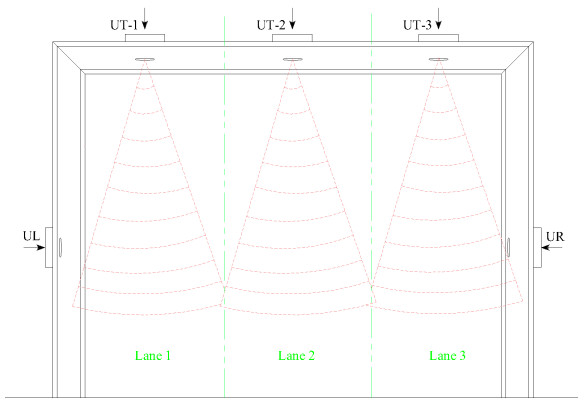
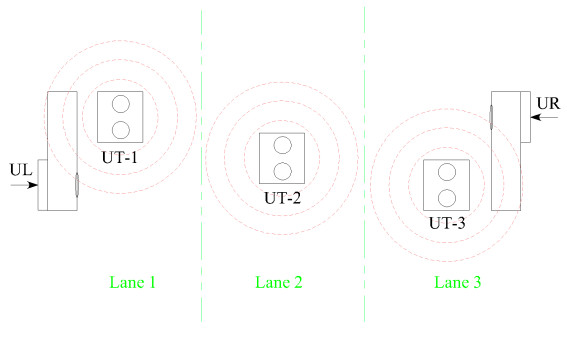
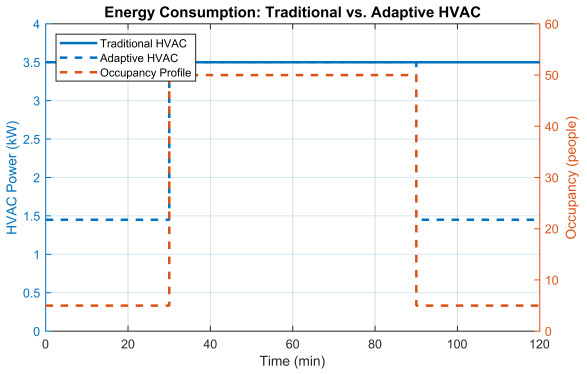
This article presents an occupancy-based thermal modeling and HVAC control framework for large public indoor spaces characterized by rapidly changing human participation. A multi-zone ultrasonic door sensor system was used to enable real-time estimation of occupancy status, including conditions of wide doorways and multiple-person transitions. Field observations supported by thermal imaging were utilized to measure internal heat gains and initiate a dynamic thermal response model of the indoor environment. Based on these observations, a MATLAB-based heat transfer model was developed and integrated with an adaptive feedback control strategy that continuously adjusts HVAC operating parameters as a function of the estimated occupancy status. The model's performance was evaluated using robust error metrics, including the mean absolute deviation, demonstrating accurate temperature tracking under transient occupancy conditions. Simulation results indicated that the proposed adaptive control law can reduce HVAC energy consumption by approximately 20%–30% compared to fixed setpoint operation while maintaining thermal comfort. The results showed that the integration of occupancy assessment, dynamic thermal modeling, and adaptive control logic provides an effective and computationally lightweight approach to improving energy efficiency and indoor comfort in systems exposed to highly variable external influences.
Citation: Rashad Gasimov, Nurmammad Mammadov. Mathematical modelling and adaptive control of HVAC systems driven by ultrasonic sensor-based occupancy estimation[J]. Mathematical Modelling and Control, 2026, 6(3): 263-277. doi: 10.3934/mmc.2026020
This article presents an occupancy-based thermal modeling and HVAC control framework for large public indoor spaces characterized by rapidly changing human participation. A multi-zone ultrasonic door sensor system was used to enable real-time estimation of occupancy status, including conditions of wide doorways and multiple-person transitions. Field observations supported by thermal imaging were utilized to measure internal heat gains and initiate a dynamic thermal response model of the indoor environment. Based on these observations, a MATLAB-based heat transfer model was developed and integrated with an adaptive feedback control strategy that continuously adjusts HVAC operating parameters as a function of the estimated occupancy status. The model's performance was evaluated using robust error metrics, including the mean absolute deviation, demonstrating accurate temperature tracking under transient occupancy conditions. Simulation results indicated that the proposed adaptive control law can reduce HVAC energy consumption by approximately 20%–30% compared to fixed setpoint operation while maintaining thermal comfort. The results showed that the integration of occupancy assessment, dynamic thermal modeling, and adaptive control logic provides an effective and computationally lightweight approach to improving energy efficiency and indoor comfort in systems exposed to highly variable external influences.

| [1] | A. Beltran, V. L. Erickson, A. E. Cerpa, ThermoSense: Occupancy thermal based sensing for HVAC control, Proceedings of the 5th ACM Workshop on Embedded Systems For Energy-Efficient Buildings, 2013, 1–8. https://doi.org/10.1145/2528282.2528301 |
| [2] |
N. A. Azmi, M. Arıcı, A. Baharun, A review on the factors influencing energy efficiency of mosque buildings, J. Cleaner Prod., 292 (2021), 126010. https://doi.org/10.1016/j.jclepro.2021.126010 doi: 10.1016/j.jclepro.2021.126010

|
| [3] |
I. Budaiwi, A. Abdou, HVAC system operational strategies for reduced energy consumption in buildings with intermittent occupancy: the case of mosques, Energy Convers. Manage., 73 (2013), 37–50. https://doi.org/10.1016/j.enconman.2013.04.008 doi: 10.1016/j.enconman.2013.04.008
|
| [4] |
M. A. Altaf, J. Ahn, D. Khan, M. Y. Kim, Usage of IR sensors in the HVAC systems, vehicle and manufacturing industries: a review, IEEE Sens. J., 22 (2022), 9164–9176. https://doi.org/10.1109/JSEN.2022.3166190 doi: 10.1109/JSEN.2022.3166190
|
| [5] | S. S. Shrestha, G. M. Maxwell, An experimental evaluation of HVAC-grade carbon dioxide sensors—Part Ⅰ: test and evaluation procedure, ASHRAE Transactions, 115 (2009), 471–483. |
| [6] | S. Lu, C. E. Hameen, A. Aziz, Dynamic HVAC operations with real-time vision-based occupant recognition system, ASHRAE Winter Conference, 2018, 1–8. |
| [7] |
S. Samiuddin, I. M. Budaiwi, M. A. Mohammed, Impact of HVAC operation and air distribution schemes on thermal comfort and energy consumption in intermittent high-occupancy buildings: a case of mosques, J. Archit. Eng., 29 (2022), 04022039. https://doi.org/10.1061/JAEIED.AEENG-1451 doi: 10.1061/JAEIED.AEENG-1451
|
| [8] |
F. Jazizadeh, W. Jung, Personalized thermal comfort inference using RGB video images for distributed HVAC control, Appl. Energy, 220 (2018), 829–841. https://doi.org/10.1016/j.apenergy.2018.02.049 doi: 10.1016/j.apenergy.2018.02.049
|
| [9] |
Y. Ali, M. T. Simsim, Visual surveillance for Hajj and Umrah: a review, IAES Int. J. Artif. Intell., 3 (2014), 90–104. https://doi.org/10.11591/ijai.v3.i2.pp90-104 doi: 10.11591/ijai.v3.i2.pp90-104
|
| [10] | N. Khalil, D. Benhaddou, O. Gnawali, J. Subhlok, Sonicdoor: scaling person identification with ultrasonic sensors by novel modeling of shape, behavior and walking patterns, Proceedings of the 4th ACM International Conference on Systems for Energy-Efficient Built Environments, 2017, 1–10. https://doi.org/10.1145/3137133.3137154 |
| [11] |
N. Khalil, D. Benhaddou, O. Gnawali, J. Subhlok, Nonintrusive ultrasonic-based occupant identification for energy efficient smart building applications, Appl. Energy, 220 (2018), 814–828. https://doi.org/10.1016/j.apenergy.2018.03.018 doi: 10.1016/j.apenergy.2018.03.018
|
| [12] | N. Khalil, D. Benhaddou, O. Gnawali, J. Subhlok, Nonintrusive occupant identification by sensing body shape and movement, Proceedings of the 3rd ACM International Conference on Systems for Energy-Efficient Built Environments, 2016, 1–10. https://doi.org/10.1145/2993422.2993429 |
| [13] |
S. Samiuddin, I. M. Budaiwi, Assessment of thermal comfort in high-occupancy spaces with relevance to air distribution schemes: a case study of mosques, Build. Serv. Eng. Res. T., 39 (2018), 572–589. https://doi.org/10.1177/0143624418764769 doi: 10.1177/0143624418764769
|
| [14] | F. Alzamil, H. Al Qandi, Evaluation of universal design compliance: with emphasis on the main entrance of selected Mosques in Kuwaiti governorates, Int. Des. J., 11 (2021), 339–350. |
| [15] |
L. A. Ali, F. A. Mustafa, Evaluating the impact of mosque morphology on worshipers' visual comfort: simulation analysis for daylighting performance, Ain Shams Eng. J., 15 (2024), 102412. https://doi.org/10.1016/j.asej.2023.102412 doi: 10.1016/j.asej.2023.102412
|
| [16] |
F. F. Al-ajmi, Thermal comfort in air-conditioned mosques in the dry desert climate, Build. Environ., 45 (2010), 2407–2413. https://doi.org/10.1016/j.buildenv.2010.05.003 doi: 10.1016/j.buildenv.2010.05.003
|
| [17] |
A. B. Atmaca, G. Z. Gedik, Determination of thermal comfort of religious buildings by measurement and survey methods: examples of mosques in a temperate-humid climate, J. Build. Eng., 30 (2020), 101246. https://doi.org/10.1016/j.jobe.2020.101246 doi: 10.1016/j.jobe.2020.101246
|
| [18] |
N. Chalfoun, O. D. Al-Hassawi, Designing thermally comfortable outdoor spaces for mosques in hot arid regions: a case study of the Jawharatul Islam Mosque in Phoenix, Arizona, USA, Int. J. Environ. Sustain., 8 (2013), 61–80. https://doi.org/10.18848/2325-1077/CGP/v08i03/55053 doi: 10.18848/2325-1077/CGP/v08i03/55053
|
| [19] |
Z. Yang, B. Becerik-Gerber, How does building occupancy influence energy efficiency of HVAC systems, Energy Procedia, 88 (2016), 775–780. https://doi.org/10.1016/j.egypro.2016.06.111 doi: 10.1016/j.egypro.2016.06.111
|
| [20] |
L. Nikdel, K. Janoyan, S. D. Bird, S. E. Powers, Multiple perspectives of the value of occupancy-based HVAC control systems, Build. Environ., 129 (2018), 15–25. https://doi.org/10.1016/j.buildenv.2017.11.039 doi: 10.1016/j.buildenv.2017.11.039
|
| [21] |
A. Capozzoli, M. S. Piscitelli, A. Gorrino, I. Ballarini, V. Corrado, Data analytics for occupancy pattern learning to reduce the energy consumption of HVAC systems in office buildings, Sustainable Cities Soc., 35 (2017), 191–208. https://doi.org/10.1016/j.scs.2017.07.016 doi: 10.1016/j.scs.2017.07.016
|
| [22] |
G. Rashad, M. Nurmammad, M. Cengiz Taplamacioglu, Occupancy‐based HVAC control. Mathematical and simulation based approach, Math. Methods Appl. Sci., 49 (2026), 10334–10346. https://doi.org/10.1002/mma.70584 doi: 10.1002/mma.70584
|
Figures(9)
Rashad Gasimov, Nurmammad Mammadov. Mathematical modelling and adaptive control of HVAC systems driven by ultrasonic sensor-based occupancy estimation[J]. Mathematical Modelling and Control, 2026, 6(3): 263-277. doi: 10.3934/mmc.2026020




 DownLoad: