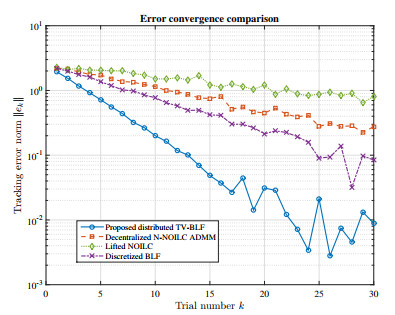
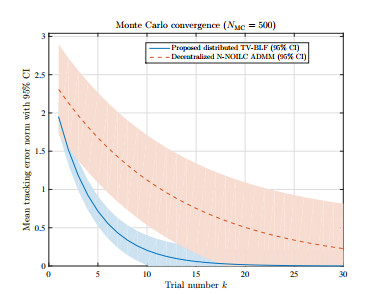
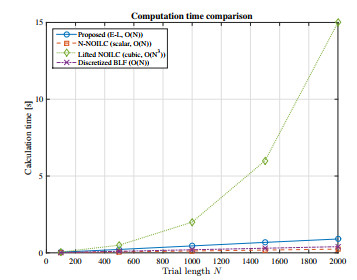
Coordinated trajectory tracking in networks of robotic manipulators is fundamental to collaborative automation, yet strict joint-velocity limits and network-induced communication delays frequently cause standard controllers to violate safety constraints or diverge. Existing decentralized iterative learning control (ILC) methods fail here because they rely on scalar first-order dynamics and centralized topologies, which cannot handle coupled second-order Euler–Lagrange (E-L) dynamics and asynchronous time-varying delays. A distributed time-varying barrier Lyapunov function (TV-BLF) norm-optimal ILC framework is therefore developed. Embedding the TV-BLF into a distributed alternating direction method of multipliers (ADMM) cost and constructing a composite Lyapunov-Krasovskii functional compensates communication delays while strictly enforcing velocity constraints. Under the standard nonlifted ILC sensitivity approximation, a quantitative margin argument establishes semi-globally uniformly ultimately bounded (SGUUB) stability with explicit delay-dependent bounds, closing the invariance gap of a purely qualitative barrier argument. Monte Carlo simulations on a heterogeneous fleet of 2-DoF manipulators show a statistically significant reduction in mean squared error (MSE) and zero constraint violations versus three baselines, while preserving $ \mathcal{O}(N) $ per-agent complexity under a bounded-ADMM-iteration proviso.
Citation: Vladimir Stojanovic, Ljubisa Dubonjic, Sasa Prodanovic. Distributed barrier iterative learning control for networked Euler–Lagrange systems under time-varying delays[J]. Mathematical Modelling and Control, 2026, 6(3): 290-300. doi: 10.3934/mmc.2026022
Coordinated trajectory tracking in networks of robotic manipulators is fundamental to collaborative automation, yet strict joint-velocity limits and network-induced communication delays frequently cause standard controllers to violate safety constraints or diverge. Existing decentralized iterative learning control (ILC) methods fail here because they rely on scalar first-order dynamics and centralized topologies, which cannot handle coupled second-order Euler–Lagrange (E-L) dynamics and asynchronous time-varying delays. A distributed time-varying barrier Lyapunov function (TV-BLF) norm-optimal ILC framework is therefore developed. Embedding the TV-BLF into a distributed alternating direction method of multipliers (ADMM) cost and constructing a composite Lyapunov-Krasovskii functional compensates communication delays while strictly enforcing velocity constraints. Under the standard nonlifted ILC sensitivity approximation, a quantitative margin argument establishes semi-globally uniformly ultimately bounded (SGUUB) stability with explicit delay-dependent bounds, closing the invariance gap of a purely qualitative barrier argument. Monte Carlo simulations on a heterogeneous fleet of 2-DoF manipulators show a statistically significant reduction in mean squared error (MSE) and zero constraint violations versus three baselines, while preserving $ \mathcal{O}(N) $ per-agent complexity under a bounded-ADMM-iteration proviso.

| [1] |
S. Arimoto, S. Kawamura, F. Miyazaki, Bettering operation of robots by learning, J. Rob. Syst., 1 (1984), 123–140. https://doi.org/10.1002/rob.4620010203 doi: 10.1002/rob.4620010203

|
| [2] |
A. D. Ames, X. Xu, J. W. Grizzle, P. Tabuada, Control barrier function based quadratic programs for safety critical systems, IEEE Trans. Autom. Control, 62 (2017), 3861–3876. https://doi.org/10.1109/TAC.2016.2638961 doi: 10.1109/TAC.2016.2638961
|
| [3] |
D. A. Bristow, M. Tharayil, A. G. Alleyne, A survey of iterative learning control, IEEE Control Syst. Mag., 26 (2006), 96–114. https://doi.org/10.1109/MCS.2006.1636313 doi: 10.1109/MCS.2006.1636313
|
| [4] |
S. Boyd, N. Parikh, E. Chu, B. Peleato, J. Eckstein, Distributed optimization and statistical learning via the alternating direction method of multipliers, Found. Trends Mach. Learn., 3 (2011), 1–122. https://doi.org/10.1561/2200000016 doi: 10.1561/2200000016
|
| [5] | A. W. Farras, T. Hatanaka, Safe control with control barrier function for Euler-Lagrange systems facing position constraint, 2021 SICE International Symposium on Control Systems (SICE ISCS), Tokyo, Japan, 2021. https://doi.org/10.23919/SICEISCS51787.2021.9495318 |
| [6] |
L. Gao, Z. Zhuang, H. Tao, Y. Chen, W. Paszke, V. Stojanovic, A decentralized optimal iterative learning control approach with efficient computation for collaborative tracking, Int. J. Robust Nonlinear Control, 35 (2025), 6652–6669. https://doi.org/10.1002/rnc.70020 doi: 10.1002/rnc.70020
|
| [7] |
A. Hock, A. P. Schoelling, Distributed iterative learning control for multi-agent systems: theoretic developments and application to formation flying, Auton. Robots, 43 (2019), 1989–2010. https://doi.org/10.1007/s10514-019-09845-4 doi: 10.1007/s10514-019-09845-4
|
| [8] | D. E. H. Hammami, S. Maraoui, K. Bouzrara, Self-triggered ADMM-based distributed NMPC under communication delays: a comparative study, 2026 IEEE International conference on Advanced Systems and Emergent Technologies (IC_ASET), Hammamet-Yasmine, Tunisia, 2026. https://doi.org/10.1109/IC_ASET69920.2026.11502085 |
| [9] | M. W. Spong, S. Hutchinson, M. Vidyasagar, Robot modeling and control, Hoboken, NJ: John Wiley & Sons, 2020. |
| [10] |
K. P. Tee, S. S. Ge, E. H. Tay, Barrier Lyapunov functions for the control of output-constrained nonlinear systems, Automatica, 45 (2009), 918–927. https://doi.org/10.1016/j.automatica.2008.11.017 doi: 10.1016/j.automatica.2008.11.017
|
| [11] |
Z. Zhuang, H. Tao, Y. Chen, V. Stojanovic, W. Paszke, An optimal iterative learning control approach for linear systems with nonuniform trial lengths under input constraints, IEEE Trans. Syst. Man Cybern. Syst., 53 (2023), 3461–3473. https://doi.org/10.1109/TSMC.2022.3225381 doi: 10.1109/TSMC.2022.3225381
|
Figures(8) / Tables(3)
Vladimir Stojanovic, Ljubisa Dubonjic, Sasa Prodanovic. Distributed barrier iterative learning control for networked Euler–Lagrange systems under time-varying delays[J]. Mathematical Modelling and Control, 2026, 6(3): 290-300. doi: 10.3934/mmc.2026022




 DownLoad: