The immune system encounters innumerable cells every day and must decide whether these cells are healthy and thus must be tolerated, or are malignant and thus must be eliminated. These decisions are made from imperfect molecular signals in a complex, noisy environment. Errors in classification may lead to diseases such as cancer and autoimmunity. In this paper, we use ideas from cancer biosemiotics and signal detection theory to formalize this notion and show that cancer and autoimmunity are two sides of the same semiotic corruption problem, rather than separate pathologies. We show how biological factors such as noise, aging, deceptive signaling, and chronic inflammation all converge on reducing the discriminability of the immune system. Using this framework, we make two clinical predictions that are consistent with results from randomized clinical trials: 1) checkpoint inhibitors increase the aggressiveness of the immune classifier, leading to improved tumor control at the cost of higher rates of immune-related adverse events, and 2) the adverse side effects associated with checkpoint inhibitors will be more systemic than those associated with antigen-directed therapies. Then, we allow the immune system's reference for normalcy to update over time, and show that the lag between the true tissue state and the immune system's perception of it leads to a transient shift in the aggressiveness/tolerance of the classifier. In accordance with the discontinuity theory of immunity, we show that abrupt changes are registered as abnormal, whereas gradual changes are absorbed into the immune system's notion of normalcy. Although we frame this discussion in the context of cancer, it applies more broadly to any biological classification problem in which the state of the sender is unknown, and signals are imperfect and corruptible.
Citation: Anuraag Bukkuri. The mask of sanity: Cancer and autoimmunity as complementary failures of semiotic classification[J]. Mathematical Biosciences and Engineering, 2026, 23(10): 3169-3183. doi: 10.3934/mbe.2026109
The immune system encounters innumerable cells every day and must decide whether these cells are healthy and thus must be tolerated, or are malignant and thus must be eliminated. These decisions are made from imperfect molecular signals in a complex, noisy environment. Errors in classification may lead to diseases such as cancer and autoimmunity. In this paper, we use ideas from cancer biosemiotics and signal detection theory to formalize this notion and show that cancer and autoimmunity are two sides of the same semiotic corruption problem, rather than separate pathologies. We show how biological factors such as noise, aging, deceptive signaling, and chronic inflammation all converge on reducing the discriminability of the immune system. Using this framework, we make two clinical predictions that are consistent with results from randomized clinical trials: 1) checkpoint inhibitors increase the aggressiveness of the immune classifier, leading to improved tumor control at the cost of higher rates of immune-related adverse events, and 2) the adverse side effects associated with checkpoint inhibitors will be more systemic than those associated with antigen-directed therapies. Then, we allow the immune system's reference for normalcy to update over time, and show that the lag between the true tissue state and the immune system's perception of it leads to a transient shift in the aggressiveness/tolerance of the classifier. In accordance with the discontinuity theory of immunity, we show that abrupt changes are registered as abnormal, whereas gradual changes are absorbed into the immune system's notion of normalcy. Although we frame this discussion in the context of cancer, it applies more broadly to any biological classification problem in which the state of the sender is unknown, and signals are imperfect and corruptible.

| [1] |
H. E. Teulings, J. Limpens, S. N. Jansen, A. H. Zwinderman, J. B. Reitsma, P. I. Spuls, et al., Vitiligo-like depigmentation in patients with stage III-IV melanoma receiving immunotherapy and its association with survival: A systematic review and meta-analysis, J. Clin. Oncol., 33 (2015), 773–781. https://doi.org/10.1200/JCO.2014.57.4756 doi: 10.1200/JCO.2014.57.4756
|
| [2] |
E. A. Engels, R. M. Pfeiffer, J. F. Fraumeni, B. L. Kasiske, A. K. Israni, J. J. Snyder, et al., Spectrum of cancer risk among US solid organ transplant recipients, JAMA, 306 (2011), 1891. https://doi.org/10.1001/jama.2011.1592 doi: 10.1001/jama.2011.1592
|
| [3] |
S. M. Amos, C. P. M. Duong, J. A. Westwood, D. S. Ritchie, R. P. Junghans, P. K. Darcy, et al., Autoimmunity associated with immunotherapy of cancer, Blood, 118 (2011), 499–509. https://doi.org/10.1182/blood-2011-01-325266 doi: 10.1182/blood-2011-01-325266
|
| [4] |
M. A. Postow, R. Sidlow, M. D. Hellmann, Immune-related adverse events associated with immune checkpoint blockade, N. Engl. J. Med., 378 (2018), 158–168. https://doi.org/10.1056/NEJMra1703481 doi: 10.1056/NEJMra1703481
|
| [5] |
T. Pradeu, S. Jaeger, E. Vivier, The speed of change: towards a discontinuity theory of immunity?, Nat. Rev. Immunol., 13 (2013), 764–769. https://doi.org/10.1038/nri3521 doi: 10.1038/nri3521
|
| [6] |
T. Pradeu, E. Vivier, The discontinuity theory of immunity, Sci. Immunol., 1 (2016). https://doi.org/10.1126/sciimmunol.aag0479 |
| [7] |
J. J. von Uexkül, A Foray Into the Worlds of Animals and Humans: With A Theory of Meaning, University of Minnesota Press, Minneapolis, 2010. |
| [8] |
I. Pavlinov, Biological Systematics: History and Theory, CRC Press, 2022. |
| [9] |
C. S. Peirce, Collected Papers of Charles Sanders Peirce, Harvard University Press, 1934. |
| [10] |
S. Brier, Cybersemiotics: Why Information is Not Enough, University Of Toronto Press, 2013. |
| [11] |
A. A. Sharov, Functional information: Towards synthesis of biosemiotics and cybernetics, Entropy, 12 (2010), 1050–1070. https://doi.org/10.3390/e12051050 doi: 10.3390/e12051050
|
| [12] |
U. Eco, A Theory of Semiotics, Indiana University Press, 1978. |
| [13] |
J. E. Park, R. A. Botting, C. Domínguez Conde, D. M. Popescu, M. Lavaert, D. J. Kunz, et al., A cell atlas of human thymic development defines T cell repertoire formation, Science, 367 (2020). https://doi.org/10.1126/science.aay3224 |
| [14] |
J. J. Goronzy, C. M. Weyand, Understanding immunosenescence to improve responses to vaccines, Nat. Immunol., 14 (2013), 428–436. https://doi.org/10.1038/ni.2588 doi: 10.1038/ni.2588
|
| [15] |
N. Song, M. A. Elbahnasawy, N. P. Weng, General and individualized changes in T cell immunity during aging, J. Immunol., 214 (2025), 872–879. https://doi.org/10.1093/jimmun/vkae033 doi: 10.1093/jimmun/vkae033
|
| [16] |
N. P. Weng, Numbers and odds: TCR repertoire size and its age changes impacting on T cell functions, Semin. Immunol., 69 (2023), 101810. https://doi.org/10.1016/j.smim.2023.101810 doi: 10.1016/j.smim.2023.101810
|
| [17] |
A. K. Sewell, Why must T cells be cross-reactive?, Nat. Rev. Immunol., 12 (2012), 669–677. https://doi.org/10.1038/nri3279 doi: 10.1038/nri3279
|
| [18] |
P. S. Kumar, T. Kodi, A. Gopinathan, B. H. Byregowda, K. Nandakumar, A. Kishore, New insights on heat shock proteins as regulators of reactive oxygen species across various stressors in diseases, Cell Biochem. Funct., 44 (2026). https://doi.org/10.1002/cbf.70173 |
| [19] |
D. R. Ciocca, S. K. Calderwood, Heat shock proteins in cancer: diagnostic, prognostic, predictive, and treatment implications, Cell Stress Chaperones, 10 (2005), 86. |
| [20] |
K. Dhatchinamoorthy, J. D. Colbert, K. L. Rock, Cancer immune evasion through loss of MHC class I antigen presentation, Front. Immunol., 12 (2021). https://doi.org/10.3389/fimmu.2021.636568 |
| [21] |
G. Tan, K. M. Spillane, J. Maher, The role and regulation of the NKG2D/NKG2D ligand system in cancer, Biology, 12 (2023), 1079. https://doi.org/10.3390/biology12081079 doi: 10.3390/biology12081079
|
| [22] |
P. A. Ascierto, M. Del Vecchio, C. Robert, A. Mackiewicz, V. Chiarion-Sileni, A. Arance, et al., Ipilimumab 10 mg/kg versus ipilimumab 3 mg/kg in patients with unresectable or metastatic melanoma: a randomised, double-blind, multicentre, phase 3 trial, Lancet Oncol., 18 (2017), 611–622. https://doi.org/10.1016/S1470-2045(17)30231-0 doi: 10.1016/S1470-2045(17)30231-0
|
| [23] |
J. Larkin, V. Chiarion-Sileni, R. Gonzalez, J. J. Grob, C. L. Cowey, C. D. Lao, et al., Combined nivolumab and ipilimumab or monotherapy in untreated melanoma, N. Engl. J. Med., 373 (2015), 23–34. https://doi.org/10.1056/NEJMoa1504030 doi: 10.1056/NEJMoa1504030
|
| [24] |
P. Nathan, J. C. Hassel, P. Rutkowski, J. F. Baurain, M. O. Butler, M. Schlaak, et al., Overall survival benefit with tebentafusp in metastatic uveal melanoma, N. Engl. J. Med., 385 (2021), 1196–1206. https://doi.org/10.1056/NEJMoa2103485 doi: 10.1056/NEJMoa2103485
|
| [25] |
J. Chen, Y. Alduais, B. Chen, Therapeutic and systemic adverse events of immune checkpoint inhibitors targeting the PD-1/PD-L1 axis for clinical management of NSCLC, Cell Transplant., 30 (2021). https://doi.org/10.1177/09636897211041587 |
| [26] |
Q. Yin, L. Wu, L. Han, X. Zheng, R. Tong, L. Li, et al., Immune-related adverse events of immune checkpoint inhibitors: a review, Front. Immunol., 14 (2023). https://doi.org/10.3389/fimmu.2023.1167975 |
| [27] |
R. E. Kalman, R. S. Bucy, New results in linear filtering and prediction theory, J. Basic Eng., 83 (1961), 95–108. https://doi.org/10.1115/1.3658902 doi: 10.1115/1.3658902
|
| [28] |
Z. Grossman, W. E. Paul, Adaptive cellular interactions in the immune system: the tunable activation threshold and the significance of subthreshold responses, PNAS, 89 (1992), 10365–10369. https://doi.org/10.1073/pnas.89.21.10365 doi: 10.1073/pnas.89.21.10365
|
| [29] |
Z. Grossman, W. E. Paul, Dynamic tuning of lymphocytes: Physiological basis, mechanisms, and function, Annu. Rev. Immunol., 33 (2015), 677–713. https://doi.org/10.1146/annurev-immunol-032712-100027 doi: 10.1146/annurev-immunol-032712-100027
|
| [30] |
D. E. Oppenheim, S. J. Roberts, S. L. Clarke, R. Filler, J. M. Lewis, R. E. Tigelaar, et al., Sustained localized expression of ligand for the activating NKG2D receptor impairs natural cytotoxicity in vivo and reduces tumor immunosurveillance, Nat. Immunol., 6 (2005), 928–937. https://doi.org/10.1038/ni1239 doi: 10.1038/ni1239
|
| [31] |
N. T. Joncker, N. Shifrin, F. Delebecque, D. H. Raulet, Mature natural killer cells reset their responsiveness when exposed to an altered MHC environment, J. Exp. Med., 207 (2010), 2065–2072. https://doi.org/10.1084/jem.20100570 doi: 10.1084/jem.20100570
|
| [32] |
H. J. Alsakaji, F. A. Rihan, K. Udhayakumar, F. El Ktaibi, Stochastic tumor-immune interaction model with external treatments and time delays: An optimal control problem, Math. Biosci. Eng., 20 (2023), 19270–19299. https://doi.org/10.3934/mbe.2023852 doi: 10.3934/mbe.2023852
|
| [33] |
F. A. Rihan, D. H. Abdelrahman, F. Al-Maskari, F. Ibrahim, M. A. Abdeen, Delay differential model for tumour-immune response with chemoimmunotherapy and optimal control, Comput. Math. Methods Med., 2014 (2014), 1–15. https://doi.org/10.1155/2014/982978 doi: 10.1155/2014/982978
|
| [34] |
F. A. Rihan, Delay Differential Equations and Applications to Biology, Springer Singapore, Singapore, 2021. https://doi.org/10.1007/978-981-16-0626-7 |
| [35] |
S. Torres-Martínez, An integrated Bayesian-heuristic semiotic model for understanding human and SARS-CoV-2 representational structures, Biosemiotics, 16 (2023), 415–439. https://doi.org/10.1007/s12304-023-09546-7 doi: 10.1007/s12304-023-09546-7
|
| [36] |
S. Torres-Martínez, Semiosic translation: a Bayesian-heuristic theory of translation and translating, Lang. Semiotic Stud., 10 (2024), 167–202. https://doi.org/10.1515/lass-2023-0042 doi: 10.1515/lass-2023-0042
|
Figures(4) / Tables(1)

Anuraag Bukkuri. The mask of sanity: Cancer and autoimmunity as complementary failures of semiotic classification[J]. Mathematical Biosciences and Engineering, 2026, 23(10): 3169-3183. doi: 10.3934/mbe.2026109

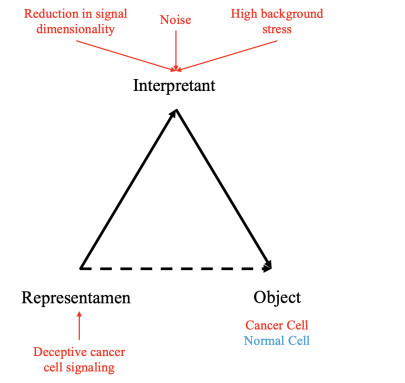
Peirce's triadic model adapted to cancer-autoimmune classification. Reduction in signal dimensionality, noise, and high background stress corrupt the immune interpretant, thus driving a divergence between the dynamical and immediate object. Deceptive cancer cell signaling corrupts the representamen
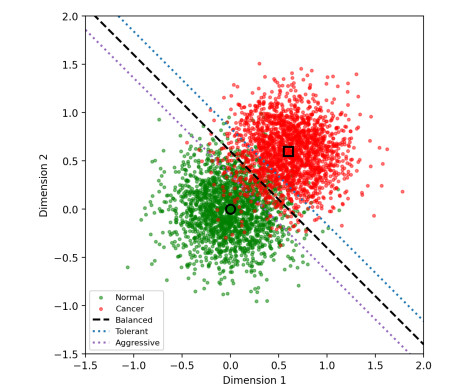
Visualization of overlapping distributions in two-dimensional signal space. 2D signal space showing normal (green) and cancer (red) distributions with three immune classifiers. The dashed line corresponds to the balanced total error minimizer ($ \lambda_1/\lambda_2 = 1 $), and the dotted lines correspond to the Bayes-optimal boundaries for aggressive ($ \lambda_1/\lambda_2 = 1/5 $) and tolerant classifiers ($ \lambda_1/\lambda_2 = 5 $). Overlapping distributions mean that misclassification will occur, regardless of where the classification boundary is set
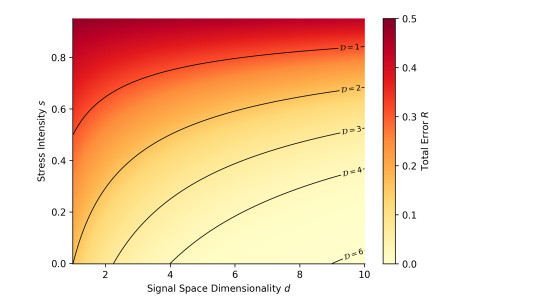
Total error rate and discriminability landscapes. Total error rate increases with stress and decreases with dimensionality. Discriminability decreases with stress and increases with dimensionality
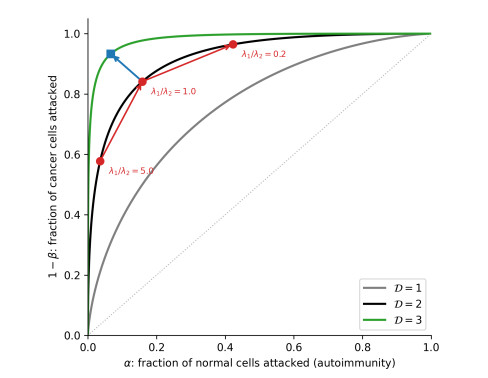
Threshold Shift vs. Discriminability Improvement. ROC curves are plotted for $ \mathcal{D} = 1, 2, 3 $. Increasing $ \lambda_2 $ (checkpoint inhibitors) moves the immune system along a fixed ROC curve, increasing cancer cell killing at a cost of increased autoimmunity. Increasing $ \mathcal{D} $ (antigen-directed therapies) moves the ROC curve, allowing both type 1 and type 2 errors to decrease




 DownLoad: