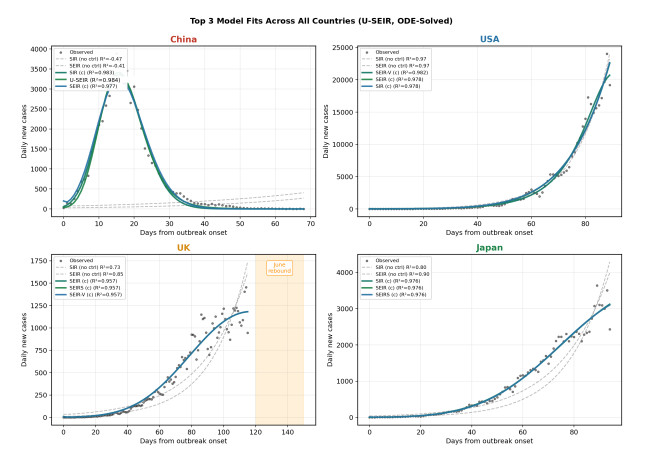
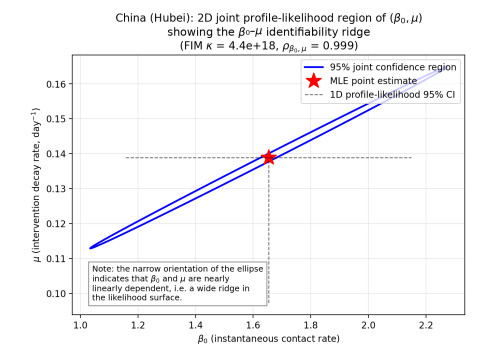
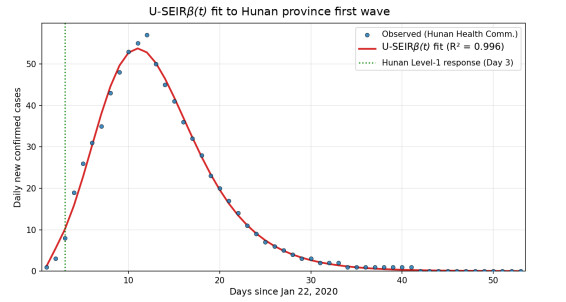
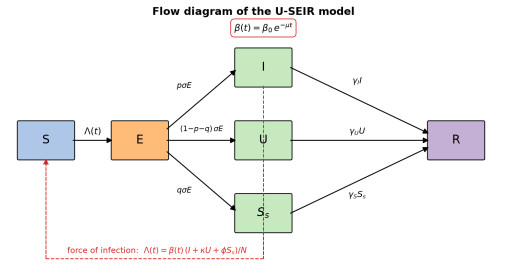
The COVID-19 pandemic exposed limitations of classical compartmental models that assume homogeneous transmission and constant contact rates. We have proposed U-SEIR, a unified six-compartment framework integrating an undetected/asymptomatic compartment, a super-spreader compartment, and a time-varying contact rate $ \beta(t) = \beta_{0}e^{-\mu t} $ representing cumulative non-pharmaceutical interventions. The basic reproduction number was derived via the next-generation matrix, and the disease-free equilibrium was proved globally asymptotically stable when $ \mathcal{R}_{0} < 1 $ by a Lyapunov argument. The model was validated on daily new-case series of five countries (China/Hubei, USA, UK, Japan, Italy) and one sub-national province (Hunan) during the first wave. A controlled comparison isolated the contributions of the intervention mechanism and structural complexity: for China/Hubei, the no-control susceptible-infectious-recovered (SIR) yielded $ R^{2} = -0.47 $, whereas the same model with the time-varying contact rate reached $ R^{2} = 0.98 $. A paired block bootstrap ($ B = 500 $, block = 7 days) and AIC (Akaike Information Criterion) showed that the asymptomatic and super-spreader compartments provide a statistically distinguishable improvement over the best $ \beta(t) $-controlled susceptible-exposed-infectious-recovered (SEIR) baseline in only one of six jurisdictions (Italy, $ p < 0.001 $, $ \Delta\mathrm{AIC} = 7.5 $). Identifiability analysis showed the eleven-parameter fit is borderline identifiable ($ \kappa_{\mathrm{FIM}} $ in the $ 10^{12} $–$ 10^{22} $ range, with $ \beta_0 $ and $ \mu $ jointly unidentifiable on a narrow ridge); fixing five parameters at clinical values and re-fitting a reduced $ K' = 6 $ model lowered the Fisher-information condition number by four to seven orders of magnitude, with profile-likelihood intervals, a structural-identifiability check, and Markov Chain Monte Carlo (MCMC) credible intervals propagated through all scenario analyses. The central finding was that intervention dynamics, not structural complexity, dominate fit quality in jurisdictions with strict lockdowns.
Citation: Shujiang Tang. A unified compartmental model (U-SEIR) integrating asymptomatic infection, super-spreading, and time-varying non-pharmaceutical interventions for the first wave of COVID-19[J]. Mathematical Biosciences and Engineering, 2026, 23(10): 3138-3168. doi: 10.3934/mbe.2026108
The COVID-19 pandemic exposed limitations of classical compartmental models that assume homogeneous transmission and constant contact rates. We have proposed U-SEIR, a unified six-compartment framework integrating an undetected/asymptomatic compartment, a super-spreader compartment, and a time-varying contact rate $ \beta(t) = \beta_{0}e^{-\mu t} $ representing cumulative non-pharmaceutical interventions. The basic reproduction number was derived via the next-generation matrix, and the disease-free equilibrium was proved globally asymptotically stable when $ \mathcal{R}_{0} < 1 $ by a Lyapunov argument. The model was validated on daily new-case series of five countries (China/Hubei, USA, UK, Japan, Italy) and one sub-national province (Hunan) during the first wave. A controlled comparison isolated the contributions of the intervention mechanism and structural complexity: for China/Hubei, the no-control susceptible-infectious-recovered (SIR) yielded $ R^{2} = -0.47 $, whereas the same model with the time-varying contact rate reached $ R^{2} = 0.98 $. A paired block bootstrap ($ B = 500 $, block = 7 days) and AIC (Akaike Information Criterion) showed that the asymptomatic and super-spreader compartments provide a statistically distinguishable improvement over the best $ \beta(t) $-controlled susceptible-exposed-infectious-recovered (SEIR) baseline in only one of six jurisdictions (Italy, $ p < 0.001 $, $ \Delta\mathrm{AIC} = 7.5 $). Identifiability analysis showed the eleven-parameter fit is borderline identifiable ($ \kappa_{\mathrm{FIM}} $ in the $ 10^{12} $–$ 10^{22} $ range, with $ \beta_0 $ and $ \mu $ jointly unidentifiable on a narrow ridge); fixing five parameters at clinical values and re-fitting a reduced $ K' = 6 $ model lowered the Fisher-information condition number by four to seven orders of magnitude, with profile-likelihood intervals, a structural-identifiability check, and Markov Chain Monte Carlo (MCMC) credible intervals propagated through all scenario analyses. The central finding was that intervention dynamics, not structural complexity, dominate fit quality in jurisdictions with strict lockdowns.

| [1] |
J. T. Wu, K. Leung, G. M. Leung, Nowcasting and forecasting the potential domestic and international spread of the 2019-nCoV outbreak originating in Wuhan, China, Lancet, 395 (2020), 689–697. https://doi.org/10.1016/S0140-6736(20)30260-9 doi: 10.1016/S0140-6736(20)30260-9

|
| [2] |
Q. Li, X. Guan, P. Wu, X. Wang, L. Zhou, Y. Tong, et al., Early transmission dynamics in Wuhan, China, of novel coronavirus-infected pneumonia, New Eng. J. Med., 382 (2020), 1199–1207. https://doi.org/10.1056/NEJMoa2001316 doi: 10.1056/NEJMoa2001316
|
| [3] |
A. L. Bertozzi, E. Franco, G. Mohler, The challenges of modeling and forecasting the spread of COVID-19, Proc. Natl. Acad. Sci. U.S.A., 117 (2020), 16732–16738. https://doi.org/10.1073/pnas.2006520117 doi: 10.1073/pnas.2006520117
|
| [4] |
W. O. Kermack, A. G. McKendrick, A contribution to the mathematical theory of epidemics, Proc. R. Soc. A, 115 (1927), 700–721. https://doi.org/10.1098/rspa.1927.0118 doi: 10.1098/rspa.1927.0118
|
| [5] |
P. Sah, M. C. Fitzpatrick, C. F. Zimmer, A. P. Galvani, Asymptomatic SARS-CoV-2 infection: A systematic review and meta-analysis, Proc. Natl. Acad. Sci., 118 (2021), e2109229118. https://doi.org/10.1073/pnas.2109229118 doi: 10.1073/pnas.2109229118
|
| [6] |
D. Buitrago-Garcia, D. Egli-Gany, M. J. Counotte, S. Hossmann, H. Imeri, A. M. Ipekci, et al., Occurrence and transmission potential of asymptomatic and presymptomatic SARS-CoV-2 infections, PLoS Med., 17 (2020), e1003346. https://doi.org/10.1371/journal.pmed.1003346 doi: 10.1371/journal.pmed.1003346
|
| [7] |
L. Ferretti, C. Wymant, M. Kendall, L. Zhao, A. Nurtay, L. Abeler-dörner, et al., Quantifying SARS-CoV-2 transmission suggests epidemic control with digital contact tracing, Science, 368 (2020), eabb6936. https://doi.org/10.1126/science.abb6936 doi: 10.1126/science.abb6936
|
| [8] |
J. O. Lloyd-Smith, S. J. Schreiber, P. E. Kopp, W. M. Getz, Superspreading and the effect of individual variation on disease emergence, Nature, 438 (2005), 355–359. https://doi.org/10.1038/nature04153 doi: 10.1038/nature04153
|
| [9] |
D. C. Adam, P. Wu, D. Wong, T. K. Tsang, S. Cauchemez, G. M. Leung, et al., Clustering and superspreading potential of SARS-CoV-2 infections in Hong Kong, Nat. Med., 26 (2020), 1714–1719. https://doi.org/10.1038/s41591-020-1092-0 doi: 10.1038/s41591-020-1092-0
|
| [10] |
S. Flaxman, S. Mishra, A. Gandy, H. J. T. Unwin, T. A. Mellan, H. Coupland, et al., Estimating the effects of non-pharmaceutical interventions on COVID-19 in Europe, Nature, 584 (2020), 257–261. https://doi.org/10.1038/s41586-020-2405-7 doi: 10.1038/s41586-020-2405-7
|
| [11] |
K. Roosa, Y. Lee, R. Luo, A. Kirpich, R. Rothenberg, J. M. Hyman, et al., Real-time forecasts of the COVID-19 epidemic in China from February 5th to February 24th, 2020, Infect. Dis. Modell., 5 (2020), 256–263. https://doi.org/10.1016/j.idm.2020.02.002 doi: 10.1016/j.idm.2020.02.002
|
| [12] |
S. Moore, E. M. Hill, M. J. Tildesley, L. Dyson, M. J. Keeling, Vaccination and non-pharmaceutical interventions for COVID-19: A mathematical modelling study, Lancet Infect. Dis., 21 (2021), 793–802. https://doi.org/10.1016/S1473-3099(21)00143-2 doi: 10.1016/S1473-3099(21)00143-2
|
| [13] |
N. M. Ferguson, D. Laydon, G. Nedjati-Gilani, N. Imai, K. Ainslie, Impact of non-pharmaceutical interventions (NPIs) to reduce COVID-19 mortality and healthcare demand, Imperial College London, (2020). https://doi.org/10.25561/77482 doi: 10.25561/77482
|
| [14] |
A. Sanyaolu, C. Okorie, A. Marinkovic, R. Patidar, K. Younis, P. Desai, et al., Comorbidity and its impact on patients with COVID-19, SN Compr. Clin. Med., 2 (2020), 1069–1076. https://doi.org/10.1007/s42399-020-00363-4 doi: 10.1007/s42399-020-00363-4
|
| [15] |
M. Khalighi, L. Lahti, F. Ndaïrou, P. Rashkov, D. F. M. Torres, Fractional modelling of COVID-19 transmission incorporating asymptomatic and super-spreader individuals, Math. Biosci., 380 (2025), 109373. https://doi.org/10.1016/j.mbs.2024.109373 doi: 10.1016/j.mbs.2024.109373
|
| [16] |
V. Ambalarajan, A. R. Mallela, V. Sivakumar, P. B. Dhandapani, V. Leiva, C. Martin-Barreiro, et al., A six-compartment model for COVID-19 with transmission dynamics and public health strategies, Sci. Rep., 14 (2024), 22226. https://doi.org/10.1038/s41598-024-72487-9 doi: 10.1038/s41598-024-72487-9
|
| [17] |
F. Saldaña, N. Stollenwerk, M. Aguiar, Modelling COVID-19 mutant dynamics: Understanding the interplay between viral evolution and disease transmission dynamics, Royal Soc. Open Sci., 11 (2024), 240919. https://doi.org/10.1098/rsos.240919 doi: 10.1098/rsos.240919
|
| [18] |
B. Shi, S. Yang, Q. Tan, L. Zhou, Y. Liu, X. Zhou, et al., Bayesian inference for the onset time and epidemiological characteristics of emerging infectious diseases, Front. Public Health, 12 (2024), 1406566. https://doi.org/10.3389/fpubh.2024.1406566 doi: 10.3389/fpubh.2024.1406566
|
| [19] |
K. Prem, Y. Liu, T. W. Russell, A. J. Kucharski, R. M. Eggo, N. Davies, et al., The effect of control strategies to reduce social mixing on outcomes of the COVID-19 epidemic in Wuhan, China: A modelling study, Lancet Public Health, 5 (2020), e261–e270. https://doi.org/10.1016/S2468-2667(20)30073-6 doi: 10.1016/S2468-2667(20)30073-6
|
| [20] |
K. C. Chong, S. Zhao, C. T. Hung, K. Min Jia, J. Y. Ho, H. C. Y. Lam, et al., Association between meteorological variations and the superspreading potential of SARS-CoV-2 infections, Environ. Int., 188 (2024), 108762. https://doi.org/10.1016/j.envint.2024.108762 doi: 10.1016/j.envint.2024.108762
|
| [21] |
K. Mamis, M. Farazmand, Modeling correlated uncertainties in stochastic compartmental models, Math. Biosci., 374 (2024), 109226. https://doi.org/10.1016/j.mbs.2024.109226 doi: 10.1016/j.mbs.2024.109226
|
| [22] |
Y. Zou, X. Peng, W. Yang, J. Zhang, W. Lin, Dynamics of simplicial SEIRS epidemic model: Global asymptotic stability and neural Lyapunov functions, J. Math. Biol., 89 (2024), 12. https://doi.org/10.1007/s00285-024-02119-3 doi: 10.1007/s00285-024-02119-3
|
| [23] |
P. van den Driessche, J. Watmough, Reproduction numbers and sub-threshold endemic equilibria for compartmental models of disease transmission, Math. Biosci., 180 (2002), 29–48. https://doi.org/10.1016/S0025-5564(02)00108-6 doi: 10.1016/S0025-5564(02)00108-6
|
| [24] |
O. Diekmann, J. A. P. Heesterbeek, J. A. J. Metz, On the definition and the computation of the basic reproduction ratio $R_{0}$ in models for infectious diseases in heterogeneous populations, J. Math. Biol., 28 (1990), 365–382. https://doi.org/10.1007/BF00178324 doi: 10.1007/BF00178324
|
| [25] |
H. W. Hethcote, The mathematics of infectious diseases, SIAM Rev., 42 (2000), 599–653. https://doi.org/10.1137/S0036144500371907 doi: 10.1137/S0036144500371907
|
| [26] |
J. A. P. Heesterbeek, A brief history of $R_{0}$ and a recipe for its calculation, Acta Biotheor., 50 (2002), 189–204. https://doi.org/10.1023/A:1015810608790 doi: 10.1023/A:1015810608790
|
| [27] |
Z. Shuai, P. van den Driessche, Global stability of infectious disease models using Lyapunov functions, SIAM J. Appl. Math., 73 (2013), 1513–1532. https://doi.org/10.1137/120876558 doi: 10.1137/120876558
|
| [28] | K. P. Burnham, D. R. Anderson, Model Selection and Multimodel Inference: A Practical Information-Theoretic Approach, 2nd edition, Springer, 2002. https://doi.org/10.1007/b97636 |
| [29] |
X. Lu, J. Feng, S. Tan, Perspectives on modelling epidemics with human mobility, Europhys. Lett., 149 (2025), 41002. https://doi.org/10.1209/0295-5075/adad94 doi: 10.1209/0295-5075/adad94
|
| [30] |
A. Endo, S. Abbott, A. J. Kucharski, S. Funk, Estimating the overdispersion in COVID-19 transmission using outbreak sizes outside China, Wellcome Open Res., 5 (2020), 67. https://doi.org/10.12688/wellcomeopenres.15842.3 doi: 10.12688/wellcomeopenres.15842.3
|
| [31] |
Q. Bi, Y. Wu, S. Mei, C. Ye, X. Zou, Z. Zhang, et al., Epidemiology and transmission of COVID-19 in 391 cases and 1286 of their close contacts in Shenzhen, China: A prospective cohort study, Lancet Infect. Dis., 20 (2020), 911–919. https://doi.org/10.1016/S1473-3099(20)30287-5 doi: 10.1016/S1473-3099(20)30287-5
|
| [32] |
O. Byambasuren, M. Cardona, K. Bell, J. Clark, M. L. McLaws, P. Glasziou, Estimating the extent of asymptomatic COVID-19 and its potential for community transmission: systematic review and meta-analysis, J. Assoc. Med. Microbiol. Infect. Dis. Can., 5 (2020), 223–234. https://doi.org/10.3138/jammi-2020-0030 doi: 10.3138/jammi-2020-0030
|
| [33] | R. M. Anderson, R. M. May, Infectious Diseases of Humans: Dynamics and Control, Oxford University Press, 1992. |
| [34] |
J. Zhang, M. Litvinova, Y. Liang, Y. Wang, W. Wang, S. Zhao, et al., Changes in contact patterns shape the dynamics of the COVID-19 outbreak in China, Science, 368 (2020), 1481–1486. https://doi.org/10.1126/science.abb8001 doi: 10.1126/science.abb8001
|
| [35] |
S. Riley, K. E. C. Ainslie, O. Eales, Y. Wang, W. Wang, S. Zhao, et al., Resurgence of SARS-CoV-2: Detection by community viral surveillance, Science, 372 (2021), 990–995. https://doi.org/10.1126/science.abe0199 doi: 10.1126/science.abe0199
|
| [36] |
R. H. Byrd, P. Lu, J. Nocedal, C. Zhu, A limited memory algorithm for bound constrained optimization, SIAM J. Sci. Comput., 16 (1995), 1190–1208. https://doi.org/10.1137/0916069 doi: 10.1137/0916069
|
| [37] |
R. Storn, K. Price, Differential evolution–-A simple and efficient heuristic for global optimization over continuous spaces, J. Global Optim., 11 (1997), 341–359. https://doi.org/10.1023/A:1008202821328 doi: 10.1023/A:1008202821328
|
| [38] |
A. Raue, C. Kreutz, T. Maiwald, J. Bachmann, M. Schilling, U. Klingmüller, et al., Structural and practical identifiability analysis of partially observed dynamical models by exploiting the profile likelihood, Bioinformatics, 25 (2009), 1923–1929. https://doi.org/10.1093/bioinformatics/btp358 doi: 10.1093/bioinformatics/btp358
|
| [39] | L. Ljung, System Identification: Theory for the User, 2nd edition, Prentice Hall, 1999. |
| [40] |
N. M. Linton, T. Kobayashi, Y. Yang, et al., Incubation period and other epidemiological characteristics of 2019 novel coronavirus infections with right truncation: A statistical analysis of publicly available case data, J. Clin. Med., 9 (2020), 538. https://doi.org/10.3390/jcm9020538 doi: 10.3390/jcm9020538
|
| [41] |
J. M. Brauner, S. Mindermann, M. Sharma, D. Johnston, J. Salvatier, T. Gavenciak, et al., Inferring the effectiveness of government interventions against COVID-19, Science, 371 (2021), eabd9338. https://doi.org/10.1126/science.abd9338 doi: 10.1126/science.abd9338
|
| [42] |
F. Riccardo, M. Ajelli, X. D. Andrianou, A. Bella, M. D. Manso, M. Fabiani, et al., Epidemiological characteristics of COVID-19 cases and estimates of the reproductive numbers 1 month into the epidemic, Italy, 28 January to 31 March 2020, Eurosurveillance, 25 (2020), 2000790. https://doi.org/10.2807/1560-7917.ES.2020.25.49.2000790 doi: 10.2807/1560-7917.ES.2020.25.49.2000790
|
| [43] |
T. R. Frieden, C. T. Lee, Identifying and interrupting superspreading events–-Implications for control of severe acute respiratory syndrome coronavirus 2, Emerging Infect. Dis., 26 (2020), 1059–1066. https://doi.org/10.3201/eid2606.200357 doi: 10.3201/eid2606.200357
|
| [44] |
T. Hale, N. Angrist, R. Goldszmidt, B. Kira, A. Petherick, T. Phillips, et al., A global panel database of pandemic policies (Oxford COVID-19 Government Response Tracker), Nat. Hum. Behav., 5 (2021), 529–538. https://doi.org/10.1038/s41562-021-01079-8 doi: 10.1038/s41562-021-01079-8
|
| [45] |
Y. Liu, C. Morgenstern, J. Kelly, R. Lowe, CMMID COVID-19 Working Group, M. Jit, The impact of non-pharmaceutical interventions on SARS-CoV-2 transmission across 130 countries and territories, BMC Med., 19 (2021), 40. https://doi.org/10.1186/s12916-020-01872-8 doi: 10.1186/s12916-020-01872-8
|
| [46] |
X. Lu, J. Feng, S. Lai, P. Holme, S. Liu, Z. Du, et al., Human mobility in epidemic modeling, Phys. Rep., 1157 (2026), 1–45. https://doi.org/10.1016/j.physrep.2025.10.010 doi: 10.1016/j.physrep.2025.10.010
|
| [47] |
Y. Kao, J. Xie, C. Wang, H. R. Karimi, A sliding mode approach to $H_\infty$ non-fragile observer-based control design for uncertain Markovian neutral-type stochastic systems, Automatica, 52 (2015), 218–226. https://doi.org/10.1016/j.automatica.2014.10.095 doi: 10.1016/j.automatica.2014.10.095
|
| [48] |
P. Zhang, Y. Kao, J. Hu, B. Niu, Robust observer-based sliding mode $H_\infty$ control for stochastic Markovian jump systems subject to packet losses, Automatica, 130 (2021), 109665. https://doi.org/10.1016/j.automatica.2021.109665 doi: 10.1016/j.automatica.2021.109665
|
| [49] |
Y. Kao, G. Yang, J. Xie, L. Shi, $H_\infty$ adaptive control for uncertain Markovian jump systems with general unknown transition rates, Appl. Math. Modell., 40 (2016), 5200–5215. https://doi.org/10.1016/j.apm.2015.10.041 doi: 10.1016/j.apm.2015.10.041
|
| [50] |
J. Xie, J. Meng, Y. Kao, Z. Liu, Quantized feedback control for Markovian jumping singular systems driven by fractional Brownian motions, Int. J. Robust Nonlinear Control, 31 (2021). https://doi.org/10.1002/rnc.5707 doi: 10.1002/rnc.5707
|
| [51] |
S. Mongolian, Y. Kao, C. Wang, H. Xia, Robust mean square stability of delayed stochastic generalized uncertain impulsive reaction-diffusion neural networks, J. Franklin Inst., 358 (2021), 877–894. https://doi.org/10.1016/j.jfranklin.2020.04.011 doi: 10.1016/j.jfranklin.2020.04.011
|
Figures(6) / Tables(13)

Shujiang Tang. A unified compartmental model (U-SEIR) integrating asymptomatic infection, super-spreading, and time-varying non-pharmaceutical interventions for the first wave of COVID-19[J]. Mathematical Biosciences and Engineering, 2026, 23(10): 3138-3168. doi: 10.3934/mbe.2026108





 DownLoad: