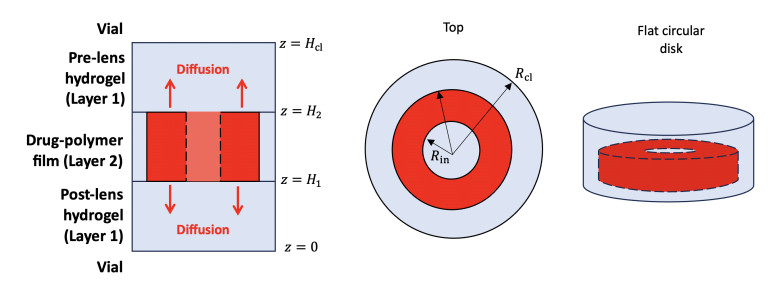
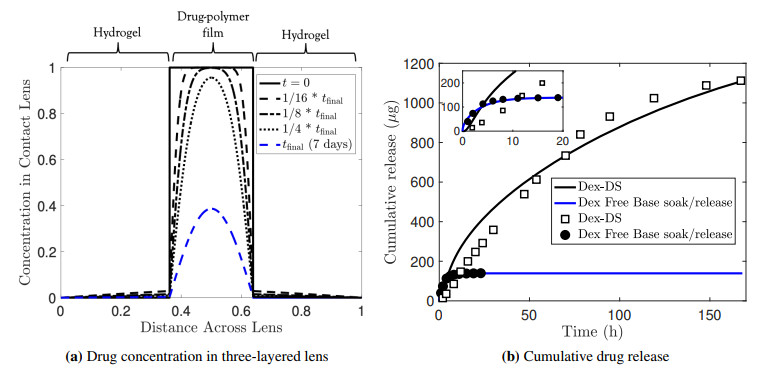
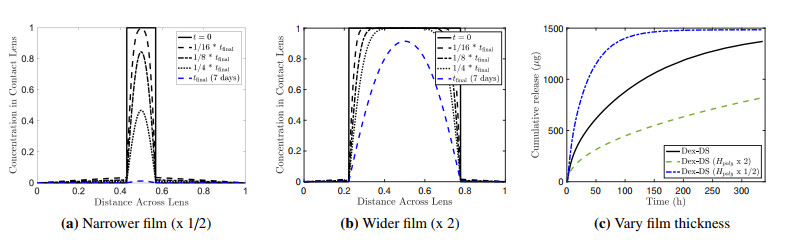
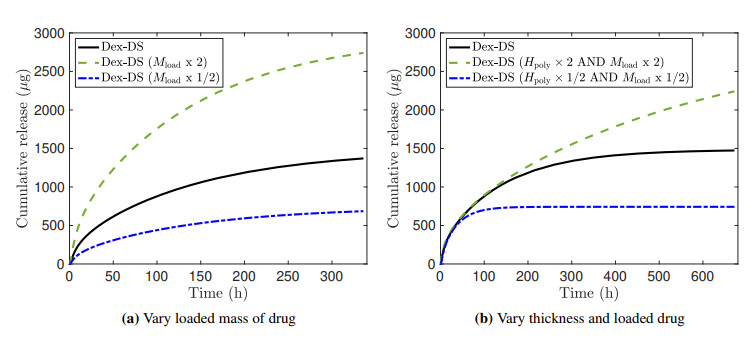
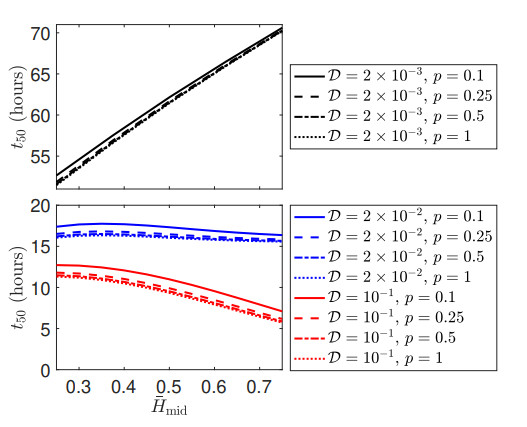
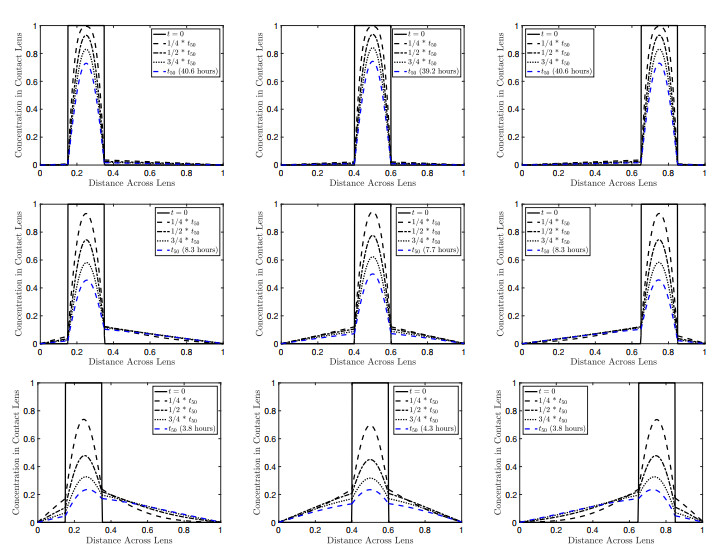
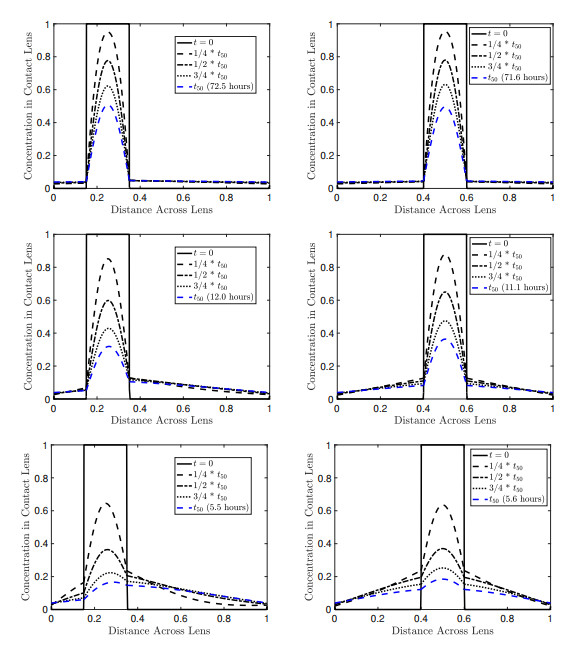
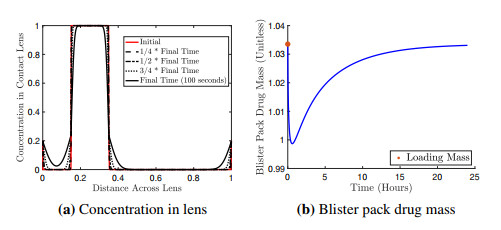
In this work we design a multi-layer model of composite contact lens drug release. Such lenses have been designed by encapsulating drug-polymer films in contact lens hydrogels. Composite lenses can promote sustained discharge of drug and achieve near zero-order release kinetics, thus surpassing other ocular delivery methods that are limited by short residence times and an undesirable initial burst release. Our model is informed by in vivo data, and includes three coupled partial differential equation layers to simulate the composite lens. We mathematically investigate the effect of composite contact lens design characteristics on the time to 50% therapeutic drug release ($ t_{50} $) in the vial, eye, and blister pack settings. In the eye setting, we incorporate our prior model that considers the effect of many blinks on the pre- and post-lens tear film drug concentrations. We simulate drug cumulative release profiles and study the variability of $ t_{50} $ across: (1) the ratio of the drug-polymer film to hydrogel diffusion coefficients, (2) the centerline of the polymer film within the hydrogel, and (3) the polymer film thickness. In the blister pack setting, we study storage questions that may inform future commercial design. We find that the diffusion coefficient ratio strongly negatively affects $ t_{50} $ across all three settings, while the dependence of $ t_{50} $ on polymer centerline depends also on the diffusion coefficient ratio and the relative pre- and post-lens drug clearance rates in the eye wear setting. A relatively small blister pack loading concentration ($ < 5\% $ that of the drug-polymer film) is required to sustain 50% of the drug in the lens for one month. Our study reveals that optimal lens design depends on the desired drug delivery rates and lens wear conditions, and that geometric and material lens properties can be adjusted towards drug delivery performance goals. This work may help medical professionals better understand the mechanics of contact lens drug delivery and predict targeted tissue transport of ophthalmic drugs.
Citation: Daniel M. Anderson, Rayanne A. Luke. Drug release dynamics from a three-layer composite contact lens in the vial, eye wear with blinking, and blister pack settings[J]. Mathematical Biosciences and Engineering, 2026, 23(10): 3098-3137. doi: 10.3934/mbe.2026107
In this work we design a multi-layer model of composite contact lens drug release. Such lenses have been designed by encapsulating drug-polymer films in contact lens hydrogels. Composite lenses can promote sustained discharge of drug and achieve near zero-order release kinetics, thus surpassing other ocular delivery methods that are limited by short residence times and an undesirable initial burst release. Our model is informed by in vivo data, and includes three coupled partial differential equation layers to simulate the composite lens. We mathematically investigate the effect of composite contact lens design characteristics on the time to 50% therapeutic drug release ($ t_{50} $) in the vial, eye, and blister pack settings. In the eye setting, we incorporate our prior model that considers the effect of many blinks on the pre- and post-lens tear film drug concentrations. We simulate drug cumulative release profiles and study the variability of $ t_{50} $ across: (1) the ratio of the drug-polymer film to hydrogel diffusion coefficients, (2) the centerline of the polymer film within the hydrogel, and (3) the polymer film thickness. In the blister pack setting, we study storage questions that may inform future commercial design. We find that the diffusion coefficient ratio strongly negatively affects $ t_{50} $ across all three settings, while the dependence of $ t_{50} $ on polymer centerline depends also on the diffusion coefficient ratio and the relative pre- and post-lens drug clearance rates in the eye wear setting. A relatively small blister pack loading concentration ($ < 5\% $ that of the drug-polymer film) is required to sustain 50% of the drug in the lens for one month. Our study reveals that optimal lens design depends on the desired drug delivery rates and lens wear conditions, and that geometric and material lens properties can be adjusted towards drug delivery performance goals. This work may help medical professionals better understand the mechanics of contact lens drug delivery and predict targeted tissue transport of ophthalmic drugs.

| [1] |
C. C. Li, A. Chauhan, Modeling ophthalmic drug delivery by soaked contact lenses, Ind. Eng. Chem. Res., 45 (2006), 3718–3734. https://doi.org/10.1021/ie0507934 doi: 10.1021/ie0507934

|
| [2] |
L. Bengani, K. H. Hsu, S. Gause, A. Chauhan, Contact lenses as a platform for ocular drug delivery, Expert Opin. Drug Deliv., 10 (2013), 1483–1496. https://doi.org/10.1517/17425247.2013.821462 doi: 10.1517/17425247.2013.821462
|
| [3] |
I. M. Carvalho, C. S. Marques, R. S. Oliveira, P. B. Coelho, P. C. Costa, D. C. Ferreira, Sustained drug release by contact lenses for glaucoma treatment–a review, J. Control. Release, 202 (2015), 76–82. https://doi.org/10.1016/j.jconrel.2015.01.023 doi: 10.1016/j.jconrel.2015.01.023
|
| [4] |
F. T. Fraunfelder, S. M. Meyer, Systemic side effects from ophthalmic timolol and their prevention, J. Ocul. Pharmacol., 3 (1987), 177–184. https://doi.org/10.1089/jop.1987.3 doi: 10.1089/jop.1987.3
|
| [5] |
P. Franco, I. De Marco, Contact lenses as ophthalmic drug delivery systems: A review, Polymers, 13 (2021), 1102. https://doi.org/10.3390/polym13071102 doi: 10.3390/polym13071102
|
| [6] |
L. Zhao, J. Song, Y. Du, C. Ren, B. Guo, H. Bi, Therapeutic applications of contact lens-based drug delivery systems in ophthalmic diseases, Drug Deliv., 30 (2023), 2219419. https://doi.org/10.1080/10717544.2023.2219419 doi: 10.1080/10717544.2023.2219419
|
| [7] |
C. M. Phan, M. Bajgrowicz, H. Gao, L. N. Subbaraman, L. W. Jones, Release of fluconazole from contact lenses using a novel in vitro eye model, Optom. Vis. Sci., 93 (2016), 387–394. https://doi.org/10.1097/OPX.0000000000000760 doi: 10.1097/OPX.0000000000000760
|
| [8] |
Y. M. G. Mohamdeen, A. G. Tabriz, M. Tighsazzadeh, U. Nandi, R. Khalaj, I. Andreadis, et al., Development of 3D printed drug-eluting contact lenses, J. Pharm. Pharmacol., 74 (2021), 1467–1476. https://doi.org/10.1093/jpp/rgab173 doi: 10.1093/jpp/rgab173
|
| [9] |
P. Garg, P. Shokrollahi, H. F. Darge, C. M. Phan, L. W. Jones, 3D-printed contact lenses to release polyvinyl alcohol as a therapeutic agent for the treatment of dry eyes, Pharmaceutics, 17 (2025), 219. https://doi.org/10.3390/pharmaceutics17020219 doi: 10.3390/pharmaceutics17020219
|
| [10] |
A. Manjeri, S. D. George, Hydrogel-embedded polydimethylsiloxane contact lens for ocular drug delivery, ACS Appl. Bio Mater., 7 (2024), 7324–7331. https://doi.org/10.1021/acsabm.4c00975 doi: 10.1021/acsabm.4c00975
|
| [11] |
D. Gulsen, A. Chauhan, Dispersion of microemulsion drops in HEMA hydrogel: A potential ophthalmic drug delivery vehicle, Int. J. Pharm., 292 (2005), 95–117. https://doi.org/10.1016/j.ijpharm.2004.11.033 doi: 10.1016/j.ijpharm.2004.11.033
|
| [12] |
J. B. Ciolino, T. R. Hoare, N. G. Iwata, I. Behlau, C. H. Dohlman, R. Langer, et al., drug-eluting contact lens, Invest. Ophthalmol. Visual Sci, 50 (2009), 3346–3352. https://doi.org/10.1167/iovs.08-2826 doi: 10.1167/iovs.08-2826
|
| [13] |
V. Kudryavtseva, M. Otero, J. Zhang, A. Bukatin, D. Gould, G. B. Sukhorukov, Drug-eluting sandwich hydrogel lenses based on microchamber film drug encapsulation, ACS Nanosci. Au, 3 (2023), 256–265. https://doi.org/10.1021/acsnanoscienceau.2c00066 doi: 10.1021/acsnanoscienceau.2c00066
|
| [14] |
Y. Wei, Y. Hu, X. Shen, X. Zhang, J. Guan, S. Mao, Design of circular-ring film embedded contact lens for improved compatibility and sustained ocular drug delivery, Eur. J. Pharma. Biopharm., 157 (2020), 28–37. https://doi.org/10.1016/j.ejpb.2020.09.010 doi: 10.1016/j.ejpb.2020.09.010
|
| [15] |
C. C. S. Karlgard, N. S. Wong, L. W. Jones, C. Moresoli, In vitro uptake and release studies of ocular pharmaceutical agents by silicon-containing and p-HEMA hydrogel contact lens materials, Int. J. Pharm., 257 (2003), 141–151. https://doi.org/10.1016/s0378-5173(03)00124-8 doi: 10.1016/s0378-5173(03)00124-8
|
| [16] |
A. Hui, M. Willcox, L. W. Jones, In vitro and in vivo evaluation of novel ciprofloxacin-releasing silicone hydrogel contact lenses, Invest. Ophthalmol. Visual Sci., 55 (2014), 4896–4904. https://doi.org/10.1167/iovs.14-14855 doi: 10.1167/iovs.14-14855
|
| [17] |
J. B. Ciolino, C. F. Stefanescu, A. E. Ross, B. Salvador-Culla, P. Cortez, E. M. Ford, et al., In vivo performance of a drug-eluting contact lens to treat glaucoma for a month, Biomaterials, 35 (2014), 432–439. https://doi.org/10.1016/j.biomaterials.2013.09.03 doi: 10.1016/j.biomaterials.2013.09.03
|
| [18] |
A. F. R. Pimenta, A. P. Serro, P. Paradiso, B. Saramago, R. Colaço, Diffusion-based design of multi-layered ophthalmic lenses for controlled drug release, PLoS One, 11 (2016), e0167728. https://doi.org/10.1371/journal.pone.0167728 doi: 10.1371/journal.pone.0167728
|
| [19] |
A. E. Ross, L. C. Bengani, R. Tulsan, D. E. Maidana, B. Salvador-Culla, H. Kobashi, et al., Topical sustained drug delivery to the retina with a drug-eluting contact lens, Biomaterials, 217 (2019), 119285. https://doi.org/10.1016/j.biomaterials.2019.119285 doi: 10.1016/j.biomaterials.2019.119285
|
| [20] |
L. C. Bengani, H. Kobashi, A. E. Ross, H. Zhai, B. Salvador-Culla, R. Tulsan, et al., Steroid-eluting contact lenses for corneal and intraocular inflammation, Acta Biomater., 116 (2020), 149–161. https://doi.org/10.1016/j.actbio.2020.08.013 doi: 10.1016/j.actbio.2020.08.013
|
| [21] |
L. Kuang, A. E. Ross, L. Chen, L. N. Kanu, N. Boychev, A. Ghaffarieh, et al., Overcoming antimicrobial resistance in bacterial keratitis with an antibiotic-eluting contact lens, Invest. Ophthalmol. Visual Sci., 66 (2025), 38. https://doi.org/10.1167/iovs.66.15.38 doi: 10.1167/iovs.66.15.38
|
| [22] |
Y. H. Kim, M. C. Lin, C. J. Radke, Central-to-peripheral corneal edema during wear of embedded-component contact lenses, Cont. Lens Anterior Eye, 45 (2022), 101443. https://doi.org/10.1016/j.clae.2021.101443 doi: 10.1016/j.clae.2021.101443
|
| [23] |
A. F. Pereira-da Mota, C. M. Phan, A. Concheiro, L. W. Jones, C. Alvarez-Lorenzo, Testing drug release from medicated contact lenses: The missing link to predict in vivo performance, J. Controlled Release, 343 (2022), 672–702. https://doi.org/10.1016/j.jconrel.2022.02.014 doi: 10.1016/j.jconrel.2022.02.014
|
| [24] |
D. E. Liu, C. Kotsmar, F. Nguyen, T. Sells, N. O. Taylor, J. M. Prausnitz, et al., Macromolecule sorption and diffusion in HEMA/MAA hydrogels, Ind. Eng. Chem. Res., 52 (2013), 18109–18120. https://doi.org/10.1021/ie402148u doi: 10.1021/ie402148u
|
| [25] |
N. Toffoletto, B. Saramago, A. P. Serro, A. Chauhan, A physiology-based mathematical model to understand drug delivery from contact lenses to the back of the eye, Pharm. Res., 40 (2023), 1939–1951. https://doi.org/10.1007/s11095-023-03560-7 doi: 10.1007/s11095-023-03560-7
|
| [26] |
L. Carichino, K. L. Maki, N. D. Gunputh, C. M. Phan, A meta-analysis of in vitro release of hydrophilic therapeutics from contact lenses using mathematical modeling, Pharmaceutics, 17 (2025), 1479. https://doi.org/10.3390/pharmaceutics17111479 doi: 10.3390/pharmaceutics17111479
|
| [27] | J. A. Ferreira, P. Oliveira, P. M. Silva, A. Carreira, J. N. Murta, Sustained drug release from contact lenses, Comput. Model. Eng. Sci., 60 (2010), 151. |
| [28] |
J. A. Ferreira, P. De Oliveira, P. M. Da Silva, Mathematical analysis of waiting times for reaching therapeutic effects, Comput. Model. Eng. Sci., 76 (2011), 163–174. https://doi.org/10.3970/cmes.2011.076.163 doi: 10.3970/cmes.2011.076.163
|
| [29] |
P. Dixon, A. Chauhan, Effect of the surface layer on drug release from delefilcon-A (Dailies Total1®) contact lenses, Int. J. Pharm., 529 (2017), 89–101. https://doi.org/10.1016/j.ijpharm.2017.06.036 doi: 10.1016/j.ijpharm.2017.06.036
|
| [30] |
K. Gudnason, S. Solodova, A. Vilardell, M. Masson, S. Sigurdsson, F. Jonsdottir, Numerical simulation of Franz diffusion experiment: Application to drug loaded soft contact lenses, J. Drug Delivery Sci. Technol., 38 (2017), 18–27. https://doi.org/10.1016/j.jddst.2016.12.011 doi: 10.1016/j.jddst.2016.12.011
|
| [31] |
K. Gudnason, S. Sigurdsson, B. S. Snorradottir, M. Masson, F. Jonsdottir, A numerical framework for drug transport in a multi-layer system with discontinuous interlayer condition, Math. Biosci., 295 (2018), 11–23. https://doi.org/10.1016/j.mbs.2017.10.012 doi: 10.1016/j.mbs.2017.10.012
|
| [32] |
K. Gudnason, S. Sigurdsson, F. Jonsdottir, Multi-region finite element modelling of drug release from hydrogel based ophthalmic lenses, Math. Biosci., 331 (2021), 108497. https://doi.org/10.1016/j.mbs.2020.108497 doi: 10.1016/j.mbs.2020.108497
|
| [33] |
D. M. Anderson, R. A. Luke, Mathematical models of drug delivery via a contact lens during wear, La Mat., 3 (2024), 1510–1564. https://doi.org/10.1007/s44007-024-00136-8 doi: 10.1007/s44007-024-00136-8
|
| [34] | H. S. Carslaw, J. C. Jaeger, Conduction of Heat in Solids, 2$^{nd}$ edition, Oxford Science Publications, 1986. |
| [35] |
C. M. Phan, M. Shukla, H. Walther, M. Heynen, D. Suh, L. Jones, Development of an in vitro blink model for ophthalmic drug delivery, Pharmaceutics, 13 (2021), 300. https://doi.org/10.3390/pharmaceutics13030300 doi: 10.3390/pharmaceutics13030300
|
| [36] |
A. Zheng, T. Waterkotte, T. Debele, G. Dion, Y. Park, Biodegradable dexamethasone polymer capsule for long-term release, Korean J. Chem. Eng., 40 (2023), 452–460. https://doi.org/10.1007/s11814-022-1358-y doi: 10.1007/s11814-022-1358-y
|
| [37] |
J. J. Nichols, G. L. Mitchell, P. E. King-Smith, Thinning rate of the precorneal and prelens tear films, Invest. Ophthalmol. Visual Sci., 46 (2005), 2353–2361. https://doi.org/10.1167/iovs.05-0094 doi: 10.1167/iovs.05-0094
|
| [38] |
R. J. Braun, P. E. King-Smith, C. G. Begley, L. Li, N. R. Gewecke, Dynamics and function of the tear film in relation to the blink cycle, Prog. Retin. Eye Res., 45 (2015), 132–164. https://doi.org/10.1016/j.preteyeres.2014.11.001 doi: 10.1016/j.preteyeres.2014.11.001
|
| [39] |
R. J. Braun, T. A. Driscoll, C. G. Begley, P. E. King-Smith, J. I. Siddique, On tear film breakup (TBU): Dynamics and imaging, Math. Med. Biol., 35 (2018), 145–180. https://doi.org/10.1093/imammb/dqw023 doi: 10.1093/imammb/dqw023
|
| [40] | R. S. Hamilton, Packaging for contact lenses, U.S. Patent, June 2007. Filed November 7, 2002. |
| [41] |
B. D. Wood, S. Whitaker, Multi-species diffusion and reaction in biofilms and cellular media, Chem. Eng. Sci., 55 (2000), 3397–3418. https://doi.org/10.1016/S0009-2509(99)00572-2 doi: 10.1016/S0009-2509(99)00572-2
|
| [42] |
G. G. de la Cruz, Y. G. Gurevich, Thermal diffusion of a two-layer system, Phys. Rev. B, 51 (1995), 2188–2192. https://doi.org/10.1103/PhysRevB.51.2188 doi: 10.1103/PhysRevB.51.2188
|
| [43] |
M. F. Saettone, L. Salminen, Ocular inserts for topical delivery, Adv. Drug Deliv. Rev., 16 (1995), 95–106. https://doi.org/10.1016/0169-409X(95)00014-X doi: 10.1016/0169-409X(95)00014-X
|
| [44] |
M. Mariz, J. Murta, M. H. Gil, P. Ferreira, An ocular insert with zero-order extended delivery: Release kinetics and mathematical models, Eur. J. Pharm. Biopharm., 181 (2022), 79–87. https://doi.org/10.1016/j.ejpb.2022.10.023 doi: 10.1016/j.ejpb.2022.10.023
|
| [45] |
G. D. Novack, US regulatory approval of a drug-eluting contact lens, Eye Contact Lens: Sci. Clin. Pract., 49 (2023), 136–138. https://doi.org/10.1097/ICL.0000000000000980 doi: 10.1097/ICL.0000000000000980
|
Figures(15) / Tables(4)

Daniel M. Anderson, Rayanne A. Luke. Drug release dynamics from a three-layer composite contact lens in the vial, eye wear with blinking, and blister pack settings[J]. Mathematical Biosciences and Engineering, 2026, 23(10): 3098-3137. doi: 10.3934/mbe.2026107





 DownLoad: