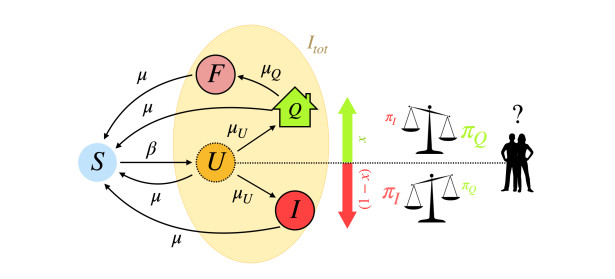
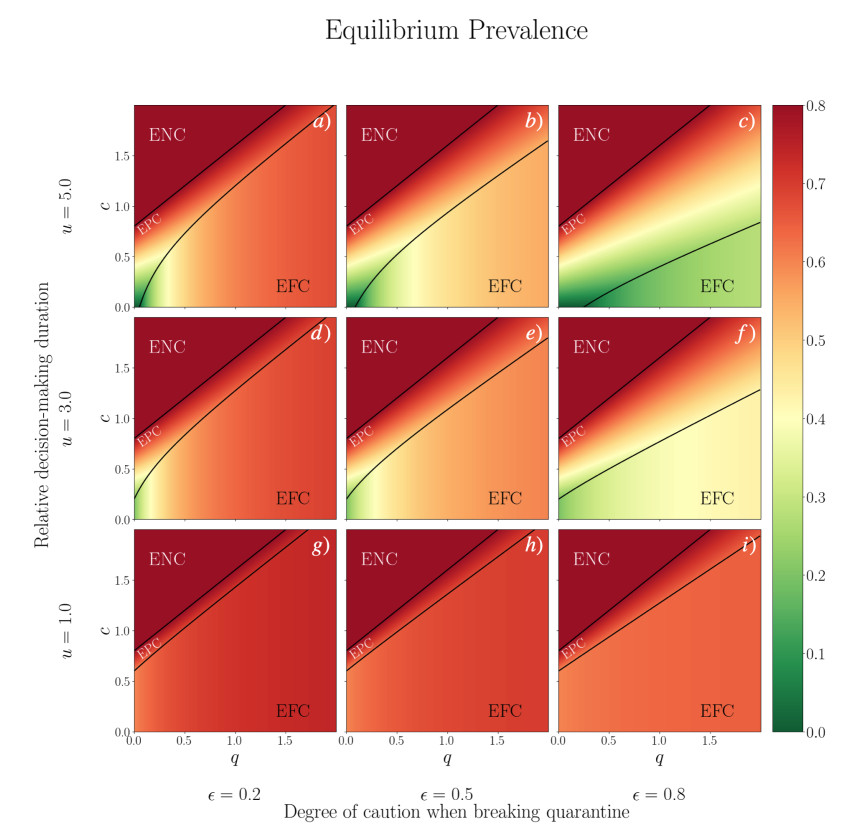
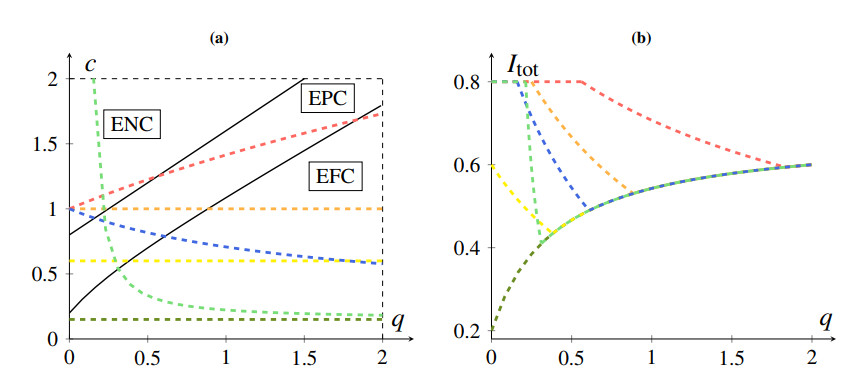
In recent years, numerous advances have been made in understanding how epidemic dynamics are affected by changes in individual behaviors. We propose a Susceptible-Infected-Susceptible (SIS) based compartmental model to tackle the simultaneous and coupled evolution of an outbreak and of the adoption by individuals of the isolation measure. The compliance with self-isolation is described with the help of the imitation dynamics framework. Individuals are incentivized to isolate based on the prevalence and the incidence rate of the outbreak, and are tempted to defy isolation recommendations depending on the duration of the isolation and on the cost of putting social interactions on hold. We are able to derive analytical results on the equilibria of the model under the homogeneous mean-field approximation. Simulating the compartmental model on empirical networks, we also perform a preliminary check of the impact of a network structure on our analytical predictions. We find that the dynamics collapse to surprisingly simple regimes where either the imitation dynamics no longer plays a role or the equilibrium prevalence depends on only two parameters of the model, namely the cost and the relative time spent in isolation. Whether individuals prioritize disease prevalence or incidence as an indicator of the state of the outbreak appears to play no role on the equilibria of the dynamics. However, it turns out that favoring incidence may help to flatten the curve in the transient phase of the dynamics. We also find a fair agreement between our analytical predictions and simulations run on an empirical multiplex network.
Citation: Giulia de Meijere, Hugo Martin. Incentives for self-isolation based on incidence rather than prevalence could help to flatten the curve: A modeling study[J]. Mathematical Biosciences and Engineering, 2026, 23(2): 333-365. doi: 10.3934/mbe.2026014
In recent years, numerous advances have been made in understanding how epidemic dynamics are affected by changes in individual behaviors. We propose a Susceptible-Infected-Susceptible (SIS) based compartmental model to tackle the simultaneous and coupled evolution of an outbreak and of the adoption by individuals of the isolation measure. The compliance with self-isolation is described with the help of the imitation dynamics framework. Individuals are incentivized to isolate based on the prevalence and the incidence rate of the outbreak, and are tempted to defy isolation recommendations depending on the duration of the isolation and on the cost of putting social interactions on hold. We are able to derive analytical results on the equilibria of the model under the homogeneous mean-field approximation. Simulating the compartmental model on empirical networks, we also perform a preliminary check of the impact of a network structure on our analytical predictions. We find that the dynamics collapse to surprisingly simple regimes where either the imitation dynamics no longer plays a role or the equilibrium prevalence depends on only two parameters of the model, namely the cost and the relative time spent in isolation. Whether individuals prioritize disease prevalence or incidence as an indicator of the state of the outbreak appears to play no role on the equilibria of the dynamics. However, it turns out that favoring incidence may help to flatten the curve in the transient phase of the dynamics. We also find a fair agreement between our analytical predictions and simulations run on an empirical multiplex network.

| [1] |
M. Setbon, J. Raude, Factors in vaccination intention against the pandemic influenza a/h1n1, European J. Public Health, 20 (2010), 490–494. https://doi.org/10.1093/eurpub/ckq054 doi: 10.1093/eurpub/ckq054

|
| [2] |
J. Raude, J.-M. Lecrique, L. Lasbeur, C. Leon, R. Guignard, E. du Roscoät, et al., Determinants of preventive behaviors in response to the covid-19 pandemic in france: Comparing the sociocultural, psychosocial, and social cognitive explanations, Front. Psychol., 11 (2020). https://doi.org/10.3389/fpsyg.2020.584500 doi: 10.3389/fpsyg.2020.584500
|
| [3] |
P. Peretti-Watel, V. Seror, S. Cortaredona, O. Launay, J. Raude, P. Verger, et al., Enquête Longitudinale, and for the Coronavirus and Confinement and COCONEL and Study Group, Attitudes about COVID-19 lockdown among general population, France, March 2020, Emerg. Infect. Dis., 27 (2020), 301–303. https://doi.org/10.3201/eid2701.201377 doi: 10.3201/eid2701.201377
|
| [4] |
S. Bartolo, E. Deliege, O. Mancel, P. Dufour, S. Vanderstichele, M. Roumilhac, et al., Determinants of influenza vaccination uptake in pregnancy: A large single-centre cohort study, BMC Pregnancy Childb., 19 (2019). https://doi.org/10.1186/s12884-019-2628-5 doi: 10.1186/s12884-019-2628-5
|
| [5] |
S. C. Montgomery, M. Donnelly, P. Bhatnagar, A. Carlin, F. Kee, R. F. Hunter, Peer social network processes and adolescent health behaviors: A systematic review, Prev. Med., 130 (2020), 105900. https://doi.org/10.1016/j.ypmed.2019.105900 doi: 10.1016/j.ypmed.2019.105900
|
| [6] |
A. Aghaeeyan, P. Ramazi, M. A. Lewis, Revealing decision-making strategies of americans in taking covid-19 vaccination, Bull. Math. Biol., 86 (2024). https://doi.org/10.1007/s11538-024-01290-4 doi: 10.1007/s11538-024-01290-4
|
| [7] |
C. Betsch, F. Renkewitz, T. Betsch, C. Ulshöfer, The influence of vaccine-critical websites on perceiving vaccination risks, J. Health Psychol., 15 (2010). https://doi.org/10.1177/1359105309353647 doi: 10.1177/1359105309353647
|
| [8] |
S. Funk, M. Salathé, V. Jansen, Modelling the influence of human behaviour on the spread of infectious diseases: A review, J. R. Soc. Interface, 7 (2010). https://doi.org/10.1098/rsif.2010.0142 doi: 10.1098/rsif.2010.0142
|
| [9] |
S. Funk, S. Bansal, C. T. Bauch, K. T. Eames, W. J. Edmunds, A. P. Galvani, et al., Nine challenges in incorporating the dynamics of behaviour in infectious diseases models, Epidemics, 10 (2015), 21–25. https://doi.org/10.1016/j.epidem.2014.09.005 doi: 10.1016/j.epidem.2014.09.005
|
| [10] |
F. Verelst, L. Willem, P. Beutels, Behavioural change models for infectious disease transmission: A systematic review (2010–2015), J. R. Soc. Interface, 13 (2016), 20160820. https://doi.org/10.1098/rsif.2016.0820 doi: 10.1098/rsif.2016.0820
|
| [11] |
S. L. Chang, M. Piraveenan, P. Pattison, M. Prokopenko, Game theoretic modelling of infectious disease dynamics and intervention methods: A review, J. Biol. Dyn., 14 (2020), 57–89. https://doi.org/10.1080/17513758.2020.1720322 doi: 10.1080/17513758.2020.1720322
|
| [12] |
L. LeJeune, N. Ghaffarzadegan, L. M. Childs, O. Saucedo, Formulating human risk response in epidemic models: Exogenous vs endogenous approaches, Eur. J. Oper. Res., 324 (2025), 246–258. https://doi.org/10.1016/j.ejor.2025.01.004 doi: 10.1016/j.ejor.2025.01.004
|
| [13] |
Z. Wang, M. A. Andrews, Z.-X. Wu, L. Wang, C. T. Bauch, Coupled disease–behavior dynamics on complex networks: A review, Phys. Life Rev., 15 (2015), 1–29. https://doi.org/10.1016/j.plrev.2015.07.006 doi: 10.1016/j.plrev.2015.07.006
|
| [14] |
A. Reitenbach, F. Sartori, S. Banisch, A. Golovin, A. Calero Valdez, M. Kretzschmar, et al., Coupled infectious disease and behavior dynamics. A review of model assumptions, Rep. Prog. Phys., 88 (2024), 016601. https://dx.doi.org/10.1088/1361-6633/ad90ef doi: 10.1088/1361-6633/ad90ef
|
| [15] |
D. Weston, K. Hauck, R. Amlôt, Infection prevention behaviour and infectious disease modelling: A review of the literature and recommendations for the future, BMC Public Health, 18 (2018), 336. https://doi.org/10.1186/s12889-018-5223-1 doi: 10.1186/s12889-018-5223-1
|
| [16] |
A. Hamilton, F. Haghpanah, A. Tulchinsky, N. Kipshidze, S. Poleon, G. Lin, et al., Incorporating endogenous human behavior in models of covid-19 transmission: A systematic scoping review, Dialogues Health, 4 (2024), 100179. https://doi.org/10.1016/j.dialog.2024.100179 doi: 10.1016/j.dialog.2024.100179
|
| [17] |
J. Bedson, L. Skrip, D. Pedi, S. Abramowitz, S. Carter, M. Jalloh, et al., A review and agenda for integrated disease models including social and behavioural factors, Nat. Hum. Behav., 5 (2021), 834–846. https://doi.org/10.1038/s41562-021-01136-2 doi: 10.1038/s41562-021-01136-2
|
| [18] | A. D'Onofrio, P. Manfredi, Modeling the Interplay Between Human Behavior and the Spread of Infectious Diseases, Springer, 2013. https://doi.org/10.1007/978-1-4614-5474-8 |
| [19] | J. Tanimoto, Sociophysics approach to epidemics, Evolutionary Economics and Social Complexity Science, Springer, Singapore, 2021. https://doi.org/10.1007/978-981-33-6481-3 |
| [20] | K. S. Josef Hofbauer, The theory of evolution and dynamical systems: Mathematical aspects of selection, Cambridge Univ. Press, 1988. |
| [21] |
C. T. Bauch, Imitation dynamics predict vaccinating behaviour, Proc. R. Soc. B., 272 (2005), 1669–1675. https://doi.org/10.1098/rspb.2005.3153 doi: 10.1098/rspb.2005.3153
|
| [22] |
T. Oraby, V. Thampi, C. T. Bauch, The influence of social norms on the dynamics of vaccinating behaviour for paediatric infectious diseases, Proc. R. Soc. B Biol. Sci., 281 (2014), 20133172. https://doi.org/10.1098/rspb.2013.3172 doi: 10.1098/rspb.2013.3172
|
| [23] |
S. L. Chang, M. Piraveenan, M. Prokopenko, The effects of imitation dynamics on vaccination behaviours in SIR-network model, Int. J. Environ. Res. Public Health, 16 (2019), 2477. https://doi.org/10.3390/ijerph16142477 doi: 10.3390/ijerph16142477
|
| [24] |
Q. Yin, Z. Wang, C. Xia, C. T. Bauch, Impact of co-evolution of negative vaccine-related information, vaccination behavior and epidemic spreading in multilayer networks, Commun. Nonlinear Sci. Numer. Simulat., 109 (2022), 106312. https://doi.org/10.1016/j.cnsns.2022.106312 doi: 10.1016/j.cnsns.2022.106312
|
| [25] |
M. M.-U.-R. Khan, J. Tanimoto, Influence of waning immunity on vaccination decision-making: A multi-strain epidemic model with an evolutionary approach analyzing cost and efficacy, Infect. Dis. Model., 9 (2024), 657–672. https://doi.org/10.1016/j.idm.2024.03.004 doi: 10.1016/j.idm.2024.03.004
|
| [26] |
P. Poletti, B. Caprile, M. Ajelli, A. Pugliese, S. Merler, Spontaneous behavioural changes in response to epidemics, J. Theor. Biol., 260 (2009). https://doi.org/10.1016/j.jtbi.2009.04.029 doi: 10.1016/j.jtbi.2009.04.029
|
| [27] |
S. Zhao, L. Stone, D. Gao, S. S. Musa, M. K. C. Chong, D. He, et al., Imitation dynamics in the mitigation of the novel coronavirus disease (covid-19) outbreak in Wuhan, China from 2019 to 2020, Ann. Transl. Med., 8 (2020). https://doi.org/10.21037/atm.2020.03.168 doi: 10.21037/atm.2020.03.168
|
| [28] |
N. T. Maia Martcheva, C. N. Ngonghala, Effects of social-distancing on infectious disease dynamics: An evolutionary game theory and economic perspective, J. Biol. Dyn., 15 (2021), 342–366. https://doi.org/10.1080/17513758.2021.1946177 doi: 10.1080/17513758.2021.1946177
|
| [29] |
J. Cascante-Vega, S. Torres-Florez, J. Cordovez, M. Santos-Vega, How disease risk awareness modulates transmission: Coupling infectious disease models with behavioural dynamics, R. Soc. Open Sci., 9 (2022), 210803. https://doi.org/10.1098/rsos.210803 doi: 10.1098/rsos.210803
|
| [30] |
A. Kabir, T. Risa, J. Tanimoto, Prosocial behavior of wearing a mask during an epidemic: An evolutionary explanation, Sci. Rep., 11 (2021), 12621. https://doi.org/10.1038/s41598-021-92094-2 doi: 10.1038/s41598-021-92094-2
|
| [31] |
A. Traulsen, S. A. Levin, C. M. Saad-Roy, Individual costs and societal benefits of interventions during the Covid-19 pandemic, Proc. Natl. Acad. Sci. U.S.A., 120 (2023), e2303546120. https://doi.org/10.1073/pnas.2303546120 doi: 10.1073/pnas.2303546120
|
| [32] |
M. Asfaw, B. Buonomo, S. Kassa, Impact of human behavior on itns control strategies to prevent the spread of vector borne diseases, Atti. Accad. Pelorit. Pericol., Cl. Sci. Fis. Mat. Nat., 96 (2018), 2. https://doi.org/10.1478/AAPP.96S3A2 doi: 10.1478/AAPP.96S3A2
|
| [33] | H. Martin, F. Castella, F. Hamelin, Wearing face masks to protect oneself and/or others: Counter-intuitive results from a simple epidemic model accounting for selfish and altruistic human behaviour, submitted for publication. |
| [34] |
C. M. Peak, L. M. Childs, Y. H. Grad, C. O. Buckee, Comparing nonpharmaceutical interventions for containing emerging epidemics, Proc. Natl. Acad. Sci. U.S.A., 114 (2017), 4023–4028. https://doi.org/10.1073/pnas.1616438114 doi: 10.1073/pnas.1616438114
|
| [35] |
R. Tori, J. Tanimoto, A study on prosocial behavior of wearing a mask and self-quarantining to prevent the spread of diseases underpinned by evolutionary game theory, Chaos Soliton. Fract., 158 (2022), 112030. https://doi.org/10.1016/j.chaos.2022.112030 doi: 10.1016/j.chaos.2022.112030
|
| [36] |
C. Eksin, J. S. Shamma, J. S. Weitz, Disease dynamics in a stochastic network game: A little empathy goes a long way in averting outbreaks, Sci. Rep., 7 (2017), 44122. http://dx.doi.org/10.1038/srep44122 doi: 10.1038/srep44122
|
| [37] |
R. Zhang, B. Xie, Y. Kang, M. Liu, Modeling and analyzing quarantine strategies of epidemic on two-layer networks: Game theory approach, J. Biol. Sys., 31 (2023), 21–35. https://doi.org/10.1142/S021833902350002X doi: 10.1142/S021833902350002X
|
| [38] |
G. de Meijere, V. Colizza, E. Valdano, C. Castellano, Effect of delayed awareness and fatigue on the efficacy of self-isolation in epidemic control, Phys. Rev. E, 104 (2021), 044316. https://doi.org/10.1103/PhysRevE.104.044316 doi: 10.1103/PhysRevE.104.044316
|
| [39] |
H. Hethcote, M. Zhien, L. Shengbing, Effects of quarantine in six endemic models for infectious diseases, Math. Biosci., 180 (2002), 141–160. https://doi.org/10.1016/S0025-5564(02)00111-6 doi: 10.1016/S0025-5564(02)00111-6
|
| [40] |
S. Chen, M. Small, X. Fu, Global stability of epidemic models with imperfect vaccination and quarantine on scale-free networks, IEEE Trans. Netw. Sci. Eng., 7 (2019), 1583–1596. https://doi.org/10.1109/TNSE.2019.2942163 doi: 10.1109/TNSE.2019.2942163
|
| [41] |
A. Petherick, R. Goldszmidt, E. B. Andrade, R. Furst, T. Hale, A. Pott, et al., A worldwide assessment of changes in adherence to covid-19 protective behaviours and hypothesized pandemic fatigue, Nat. Hum. Behav., 5 (2021), 1145–1160. https://doi.org/10.1038/s41562-021-01181-x doi: 10.1038/s41562-021-01181-x
|
| [42] |
X. He, E. H. Y. Lau, P. Wu, X. Deng, J. Wang, X. Hao, et al., Temporal dynamics in viral shedding and transmissibility of COVID-19, Nat. Med., 26 (2020), 672–675. https://doi.org/10.1038/s41591-020-0869-5. doi: 10.1038/s41591-020-0869-5
|
| [43] |
A. Marc, M. Kerioui, F. Blanquart, J. Bertrand, O. Mitjà, M. Corbacho-Monné, et al., Quantifying the relationship between sars-cov-2 viral load and infectiousness, eLife, 10 (2021), e69302. https://doi.org/10.7554/eLife.69302 doi: 10.7554/eLife.69302
|
| [44] | P. J. White, Mathematical models in infectious disease epidemiology, in Infect. Dis. (Fourth Edition) (eds. J. Cohen, W. G. Powderly and S. M. Opal), fourth edition edition. Elsevier, 2017, 49–53. https://doi.org/10.1016/B978-0-7020-6285-8.00005-8 |
| [45] | P.-A. Bliman, A. Carrozzo-Magli, A. D'Onofrio, P. Manfredi, Tiered social distancing policies and epidemic control, Proc. R. Soc. A, 478 (2022). https://doi.org/10.1098/rspa.2022.0175 |
| [46] |
M. A. Amaral, M. M. de Oliveira, M. A. Javarone, An epidemiological model with voluntary quarantine strategies governed by evolutionary game dynamics, Chaos Soliton. Fract., 143 (2021), 110616. https://doi.org/10.1016/j.chaos.2020.110616 doi: 10.1016/j.chaos.2020.110616
|
| [47] | R. M. Anderson, R. M. May, Infectious Diseases of Humans: Dynamics and Control, Oxford University Press, 1991. |
| [48] |
L.-S. Young, S. Ruschel, S. Yanchuk, T. Pereira, Consequences of delays and imperfect implementation of isolation in epidemic control, Sci. Rep., 9 (2019), 3505. https://doi.org/10.1038/s41598-019-39714-0 doi: 10.1038/s41598-019-39714-0
|
| [49] |
X.-B. Zhang, H.-F. Huo, H. Xiang, Q. Shi, D. Li, The threshold of a stochastic siqs epidemic model, Phys. A, 482 (2017), 362–374. https://doi.org/10.1016/j.physa.2017.04.100 doi: 10.1016/j.physa.2017.04.100
|
| [50] |
M. Mancastroppa, R. Burioni, V. Colizza, A. Vezzani, Active and inactive quarantine in epidemic spreading on adaptive activity-driven networks, Phys. Rev. E, 102 (2020), 020301. https://doi.org/10.1103/PhysRevE.102.020301 doi: 10.1103/PhysRevE.102.020301
|
| [51] |
M. N. Mbah, J. Liu, C. Bauch, Y. Tekel, J. Medlock, L. A. Meyers, et al., The impact of imitation on vaccination behavior in social contact networks, PLoS Comput. Biol., 8 (2012), e1002469. https://doi.org/10.1371/journal.pcbi.1002469 doi: 10.1371/journal.pcbi.1002469
|
| [52] |
P. van den Driessche, Reproduction numbers of infectious disease models, Infect. Dis. Model., 2 (2017), 288–303. http://dx.doi.org/10.1016/j.idm.2017.06.002 doi: 10.1016/j.idm.2017.06.002
|
| [53] |
Y. Alimohamadi, M. Taghdir, M. Sepandi, Estimate of the basic reproduction number for covid-19: A systematic review and meta-analysis, J. Prev. Med. Public Health, 53 (2020), 151–157. http://dx.doi.org/10.3961/jpmph.20.076 doi: 10.3961/jpmph.20.076
|
| [54] |
D. Leith, C. L'Orange, J. Volckens, Quantitative protection factors for common masks and face coverings, Environ. Sci. Technol., 55 (2021), 3136–3143. https://doi.org/10.1021/acs.est.0c07291 doi: 10.1021/acs.est.0c07291
|
| [55] |
X. Q. Koh, A. Sng, J. Y. Chee, A. Sadovoy, P. Luo, D. Daniel, Outward and inward protection efficiencies of different mask designs for different respiratory activities, Aerosol. Sci., 160 (2022), 105905. https://doi.org/10.1016/j.jaerosci.2021.105905 doi: 10.1016/j.jaerosci.2021.105905
|
| [56] |
W. Cota, S. C. Ferreira, Optimized gillespie algorithms for the simulation of markovian epidemic processes on large and heterogeneous networks, Comput. Phys. Commun., 219 (2017). https://doi.org/10.1016/j.cpc.2017.06.007 doi: 10.1016/j.cpc.2017.06.007
|
| [57] |
S. C. Ferreira, C. Castellano, R. Pastor-Satorras, Epidemic thresholds of the susceptible-infected-susceptible model on networks: A comparison of numerical and theoretical results, Phys. Rev. E, 86 (2012), 041125. https://doi.org/10.1103/PhysRevE.86.041125 doi: 10.1103/PhysRevE.86.041125
|
| [58] |
Z. Qiu, B. Espinoza, V. V. Vasconcelos, C. Chen, S. M. Constantino, S. A. Crabtree, et al., Understanding the coevolution of mask wearing and epidemics: A network perspective, Proc. Natl. Acad. Sci. U.S.A., 119 (2022), e2123355119. http://dx.doi.org/10.1073/pnas.2123355119 doi: 10.1073/pnas.2123355119
|
| [59] |
P. Sapiezynski, A. Stopczynski, D. D. Lassen, S. Lehmann, Interaction data from the copenhagen networks study, Sci. Data, 6 (2019), 315. https://doi.org/10.1038/s41597-019-0325-x doi: 10.1038/s41597-019-0325-x
|
| [60] | T. P. Peixoto, The netzschleuder network catalogue and repository, 2020, Available from: https://networks.skewed.de/ |
| [61] |
F. Wu, X. Liang, J. Lei, Modelling Covid-19 epidemic with confirmed cases-driven contact tracing quarantine, Infect. Dis. Model., 8 (2023), 415–426. https://doi.org/10.1016/j.idm.2023.04.001 doi: 10.1016/j.idm.2023.04.001
|
| [62] |
R. Della Marca, N. Loy, A. Tosin, An SIR model with viral load-dependent transmission, J. Math. Biol., 86 (2023), 61. https://doi.org/10.1007/s00285-023-01901-z doi: 10.1007/s00285-023-01901-z
|
| [63] |
A. d'Onofrio, P. Manfredi, E. Salinelli, Vaccinating behaviour, information, and the dynamics of sir vaccine preventable diseases, Theor. Popul. Biol., 71 (2007). https://doi.org/10.1016/j.tpb.2007.01.001 doi: 10.1016/j.tpb.2007.01.001
|
| [64] |
Y. N. Kyrychko, K. B. Blyuss, Vaccination games and imitation dynamics with memory, Chaos, 33 (2023), 033134. https://doi.org/10.1063/5.0143184 doi: 10.1063/5.0143184
|
| [65] |
P. Verma, V. Kumar, S. Bhattacharyya, Modelling behavioural interactions in infection disclosure during an outbreak: An evolutionary game theory approach, Math. Biosci. Eng., 22 (2025), 1931–1955. https://doi.org/10.3934/mbe.2025070 doi: 10.3934/mbe.2025070
|
| [66] |
D. H. Silva, C. Anteneodo, S. C. Ferreira, Epidemic outbreaks with adaptive prevention on complex networks, Commun. Nonlinear Sci. Numer. Simulat., 116 (2023), 106877. https://doi.org/10.1016/j.cnsns.2022.106877 doi: 10.1016/j.cnsns.2022.106877
|
| [67] |
M. Banerjee, V. Volpert, P. Manfredi, A. d'Onofrio, Behavior-induced phase transitions with far from equilibrium patterning in a sis epidemic model: Global vs non-local feedback, Phys. D, 469 (2024), 134316. https://doi.org/10.1016/j.physd.2024.134316 doi: 10.1016/j.physd.2024.134316
|
| [68] |
B. Mønsted, P. Sapieżyński, E. Ferrara, S. Lehmann, Evidence of complex contagion of information in social media: An experiment using twitter bots, PLoS ONE, 12 (2017), e0184148. https://doi.org/10.1371/journal.pone.0184148 doi: 10.1371/journal.pone.0184148
|
| [69] |
D. A. Sprague, T. House, Evidence for complex contagion models of social contagion from observational data, PLoS ONE, 12 (2017), e0180802. https://doi.org/10.1371/journal.pone.0180802 doi: 10.1371/journal.pone.0180802
|
| [70] |
Z. He, C. T. Bauch, Effect of homophily on coupled behavior-disease dynamics near a tipping point, Math. Biosci., 376 (2024), 109264. https://doi.org/10.1016/j.mbs.2024.109264 doi: 10.1016/j.mbs.2024.109264
|
| [71] | L. Allen, An Introduction to Mathematical Biology, Pearson/Prentice Hall, 2007. |
Figures(7) / Tables(2)

Giulia de Meijere, Hugo Martin. Incentives for self-isolation based on incidence rather than prevalence could help to flatten the curve: A modeling study[J]. Mathematical Biosciences and Engineering, 2026, 23(2): 333-365. doi: 10.3934/mbe.2026014





 DownLoad: