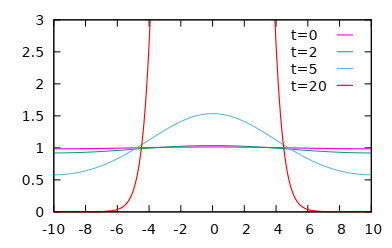
A wide variety of works exists on the dynamics of large populations, ranging from simple heuristic modeling to those based on advanced computer-supported methods. However, their interconnections remain mostly vague, which, in particular, limits the effectiveness of computer methods in this domain. In this work, we propose and justify the following concept. Typically, the description of the population dynamics is based on the sole use of low-order correlations. As we demonstrate here, in important cases, where the local population structure is shaped by strong interactions, higher-order correlations become essential. To verify when one can or cannot rely on studying low-order correlations only, we suggest to explicitly use probability measures as micro-states. Among such states may be those whose adequate characterization is based on their low-order correlation functions. In particular, this is the case for sub-Poissonian states where the large $ n $ asymptotics of the probability of finding $ n $ particles in a given vessel is similar to that for non-interacting entities, which can completely be described by the density of the particles. To illustrate this concept, a general individual-based model of an infinite population of interacting entities is analyzed. The evolution of this model preserves the sub-Poissonian states, which allows one to describe it through the correlation functions of such states for which a chain of evolution equations is obtained. The corresponding kinetic equation is derived, numerically solved, and analyzed.
Citation: Yuri Kozitsky, Krzysztof Pilorz. On the statistical description of large populations[J]. Mathematical Biosciences and Engineering, 2026, 23(2): 312-332. doi: 10.3934/mbe.2026013
A wide variety of works exists on the dynamics of large populations, ranging from simple heuristic modeling to those based on advanced computer-supported methods. However, their interconnections remain mostly vague, which, in particular, limits the effectiveness of computer methods in this domain. In this work, we propose and justify the following concept. Typically, the description of the population dynamics is based on the sole use of low-order correlations. As we demonstrate here, in important cases, where the local population structure is shaped by strong interactions, higher-order correlations become essential. To verify when one can or cannot rely on studying low-order correlations only, we suggest to explicitly use probability measures as micro-states. Among such states may be those whose adequate characterization is based on their low-order correlation functions. In particular, this is the case for sub-Poissonian states where the large $ n $ asymptotics of the probability of finding $ n $ particles in a given vessel is similar to that for non-interacting entities, which can completely be described by the density of the particles. To illustrate this concept, a general individual-based model of an infinite population of interacting entities is analyzed. The evolution of this model preserves the sub-Poissonian states, which allows one to describe it through the correlation functions of such states for which a chain of evolution equations is obtained. The corresponding kinetic equation is derived, numerically solved, and analyzed.

| [1] |
B. M. Bolker, S. W. Pacala, Using moment equations to understand stochastically driven spatial pattern formation in ecological systems, Theor. Popul. Biol., 52 (1997), 179–197. https://doi.org/10.1006/tpbi.1997.1331 doi: 10.1006/tpbi.1997.1331

|
| [2] | C. Neuhauser, Mathematical challenges in spatial ecology, Notices Amer. Math. Soc., 48 (2001), 1304–1314. |
| [3] |
B. M. Bolker, S. W. Pacala, C. Neuhauser, Spatial dynamics in model plant communities: What do we really know?, Am. Soc. Nat., 162 (2003), 135–148. https://doi.org/10.1086/376575 doi: 10.1086/376575
|
| [4] |
D. J. Murrell, U. Dieckmann, R. Law, On moment closures for population dynamics in continuous space, J. Theor. Biol., 229 (2004), 421–432. https://doi.org/10.1016/j.jtbi.2004.04.013 doi: 10.1016/j.jtbi.2004.04.013
|
| [5] | N. Bellomo, S. Stöcker, Development of Boltzmann models in mathematical biology, in Modeling in Applied Sciences, Birkhäuser Boston, Boston, MA, (2000), 225–262. |
| [6] | D. Burini, L. Gibelli, N. Outada, A kinetic theory approach to the modeling of complex living systems, in Active Particles, Birkhäuser, Cham, (2017), 229–258. |
| [7] |
N. Bellomo, D. Knopoff, J. Soler, On the difficult interplay between life, "complexity", and mathematical sciences, Math. Models Methods Appl. Sci., 23 (2013), 1861–1913. https://doi.org/10.1142/S021820251350053X doi: 10.1142/S021820251350053X
|
| [8] | L. Pareschi, G. Toscani, Interacting Multiagent Systems: Kinetic Equations and Monte Carlo Methods, Oxford University Press, Oxford, 2014. |
| [9] |
G. Dimarco, B. Perthame. G. Toscani, M. Zanella, Kinetic models for epidemic dynamics with social heterogeneity, J. Math. Biol., 83 (2021), 1–32. https://doi.org/10.1007/s00285-021-01630-1 doi: 10.1007/s00285-021-01630-1
|
| [10] |
A. Bodesan, M. Menale, G. Toscani, M. Zanella, Lotka-Volterra-type kinetic equations for interacting species, Nonlinearity, 38 (2025), 075026. https://doi.org/10.1088/1361-6544/addfa1 doi: 10.1088/1361-6544/addfa1
|
| [11] |
A. M. Etheridge, Survival and extinction in a locally regulated population, Ann. Appl. Probab., 14 (2004), 188–214. https://doi.org/10.1214/aoap/1075828051 doi: 10.1214/aoap/1075828051
|
| [12] |
N. Fournier, S. Méléard, A microscopic probabilistic description of a locally regulated population and macroscopic approximations, Ann. Appl. Probab., 14 (2004), 1880–1919. https://doi.org/10.1214/105051604000000882 doi: 10.1214/105051604000000882
|
| [13] |
O. Ovaskainen, B. Meerson, Stochastic models of population extinction, Trends Ecol. Evol., 25 (2010), 643–652. https://doi.org/10.1016/j.tree.2010.07.009 doi: 10.1016/j.tree.2010.07.009
|
| [14] |
S. J. Cornell, Y. F. Suprunenko, D. Finkelshtein, P. Somervuo, O. Ovaskainen, A unified framework for analysis of individual-based models in ecology and beyond, Nat. Commun., 10 (2019), 4716. https://doi.org/10.1038/s41467-019-12172-y doi: 10.1038/s41467-019-12172-y
|
| [15] |
O. Ovaskainen, P. Somervuo, D. Finkelshtein, A general mathematical method for predicting spatio-temporal correlations emerging from agent-based models, J. R. Soc. Interface, 17 (2020), 20200655. https://doi.org/10.1098/rsif.2020.0655 doi: 10.1098/rsif.2020.0655
|
| [16] | S. Molchanov, J. Whitmeyer, Spatial models of population processes, in Modern Problems of Stochastic Analysis and Statistics, Springer International Publishing, (2016), 435–454. https://doi.org/10.1007/978-3-319-65313-6_17 |
| [17] |
D. L. DeAngelis, W. M. Mooij, Individual-based modeling of ecological and evolutionary processes, Ann. Rev. Ecol. Evol. Syst., 36 (2005), 147–168. https://doi.org/10.1146/annurev.ecolsys.36.102003.152644 doi: 10.1146/annurev.ecolsys.36.102003.152644
|
| [18] |
D. Finkelshtein, Y. Kondratiev, O. Kutoviy, Individual based model with competition in spatial ecology, SIAM J. Math. Anal., 41 (2009), 297–317. https://doi.org/10.1137/080719376 doi: 10.1137/080719376
|
| [19] | B. Simon, The Statistical Mechanics of Lattice Gases, Vol. I, Princeton University Press, Princeton, NJ, 1993. https://doi.org/10.1515/9781400863433 |
| [20] | R. L. Dobrushin, Y. G. Sinai, Y. M. Sukhov, Dynamical systems of statistical mechanics, in Dynamical Systems II. Encyclopaedia of Mathematical Sciences, Springer, (1989), 197–211. |
| [21] |
Y. Kondratiev, Y. Kozitsky, The evolution of states in a spatial population model, J. Dyn. Differ. Equations, 30 (2018), 135–173. https://doi.org/10.1007/s10884-016-9526-6 doi: 10.1007/s10884-016-9526-6
|
| [22] |
Y. Kozitsky, Evolution of infinite populations of immigrants: Micro- and mesoscopic description, J. Math. Anal. Appl., 477 (2019), 294–333. https://doi.org/10.1016/j.jmaa.2019.04.033 doi: 10.1016/j.jmaa.2019.04.033
|
| [23] |
I. Omelyan, Y. Kozitsky, Spatially inhomogeneous population dynamics: Beyond the mean field approximation, J. Phys. A, 52 (2019), 305601, 18. https://doi.org/10.1088/1751-8121/ab2808 doi: 10.1088/1751-8121/ab2808
|
| [24] |
Y. Kozitsky, An interplay between attraction and repulsion in infinite populations, Anal. Math. Phys., 11 (2021). https://doi.org/10.1007/s13324-021-00580-7 doi: 10.1007/s13324-021-00580-7
|
| [25] |
Y. Kozitsky, I. Omelyan, K. Pilorz, Jumps and coalescence in the continuum: A numerical study, Appl. Math. Comput., 390 (2021), 125610. https://doi.org/10.1016/j.amc.2020.125610 doi: 10.1016/j.amc.2020.125610
|
| [26] |
A. Ben-Naim, The kirkwood superposition approximation, revisited and reexamined, J. Adv. Chem., 1 (2013), 27–35. https://doi.org/10.24297/jac.v1i1.838 doi: 10.24297/jac.v1i1.838
|
| [27] |
D. Ruelle, Superstable interactions in classical statistical mechanics, Commun. Math. Phys., 18 (1970), 127–159. https://doi.org/10.1007/BF01646091 doi: 10.1007/BF01646091
|
| [28] |
D. Ruelle, Existence of a phase transition in a continuous classical system, Phys. Rev. Lett., 27 (1971), 1040–1041. https://doi.org/10.1103/PhysRevLett.27.1040 doi: 10.1103/PhysRevLett.27.1040
|
| [29] | D. J. Daley, D. Vere-Jones, An Introduction To the Theory of Point Processes: Volume I: Elementary Theory and Methods, 2nd edition, Springer-Verlag, New York, 2003. |
| [30] |
A. Lenard, Correlation functions and the uniqueness of the state in classical statistical mechanics, Commun. Math. Phys., 30 (1973), 35–44. https://doi.org/10.1007/BF01646686 doi: 10.1007/BF01646686
|
| [31] | L. Klebanov, Heavy Tailed Distributions, MatfyzPress, Prague, 2003. |
| [32] |
D. E. Weidemann, J. Holehouse, A. Singh, S. Hauf, The minimal intrinsic stochasticity of constitutively expressed eukaryotic genes is sub-Poissonian, Sci. Adv., 9 (2023), eadh5138. https://doi.org/10.1126/sciadv.adh5138 doi: 10.1126/sciadv.adh5138
|
| [33] |
L. Davidovich, Sub-Poissonian processes in quantum optics, Rev. Mod. Phys., 68 (1996), 127–173. https://doi.org/10.1103/RevModPhys.68.127 doi: 10.1103/RevModPhys.68.127
|
| [34] | J. Riordan, Combinatorial Identities, John Wiley & Sons, Inc., New York-London-Sydney, 1968. |
| [35] |
K. N. Boyadzhiev, Exponential polynomials, Stirling numbers, and evaluation of some gamma integrals, Abstr. Appl. Anal., 2009 (2009), 168672. https://doi.org/10.1155/2009/168672 doi: 10.1155/2009/168672
|
| [36] | B. C. Berndt, Ramanujan reaches his hand from his grave to snatch your theorems from you, Asia Pac. Math. Newsl., 1 (2011), 8–13. |
| [37] | N. G. de Bruijn, Asymptotic Methods in Analysis, 3rd edition, Dover Publications, Inc., New York, 1981. |
| [38] |
R. E. Baker, M. J. Simpson, Correcting mean-field approximations for birth-death-movement processes, Phys. Rev. E, 82 (2010), 041905. https://doi.org/10.1103/PhysRevE.82.041905 doi: 10.1103/PhysRevE.82.041905
|
Figures(5)

Yuri Kozitsky, Krzysztof Pilorz. On the statistical description of large populations[J]. Mathematical Biosciences and Engineering, 2026, 23(2): 312-332. doi: 10.3934/mbe.2026013





 DownLoad: