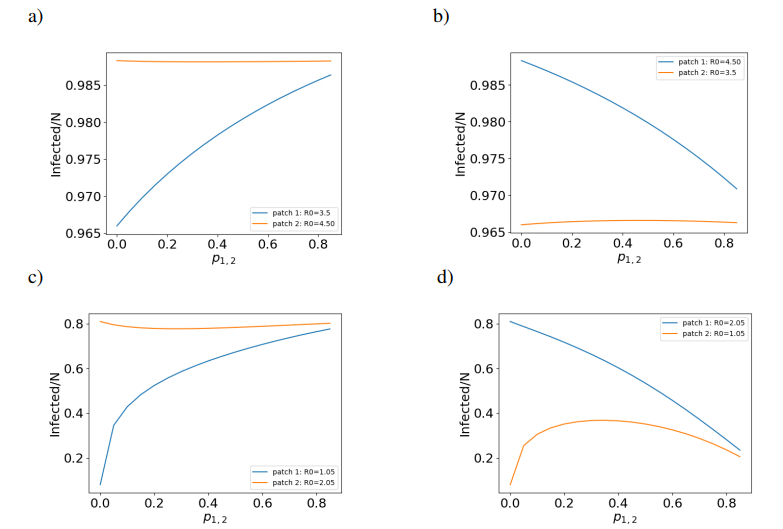
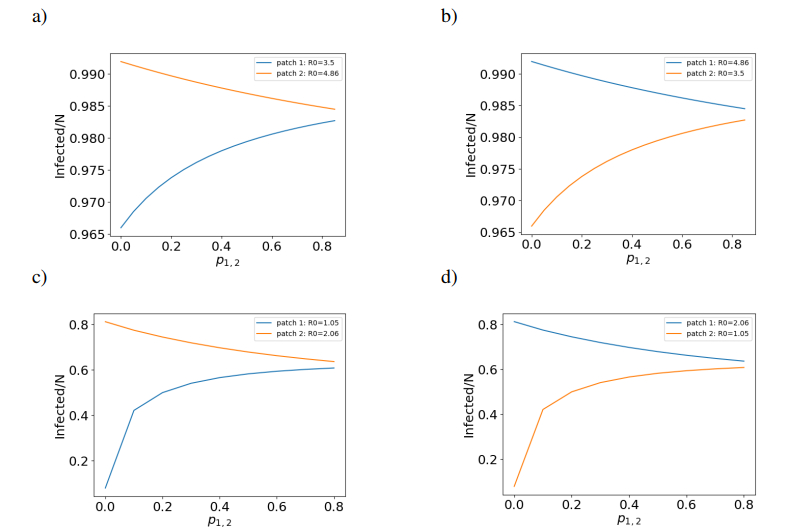
Epidemic severity indices that incorporate disease information are essential tools for decision-makers, as these indices allow the design and evaluation of possible control strategies in advance of implementation in susceptible populations. In spatially structured settings, indices that consider human mobility provide valuable information on the spread of infectious diseases and the potential impact of mobility restrictions during outbreaks. In this context, the final epidemic size in metapopulation models serves as an effective measure of outbreak severity in geographical terms. However, the existence and uniqueness of the solution to the corresponding equation have only been established in particular cases. In this study, we derived conditions that guarantee the existence and uniqueness of the solution to the final epidemic size equation in a SIR-type metapopulation model. We also conducted a sensitivity analysis in a two-region, unidirectional infection scenario, which allowed us to examine the effects of mobility between an infected region and a susceptible one. Our results indicate that, under relatively simple conditions, restricting mobility can help contain outbreaks. However, we also identified situations in which mobility is not detrimental and may even be beneficial. These findings provide a preliminary framework for assessing the appropriateness of mobility restrictions during infectious disease outbreaks in spatially structured regions.
Citation: Uvencio José Giménez-Mujica, Oziel Gómez-Martínez, Jorge Velázquez-Castro, Ignacio Barradas, Andrés Fraguela-Collar. Local epidemic control through mobility restrictions[J]. Mathematical Biosciences and Engineering, 2026, 23(2): 291-311. doi: 10.3934/mbe.2026012
Epidemic severity indices that incorporate disease information are essential tools for decision-makers, as these indices allow the design and evaluation of possible control strategies in advance of implementation in susceptible populations. In spatially structured settings, indices that consider human mobility provide valuable information on the spread of infectious diseases and the potential impact of mobility restrictions during outbreaks. In this context, the final epidemic size in metapopulation models serves as an effective measure of outbreak severity in geographical terms. However, the existence and uniqueness of the solution to the corresponding equation have only been established in particular cases. In this study, we derived conditions that guarantee the existence and uniqueness of the solution to the final epidemic size equation in a SIR-type metapopulation model. We also conducted a sensitivity analysis in a two-region, unidirectional infection scenario, which allowed us to examine the effects of mobility between an infected region and a susceptible one. Our results indicate that, under relatively simple conditions, restricting mobility can help contain outbreaks. However, we also identified situations in which mobility is not detrimental and may even be beneficial. These findings provide a preliminary framework for assessing the appropriateness of mobility restrictions during infectious disease outbreaks in spatially structured regions.

| [1] |
N.-N. Wang, Y.-J. Wang, S.-H. Qiu, Z.-R. Di, Epidemic spreading with migration in networked metapopulation, Commun. Nonlinear Sci. Numer. Simul., 109 (2022), 106260. https://doi.org/10.1016/j.cnsns.2022.106260 doi: 10.1016/j.cnsns.2022.106260

|
| [2] |
F. Brauer, Mathematical epidemiology: Past, present, and future, Infect. Disease Model., 2 (2017), 113–127. https://doi.org/10.1016/j.idm.2017.02.001 doi: 10.1016/j.idm.2017.02.001
|
| [3] |
Y. Yan, A. A. Malik, J. Bayham, E. P. Fenichel, C. Couzens, S. B. Omer, Measuring voluntary and policy-induced social distancing behavior during the COVID-19 pandemic, Proc. Natl. Acad. Sci. U.S.A., 118 (2021), e2008814118. https://doi.org/10.1073/pnas.2008814118 doi: 10.1073/pnas.2008814118
|
| [4] |
C. Fraser, C. A. Donnelly, S. Cauchemez, W. P. Hanage, M. D. Van Kerkhove, T. D. Hollingsworth, et al., Pandemic potential of a strain of influenza A (H1N1): Early findings, Science, 324 (2009), 1557–1561. https://doi.org/10.1126/science.1176062 doi: 10.1126/science.1176062
|
| [5] |
J. Lee, B. Y. Choi, E. Jung, Metapopulation model using commuting flow for national spread of the 2009 H1N1 influenza virus in the Republic of Korea, J. Theor. Biol., 454 (2018), 320–329. https://doi.org/10.1016/j.jtbi.2018.06.016 doi: 10.1016/j.jtbi.2018.06.016
|
| [6] |
K. M. Angelo, P. A. Gastañaduy, A. T. Walker, M. Patel, S. Reef, C. Virginia Lee, et al., Spread of measles in Europe and implications for US travelers, Pediatrics, 144 (2019), e20190414. https://doi.org/10.1542/peds.2019-0414 doi: 10.1542/peds.2019-0414
|
| [7] |
T. Kieber-Emmons, A. Pashov, Living with endemic COVID-19, Monoclonal Antib. Immunodiagn. Immunother., 41 (2022), 171–172. https://doi.org/10.1089/mab.2022.29009.editorial doi: 10.1089/mab.2022.29009.editorial
|
| [8] |
P. Hunter, The spread of the COVID-19 coronavirus, EMBO Rep., 21 (2020), e202050334. https://doi.org/10.15252/embr.202050334 doi: 10.15252/embr.202050334
|
| [9] | F. Brauer, C. Castillo-Chavez, Z. Feng, Mathematical Models in Epidemiology, Texts Appl. Math., Springer, New York, (2019). https://doi.org/10.1007/978-1-4939-9828-9 |
| [10] | M. Martcheva, An Introduction to Mathematical Epidemiology, Texts Appl. Math., Springer, New York, (2015). https://doi.org/10.1007/978-1-4899-7612-3 |
| [11] | F. Brauer, C. Castillo-Chavez, Mathematical Models in Population Biology and Epidemiology, Texts Appl. Math., Springer, New York, (2012). https://doi.org/10.1007/978-1-4614-1686-9 |
| [12] |
J. Guan, Y. Wei, Y. Zhao, F. Chen, Modeling the transmission dynamics of COVID-19 epidemic: A systematic review, J. Biomed. Res., 34 (2020), 422–433. https://doi.org/10.7555/jbr.34.20200119 doi: 10.7555/jbr.34.20200119
|
| [13] |
I. F. Mello, L. Squillante, G. O. Gomes, A. C. Seridonio, M. de Souza, Epidemics, the Ising-model and percolation theory: A comprehensive review focused on COVID-19, Physica A., 573 (2021), 125963. https://doi.org/10.1016/j.physa.2021.125963 doi: 10.1016/j.physa.2021.125963
|
| [14] |
R. ud Din, A. R. Seadawy, K. Shah, A. Ullah, D. Baleanu, Study of global dynamics of COVID-19 via a new mathematical model, Results Phys., 19 (2020), 103468. https://doi.org/10.1016/j.rinp.2020.103468 doi: 10.1016/j.rinp.2020.103468
|
| [15] |
H. A. Adekola, I. A. Adekunle, H. O. Egberongbe, S. A. Onitilo, I. N. Abdullahi, Mathematical modeling for infectious viral disease: The COVID-19 perspective, J. Public Aff., 20 (2020), e2306. https://doi.org/10.1002/pa.2306 doi: 10.1002/pa.2306
|
| [16] |
M. J. Kühn, D. Abele, S. Binder, K. Rack, M. Klitz, et al., Regional opening strategies with commuter testing and containment of new SARS-CoV-2 variants in Germany, BMC Infect. Dis., 22 (2022), 395. https://doi.org/10.1186/s12879-022-07302-9 doi: 10.1186/s12879-022-07302-9
|
| [17] |
A. O. Akuno, L. L. Ramírez-Ramírez, C. Mehta, C. G. Krishnanunni, T. Bui-Thanh, J. A. Montoya, Multi-patch epidemic models with partial mobility, residency, and demography, Chaos Solitons Fractals., 173 (2023), 113690. https://doi.org/10.1016/j.chaos.2023.113690 doi: 10.1016/j.chaos.2023.113690
|
| [18] |
A. O. Akuno, L. L. Ramírez-Ramírez, J. F. Espinoza, Inference on a multi-patch epidemic model with partial mobility, residency, and demography: Case of the 2020 COVID-19 outbreak in Hermosillo, Mexico, Entropy, 25 (2023), 968. https://doi.org/10.3390/e25070968 doi: 10.3390/e25070968
|
| [19] |
L. L. Ramírez-Ramírez, J. A. Montoya, J. F. Espinoza, C. Mehta, A. O. Akuno, T. Bui-Thanh, Use of mobile phone sensing data to estimate residence and occupation times in urban patches: Human mobility restrictions and the 2020 COVID-19 outbreak in Hermosillo, Mexico, Comput. Urban Sci., 5 (2025). https://doi.org/10.1007/s43762-025-00168-y doi: 10.1007/s43762-025-00168-y
|
| [20] |
S. Lee, O. Baek, L. Melara, Resource allocation in two-patch epidemic model with state-dependent dispersal behaviors using optimal control, Processes, 8 (2020), 1087. https://doi.org/10.3390/pr8091087 doi: 10.3390/pr8091087
|
| [21] |
H. Li, R. Peng, Dynamics and asymptotic profiles of endemic equilibrium for SIS epidemic patch models, J. Math. Biol., 79 (2019), 1279–1317. https://doi.org/10.1007/s00285-019-01395-8 doi: 10.1007/s00285-019-01395-8
|
| [22] |
G. R. Phaijoo, D. B. Gurung, Mathematical study of dengue disease transmission in multi-patch environment, Appl. Math., 7 (2016), 1521–1533. https://doi.org/10.4236/am.2016.714132 doi: 10.4236/am.2016.714132
|
| [23] |
J. Rebaza, Global stability of a multipatch disease epidemics model, Chaos Solitons Fractals., 120 (2019), 56–61. https://doi.org/10.1016/j.chaos.2019.01.020 doi: 10.1016/j.chaos.2019.01.020
|
| [24] |
J. Rebaza, A general multipatch model of Ebola dynamics, Nonauton. Dyn. Syst., 8 (2021), 125–135. https://doi.org/10.1515/msds-2020-0129 doi: 10.1515/msds-2020-0129
|
| [25] |
U. J. Giménez-Mujica, J. Velázquez-Castro, A. Anzo-Hernández, I. Barradas, Final size index-driven strategies for cost-effective epidemic management in metapopulation, Bull. Math. Biol., 87 (2025). https://doi.org/10.1007/s11538-025-01500-7 doi: 10.1007/s11538-025-01500-7
|
| [26] |
A. González-Galeano, I. Barradas, J. G. Villavicencio-Pulido, Beyond $R_0$: Exploring new approaches, Rev. Model. Mat. Sist. Biol., 3 (2023), 1–11. https://doi.org/10.58560/rmmsb.v03.n02.023.09 doi: 10.58560/rmmsb.v03.n02.023.09
|
| [27] |
V. Colizza, A. Vespignani, Epidemic modeling in metapopulation systems with heterogeneous coupling pattern: Theory and simulations, J. Theor. Biol., 251 (2008), 450–467. https://doi.org/10.1016/j.jtbi.2007.11.028 doi: 10.1016/j.jtbi.2007.11.028
|
| [28] |
D. Balcan, A. Vespignani, Invasion threshold in structured populations with recurrent mobility patterns, J. Theor. Biol., 293 (2012), 87–100. https://doi.org/10.1016/j.jtbi.2011.10.010 doi: 10.1016/j.jtbi.2011.10.010
|
| [29] |
R. Pastor-Satorras, C. Castellano, P. Van Mieghem, A. Vespignani, Epidemic processes in complex networks, Rev. Mod. Phys., 87 (2015), 925–979. https://doi.org/10.1103/revmodphys.87.925 doi: 10.1103/revmodphys.87.925
|
| [30] |
P. Magal, O. Seydi, G. Webb, Final size of a multi-group SIR epidemic model: Irreducible and non-irreducible modes of transmission, Math. Biosci., 301 (2018), 59–67. https://doi.org/10.1016/j.mbs.2018.03.020 doi: 10.1016/j.mbs.2018.03.020
|
| [31] |
U. J. Giménez-Mujica, A. Anzo-Hernández, J. Velázquez-Castro, Epidemic local final size in a metapopulation network as indicator of geographical priority for control strategies in SIR type diseases, Math. Biosci., 343 (2022), 108730. https://doi.org/10.1016/j.mbs.2021.108730 doi: 10.1016/j.mbs.2021.108730
|
| [32] |
D. Ludwig, Final size distribution for epidemics, Math. Biosci., 23 (1975), 33–46. https://doi.org/10.1016/0025-5564(75)90119-4 doi: 10.1016/0025-5564(75)90119-4
|
| [33] |
J. C. Miller, A primer on the use of probability generating functions in infectious disease modeling, Infect. Dis. Model., 3 (2018), 192–248. https://doi.org/10.1016/j.idm.2018.08.001 doi: 10.1016/j.idm.2018.08.001
|
| [34] |
S. Bidari, X. Chen, D. Peters, D. Pittman, P. L. Simon, Solvability of implicit final size equations for SIR epidemic models, Math. Biosci., 282 (2016), 181–190. https://doi.org/10.1016/j.mbs.2016.10.012 doi: 10.1016/j.mbs.2016.10.012
|
| [35] |
J. C. Miller, A note on the derivation of epidemic final sizes, Bull. Math. Biol., 74 (2012), 2125–2141. https://doi.org/10.1007/s11538-012-9749-6 doi: 10.1007/s11538-012-9749-6
|
| [36] | I. Z. Kiss, J. C. Miller, P. L. Simon, Introduction to networks and diseases, in Mathematics of Epidemics on Networks, Springer, (2017), 1–26. https://doi.org/10.1007/978-3-319-50806-1_1 |
| [37] |
D. Bichara, Y. Kang, C. Castillo-Chavez, R. Horan, C. Perrings, SIS and SIR epidemic models under virtual dispersal, Bull. Math. Biol., 77 (2015), 2004–2034. https://doi.org/10.1007/s11538-015-0113-5 doi: 10.1007/s11538-015-0113-5
|
| [38] |
J. Velázquez-Castro, A. Anzo-Hernández, B. Bonilla-Capilla, M. Soto-Bajo, A. Fraguela-Collar, Vector-borne disease risk indexes in spatially structured populations, PLoS Negl. Trop. Dis., 12 (2018), e0006234. https://doi.org/10.1371/journal.pntd.0006234 doi: 10.1371/journal.pntd.0006234
|
| [39] |
J. C. Miller, Mathematical models of SIR disease spread with combined non-sexual and sexual transmission routes, Infect. Dis. Model., 2 (2017), 35–55. https://doi.org/10.1016/j.idm.2016.12.003 doi: 10.1016/j.idm.2016.12.003
|
| [40] |
L. Pellis, N. M. Ferguson, C. Fraser, The relationship between real-time and discrete-generation models of epidemic spread, Math. Biosci., 216 (2008), 63–70. https://doi.org/10.1016/j.mbs.2008.08.009 doi: 10.1016/j.mbs.2008.08.009
|
| [41] | R. L. Burden, J. D. Faires, Numerical Analysis, 9th ed., Brooks/Cole, Cengage Learning, (2010). |
| [42] |
R. Manjoo-Docrat, A spatio-stochastic model for the spread of infectious diseases, J. Theor. Biol., 533 (2022), 110943. https://doi.org/10.1016/j.jtbi.2021.110943 doi: 10.1016/j.jtbi.2021.110943
|
| [43] |
T. McMahon, A. Chan, S. Havlin, L. K. Gallos, Spatial correlations in geographical spreading of COVID-19 in the United States, Sci. Rep., 12 (2022). https://doi.org/10.1038/s41598-021-04653-2 doi: 10.1038/s41598-021-04653-2
|
| [44] | H. Noorbhai, R. Suliman, A mathematical model and strategy to guide the reopening of BRICS economies during the COVID-19 pandemic, in Modeling, Control and Drug Development for COVID-19 Outbreak Prevention, (2021), 763–795. https://doi.org/10.1007/978-3-030-72834-2_22 |
| [45] |
W. O. Kermack, A. G. McKendrick, A contribution to the mathematical theory of epidemics, Proc. R. Soc. Lond. A., 115 (1927), 700–721. https://doi.org/10.1098/rspa.1927.0118 doi: 10.1098/rspa.1927.0118
|
Figures(2)

Uvencio José Giménez-Mujica, Oziel Gómez-Martínez, Jorge Velázquez-Castro, Ignacio Barradas, Andrés Fraguela-Collar. Local epidemic control through mobility restrictions[J]. Mathematical Biosciences and Engineering, 2026, 23(2): 291-311. doi: 10.3934/mbe.2026012





 DownLoad: