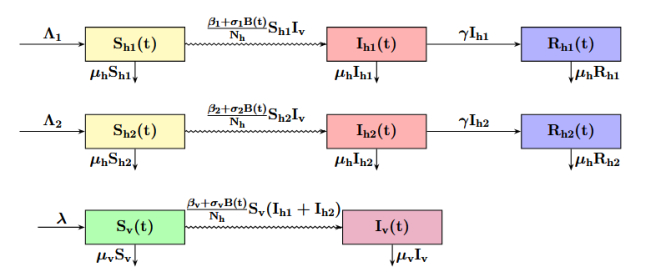
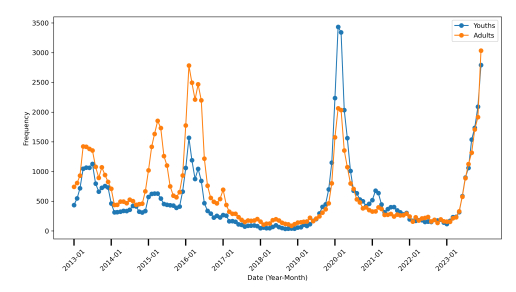
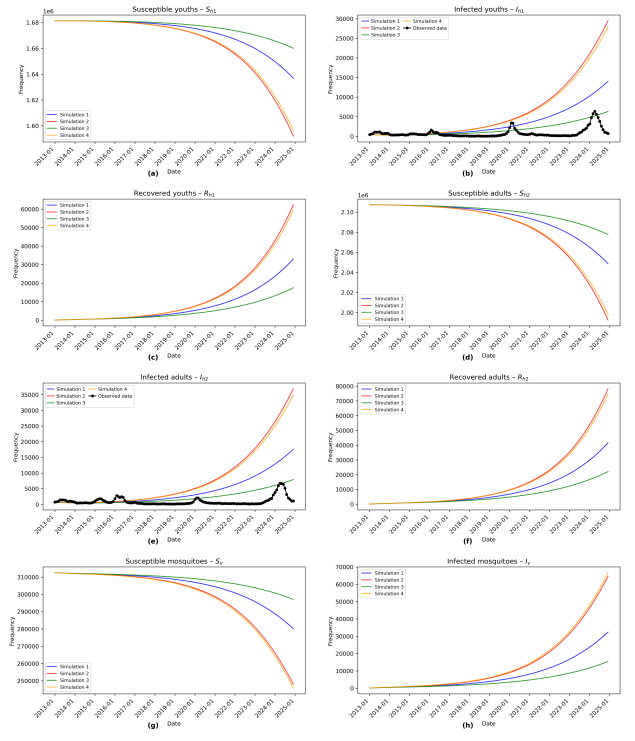
Dengue remains a major public health challenge in Colombia, with Valle del Cauca experiencing recurrent outbreaks characterized by seasonal fluctuations and long-term variability. Understanding the transmission dynamics of Dengue across age groups is critical for targeted interventions. In this study, we developed an age-structured stochastic host–vector model, incorporating a compartmental SIR–SI framework within a stochastic differential equation (SDE) approach. The population is stratified into youths (0–17 years) and adults (18 years and older), enabling analysis of age-specific infection and recovery patterns. Simulations and forecasts were performed using the Euler–Maruyama method, informed by fixed parameters from the literature, estimated disease-specific parameters, and epidemiological data from Colombia's Public Health Surveillance System (SIVIGILA) spanning 2013–2023. Additionally, a Seasonal Autoregressive Integrated Moving Average (SARIMA) model was employed as a complementary approach to capture and forecast monthly Dengue incidence. Our results highlighted distinct epidemic patterns across age groups, the higher infection burden among adults, and the complementary roles of mechanistic SDE modeling and SARIMA forecasting for surveillance and control planning.
Citation: Diego Alejandro Becerra-Becerra, Jhonier Rangel, Viswanathan Arunachalam. Stochastic modeling, analysis, and simulation of Dengue in Valle del Cauca: A case study[J]. Mathematical Biosciences and Engineering, 2026, 23(2): 266-290. doi: 10.3934/mbe.2026011
Dengue remains a major public health challenge in Colombia, with Valle del Cauca experiencing recurrent outbreaks characterized by seasonal fluctuations and long-term variability. Understanding the transmission dynamics of Dengue across age groups is critical for targeted interventions. In this study, we developed an age-structured stochastic host–vector model, incorporating a compartmental SIR–SI framework within a stochastic differential equation (SDE) approach. The population is stratified into youths (0–17 years) and adults (18 years and older), enabling analysis of age-specific infection and recovery patterns. Simulations and forecasts were performed using the Euler–Maruyama method, informed by fixed parameters from the literature, estimated disease-specific parameters, and epidemiological data from Colombia's Public Health Surveillance System (SIVIGILA) spanning 2013–2023. Additionally, a Seasonal Autoregressive Integrated Moving Average (SARIMA) model was employed as a complementary approach to capture and forecast monthly Dengue incidence. Our results highlighted distinct epidemic patterns across age groups, the higher infection burden among adults, and the complementary roles of mechanistic SDE modeling and SARIMA forecasting for surveillance and control planning.

| [1] | OMS, Dengue y Dengue grave, OMS, 2024. Available from: https://www.who.int/es/news-room/fact-sheets/detail/Dengue-and-severe-Dengue |
| [2] | O. A. Montesinos-López, C. M. Hernández-Suárez, Modelos matemáticos para enfermedades infecciosas, Salud Publica Mex., 49 (2007), 218–226. |
| [3] |
Y. Guo, T. Li, Modeling the competitive transmission of the Omicron strain and Delta strain of COVID-19, J. Math. Anal. Appl., 526 (2023), 127283. https://doi.org/10.1016/j.jmaa.2023.127283 doi: 10.1016/j.jmaa.2023.127283

|
| [4] |
A. Gray, D. Greenhalgh, L. Hu, X. Mao, J. Pan, A stochastic differential equation SIS epidemic model, SIAM J. Appl. Math., 71 (2011), 876–902. https://doi.org/10.1137/10081856X doi: 10.1137/10081856X
|
| [5] |
A. Ríos-Gutiérrez, S. Torres, V. Arunachalam, Studies on the basic reproduction number in stochastic epidemic models with random perturbations, Adv. Differ. Equ., 2021 (2021), 288. https://doi.org/10.1186/s13662-021-03445-2 doi: 10.1186/s13662-021-03445-2
|
| [6] |
Y. Sabbar, A. Din, D. Kiouach, Influence of fractal–fractional differentiation and independent quadratic Lévy jumps on the dynamics of a general epidemic model with vaccination strategy, Chaos Solitons Fractals, 171 (2023), 113434. https://doi.org/10.1016/j.chaos.2023.113434 doi: 10.1016/j.chaos.2023.113434
|
| [7] |
Y. Sabbar, Refining extinction criteria in a complex multi-stage epidemic system with non-Gaussian Lévy noise, Commun. Nonlinear Sci. Numer. Simul., 149 (2025), 108911. https://doi.org/10.1016/j.cnsns.2025.108911 doi: 10.1016/j.cnsns.2025.108911
|
| [8] | I. N. de Salud, Sistema de Vigilancia en Salud Pública (SIVIGILA), 2025. Available from: https://portalsivigila.ins.gov.co/. |
| [9] | D. Peña, Análisis de series temporales, Alianza, 2005. |
| [10] |
A. Din, T. Khan, Y. Li, H. Tahir, A. Khan, W. A. Khan, Mathematical analysis of Dengue stochastic epidemic model, Results Phys., 20 (2021), 103719. https://doi.org/10.1016/j.rinp.2020.103719 doi: 10.1016/j.rinp.2020.103719
|
| [11] |
M. Z. Ndii, Y. A. Adi, B. S. Djahi, Deterministic and stochastic Dengue epidemic model: Exploring the probability of extinction, Barekeng: J. Ilmu Mat. Ter., 16 (2022), 583–596. https://doi.org/10.30598/barekengvol16iss2pp583-596 doi: 10.30598/barekengvol16iss2pp583-596
|
| [12] | I. Karatzas, S. E. Shreve, Brownian Motion and Stochastic Calculus, 2nd edition, Springer, 1991. https://doi.org/10.1007/978-1-4612-0949-2 |
| [13] | P. E. Kloeden, E. Platen, Numerical Solution of Stochastic Differential Equations, Springer, 1992. https://doi.org/10.1007/978-3-662-12616-5 |
| [14] |
X. Mao, C. Yuan, J. Zou, Stochastic differential delay equations of population dynamics, J. Math. Anal. Appl., 304 (2005), 296–320. https://doi.org/10.1016/j.jmaa.2004.09.027 doi: 10.1016/j.jmaa.2004.09.027
|
| [15] |
G. Maruyama, Continuous Markov processes and stochastic equations, Rend. Circ. Mat. Palermo, 4 (1955), 48–90. https://doi.org/10.1007/BF02846028 doi: 10.1007/BF02846028
|
| [16] | DANE, Estadísticas vitales: Nacimientos, 2023. Available from: https://www.dane.gov.co/index.php/estadisticas-por-tema/salud |
| [17] |
M. Andraud, N. Hens, C. Marais, P. Beutels, Dynamic epidemiological models for Dengue transmission: A systematic review of structural approaches, PLoS ONE, 7 (2012), e49085. https://doi.org/10.1371/journal.pone.0049085 doi: 10.1371/journal.pone.0049085
|
| [18] |
M. K. Enduri, S. Jolad, Dynamics of Dengue disease with human and vector mobility, Spatial Spatio-temporal Epidemiol., 25 (2018), 57–66. https://doi.org/10.1016/j.sste.2018.03.001 doi: 10.1016/j.sste.2018.03.001
|
| [19] |
D. P. Lizarralde-Bejarano, S. Arboleda-Sánchez, M. E. Puerta-Yepes, Understanding epidemics from mathematical models: Details of the 2010 Dengue epidemic in Bello (Antioquia, Colombia), Appl. Math. Modell., 43 (2017), 566–578. https://doi.org/10.1016/j.apm.2016.11.022 doi: 10.1016/j.apm.2016.11.022
|
| [20] | DANE, Identidad gráfica del Censo Nacional de Población y Vivienda 2018, 2019. Available from: https://sitios.dane.gov.co/cnpv/ |
| [21] |
M. A. Branch, T. F. Coleman, Y. Li, A subspace, interior, and conjugate gradient method for large-scale bound-constrained minimization problems, SIAM J. Sci. Comput., 21 (1999), 1–23. https://doi.org/10.1137/S1064827595289108 doi: 10.1137/S1064827595289108
|
| [22] |
P. Virtanen, R. Gommers, T. E. Oliphant, M. Haberland, T. Reddy, D. Cournapeau, et al., SciPy 1.0: Fundamental algorithms for scientific computing in Python, Nat. Methods, 17 (2020), 261–272. https://doi.org/10.1038/s41592-019-0686-2 doi: 10.1038/s41592-019-0686-2
|
| [23] | P. J. Brockwell, R. A. Davis, Time Series: Theory and Methods, Springer, 1991. https://doi.org/10.1007/978-1-4419-0320-4 |
| [24] | P. J. Brockwell, R. A. Davis, Introduction to Time Series and Forecasting, Springer, 2016. https://doi.org/10.1007/978-3-319-29854-2 |
Figures(12) / Tables(9)

Diego Alejandro Becerra-Becerra, Jhonier Rangel, Viswanathan Arunachalam. Stochastic modeling, analysis, and simulation of Dengue in Valle del Cauca: A case study[J]. Mathematical Biosciences and Engineering, 2026, 23(2): 266-290. doi: 10.3934/mbe.2026011





 DownLoad: