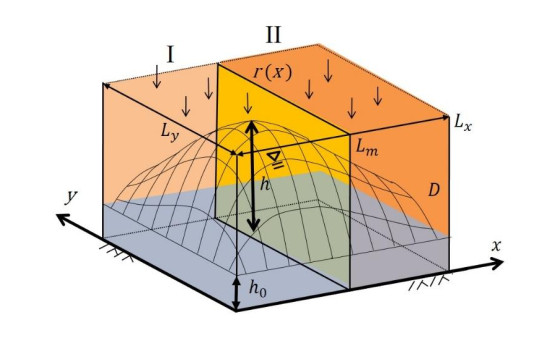
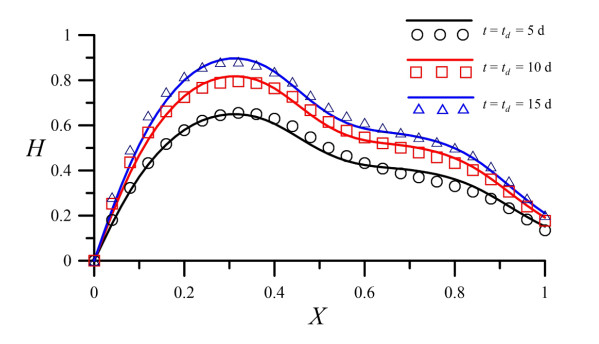
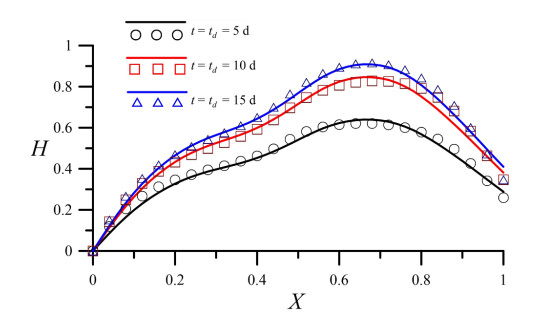
Aquifer systems are often simplified as homogeneous and infinite, yet natural deposits typically display heterogeneity and occur within finite domains. In this study, we developed a two-dimensional analytical framework for groundwater flow in an unconfined two-region aquifer that represents lateral heterogeneity through piecewise hydraulic properties, subjected to spatially variable recharge, formulated using the generalized integral transform technique (GITT). The model was benchmarked against finite-difference simulations of the nonlinear Boussinesq equation, showing close agreement and validating the linearized approach. Applications to contrasting soil properties and recharge patterns revealed that heterogeneity and recharge variability strongly influence groundwater levels and hydraulic gradients. Uniform recharge leads to higher mounding in low-permeability zones, while spatially increasing recharge amplifies head buildup and steepens gradients. In contrast, decreasing recharge shifts the mound toward the aquifer center and produces outward flow. Comparisons between homogeneous and two-region composite aquifers showed that only the latter exhibit abrupt head changes at interfaces. The framework provides a practical tool for groundwater analysis and management.
Citation: Ming-Chang Wu, Ping-Cheng Hsieh. Groundwater flow in a two-region aquifer: A 2D analytical solution with recharge forcing[J]. AIMS Mathematics, 2026, 11(3): 5669-5691. doi: 10.3934/math.2026233
Aquifer systems are often simplified as homogeneous and infinite, yet natural deposits typically display heterogeneity and occur within finite domains. In this study, we developed a two-dimensional analytical framework for groundwater flow in an unconfined two-region aquifer that represents lateral heterogeneity through piecewise hydraulic properties, subjected to spatially variable recharge, formulated using the generalized integral transform technique (GITT). The model was benchmarked against finite-difference simulations of the nonlinear Boussinesq equation, showing close agreement and validating the linearized approach. Applications to contrasting soil properties and recharge patterns revealed that heterogeneity and recharge variability strongly influence groundwater levels and hydraulic gradients. Uniform recharge leads to higher mounding in low-permeability zones, while spatially increasing recharge amplifies head buildup and steepens gradients. In contrast, decreasing recharge shifts the mound toward the aquifer center and produces outward flow. Comparisons between homogeneous and two-region composite aquifers showed that only the latter exhibit abrupt head changes at interfaces. The framework provides a practical tool for groundwater analysis and management.

| [1] |
F. A. Montalto, J. Y. Parlange, T. S. Steenhuis, A simple model for predicting water table fluctuations in a tidal marsh, Water Res. Res., 43 (2007), W03424. https://doi.org/10.1029/2004WR003913 doi: 10.1029/2004WR003913

|
| [2] |
H. Li, J. J. Jiao, Z. Tang, Semi-numerical simulation of groundwater flow induced by periodic forcing with a case-study at an island aquifer, J. Hydrol., 327 (2006), 438–446. https://doi.org/10.1016/j.jhydrol.2005.11.032 doi: 10.1016/j.jhydrol.2005.11.032
|
| [3] |
H. Li, G. Li, J. Cheng, M. C. Boufadel, Tide‐induced head fluctuations in a confined aquifer with sediment covering its outlet at the sea floor, Water Res. Res., 4 (2007), W03403. https://doi.org/10.1029/2005WR004724 doi: 10.1029/2005WR004724
|
| [4] |
Y. Q. Xia, H. L. Li, A combined field and modeling study of groundwater flow in a tidal marsh, Hydrol. Earth Sys. Sci., 16 (2012), 741–759. https://doi.org/10.5194/hess-16-741-2012 doi: 10.5194/hess-16-741-2012
|
| [5] |
P. Kreyns, X. Geng, H. A. Michael, The influence of connected heterogeneity on groundwater flow and salinity distributions in coastal volcanic aquifers, J. Hydrol., 586 (2020), 124863. https://doi.org/10.1016/j.jhydrol.2020.124863 doi: 10.1016/j.jhydrol.2020.124863
|
| [6] |
C. L. Winter, D. M. Tartakovsky, Groundwater flow in heterogeneous composite aquifers, Water Res. Res., 38 (2002), 23-1–23-12. https://doi.org/10.1029/2001WR000450 doi: 10.1029/2001WR000450
|
| [7] |
E. Kalbus, C. Schmidt, J. W. Molson, F. Reinstorf, M. Schirmer, Influence of aquifer and streambed heterogeneity on the distribution of groundwater discharge, Hydrol. Earth Sys. Sci., 13 (2009), 69–77. https://doi.org/10.5194/hess-13-69-2009 doi: 10.5194/hess-13-69-2009
|
| [8] |
W. A. Illman, J. Zhu, A. J. Craig, D. Yin, Comparison of aquifer characterization approaches through steady state groundwater model validation: A controlled laboratory sandbox study, Water Res. Res., 46 (2010), W04502. https://doi.org/10.1029/2009WR007745 doi: 10.1029/2009WR007745
|
| [9] |
A. Hartmann, T. Gleeson, Y. Wada, T. Wagener, Enhanced groundwater recharge rates and altered recharge sensitivity to climate variability through subsurface heterogeneity, Pro. N. Aca. Sci., 114 (2017), 2842–2847. https://doi.org/10.1073/pnas.1614941114 doi: 10.1073/pnas.1614941114
|
| [10] |
S. E. Serrano, Analytical solutions of the nonlinear groundwater flow equation in unconfined aquifers and the effect of heterogeneity, Water Res. Res., 31 (1995), 2733–2742. https://doi.org/10.1029/95WR02038 doi: 10.1029/95WR02038
|
| [11] |
M. G. Trefry, Periodic forcing in composite aquifers, Adv. Water Res., 22 (1999), 645–656. https://doi.org/10.1016/S0309-1708(98)00037-2 doi: 10.1016/S0309-1708(98)00037-2
|
| [12] |
M. H. Chuang, C. S. Huang, G. H. Li, H. D. Yeh, Groundwater fluctuations in heterogeneous coastal leaky aquifer systems, Hydrol. Earth Sys. Sci., 14 (2010), 1819–1826. https://doi.org/10.5194/hess-14-1819-2010 doi: 10.5194/hess-14-1819-2010
|
| [13] |
T. Ptak, M. Piepenbrink, E. Martac, Tracer tests for the investigation of heterogeneous porous media and stochastic modelling of flow and transport—a review of some recent developments, J. hydrol., 294 (2004), 122–163. https://doi.org/10.1016/j.jhydrol.2004.01.020 doi: 10.1016/j.jhydrol.2004.01.020
|
| [14] |
M. C. Wu, P. C. Hsieh, Improved solutions to the linearized Boussinesq equation with temporally varied rainfall recharge for a sloping aquifer, Water, 11 (2019), 826. https://doi.org/10.3390/w11040826 doi: 10.3390/w11040826
|
| [15] |
P. M. Morse, H. Feshbach, Methods of theoretical physics, Am. J. Phy., 22 (1954), 410–413. https://doi.org/10.1119/1.1933765 doi: 10.1119/1.1933765
|
| [16] | M. N. Özisik, Boundary value problems of heat conduction, New York, NY, USA: Dover Publications Inc., 1968. |
| [17] |
G. P. Mulholland, M. H. Cobble, Diffusion through composite media, Inter. J. Heat Mass Trans., 15 (1972), 147–160. https://doi.org/10.1016/0017-9310(72)90172-X doi: 10.1016/0017-9310(72)90172-X
|
| [18] |
Y. Sun, I. S. Wichman, On transient heat conduction in a one-dimensional composite slab, Inter. J. Heat Mass Trans., 47 (2004), 1555–1559. https://doi.org/10.1016/j.ijheatmasstransfer.2003.09.011 doi: 10.1016/j.ijheatmasstransfer.2003.09.011
|
| [19] |
Y. Zhang, Nonlinear inversion of an unconfined aquifer: Simultaneous estimation of heterogeneous hydraulic conductivities, recharge rates, and boundary conditions, Trans. Por. Med., 102 (2014), 275–299. https://doi.org/10.1007/s11242-014-0275-x doi: 10.1007/s11242-014-0275-x
|
| [20] |
S. K. Das, S. J. Ganesh, T. S. Lundström, Modeling of a groundwater mound in a two-dimensional heterogeneous unconfined aquifer in response to precipitation recharge, J. Hydrol. Eng., 20 (2015), 04014081. https://doi.org/10.1061/(ASCE)HE.1943-5584.0001071 doi: 10.1061/(ASCE)HE.1943-5584.0001071
|
| [21] |
J. F. Águila, J. Samper, B. Pisani, Parametric and numerical analysis of the estimation of groundwater recharge from water-table fluctuations in heterogeneous unconfined aquifers, Hydrogeo. J., 27 (2019), 1309–1328. https://doi.org/10.1007/s10040-018-1908-x doi: 10.1007/s10040-018-1908-x
|
| [22] |
K. Hemker, M. Bakker, Analytical solutions for whirling groundwater flow in two-dimensional heterogeneous anisotropic aquifers, Water Resour. Res., 42 (2006), W12419. https://doi.org/10.1029/2006WR004901 doi: 10.1029/2006WR004901
|
| [23] |
H. Guo, J. J. Jiao, H. Li, Groundwater response to tidal fluctuation in a two-zone aquifer, J. Hydrol., 381 (2010), 364–371. https://doi.org/10.1016/j.jhydrol.2009.12.009 doi: 10.1016/j.jhydrol.2009.12.009
|
| [24] |
X. Liang, Y. K. Zhang, Analytic solutions to transient groundwater flow under time-dependent sources in a heterogeneous aquifer bounded by fluctuating river stage, Adv. Water Resour., 58 (2013), 1–9. https://doi.org/10.1016/j.advwatres.2013.03.010 doi: 10.1016/j.advwatres.2013.03.010
|
| [25] |
M. C. Wu, P. C. Hsieh, Variation of groundwater flow caused by any spatiotemporally varied recharge, Water, 12 (2020), 287. https://doi.org/10.3390/w12010287 doi: 10.3390/w12010287
|
| [26] |
P. C. Hsieh, M. C. Wu, Changes in groundwater flow in an unconfined aquifer adjacent to a river under surface recharge, Hydro. Sci. J., 68 (2023), 920–937. https://doi.org/10.1080/02626667.2023.2193295 doi: 10.1080/02626667.2023.2193295
|
| [27] | J. Bear, Dynamics of fluids in porous media, New York, NY, USA: Elsevier, 1975. |
| [28] |
W. Guo, Transient groundwater flow between reservoirs and water-table aquifers, J. Hydrol., 195 (1997), 370–384. https://doi.org/10.1016/S0022-1694(96)03200-3 doi: 10.1016/S0022-1694(96)03200-3
|
| [29] |
X. Liang, Y. K. Zhang, A new analytical method for groundwater recharge and discharge estimation, J. Hydrol., 450 (2012), 17–24. https://doi.org/10.1016/j.jhydrol.2012.05.036 doi: 10.1016/j.jhydrol.2012.05.036
|
| [30] |
X. Liang, Y. K. Zhang, Temporal and spatial variation and scaling of groundwater levels in a bounded unconfined aquifer, J. Hydrol., 479 (2013), 139–145. https://doi.org/10.1016/j.jhydrol.2012.11.044 doi: 10.1016/j.jhydrol.2012.11.044
|
| [31] |
G. Gao, H. Zhan, S. Feng, B. Fu, G. Huang, A mobile–immobile model with an asymptotic scale-dependent dispersion function, J. Hydrol., 424-425 (2012), 172–183. https://doi.org/10.1016/j.jhydrol.2011.12.041 doi: 10.1016/j.jhydrol.2011.12.041
|
| [32] |
R. K. Bansal, C. K. Lande, A. Warke, Unsteady groundwater flow over sloping beds: Analytical quantification of stream–aquifer interaction in presence of thin vertical clogging layer, J. Hydrol. Eng., 21 (2016), 04016017. https://doi.org/10.1061/(ASCE)HE.1943-5584.0001362 doi: 10.1061/(ASCE)HE.1943-5584.0001362
|
Figures(12)

Ming-Chang Wu, Ping-Cheng Hsieh. Groundwater flow in a two-region aquifer: A 2D analytical solution with recharge forcing[J]. AIMS Mathematics, 2026, 11(3): 5669-5691. doi: 10.3934/math.2026233





 DownLoad: