Soft set theory, characterized by approximate modeling (instead of precise modeling) for deriving approximate solutions with the aid of unrestricted parameterization tools, has been regarded as a versatile tool for handling diverse uncertainties in real-world scenarios. Despite the emergence of numerous versions of soft set operations, soft set theory founder Molodtsov noted that some deviated from the essence of soft sets as parameterized families, and thus formulated their correct rules. Since the parameterized family that determines the structure of a soft set can be regarded as an analogue of a topology, this paper investigates the topology generated by soft sets and defines some basic operations on the topology, such as intersection, union, sum, and Cartesian product, along with homeomorphism, with illustrative examples and proofs. Moreover, new distance and similarity measures based on the parameterized families of soft sets are proposed, and a corresponding algorithm for multi-attribute decision making (MADM) in environments with approximately descriptive information is developed. Finally, the rationality and applicability of the proposed algorithm are illustrated by a medical diagnosis case study and comparative analysis of the ranking results with other soft set similarity measures.
Citation: Yuan Zou. Topology and measures for soft sets based on parameterized families and application in MADM[J]. AIMS Mathematics, 2026, 11(11): 38697-38720. doi: 10.3934/math.20261493
Soft set theory, characterized by approximate modeling (instead of precise modeling) for deriving approximate solutions with the aid of unrestricted parameterization tools, has been regarded as a versatile tool for handling diverse uncertainties in real-world scenarios. Despite the emergence of numerous versions of soft set operations, soft set theory founder Molodtsov noted that some deviated from the essence of soft sets as parameterized families, and thus formulated their correct rules. Since the parameterized family that determines the structure of a soft set can be regarded as an analogue of a topology, this paper investigates the topology generated by soft sets and defines some basic operations on the topology, such as intersection, union, sum, and Cartesian product, along with homeomorphism, with illustrative examples and proofs. Moreover, new distance and similarity measures based on the parameterized families of soft sets are proposed, and a corresponding algorithm for multi-attribute decision making (MADM) in environments with approximately descriptive information is developed. Finally, the rationality and applicability of the proposed algorithm are illustrated by a medical diagnosis case study and comparative analysis of the ranking results with other soft set similarity measures.

| [1] |
L. A. Zadeh, Fuzzy sets, Inf. Control, 8 (1965), 338–353. https://doi.org/10.1016/S0019-9958(65)90241-X doi: 10.1016/S0019-9958(65)90241-X
|
| [2] |
K. T. Atanassov, Intuitionistic fuzzy sets, Fuzzy Sets Syst., 20 (1986), 87–96. https://doi.org/10.1016/S0165-0114(86)80034-3 doi: 10.1016/S0165-0114(86)80034-3
|
| [3] |
Z. Pawlak, Rough sets, Int. J. Comput. Inf. Sci., 11 (1982), 341–356. https://doi.org/10.1007/BF01001956 doi: 10.1007/BF01001956
|
| [4] |
W. L. Gau, D. J. Buehrer, Vague sets, IEEE Trans. Syst. Man Cybern., 23 (1993), 610–614. https://doi.org/10.1109/21.229476 doi: 10.1109/21.229476
|
| [5] |
M. B. Gorzałczany, A method of inference in approximate reasoning based on interval-valued fuzzy sets, Fuzzy Sets Syst., 21 (1987), 1–17. https://doi.org/10.1016/0165-0114(87)90148-5 doi: 10.1016/0165-0114(87)90148-5
|
| [6] |
D. Molodtsov, Soft set theory-first results, Comput. Math. Appl., 37 (1999), 19–31. https://doi.org/10.1016/S0898-1221(99)00056-5 doi: 10.1016/S0898-1221(99)00056-5
|
| [7] |
Z. Pawlak, Hard and soft sets, In: Rough sets, fuzzy sets and knowledge discovery, London: Springer, 1994,130–135. https://doi.org/10.1007/978-1-4471-3238-7_15 |
| [8] |
K. Atanassov, G. Gargov, Interval valued intuitionistic fuzzy sets, Fuzzy Sets Syst., 31 (1989), 343–349. https://doi.org/10.1016/0165-0114(89)90205-4 doi: 10.1016/0165-0114(89)90205-4
|
| [9] |
J. M. Mendel, R. I. B. John, Type-2 fuzzy sets made simple, IEEE Trans. Fuzzy Syst., 10 (2002), 117–127. https://doi.org/10.1109/91.995115 doi: 10.1109/91.995115
|
| [10] |
J. M. Mendel, R. I. John, F. Liu, Interval type-2 fuzzy logic systems made simple, IEEE Trans. Fuzzy Syst., 14 (2006), 808–821. https://doi.org/10.1109/TFUZZ.2006.879986 doi: 10.1109/TFUZZ.2006.879986
|
| [11] |
Y. Yao, B. Yao, Covering based rough set approximations, Inf. Sci., 200 (2012), 91–107. https://doi.org/10.1016/j.ins.2012.02.065 doi: 10.1016/j.ins.2012.02.065
|
| [12] |
D. Dubois, H. Prade, Rough fuzzy sets and fuzzy rough sets, Int. J. Gen. Syst., 17 (1990), 191–209. https://doi.org/10.1080/03081079008935107 doi: 10.1080/03081079008935107
|
| [13] |
W. Ziarko, Variable precision rough set model, J. Comput. Syst. Sci., 46 (1993), 39–59. https://doi.org/10.1016/0022-0000(93)90048-2 doi: 10.1016/0022-0000(93)90048-2
|
| [14] |
P. K. Maji, R. Biswas, A. R. Roy, Soft set theory, Comput. Math. Appl., 45 (2003), 555–562. https://doi.org/10.1016/S0898-1221(03)00016-6 |
| [15] |
D. G. Chen, E. C. C. Tsang, D. S. Yeung, X. Wang, The parameterization reduction of soft sets and its applications, Comput. Math. Appl., 49 (2005), 757–763. https://doi.org/10.1016/j.camwa.2004.10.036 doi: 10.1016/j.camwa.2004.10.036
|
| [16] |
M. I. Ali, F. Feng, X. Liu, W. K. Min, M. Shabir, On some new operations in soft set theory, Comput. Math. Appl., 57 (2009), 1547–1553. https://doi.org/10.1016/j.camwa.2008.11.009 doi: 10.1016/j.camwa.2008.11.009
|
| [17] |
A. Sezgin, A. O. Atagün, On operations of soft sets, Comput. Math. Appl., 61 (2011), 1457–1467. https://doi.org/10.1016/j.camwa.2011.01.018 doi: 10.1016/j.camwa.2011.01.018
|
| [18] |
F. Feng, Y. Li, Soft subsets and soft product operations, Inf. Sci., 232 (2013), 44–57. https://doi.org/10.1016/j.ins.2013.01.001 doi: 10.1016/j.ins.2013.01.001
|
| [19] |
Z. Kong, L. Gao, L. Wang, S. Li, The normal parameter reduction of soft sets and its algorithm, Comput. Math. Appl., 56 (2008), 3029–3037. https://doi.org/10.1016/j.camwa.2008.07.013 doi: 10.1016/j.camwa.2008.07.013
|
| [20] |
J. M. Zhan, J. C. R. Alcantud, A survey of parameter reduction of soft sets and corresponding algorithms, Artif. Intell. Rev., 52 (2019), 1839–1872. https://doi.org/10.1007/s10462-017-9592-0 doi: 10.1007/s10462-017-9592-0
|
| [21] |
N. Çağman, S. Karataş, S. Enginoğlu, Soft topology, Comput. Math. Appl., 62 (2011), 351–358. https://doi.org/10.1016/j.camwa.2011.05.016 doi: 10.1016/j.camwa.2011.05.016
|
| [22] |
P. Majumdar, S. K. Samanta, On soft mappings, Comput. Math. Appl., 60 (2010), 2666–2672. https://doi.org/10.1016/j.camwa.2010.09.004 |
| [23] |
A. R. Roy, P. K. Maji, A fuzzy soft set theoretic approach to decision making problems, J. Comput. Appl. Math., 203 (2007), 412–418. https://doi.org/10.1016/j.cam.2006.04.008 doi: 10.1016/j.cam.2006.04.008
|
| [24] |
P. Majumdar, S. K. Samanta, Generalised fuzzy soft sets, Comput. Math. Appl., 59 (2010), 1425–1432. https://doi.org/10.1016/j.camwa.2009.12.006 doi: 10.1016/j.camwa.2009.12.006
|
| [25] |
F. Feng, X. Liu, V. Leoreanu-Fotea, Y. B. Jun, Soft sets and soft rough sets, Inf. Sci., 181 (2011), 1125–1137. https://doi.org/10.1016/j.ins.2010.11.004 doi: 10.1016/j.ins.2010.11.004
|
| [26] |
W. Xu, J. Ma, S. Wang, G. Hao, Vague soft sets and their properties, Comput. Math. Appl., 59 (2010), 787–794. https://doi.org/10.1016/j.camwa.2009.10.015 doi: 10.1016/j.camwa.2009.10.015
|
| [27] |
N. Çağman, S. Enginoğlu, Soft set theory and uni-int decision making, Eur. J. Oper. Res., 207 (2010), 848–855. https://doi.org/10.1016/j.ejor.2010.05.004 doi: 10.1016/j.ejor.2010.05.004
|
| [28] |
Y. Zou, Bayesian decision making with soft probabilities under statistical regularity, AIMS Mathematics, 11 (2026), 10883–10907. https://doi.org/10.3934/math.2026447 doi: 10.3934/math.2026447
|
| [29] |
Y. Zou, Z. Xiao, Data analysis approaches of soft sets under incomplete information, Knowl.-Based Syst., 21 (2008), 941–945. https://doi.org/10.1016/j.knosys.2008.04.004 doi: 10.1016/j.knosys.2008.04.004
|
| [30] |
F. Feng, J. Cho, W. Pedrycz, H. Fujita, T. Herawan, Soft set based association rule mining, Knowl.-Based Syst., 111 (2016), 268–282. https://doi.org/10.1016/j.knosys.2016.08.020 doi: 10.1016/j.knosys.2016.08.020
|
| [31] |
W. Xu, Z. Xiao, X. Dang, D. Yang, X. Yang, Financial ratio selection for business failure prediction using soft set theory, Knowl.-Based Syst., 63 (2014), 59–67. https://doi.org/10.1016/j.knosys.2014.03.007 doi: 10.1016/j.knosys.2014.03.007
|
| [32] |
K. H. Chang, A more general risk assessment methodology using a soft set-based ranking technique, Soft Comput., 18 (2014), 169–183. https://doi.org/10.1007/s00500-013-1045-3 doi: 10.1007/s00500-013-1045-3
|
| [33] |
D. Orhan, N. Demirta, Algorithms for Covid-19 outbreak using soft set theory: Estimation and application, Soft Comput., 27 (2023), 3203–3211. https://doi.org/10.1007/s00500-022-07519-5 doi: 10.1007/s00500-022-07519-5
|
| [34] |
D. Molodtsov, Equivalence and correct operations for soft sets, Int. Rob. Auto. J., 4 (2018), 18–21. https://doi.org/10.15406/iratj.2018.04.00086 doi: 10.15406/iratj.2018.04.00086
|
| [35] |
S. Acharjee, A. Oza, Correct structures and similarity measures of soft sets along with historic comments of Prof. D. A. Molodtsov, Vestnik Udmurtskogo Universiteta. Matematika. Mekhanika. Komp'yuternye Nauki, 33 (2023), 32–53. https://doi.org/10.48550/arXiv.2206.03725 doi: 10.48550/arXiv.2206.03725
|
| [36] |
Z. Xiao, Y. Zou, A comparative study of soft sets with fuzzy sets and rough sets, J. Intell. Fuzzy Syst., 27 (2014), 425–434. https://doi.org/10.3233/IFS-131010 doi: 10.3233/IFS-131010
|
| [37] |
S. A. Morris, Topology without tears, 2018. |
| [38] |
E. Aygün, H. Kamacı, Some new algebraic structures of soft sets, Soft Comput., 25 (2021), 8609–8626. https://doi.org/10.1007/s00500-021-05744-y doi: 10.1007/s00500-021-05744-y
|
| [39] |
P. Majumdar, S. K. Samanta, Similarity measure of soft sets, New Math. Nat. Comput., 4 (2008), 1–12. https://doi.org/10.1142/S1793005708000908 doi: 10.1142/S1793005708000908
|
| [40] |
A. Kharal, Distance and similarity measures for soft sets, New Math. Nat. Comput., 6 (2010), 321–334. https://doi.org/10.1142/S1793005710001724 doi: 10.1142/S1793005710001724
|
Figures(2) / Tables(1)

Yuan Zou. Topology and measures for soft sets based on parameterized families and application in MADM[J]. AIMS Mathematics, 2026, 11(11): 38697-38720. doi: 10.3934/math.20261493

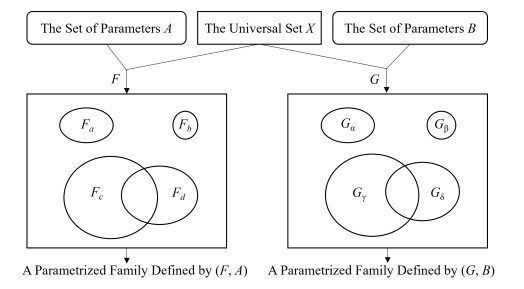
The representation of two equivalent soft sets
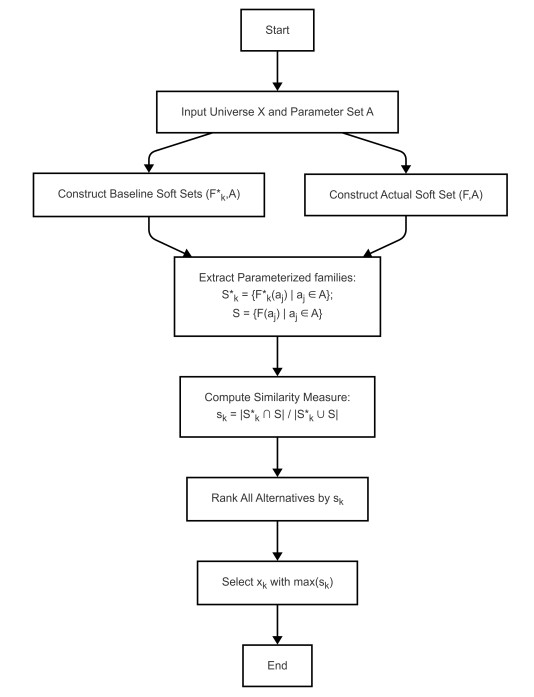
The flowchart of the MADM problem algorithm based on similarity of soft sets




 DownLoad: