The computational complexity inherent in decision-making systems appears from the ontological uncertainty of the data. This complexity is further compounded by the intricacies of human brain activity, which include linguistic imprecision, internal conflicts, and the nuanced structure of perception, often resulting in the breakdown of conventional frameworks. The interdependent nature of multi-attribute environments poses challenges for modeling using traditional classical optimization and fuzzy sets. In this study, we proposed a more reliable framework, namely entropy-based particle swarm optimization, tailored for the plithogenic Pythagorean fuzzy hypersoft set environment. To effectively manage the PSO search process and balance exploration and exploitation in response to the evolving landscape of uncertainty, an entropy measure was developed to quantify the underlying informational ambiguity. Through the proposed integration, entropy was transformed from a passive measure of uncertainty into an active driver of optimization. The application of the proposed AI-driven optimization structure in a chatbot evaluation framework demonstrated improved transparency, robustness, and decision precision, highlighting the efficacy of the suggested framework in addressing complex real-world decision-making scenarios.
Citation: Mahrukh Irfan, Usman Afzal, Shah Zeb, Khalil Ur Rehman, Wasfi Shatanawi. Decision-making with entropy-driven particle swarm optimization for plithogenic Pythagorean fuzzy hypersoft sets[J]. AIMS Mathematics, 2026, 11(11): 38653-38675. doi: 10.3934/math.20261491
The computational complexity inherent in decision-making systems appears from the ontological uncertainty of the data. This complexity is further compounded by the intricacies of human brain activity, which include linguistic imprecision, internal conflicts, and the nuanced structure of perception, often resulting in the breakdown of conventional frameworks. The interdependent nature of multi-attribute environments poses challenges for modeling using traditional classical optimization and fuzzy sets. In this study, we proposed a more reliable framework, namely entropy-based particle swarm optimization, tailored for the plithogenic Pythagorean fuzzy hypersoft set environment. To effectively manage the PSO search process and balance exploration and exploitation in response to the evolving landscape of uncertainty, an entropy measure was developed to quantify the underlying informational ambiguity. Through the proposed integration, entropy was transformed from a passive measure of uncertainty into an active driver of optimization. The application of the proposed AI-driven optimization structure in a chatbot evaluation framework demonstrated improved transparency, robustness, and decision precision, highlighting the efficacy of the suggested framework in addressing complex real-world decision-making scenarios.

| [1] |
L. A. Zadeh, Fuzzy sets, Information and Control, 8 (1965), 338–353. http://dx.doi.org/10.1016/S0019-9958(65)90241-X doi: 10.1016/S0019-9958(65)90241-X
|
| [2] |
A. Shahzad, A. Shoaib, N. Mlaiki, S. S. Aiadi, Results for fuzzy mappings and stability of fuzzy sets with applications, Fractal Fract., 6 (2022), 556. http://dx.doi.org/10.3390/fractalfract6100556 doi: 10.3390/fractalfract6100556
|
| [3] |
K. T. Atanassov, Intuitionistic fuzzy sets, Fuzzy Set. Syst., 20 (1986), 87–96. http://dx.doi.org/10.1016/S0165-0114(86)80034-3 doi: 10.1016/S0165-0114(86)80034-3
|
| [4] |
R. R. Yager, Pythagorean fuzzy subsets, Proceedings of the Joint IFSA World Congress and NAFIPS Annual Meeting (IFSA/NAFIPS), 2013, 57–61. http://dx.doi.org/10.1109/IFSA-NAFIPS.2013.6608375 doi: 10.1109/IFSA-NAFIPS.2013.6608375
|
| [5] |
P. A. Ejegwa, Modal operators on Pythagorean fuzzy sets and some of their properties, Journal of Fuzzy Mathematics, 27 (2019), 939–956. |
| [6] |
D. Molodtsov, Soft set theory–-first results, Comput. Math. Appl., 37 (1999), 19–31. http://dx.doi.org/10.1016/S0898-1221(99)00056-5 doi: 10.1016/S0898-1221(99)00056-5
|
| [7] |
P. Zhu, Q. Wen, Operations on soft sets revisited, J. Appl. Math., 2013 (2013), 105752. http://dx.doi.org/10.1155/2013/105752 doi: 10.1155/2013/105752
|
| [8] |
A. R. Roy, P. K. Maji, A fuzzy soft set theoretic approach to decision making problems, J. Comput. Appl. Math., 203 (2007), 412–418. http://dx.doi.org/10.1016/j.cam.2006.04.008 doi: 10.1016/j.cam.2006.04.008
|
| [9] |
F. Smarandache, Extension of soft set to hypersoft set, and then to plithogenic hypersoft set, Neutrosophic Set. Syst., 22 (2018), 168–170. http://dx.doi.org/10.5281/zenodo.2159755 doi: 10.5281/zenodo.2159755
|
| [10] |
R. M. Zulqarnain, X. L. Xin, M. Saeed, A development of Pythagorean fuzzy hypersoft set with basic operations and decision-making approach based on the correlation coefficient, In: Theory and application of hypersoft set, Brussels: Pons Publishing House, 2021, 85–106. http://dx.doi.org/10.5281/zenodo.4788064 |
| [11] |
R. M. Zulqarnain, X. L. Xin, H. Garg, W. A. Khan, Aggregation operators of Pythagorean fuzzy soft sets with their application for green supplier chain management, J. Intell. Fuzzy Syst., 40 (2021), 5545–5563. http://dx.doi.org/10.3233/JIFS-202781 doi: 10.3233/JIFS-202781
|
| [12] |
S. Khan, M. I. Asjad, M. B. Riaz, A. Wahab, H. Ashaq, T. Muhammad, Innovative player evaluation: dual-possibility Pythagorean fuzzy hypersoft sets for accurate international football rankings, Heliyon, 10 (2024), e36993. http://dx.doi.org/10.1016/j.heliyon.2024.e36993 doi: 10.1016/j.heliyon.2024.e36993
|
| [13] |
F. Smarandache, Plithogeny, plithogenic set, logic, probability, and statistics, Brussels: Pons Publishing House, 2017. |
| [14] |
C. E. Shannon, A mathematical theory of communication, Bell System Technical Journal, 27 (1948), 379–423. http://dx.doi.org/10.1002/j.1538-7305.1948.tb01338.x doi: 10.1002/j.1538-7305.1948.tb01338.x
|
| [15] |
A. De Luca, S. Termini, A definition of a nonprobabilistic entropy in the setting of fuzzy sets theory, Information and Control, 20 (1972), 301–312. http://dx.doi.org/10.1016/S0019-9958(72)90199-4 doi: 10.1016/S0019-9958(72)90199-4
|
| [16] |
S. G. Quek, G. Selvachandran, F. Smarandache, J. Vimala, S. H. Le, Q. T. Bui, et al., Entropy measures for plithogenic sets and applications in multi-attribute decision making, Mathematics, 8 (2020), 965. http://dx.doi.org/10.3390/math8060965 doi: 10.3390/math8060965
|
| [17] |
J. Kennedy, R. Eberhart, Particle swarm optimization, Proceedings of ICNN'95—International Conference on Neural Networks, 1995, 1942–1948. http://dx.doi.org/10.1109/ICNN.1995.488968 doi: 10.1109/ICNN.1995.488968
|
| [18] |
M. C. Z. Zambou, A. S. T. Kammogne, M. S. Siewe, A. T. Azar, S. Ahmed, I. A. Hameed, Optimized nonlinear PID control for maximum power point tracking in PV systems using particle swarm optimization, Math. Comput. Appl., 29 (2024), 88. http://dx.doi.org/10.3390/mca29050088 doi: 10.3390/mca29050088
|
| [19] |
M. Soleimani, A. Harooni, N. Erfani, A. R. Khan, T. Saba, S. A. Bahaj, Classification of cancer types based on microRNA expression using a hybrid radial basis function and particle swarm optimization algorithm, Microsc. Res. Tech., 87 (2024), 1052–1062. http://dx.doi.org/10.1002/jemt.24492 doi: 10.1002/jemt.24492
|
Figures(5) / Tables(8)

Mahrukh Irfan, Usman Afzal, Shah Zeb, Khalil Ur Rehman, Wasfi Shatanawi. Decision-making with entropy-driven particle swarm optimization for plithogenic Pythagorean fuzzy hypersoft sets[J]. AIMS Mathematics, 2026, 11(11): 38653-38675. doi: 10.3934/math.20261491

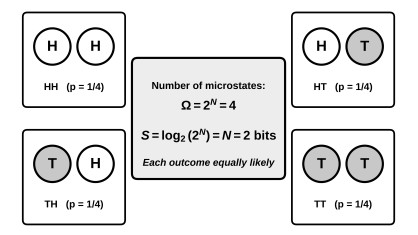
Coin entropy
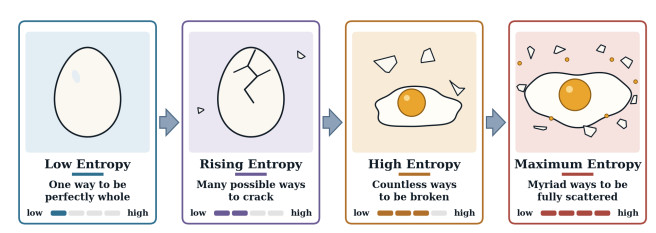
Entropy increases as an egg moves from a whole state to a fully scattered state
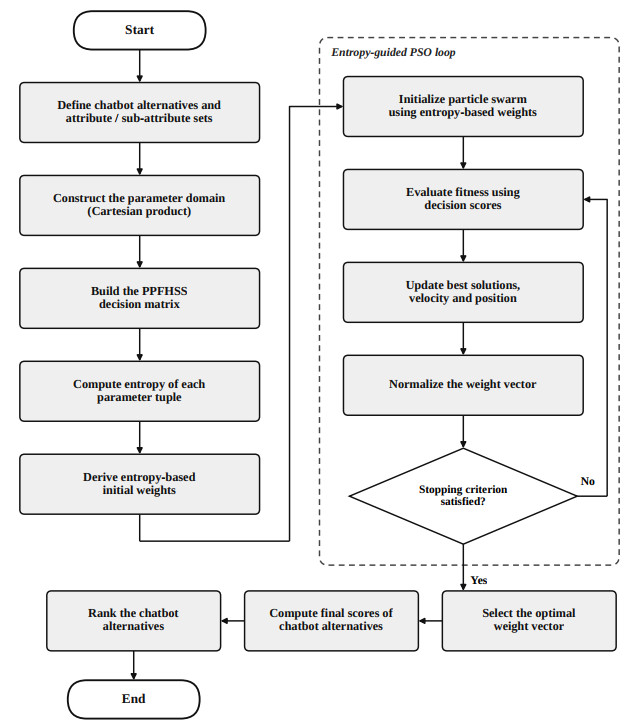
PSO-driven entropy optimization process for decision-making in chatbot evaluation using hypersoft fuzzy structures
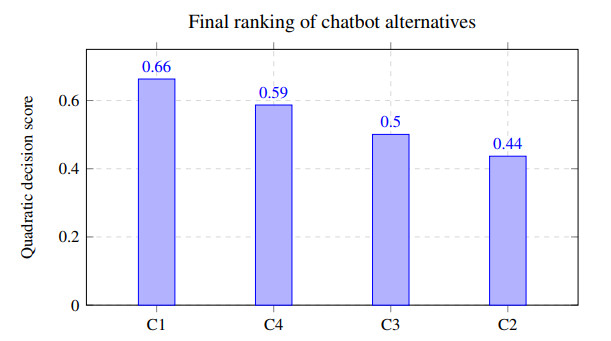
Final ranking of chatbot alternatives based on the aggregated quadratic decision scores
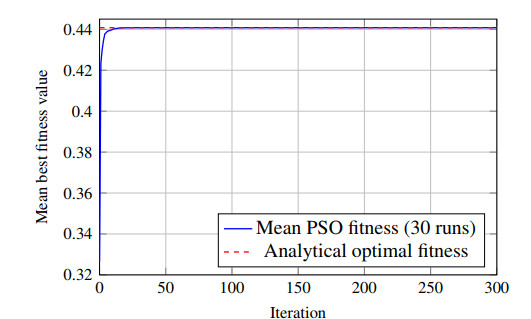
Mean PSO convergence over 30 independent runs compared with the analytical optimal fitness




 DownLoad: