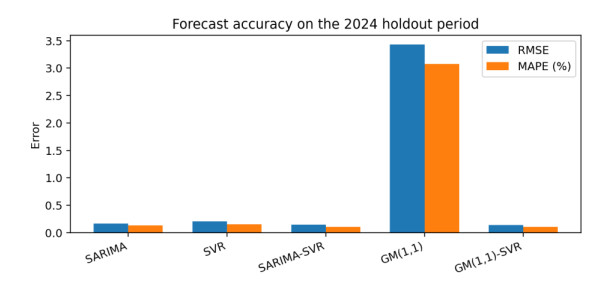
Accurate short-term forecasting of the consumer price index (CPI) is useful for monitoring changes in the general price level. This study compares three standalone forecasting models—seasonal autoregressive integrated moving average (SARIMA), grey model GM(1, 1), and support vector regression (SVR)—with two residual correction hybrids, SARIMA–SVR and GM(1, 1)–SVR, using 108 monthly Saudi CPI observations from January 2016 to December 2024. The data are divided chronologically into a 2016–2023 training period and a January–December 2024 out-of-sample holdout. Model selection, scaling, lag selection, and hyperparameter tuning are restricted to pre-2024 information, and all forecasts are generated by rolling one-step-ahead evaluation. A training-only seasonal differencing specification check resolves the near-boundary seasonal moving average estimate in the earlier SARIMA by selecting SARIMA(1, 1, 1)(0, 0, 1)(12). Forecast performance is evaluated using root mean square error (RMSE), mean absolute percentage error (MAPE), Theil's U, and Harvey–Leybourne–Newbold-adjusted Diebold–Mariano tests. GM(1, 1)–SVR has the lowest 2024 RMSE (0.1421; MAPE = 0.1062%; U = 0.6427), while SARIMA–SVR has the lowest MAPE (0.1044%; RMSE = 0.1443; U = 0.6528); the difference between these two hybrids is not statistically significant (adjusted p = 0.849). Residual correction produces a large and stable gain for the weak GM(1, 1) base, whereas the gain for SARIMA is smaller and not statistically established. The results therefore support residual predictability as an empirical screening principle for deciding whether a correction stage is worth adding, rather than supporting the universal superiority of the hybrids. Because the final Saudi holdout contains only 12 observations and the models are univariate, the findings remain short-horizon forecasting evidence rather than direct policy guidance.
Citation: Zahrah Fayez Althobaiti. Forecasting Saudi Arabia's monthly consumer price index using hybrid support vector regression models: Evidence from SARIMA-SVR and GM(1, 1)-SVR[J]. AIMS Mathematics, 2026, 11(11): 38721-38761. doi: 10.3934/math.20261494
Accurate short-term forecasting of the consumer price index (CPI) is useful for monitoring changes in the general price level. This study compares three standalone forecasting models—seasonal autoregressive integrated moving average (SARIMA), grey model GM(1, 1), and support vector regression (SVR)—with two residual correction hybrids, SARIMA–SVR and GM(1, 1)–SVR, using 108 monthly Saudi CPI observations from January 2016 to December 2024. The data are divided chronologically into a 2016–2023 training period and a January–December 2024 out-of-sample holdout. Model selection, scaling, lag selection, and hyperparameter tuning are restricted to pre-2024 information, and all forecasts are generated by rolling one-step-ahead evaluation. A training-only seasonal differencing specification check resolves the near-boundary seasonal moving average estimate in the earlier SARIMA by selecting SARIMA(1, 1, 1)(0, 0, 1)(12). Forecast performance is evaluated using root mean square error (RMSE), mean absolute percentage error (MAPE), Theil's U, and Harvey–Leybourne–Newbold-adjusted Diebold–Mariano tests. GM(1, 1)–SVR has the lowest 2024 RMSE (0.1421; MAPE = 0.1062%; U = 0.6427), while SARIMA–SVR has the lowest MAPE (0.1044%; RMSE = 0.1443; U = 0.6528); the difference between these two hybrids is not statistically significant (adjusted p = 0.849). Residual correction produces a large and stable gain for the weak GM(1, 1) base, whereas the gain for SARIMA is smaller and not statistically established. The results therefore support residual predictability as an empirical screening principle for deciding whether a correction stage is worth adding, rather than supporting the universal superiority of the hybrids. Because the final Saudi holdout contains only 12 observations and the models are univariate, the findings remain short-horizon forecasting evidence rather than direct policy guidance.

| [1] |
D. S. Metwally, M. El-Morshedy, H. S. Shahen, A. S. M. A. Elshafei, The impact of financial stress on Saudi Arabia government spending: Using machine learning, J. Radiat. Res. Appl. Sci., 18 (2025), 101582. https://doi.org/10.1016/j.jrras.2025.101582 doi: 10.1016/j.jrras.2025.101582
|
| [2] |
Saudi Arabia's annual inflation accelerates to 2.3% in June, Reuters. (n. d.), 2025. Available from: https://www.reuters.com/world/middle-east/saudi-arabias-annual-inflation-accelerates |
| [3] |
D. Havrlant, A. Darandary, Economic diversification under Saudi Vision 2030, 2021. https://doi.org/10.30573/KS--2021-DP06 |
| [4] |
R. Guido, S. Ferrisi, D. Lofaro, D. Conforti, An overview on the advancements of support vector machine models in healthcare applications: A review, Information, 15 (2024), 235. https://doi.org/10.3390/info15040235 doi: 10.3390/info15040235
|
| [5] |
G. E. P. Box, G. M. Jenkins, G. C. Reinsel, G. M. Ljung, Time series analysis: Forecasting and control, 5 Eds., Wiley, 2016. |
| [6] |
J. L. Deng, Introduction to grey system theory, J. Grey Syst., 1 (1989), 1–24. https://dl.acm.org/doi/10.5555/90757.90758 doi: 10.5555/90757.90758
|
| [7] |
V. N. Vapnik, An overview of statistical learning theory, IEEE Trans. Neural Netw., 10 (1999), 988–999. https://doi.org/10.1109/72.788640 doi: 10.1109/72.788640
|
| [8] |
D. N. Shah, M. Thaker, Forecasting stock index using a hybrid ARIMA-SVM model, IOSR J. Econ. Fin., 15 (2024), 15–21. https://doi.org/10.9790/5933-1502011521 doi: 10.9790/5933-1502011521
|
| [9] |
T. Nyoni, Predicting consumer price index in Saudi Arabia, 2019, 1‒9. |
| [10] |
A. Mahgoub, T. Alam, Modelling and predicting the consumer price index in Saudi Arabia, J. Infras. Policy. Dev., 8 (2024), 5270. https://doi.org/10.24294/jipd.v8i9.5270 doi: 10.24294/jipd.v8i9.5270
|
| [11] |
F. N Sibai, A. El-Moursy, A. Sibai, Forecasting the consumer price index: A comparative study of machine learning methods, Int. J. Com. Dig. Sys., 15 (2024), 487–497. https://doi.org/10.12785/ijcds/150137 doi: 10.12785/ijcds/150137
|
| [12] |
V. Ülke, A. Sahin, A. Subasi, A comparison of time series and machine learning models for inflation forecasting: empirical evidence from the USA, Neural Comput. Appl., 30 (2018), 1519–1527. https://doi.org/10.1007/s00521-016-2766-x doi: 10.1007/s00521-016-2766-x
|
| [13] |
M. J. Lawrence, R. H. Edmundson, M. J. O'Connor, The accuracy of combining judgemental and statistical forecasts, Manage. Sci., 32 (1986), 1521–1532. https://dl.acm.org/doi/10.5555/2782812.2782813 doi: 10.5555/2782812.2782813
|
| [14] |
A. H. Ashton, R. H. Ashton, Aggregating subjective forecasts: Some empirical results, Manage. Sci., 31 (1985), 1499–1508. https://doi.org/10.1287/mnsc.31.12.1499 doi: 10.1287/mnsc.31.12.1499
|
| [15] |
J. T. Luxhøj, J. O. Riis, B. Stensballe, A hybrid econometric—neural network modeling approach for sales forecasting, Int. J. Prod. Econ., 43 (1996), 175–192. https://doi.org/10.1016/0925-5273(96)00039-4 doi: 10.1016/0925-5273(96)00039-4
|
| [16] |
J. Du Preez, S. F. Witt, Univariate versus multivariate time series forecasting: An application to international tourism demand, Int. J. Forecasting, 19 (2003), 435–451. https://doi.org/10.1016/S0169-2070(02)00057-2 doi: 10.1016/S0169-2070(02)00057-2
|
| [17] |
G. P. Zhang, Time series forecasting using a hybrid ARIMA and neural network model, Neurocomputing, 50 (2003), 159–175. https://doi.org/10.1016/S0925-2312(01)00702-0 doi: 10.1016/S0925-2312(01)00702-0
|
| [18] |
Y. Du, Y. Cai, M. Chen, W. Xu, H. Yuan, T. Li, A novel divide-and-conquer model for CPI prediction using ARIMA, Gray Model and BPNN, Procedia Comput. Sci., 31 (2014), 842–851. https://doi.org/10.1016/j.procs.2014.05.335 doi: 10.1016/j.procs.2014.05.335
|
| [19] |
P. F. Pai, C. S. Lin, A hybrid ARIMA and support vector machines model in stock price forecasting, Omega, 33 (2005), 497–505. https://doi.org/10.1016/j.omega.2004.07.024 doi: 10.1016/j.omega.2004.07.024
|
| [20] |
Z. Zhao, Y. Zhang, Y. Yang, S. Yuan, Load forecasting via grey model-least squares support vector machine model and spatial-temporal distribution of electric consumption intensity, Energy, 255 (2022), 124468. https://doi.org/10.1016/j.energy.2022.124468 doi: 10.1016/j.energy.2022.124468
|
| [21] |
J. Riofrío, O. Chang, E. J. Revelo-Fuelagán, D. H. Peluffo-Ordóñez, Forecasting the consumer price index (CPI) of Ecuador: A comparative study of predictive models, Int. J. Adv. Sci. Eng. Inf. Technol., 10 (2020), 1078–1084. https://doi.org/10.18517/ijaseit.10.3.10813 doi: 10.18517/ijaseit.10.3.10813
|
| [22] |
Y. E. Gur, Development and application of machine learning models in US consumer price index forecasting: Analysis of a hybrid approach, Data Sci. Finance Econ., 4 (2024), 469–513. https://doi.org/10.3934/DSFE.2024020 doi: 10.3934/DSFE.2024020
|
| [23] |
A. I. Şimşek, Forecasting consumer price index using macroeconomic variables: A comparative analysis of machine learning and deep learning approaches, Bingöl Üniver. Sosyal Bilimler Enstitüsü Dergisi, 14 (2024), 15–29. https://doi.org/10.29029/busbed.1394983 doi: 10.29029/busbed.1394983
|
| [24] |
H. Nie, G. Liu, X. Liu, Y. Wang, Hybrid of ARIMA and SVMs for short-term load forecasting, Energy Procedia, 16 (2012), 1455–1460. https://doi.org/10.1016/j.egypro.2012.01.229 doi: 10.1016/j.egypro.2012.01.229
|
| [25] |
J. Zhang, Z. Jiang, A new grey quadratic polynomial model and its application in the COVID-19 in China, Sci. Rep., 11 (2021), 12588. https://doi.org/10.1038/s41598-021-91970-1 doi: 10.1038/s41598-021-91970-1
|
| [26] |
B. Scholkopf, A. J. Smola, Learning with kernels: Support vector machines, regularization, optimization, and beyond, MIT Press, 2001. https://doi.org/10.7551/mitpress/4175.001.0001 |
| [27] |
S. Abe, Support vector machines for pattern classification, London: Springer, 2005. https://doi.org/10.1007/1-84628-219-5 |
| [28] |
N. R. Babu, B. J. Mohan, Fault classification in power systems using EMD and SVM, Ain Shams Eng. J., 8 (2017), 103–111. https://doi.org/10.1016/j.asej.2015.08.005 doi: 10.1016/j.asej.2015.08.005
|
| [29] |
J. A. Mincer, V. Zarnowitz, The evaluation of economic forecasts, In: Economic forecasts and expectations: Analysis of forecasting behavior and performance, NBER, 1969, 3‒46. |
| [30] |
R. J. Hyndman, A. B. Koehler, Another look at measures of forecast accuracy, Int. J. Forecasting, 22 (2006), 679–688. https://doi.org/10.1016/j.ijforecast.2006.03.001 doi: 10.1016/j.ijforecast.2006.03.001
|
| [31] |
C. D. Lewis, Industrial and business forecasting methods: A practical guide to exponential smoothing and curve fitting, 1982. |
| [32] |
D. Harvey, S. Leybourne, P. Newbold, Testing the equality of prediction mean squared errors, Int. J. Forecasting, 13 (1997), 281–291. https://doi.org/10.1016/S0169-2070(96)00719-4 doi: 10.1016/S0169-2070(96)00719-4
|
| [33] |
R. Giacomini, H. White, Tests of conditional predictive ability, Econometrica, 74 (2006), 1545–1578. https://doi.org/10.1111/j.1468-0262.2006.00718.x doi: 10.1111/j.1468-0262.2006.00718.x
|
Figures(14) / Tables(15)

Zahrah Fayez Althobaiti. Forecasting Saudi Arabia's monthly consumer price index using hybrid support vector regression models: Evidence from SARIMA-SVR and GM(1, 1)-SVR[J]. AIMS Mathematics, 2026, 11(11): 38721-38761. doi: 10.3934/math.20261494

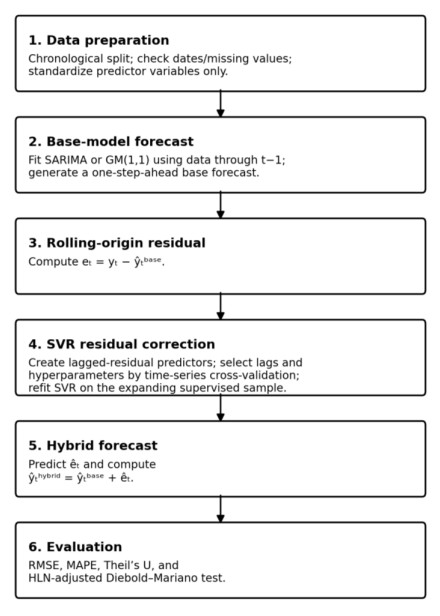
Revised rolling-origin construction of the GM(1, 1)–SVR and SARIMA–SVR residual correction models
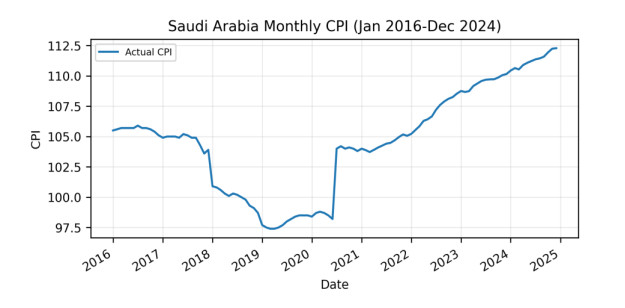
Saudi Arabia's monthly CPI (January 2016–December 2024)
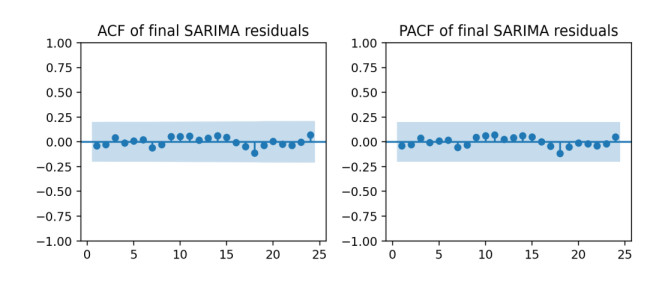
ACF and PACF of residuals from the final SARIMA(1, 1, 1)(0, 0, 1)[12] training fit
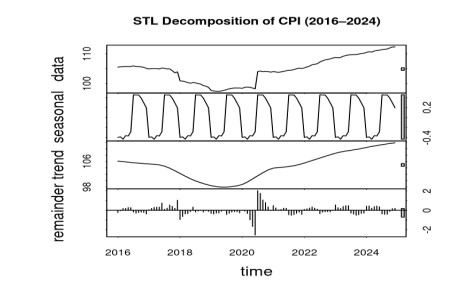
Seasonal trend decomposition of the CPI time series
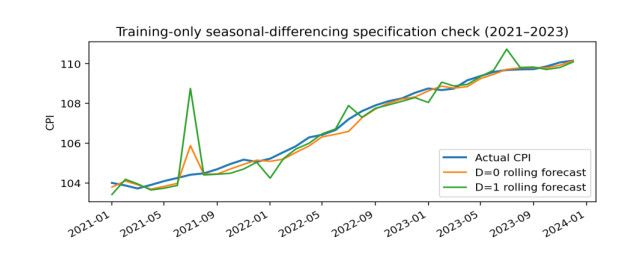
Training-only rolling comparison of the D = 0 and D = 1 SARIMA specifications (2021–2023)
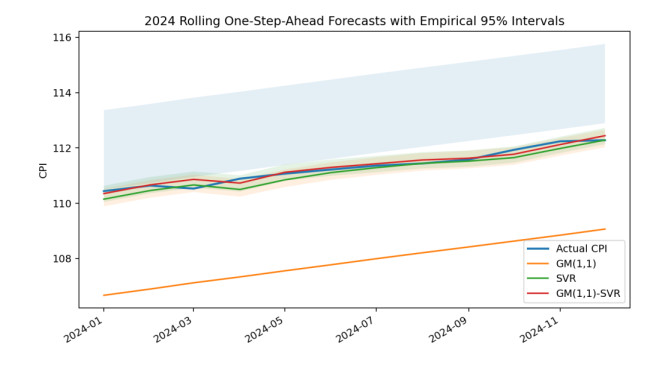
Actual CPI and revised GM(1, 1), SVR, and GM(1, 1)–SVR rolling one-step-ahead forecasts for 2024 with empirical 95% forecast intervals
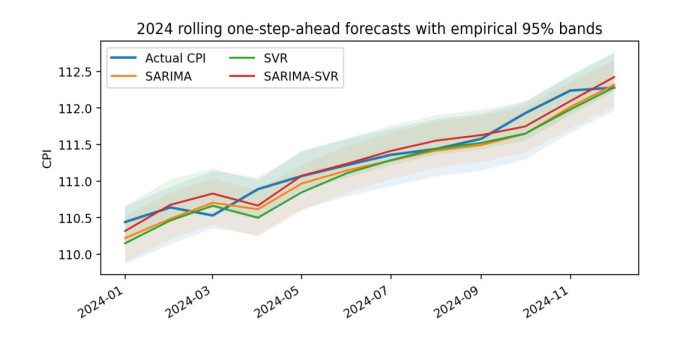
Actual CPI and final D = 0 SARIMA, SVR, and SARIMA–SVR rolling one-step-ahead forecasts for 2024 with empirical 95% forecast bands
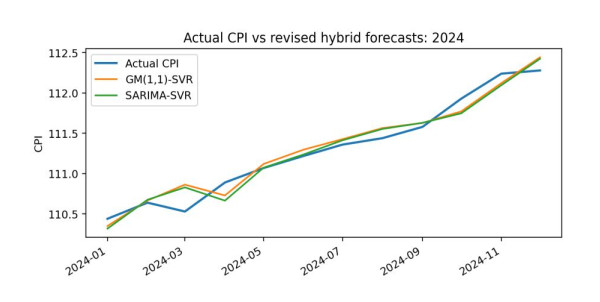
Actual CPI and revised hybrid forecasts (January–December 2024)
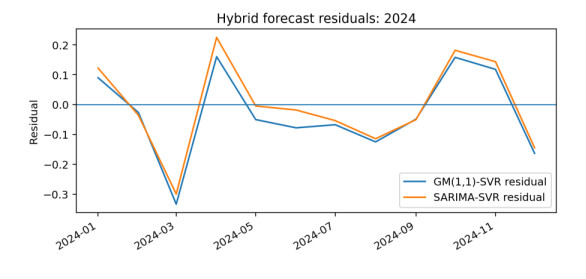
Revised hybrid model residuals over time (January–December 2024)
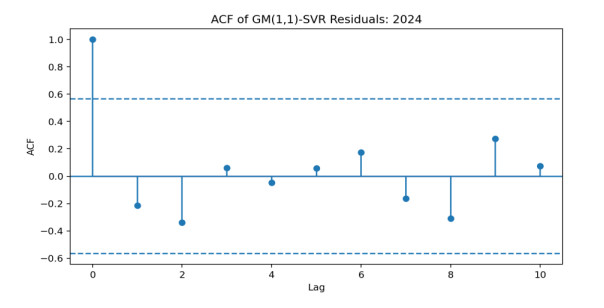
ACF of GM(1, 1)–SVR residuals
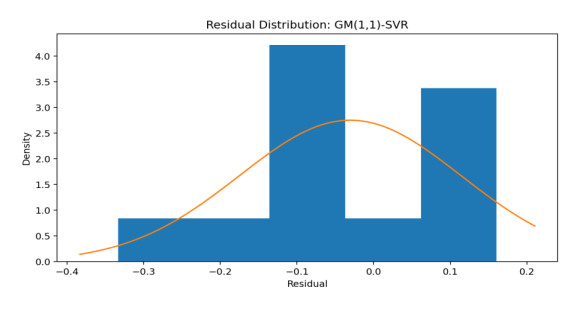
Residual distribution for GM(1, 1)–SVR
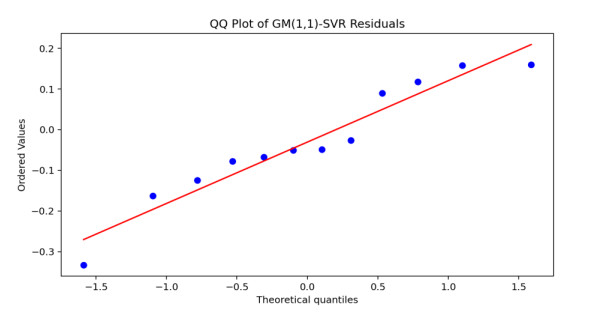
QQ plot of GM(1, 1)–SVR residuals
RMSE and MAPE for rolling one-step-ahead forecasts on the 2024 holdout period
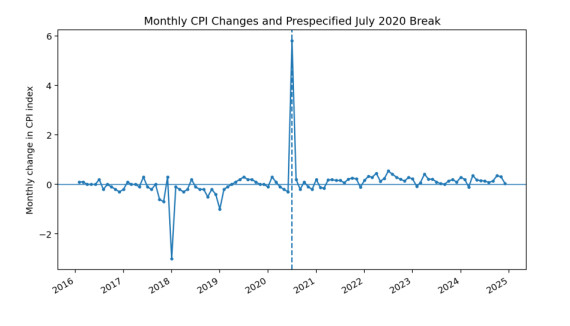
Monthly CPI changes and the prespecified July 2020 structural break date




 DownLoad: