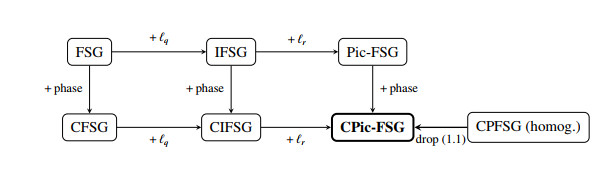
Abbas and Malik recently introduced complex picture fuzzy subgroups (CPic-FSGs) and developed their basic theory. Their development rests on a standing homogeneity assumption: in every component, the amplitude and the phase are required to be comonotone, so that the two induce the same order and a comparison of complex grades becomes one-dimensional. This paper removes that assumption. We replace homogeneity by an explicit order. The set of admissible complex grades is shown to be a complete lattice under the componentwise order, and every inequality used in this theory is identified as an inequality in that lattice. On that basis, we prove that a complex picture fuzzy set is a CPic-FSG if and only if both its amplitude triple and its phase triple are picture fuzzy subgroups, without any comonotonicity hypothesis. Four worked examples are exhibited, each of which fails the homogeneity condition and therefore lies outside the scope of Abbas and Malik; in one of them, the amplitude triple is a picture fuzzy subgroup while the phase triple is not, which cannot occur under homogeneity. Then, we treat the two questions that the admissibility constraints are non-trivial, which are not addressed in the prior literature. First, we explicitly define the intersection and union that preserves admissibility. Second, we prove that the homomorphic image is a complex picture fuzzy set, that outright fails for the variant of the definition in which the neutral grade is collected by a supremum. Finally, we sharpen the homomorphism theory: Direct images are shown to transport the subgroup and normality conditions under epimorphisms, and inverse images under arbitrary homomorphisms, in each case weakening the isomorphism hypothesis previously used.
Citation: Lulwah AL-Essa, Eman A. AbuHijleh. On complex picture fuzzy subgroups: a Lattice-ordered and sharpened homomorphism theorems[J]. AIMS Mathematics, 2026, 11(11): 38271-38300. doi: 10.3934/math.20261478
Abbas and Malik recently introduced complex picture fuzzy subgroups (CPic-FSGs) and developed their basic theory. Their development rests on a standing homogeneity assumption: in every component, the amplitude and the phase are required to be comonotone, so that the two induce the same order and a comparison of complex grades becomes one-dimensional. This paper removes that assumption. We replace homogeneity by an explicit order. The set of admissible complex grades is shown to be a complete lattice under the componentwise order, and every inequality used in this theory is identified as an inequality in that lattice. On that basis, we prove that a complex picture fuzzy set is a CPic-FSG if and only if both its amplitude triple and its phase triple are picture fuzzy subgroups, without any comonotonicity hypothesis. Four worked examples are exhibited, each of which fails the homogeneity condition and therefore lies outside the scope of Abbas and Malik; in one of them, the amplitude triple is a picture fuzzy subgroup while the phase triple is not, which cannot occur under homogeneity. Then, we treat the two questions that the admissibility constraints are non-trivial, which are not addressed in the prior literature. First, we explicitly define the intersection and union that preserves admissibility. Second, we prove that the homomorphic image is a complex picture fuzzy set, that outright fails for the variant of the definition in which the neutral grade is collected by a supremum. Finally, we sharpen the homomorphism theory: Direct images are shown to transport the subgroup and normality conditions under epimorphisms, and inverse images under arbitrary homomorphisms, in each case weakening the isomorphism hypothesis previously used.

| [1] |
L. A. Zadeh, Fuzzy sets, Inf. Control, 8 (1965), 338–353. https://doi.org/10.1016/S0019-9958(65)90241-X doi: 10.1016/S0019-9958(65)90241-X
|
| [2] |
K. T. Atanassov, Intuitionistic fuzzy sets, Fuzzy Sets Syst., 20 (1986), 87–96. https://doi.org/10.1016/S0165-0114(86)80034-3 doi: 10.1016/S0165-0114(86)80034-3
|
| [3] |
B. C. Cuong, V. Kreinovich, Picture fuzzy sets — a new concept for computational intelligence problems, Proceedings of the Third World Congress on Information and Communication Technologies (WICT 2013), 2013. https://doi.org/10.1109/WICT.2013.7113099 |
| [4] |
B. C. Cuong, Picture fuzzy sets, J. Comput. Sci. Cybern., 30 (2014), 409–420. https://doi.org/10.15625/1813-9663/30/4/5032 doi: 10.15625/1813-9663/30/4/5032
|
| [5] |
H. J. Zimmermann, Fuzzy set theory and its applications, 4 Eds., Springer, 2013. |
| [6] |
D. Ramot, R. Milo, M. Friedman, A. Kandel, Complex fuzzy sets, IEEE Trans. Fuzzy Syst., 10 (2002), 171–186. https://doi.org/10.1109/91.995119 |
| [7] |
A. U. M. Alkouri, A. R. Salleh, Complex intuitionistic fuzzy sets, AIP Conf. Proc., 1482 (2012), 464–470. https://doi.org/10.1063/1.4757515 doi: 10.1063/1.4757515
|
| [8] |
A. U. M. Alkouri, A. R. Salleh, Complex Atanassov's intuitionistic fuzzy relation, Abstract Appl. Anal., 2013 (2013), 287382. https://doi.org/10.1155/2013/287382 doi: 10.1155/2013/287382
|
| [9] |
M. Akram, A. Bashir, H. Garg, Decision-making model under complex picture fuzzy Hamacher aggregation operators, Comput. Appl. Math., 39 (2020), 226. https://doi.org/10.1007/s40314-020-01251-2 doi: 10.1007/s40314-020-01251-2
|
| [10] |
C. Jana, T. Senapati, M. Pal, R. R. Yager, Picture fuzzy Dombi aggregation operators: application to MADM process, Appl. Soft Comput., 74 (2019), 99–109. https://doi.org/10.1016/j.asoc.2018.10.021 doi: 10.1016/j.asoc.2018.10.021
|
| [11] |
A. Rosenfeld, Fuzzy groups, J. Math. Anal. Appl., 35 (1971), 512–517. https://doi.org/10.1016/0022-247X(71)90199-5 doi: 10.1016/0022-247X(71)90199-5
|
| [12] |
R. Biswas, Intuitionistic fuzzy subgroups, Math. Forum, 10 (1989), 39–44. |
| [13] |
S. Dogra, M. Pal, Picture fuzzy subgroup, Kragujevac J. Math., 47 (2023), 911–933. https://doi.org/10.46793/KgJMat2306.911D doi: 10.46793/KgJMat2306.911D
|
| [14] |
E. A. AbuHijleh, M. Massa'deh, A. Sheimat, A. Alkouri, Complex fuzzy groups based on Rosenfeld's approach, WSEAS Trans. Math., 20 (2021), 368–377. https://doi.org/10.37394/23206.2021.20.38 doi: 10.37394/23206.2021.20.38
|
| [15] |
M. Gulzar, M. H. Mateen, D. Alghazzawi, N. Kausar, A novel application of complex intuitionistic fuzzy sets in group theory, IEEE Access, 8 (2020), 196075–196085. https://doi.org/10.1109/ACCESS.2020.3034626 doi: 10.1109/ACCESS.2020.3034626
|
| [16] |
S. Bhunia, G. Ghorai, Q. Xin, On the characterization of Pythagorean fuzzy subgroups, AIMS Math., 6 (2021), 962–978. https://doi.org/10.3934/math.2021058 doi: 10.3934/math.2021058
|
| [17] |
B. O. Onasanya, X. Ming, Y. Feng, W. Zhang, Harmonization of some fuzzy subgroups, Ital. J. Pure Appl. Math., 48 (2022), 863–876. |
| [18] |
A. Alkouri, E. AbuHijleh, E. Almuhur, G. Alafifi, Subgroups and homomorphism structures of complex Pythagorean fuzzy sets, WSEAS Trans. Math., 23 (2024), 614–626. https://doi.org/10.37394/23206.2024.23.65 doi: 10.37394/23206.2024.23.65
|
| [19] |
E. AbuHijleh, A. Alkouri, Some algebraic structures of complex Fermatean fuzzy subgroups, Eur. J. Pure Appl. Math., 18 (2025), 5572. https://doi.org/10.29020/nybg.ejpam.v18i1.5572 doi: 10.29020/nybg.ejpam.v18i1.5572
|
| [20] |
E. A. AbuHijleh, S. A. Khalil, S. Abu-Ghurra, G. Alafifi, On the characterization of harmonized fuzzy subgroups $\theta$ open set, Int. J. Neutrosophic Sci., 26 (2025), 223–233. https://doi.org/10.54216/IJNS.260119 doi: 10.54216/IJNS.260119
|
| [21] |
M. Ali, F. Smarandache, Complex neutrosophic set, Neural Comput. Appl., 28 (2017), 1817–1834. https://doi.org/10.1007/s00521-015-2154-y doi: 10.1007/s00521-015-2154-y
|
| [22] |
G. Abbas, M. Aslam Malik, Complex picture fuzzy subgroup and its application in modeling of a parallel robotic grippers, Punjab Univ. J. Math., 58 (2026), 49–82. https://doi.org/10.52280/pujm.2026.58(01)03 doi: 10.52280/pujm.2026.58(01)03
|
Figures(1) / Tables(5)

Lulwah AL-Essa, Eman A. AbuHijleh. On complex picture fuzzy subgroups: a Lattice-ordered and sharpened homomorphism theorems[J]. AIMS Mathematics, 2026, 11(11): 38271-38300. doi: 10.3934/math.20261478

Specialization relations




 DownLoad: