Equality of opportunity is an important pathway toward achieving common prosperity, and the return to education is a key indicator from the perspective of income distribution equity. Estimates of the return to education are mainly based on micro-level survey data, but such estimates may be biased due to missing data. Using data from the China Family Panel Studies from 2018 to 2022, this study estimated the returns to education in China under both the missing at random (MAR) and parametric not missing at random (NMAR) settings, employing fully parametric and semiparametric models, respectively. It further examined the effect of reclassifying migrant samples on the measurement of urban–rural differences. The results showed that: (1) Under the parametric NMAR specification adopted in this study, the estimated return to education for the national sample is lower than that obtained under the corresponding MAR specification, indicating that the measurement of returns to education is relatively sensitive to assumptions regarding the income missingness mechanism. (2) Across different missingness mechanisms, model specifications, and sample classifications, the estimated return to education is consistently higher in urban areas than in rural areas, while the rural estimates are more sensitive to the assumed missingness mechanism. (3) After treating the work-experience term nonparametrically, the estimated return to education remains higher in urban areas than in rural areas, suggesting that the main conclusion is robust to the functional-form specification of work experience. (4) Among the employed sample and under the reclassification scheme adopted in this study, reassigning employed individuals who currently reside in urban areas but hold rural hukou status to the rural sample further widens the estimated urban–rural gap in returns to education. Further comparisons showed that both assumptions about the missingness mechanism and the classification of migrant populations affect the measurement of urban–rural differences in returns to education. These findings highlight the importance of carefully accounting for uncertainty arising from income missingness mechanisms and sample-classification rules when estimating returns to education using micro-level survey data.
Citation: Chao Dai, Tingfang Luo, Hanji He, Jierui Du. Measuring the returns to education in China and their urban–rural disparities from the perspective of nonignorable missingness[J]. AIMS Mathematics, 2026, 11(11): 38301-38334. doi: 10.3934/math.20261479
Equality of opportunity is an important pathway toward achieving common prosperity, and the return to education is a key indicator from the perspective of income distribution equity. Estimates of the return to education are mainly based on micro-level survey data, but such estimates may be biased due to missing data. Using data from the China Family Panel Studies from 2018 to 2022, this study estimated the returns to education in China under both the missing at random (MAR) and parametric not missing at random (NMAR) settings, employing fully parametric and semiparametric models, respectively. It further examined the effect of reclassifying migrant samples on the measurement of urban–rural differences. The results showed that: (1) Under the parametric NMAR specification adopted in this study, the estimated return to education for the national sample is lower than that obtained under the corresponding MAR specification, indicating that the measurement of returns to education is relatively sensitive to assumptions regarding the income missingness mechanism. (2) Across different missingness mechanisms, model specifications, and sample classifications, the estimated return to education is consistently higher in urban areas than in rural areas, while the rural estimates are more sensitive to the assumed missingness mechanism. (3) After treating the work-experience term nonparametrically, the estimated return to education remains higher in urban areas than in rural areas, suggesting that the main conclusion is robust to the functional-form specification of work experience. (4) Among the employed sample and under the reclassification scheme adopted in this study, reassigning employed individuals who currently reside in urban areas but hold rural hukou status to the rural sample further widens the estimated urban–rural gap in returns to education. Further comparisons showed that both assumptions about the missingness mechanism and the classification of migrant populations affect the measurement of urban–rural differences in returns to education. These findings highlight the importance of carefully accounting for uncertainty arising from income missingness mechanisms and sample-classification rules when estimating returns to education using micro-level survey data.

| [1] |
T. Sicular, X. M. Yue, B. Gustafsson, S. Li, The urban–rural income gap and inequality in China, Rev. Income Wealth, 53 (2007), 93–126. https://doi.org/10.1111/j.1475-4991.2007.00219.x doi: 10.1111/j.1475-4991.2007.00219.x
|
| [2] |
J. A. Mincer, Schooling, experience, and earnings, New York: National Bureau of Economic Research, 1974. |
| [3] |
G. Psacharopoulos, H. A. Patrinos, Returns to investment in education: A decennial review of the global literature, Educ. Econ., 26 (2018), 445–458. https://doi.org/10.1080/09645292.2018.1484426 doi: 10.1080/09645292.2018.1484426
|
| [4] |
J. S. Zhang, Y. H. Zhao, A. Park, X. Q. Song, Economic returns to schooling in urban China, 1988 to 2001, J. Comp. Econ., 33 (2005), 730–752. https://doi.org/10.1016/j.jce.2005.05.008 doi: 10.1016/j.jce.2005.05.008
|
| [5] |
X. Zhou, Increasing returns to education, changing labor force structure, and the rise of earnings inequality in urban China, 1996–2010, Soc. Forces, 93 (2014), 429–455. https://doi.org/10.1093/sf/sou073 doi: 10.1093/sf/sou073
|
| [6] |
X. X. Ma, I. Iwasaki, Return to schooling in China: A large meta-analysis, Educ. Econ., 29 (2021), 379–410. https://doi.org/10.1080/09645292.2021.1900791 doi: 10.1080/09645292.2021.1900791
|
| [7] |
X. Gao, M. S. Li, Differences between returns to education in urban and rural China and its evolution from 1989 to 2019, PLoS One, 17 (2022), e0274506. https://doi.org/10.1371/journal.pone.0274506 doi: 10.1371/journal.pone.0274506
|
| [8] |
B. Huang, M. Tani, Y. Wei, Y. Zhu, Returns to education in China: Evidence from the great higher education expansion, China Econ. Rev., 74 (2022), 101804. https://doi.org/10.1016/j.chieco.2022.101804 doi: 10.1016/j.chieco.2022.101804
|
| [9] |
D. X. Hu, H. C. Li, H. X. Song, J. M. Liang, Trends and urban-rural disparities in the returns to higher education in China amidst scale expansion: A correlational analysis, Front. Educ., 11 (2026), 1752579. https://doi.org/10.3389/feduc.2026.1752579 doi: 10.3389/feduc.2026.1752579
|
| [10] |
Z. Q. Liu, Institution and inequality: The hukou system in China, J. Comp. Econ., 33 (2005), 133–157. https://doi.org/10.1016/j.jce.2004.11.001 doi: 10.1016/j.jce.2004.11.001
|
| [11] |
C. R. Bollinger, B. T. Hirsch, C. M. Hokayem, J. P. Ziliak, Trouble in the tails? What we know about earnings nonresponse 30 years after Lillard, Smith, and Welch, J. Polit. Econ., 127 (2019), 2143–2185. https://doi.org/10.1086/701807 doi: 10.1086/701807
|
| [12] |
D. B. Rubin, Inference and missing data, Biometrika, 63 (1976), 581–592. https://doi.org/10.1093/biomet/63.3.581 |
| [13] |
L. Q. Xia, X. L. Wang, P. X. Zhao, Y. Q. Song, Empirical likelihood for varying coefficient partially nonlinear model with missing responses, AIMS Math., 6 (2021), 7125–7152. https://doi.org/10.3934/math.2021418 doi: 10.3934/math.2021418
|
| [14] |
Z. Q. Liang, Y. Q. Zhou, Model averaging based on weighted generalized method of moments with missing responses, AIMS Math., 8 (2023), 21683–21699. https://doi.org/10.3934/math.20231106 doi: 10.3934/math.20231106
|
| [15] |
H. J. He, M. N. Li, G. M. Deng, Group feature screening for ultrahigh-dimensional data missing at random, AIMS Math., 9 (2024), 4032–4056. https://doi.org/10.3934/math.2024197 doi: 10.3934/math.2024197
|
| [16] |
J. K. Kim, C. L. Yu, A semiparametric estimation of mean functionals with nonignorable missing data, J. Am. Stat. Assoc., 106 (2011), 157–165. https://doi.org/10.1198/jasa.2011.tm10104 doi: 10.1198/jasa.2011.tm10104
|
| [17] |
J. W. Zhao, J. Shao, Semiparametric pseudo-likelihoods in generalized linear models with nonignorable missing data, J. Am. Stat. Assoc., 110 (2015), 1577–1590. https://doi.org/10.1080/01621459.2014.983234 doi: 10.1080/01621459.2014.983234
|
| [18] |
J. Shao, L. Wang, Semiparametric inverse propensity weighting for nonignorable missing data, Biometrika, 103 (2016), 175–187. https://doi.org/10.1093/biomet/asv071 doi: 10.1093/biomet/asv071
|
| [19] |
W. Miao, P. Ding, Z. Geng, Identifiability of normal and normal mixture models with nonignorable missing data, J. Am. Stat. Assoc., 111 (2016), 1673–1683. https://doi.org/10.1080/01621459.2015.1105808 doi: 10.1080/01621459.2015.1105808
|
| [20] |
J. R. Du, X. Cui, Semiparametric estimation in generalized additive partial linear models with nonignorable nonresponse data, Stat. Papers, 65 (2024), 3235–3259. https://doi.org/10.1007/s00362-023-01522-0 doi: 10.1007/s00362-023-01522-0
|
| [21] |
Y. T. Xiao, Y. F. Shi, Robust estimation for varying-coefficient partially nonlinear model with nonignorable missing response, AIMS Math., 8 (2023), 29849–29871. https://doi.org/10.3934/math.20231526 doi: 10.3934/math.20231526
|
| [22] |
M. L. Cheng, Y. K. Liu, J. Qin, A novel semiparametric approach to nonignorable missing data by catching covariate marginal information, Scand. J. Stat., 52 (2025), 691–709. https://doi.org/10.1111/sjos.12767 doi: 10.1111/sjos.12767
|
| [23] |
S. Shetty, Y. Y. Ma, J. W. Zhao, Robust estimation under a semiparametric propensity model for nonignorable missing data, Electron. J. Stat., 19 (2025), 956–981. https://doi.org/10.1214/25-EJS2355 doi: 10.1214/25-EJS2355
|
| [24] |
Y. H. Zhao, Leaving the countryside: Rural-to-urban migration decisions in China, Am. Econ. Rev., 89 (1999), 281–286. https://doi.org/10.1257/aer.89.2.281 doi: 10.1257/aer.89.2.281
|
| [25] |
X. Meng, J. S. Zhang, The two-tier labor market in urban China: Occupational segregation and wage differentials between urban residents and rural migrants in Shanghai, J. Comp. Econ., 29 (2001), 485–504. https://doi.org/10.1006/jcec.2001.1730 doi: 10.1006/jcec.2001.1730
|
| [26] |
Y. Yao, G. S. Chen, R. Salim, X. J. Yu, Schooling returns for migrant workers in China: Estimations from the perspective of the institutional environment in a rural setting, China Econ. Rev., 51 (2018), 240–256. https://doi.org/10.1016/j.chieco.2017.09.008 doi: 10.1016/j.chieco.2017.09.008
|
| [27] |
X. Gao, M. S. Li, The urban–rural difference in returns to education in China from the perspective of household registration conversion, Asia Pac. Educ. Rev., 27 (2026), 969–981. https://doi.org/10.1007/s12564-025-10058-x doi: 10.1007/s12564-025-10058-x
|
| [28] |
X. Y. Wu, M. Amorim, Return migration and educational investments in children in China: Hukou differences and the role of parental coresidence, Demogr. Res., 54 (2026), 591–644. https://doi.org/10.4054/DemRes.2026.54.20 doi: 10.4054/DemRes.2026.54.20
|
| [29] |
J. R. Du, Y. Li, X. Cui, Identification and estimation of generalized additive partial linear models with nonignorable missing response, Commun. Math. Stat., 12 (2024), 113–156. https://doi.org/10.1007/s40304-022-00284-9 doi: 10.1007/s40304-022-00284-9
|
| [30] |
E. Flachaire, N. Lustig, A. Vigorito, Underreporting of top incomes and inequality: A comparison of correction methods using simulations and linked survey and tax data, Rev. Income Wealth, 69 (2023), 1033–1059. https://doi.org/10.1111/roiw.12618 doi: 10.1111/roiw.12618
|
Figures(1) / Tables(17)

Chao Dai, Tingfang Luo, Hanji He, Jierui Du. Measuring the returns to education in China and their urban–rural disparities from the perspective of nonignorable missingness[J]. AIMS Mathematics, 2026, 11(11): 38301-38334. doi: 10.3934/math.20261479

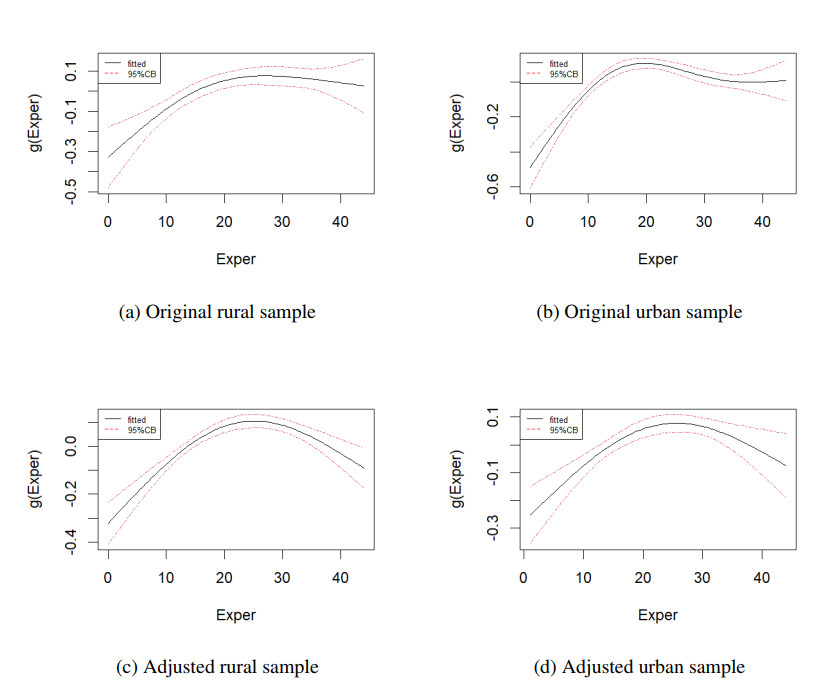
Smooth function estimates of the work experience effect on income under the NMAR mechanism




 DownLoad: