We present a compact implicit high-resolution finite volume scheme for one-dimensional multicomponent transport problems with nonlinear Langmuir sorption. The method combines a second-order compact implicit discretization with Weighted Essentially Non-Oscillatory (WENO) reconstruction and a time limiter for the treatment of steep gradients and discontinuities. Special attention is given to the Courant number used in the limiter, where local characteristic Courant numbers based on the eigenvalues of the inverse retardation matrix were considered. The compact implicit schemes were compared with analogous explicit first-order and second-order methods. Numerical experiments showed second-order convergence for smooth solutions and demonstrated that the implicit approach can be used with significantly larger Courant numbers. The method was also applied to a three-component displacement chromatography problem with sharp concentration fronts.
Citation: Dagmar Žáková, Peter Frolkovič. Compact implicit high-resolution numerical scheme for multicomponent transport problems with Langmuir sorption[J]. AIMS Mathematics, 2026, 11(11): 38242-38270. doi: 10.3934/math.20261477
We present a compact implicit high-resolution finite volume scheme for one-dimensional multicomponent transport problems with nonlinear Langmuir sorption. The method combines a second-order compact implicit discretization with Weighted Essentially Non-Oscillatory (WENO) reconstruction and a time limiter for the treatment of steep gradients and discontinuities. Special attention is given to the Courant number used in the limiter, where local characteristic Courant numbers based on the eigenvalues of the inverse retardation matrix were considered. The compact implicit schemes were compared with analogous explicit first-order and second-order methods. Numerical experiments showed second-order convergence for smooth solutions and demonstrated that the implicit approach can be used with significantly larger Courant numbers. The method was also applied to a three-component displacement chromatography problem with sharp concentration fronts.

| [1] |
M. L. Brusseau, The effect of nonlinear sorption on transformation of contaminants during transport in porous media, J. Contam. Hydrol., 17 (1995), 277–291. https://doi.org/10.1016/0169-7722(94)00041-F doi: 10.1016/0169-7722(94)00041-F
|
| [2] |
J. Kačur, B. Malengier, M. Remešíková, Solution of contaminant transport with equilibrium and non-equilibrium adsorption, Comput. Method. Appl. M., 194 (2005), 479–489. https://doi.org/10.1016/j.cma.2004.05.017 doi: 10.1016/j.cma.2004.05.017
|
| [3] |
S. B. Patil, H. S. Chore, Contaminant transport through porous media: An overview of experimental and numerical studies, Ad. Environ. Res., 3 (2014), 45–69. |
| [4] |
S. Javeed, S. Qamar, A. Seidel-Morgenstern, G. Warnecke, Efficient and accurate numerical simulation of nonlinear chromatographic processes, Comput. Chem. Eng., 35 (2011), 2294–2305. https://doi.org/10.1016/j.compchemeng.2010.10.002 doi: 10.1016/j.compchemeng.2010.10.002
|
| [5] |
R. Bürger, P. Mulet, L. Rubio, M. Sepúlveda, Linearly implicit-explicit schemes for the equilibrium dispersive model of chromatography, Appl. Math. Comput., 317 (2018), 172–186. https://doi.org/10.1016/j.amc.2017.09.006 doi: 10.1016/j.amc.2017.09.006
|
| [6] |
K. Meyer, S. Leweke, E. von Lieres, J. K. Huusom, J. Abildskov, ChromaTech: A discontinuous Galerkin spectral element simulator for preparative liquid chromatography, Comput. Chem. Eng., 141 (2020), 107012. https://doi.org/10.1016/j.compchemeng.2020.107012 doi: 10.1016/j.compchemeng.2020.107012
|
| [7] |
P. Frolkovič, M. Lampe, G. Wittum, Numerical simulation of contaminant transport in groundwater using software tools of $r^3t$, Comput. Visual. Sci., 18 (2016), 17–29. https://doi.org/10.1007/s00791-016-0268-0 doi: 10.1007/s00791-016-0268-0
|
| [8] |
D. Žáková, P. Frolkovič, Compact implicit high resolution numerical method for solving transport problems with sorption isotherms, Tatra Mountains Mathematical Publications, 91 (2025), 153–178. https://doi.org/10.2478/tmmp-2025-0030 doi: 10.2478/tmmp-2025-0030
|
| [9] |
M. A. Rasheed, S. Perveen, S. Qamar, Simulation of nonlinear and nonisothermal reactive liquid chromatography considering finite mass-transfer rates and various adsorption scenarios, ACS Omega, 9 (2024), 47284–47308. https://doi.org/10.1021/acsomega.4c08414 doi: 10.1021/acsomega.4c08414
|
| [10] |
R. Donat, M. C. Martí, P. Mulet, WENO scheme on characteristics for the equilibrium dispersive model of chromatography with generalized Langmuir isotherms, Appl. Numer. Math., 201 (2024), 247–264. https://doi.org/10.1016/j.apnum.2024.03.006 doi: 10.1016/j.apnum.2024.03.006
|
| [11] |
R. J. LeVeque, Finite-volume methods for hyperbolic problems, Cambridge: Cambridge University Press, 2002. https://doi.org/10.1017/CBO9780511791253 |
| [12] |
P. Frolkovič, J. Kačur, Semi-analytical solutions of a contaminant transport equation with nonlinear sorption in 1D, Comput. Geosci., 10 (2006), 279–290. https://doi.org/10.1007/s10596-006-9023-9 doi: 10.1007/s10596-006-9023-9
|
| [13] |
R. Donat, F. Guerrero, P. Mulet, Implicit–explicit WENO scheme for the equilibrium dispersive model of chromatography, Appl. Numer. Math., 123 (2018), 22–42. https://doi.org/10.1016/j.apnum.2017.08.008 doi: 10.1016/j.apnum.2017.08.008
|
| [14] |
P. Frolkovič, D. Žáková, Numerical solution of two dimensional scalar conservation laws using compact implicit numerical schemes on Cartesian meshes, ESAIM-Math. Model. Num., 60 (2026), 247–272. https://doi.org/10.1051/m2an/2025097 doi: 10.1051/m2an/2025097
|
| [15] |
P. Frolkovič, M. Žeravỳ, High resolution compact implicit numerical scheme for conservation laws, Appl. Math. Comput., 442 (2023), 127720. https://doi.org/10.1016/j.amc.2022.127720 doi: 10.1016/j.amc.2022.127720
|
| [16] |
C.-W. Shu, Essentially non-oscillatory and weighted essentially non-oscillatory schemes for hyperbolic conservation laws, In: Advanced numerical approximation of nonlinear hyperbolic equations, Berlin: Springer, 1998,325–432. https://doi.org/10.1007/bfb0096355 |
| [17] |
K. Duraisamy, J. D. Baeder, Implicit scheme for hyperbolic conservation laws using nonoscillatory reconstruction in space and time, SIAM J. Sci. Comput., 29 (2007), 2607–2620. https://doi.org/10.1137/070683271 doi: 10.1137/070683271
|
| [18] |
G. Puppo, M. Semplice, G. Visconti, Quinpi: Integrating conservation laws with CWENO implicit methods, Commun. Appl. Math. Comput., 5 (2023), 343–369. https://doi.org/10.1007/s42967-021-00171-0 doi: 10.1007/s42967-021-00171-0
|
| [19] |
E. Lozano, T. D. Aslam, Implicit fast sweeping method for hyperbolic systems of conservation laws, J. Comput. Phys., 430 (2021), 110039. https://doi.org/10.1016/j.jcp.2020.110039 doi: 10.1016/j.jcp.2020.110039
|
| [20] |
T. Y. Gu, Mathematical mdeling and scale-up of liquid chromatography: with application examples, Cham: Springer, 2015. https://doi.org/10.1007/978-3-319-16145-7 |
| [21] |
H. Schmidt-Traub, M. Schulte, A. Seidel-Morgenstern, Preparative chromatography, Hoboken: John Wiley & Sons, 2020. https://doi.org/10.1002/9783527816347 |
| [22] |
G. Guiochon, A. Felinger, D. G. Shirazi, Fundamentals of preparative and nonlinear chromatography, 2 Eds., Boston: Academic Press, 2006. |
| [23] |
M. Mazzotti, Nonclassical composition fronts in nonlinear chromatography: delta-shock, Ind. Eng. Chem. Res., 48 (2009), 7733–7752. https://doi.org/10.1021/ie9001537 doi: 10.1021/ie9001537
|
| [24] |
R. Donat, P. Mulet, A secular equation for the Jacobian matrix of certain multispecies kinematic flow models, Numer. Meth. Part. D. E., 26 (2010), 159–175. https://doi.org/10.1002/num.20423 doi: 10.1002/num.20423
|
| [25] |
A. Harten, High resolution schemes for hyperbolic conservation laws, J. Comput. Phys., 135 (1997), 260–278. https://doi.org/10.1006/jcph.1997.5713 doi: 10.1006/jcph.1997.5713
|
| [26] |
C.-W. Shu, S. Osher, Efficient implementation of essentially non-oscillatory shock-capturing schemes, J. Comput. Phys., 77 (1988), 439–471. https://doi.org/10.1016/0021-9991(88)90177-5 doi: 10.1016/0021-9991(88)90177-5
|
| [27] |
G.-S. Jiang, C.-W. Shu, Efficient implementation of weighted ENO schemes, J. Comput. Phys., 126 (1996), 202–228. https://doi.org/10.1006/jcph.1996.0130 doi: 10.1006/jcph.1996.0130
|
| [28] |
P. K. Sweby, High resolution schemes using flux limiters for hyperbolic conservation laws, SIAM J. Numer. Anal., 21 (1984), 995–1011. https://doi.org/10.1137/0721062 doi: 10.1137/0721062
|
| [29] |
H. K. Zhao, A fast sweeping method for Eikonal equations, Math. Comp., 74 (2005), 603–627. https://doi.org/10.1090/S0025-5718-04-01678-3 doi: 10.1090/S0025-5718-04-01678-3
|
| [30] |
J. X. Qiu, C.-W. Shu, Finite difference WENO schemes with Lax–Wendroff-type time discretizations, SIAM J. Sci. Comput., 24 (2003), 2185–2198. https://doi.org/10.1137/S1064827502412504 doi: 10.1137/S1064827502412504
|
| [31] |
J. X. Qiu, C.-W. Shu, On the construction, comparison, and local characteristic decomposition for high-order central WENO schemes, J. Comput. Phys., 183 (2002), 187–209. https://doi.org/10.1006/jcph.2002.7191 doi: 10.1006/jcph.2002.7191
|
| [32] |
C.-W. Shu, High order weighted essentially nonoscillatory schemes for convection dominated problems, SIAM Rev., 51 (2009), 82–126. https://doi.org/10.1137/070679065 doi: 10.1137/070679065
|
| [33] |
G. van Rossum, Python tutorial, CWI Report CS-R9526, Centrum voor Wiskunde en Informatica, Amsterdam, 1995. |
| [34] |
C. R. Harris, K. J. Millman, S. J. van der Walt, R. Gommers, P. Virtanen, D. Cournapeau, et al., Array programming with NumPy, Nature, 585 (2020), 357–362. https://doi.org/10.1038/s41586-020-2649-2 doi: 10.1038/s41586-020-2649-2
|
| [35] |
J. D. Hunter, Matplotlib: A 2D graphics environment, Comput. Sci. Eng., 9 (2007), 90–95. https://doi.org/10.1109/MCSE.2007.55 doi: 10.1109/MCSE.2007.55
|
| [36] |
A. Harten, B. Engquist, S. Osher, S. R. Chakravarthy, Uniformly high order accurate essentially non-oscillatory schemes, III, J. Comput. Phys., 131 (1997), 3–47. https://doi.org/10.1006/jcph.1996.5632 doi: 10.1006/jcph.1996.5632
|
| [37] |
J. Frenz, High-performance displacement chromatography, In: High-performance liquid chromatography: advances and perspectives, New York: Academic Press, 1988,211–314. https://doi.org/10.1016/b978-0-12-312205-6.50007-2 |
| [38] |
D. Žáková, P. Frolkovič, Higher order compact implicit finite volume schemes for scalar conservation laws, In: Hyperbolic problems: theory, numerics, applications, Volume II, Cham: Springer, 2024,221–231. https://doi.org/10.1007/978-3-031-55264-9_19 |
Figures(9) / Tables(4)

Dagmar Žáková, Peter Frolkovič. Compact implicit high-resolution numerical scheme for multicomponent transport problems with Langmuir sorption[J]. AIMS Mathematics, 2026, 11(11): 38242-38270. doi: 10.3934/math.20261477

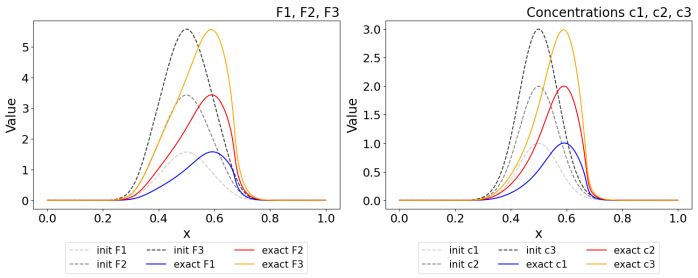
Initial profiles at $ t = 0 $, see Eq (5.2), and the corresponding reference solution at $ T = 0.5 $ for the smooth three-component Langmuir problem (Experiment 5.1). The left figure shows the accumulated concentrations $ F_1 $, $ F_2 $, and $ F_3 $, while the right panel shows the mobile concentrations $ c_1 $, $ c_2 $, and $ c_3 $. The reference solution was computed using the second-order compact implicit scheme with the constant reconstruction parameter $ \omega = 1/2 $ and $ M_{\mathrm{ref}} = 20, 480 $
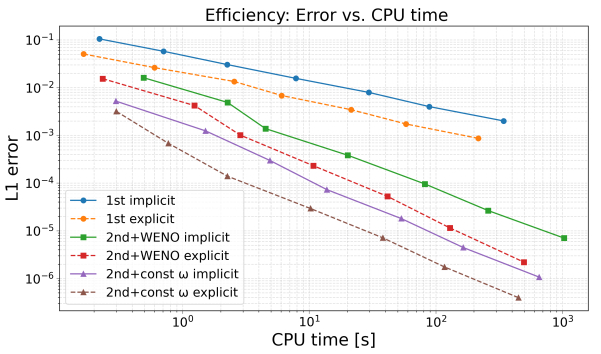
Efficiency comparison of the numerical schemes for Experiment 5.1 in terms of the $ L^1 $-error as a function of CPU time. The results are shown on a log-log scale for the explicit and implicit first-order schemes, the second-order schemes with WENO reconstruction, and the second-order schemes with the constant reconstruction parameter $ \omega = 1/2 $. The computations were performed with $ \mathrm{Co}_{\max} = 0.5 $, and the CPU times represent arithmetic means over five runs
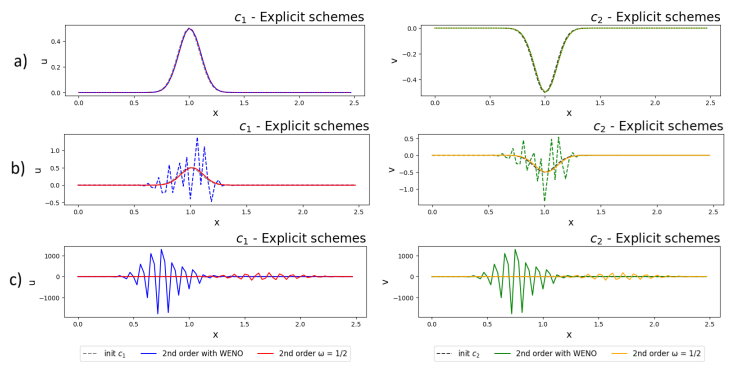
Comparison of two explicit second-order schemes, one using the constant reconstruction parameter $ \omega = 1/2 $ and the other using WENO reconstruction, for the smooth case of the linear benchmark problem in Experiment 5.2, with the exact Gaussian solution given by (5.5). The results at $ t\approx0.15 $ are shown for $ c_1 $ in the left column and for $ c_2 $ in the right column. From top to bottom, the rows correspond to $ \mathrm{Co}_{L} = 0.5 $, $ 1 $, and $ 1.25 $, denoted by $ a) $, $ b) $, and $ c) $, respectively. Both schemes remain stable for $ \mathrm{Co}_{L} = 0.5 $, oscillations appear in the WENO solution for $ \mathrm{Co}_{L} = 1 $, and both explicit schemes become unstable for $ \mathrm{Co}_{L} = 1.25 $
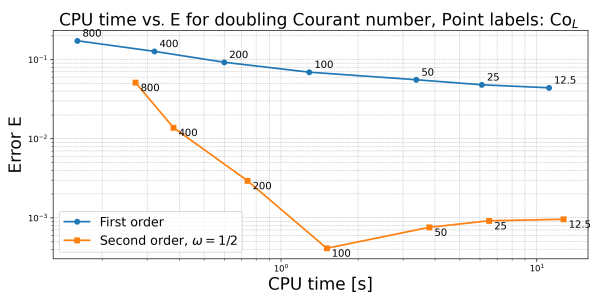
Efficiency comparison of the implicit schemes for the smooth case of the linear benchmark problem in Experiment 5.2, with the exact Gaussian solution given by (5.5). The numerical error $ E $ is plotted as a function of CPU time for the implicit first-order scheme and the compact implicit second-order scheme with the constant reconstruction parameter $ \omega = 1/2 $. The plotted points correspond to the larger Courant numbers $ \mathrm{Co}_{L} $ reported in Table 3, with $ \mathrm{Co}_{L} = 100\, \mathrm{Co}_{S} $ and $ M = 640 $ finite volumes
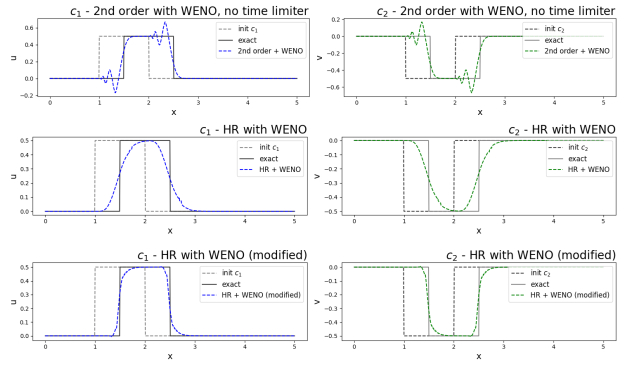
Comparison of the numerical concentration profiles for the discontinuous case of the linear benchmark problem in Experiment 5.2, with $ \mathrm{Co}_{L} = 800 $ and $ \mathrm{Co}_{S} = 8 $. The results are shown for the compact implicit second-order scheme with WENO reconstruction without time limiting (first row), the compact implicit high-resolution scheme with the time limiter based on $ \mathrm{Co}_{L} $ (second row), and the same high-resolution scheme with the time limiter based on $ \mathrm{Co}_{S} $ (third row). The WENO scheme without time limiting exhibits visible oscillations near the discontinuities, whereas both high-resolution variants control these oscillations. Using $ \mathrm{Co}_{S} $ in the limiter results in sharper and less-diffusive concentration profiles than using $ \mathrm{Co}_{L} $
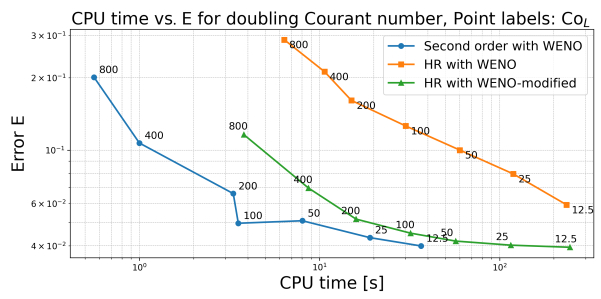
Efficiency comparison of the compact implicit schemes for the discontinuous case of the linear benchmark problem in Experiment 5.2, with the rectangular pulse exact solution. The numerical error $ E $ is plotted as a function of CPU time for the second-order scheme with WENO reconstruction without time limiting, the high-resolution scheme with WENO reconstruction and the time limiter based on $ \mathrm{Co}_{L} $, and the high-resolution scheme with WENO reconstruction and the time limiter based on $ \mathrm{Co}_{S} $. The plotted points correspond to the Courant numbers $ \mathrm{Co}_{L} $ reported in Table 4, with $ \mathrm{Co}_{L} = 100\, \mathrm{Co}_{S} $ and $ M = 640 $ finite volumes
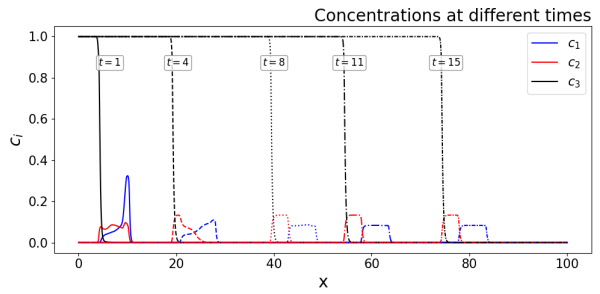
Evolution of the concentration profiles $ c_1 $ (blue), $ c_2 $ (red), and $ c_3 $ (black) for the first inlet profile in (5.7), computed using the high-resolution compact implicit scheme with WENO reconstruction and local characteristic Courant numbers in the time limiter. The solutions are shown at $ t\approx 1, \, 4, \, 8, \, 11 $ and $ T = 15 $, with $ u = 20 $ and $ \mathrm{Co}_{\max} = \tau u/h = 12 $
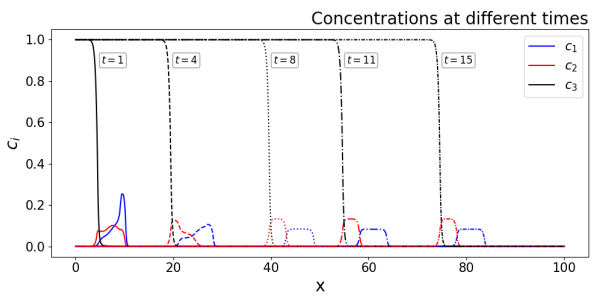
Evolution of the concentration profiles $ c_1 $ (blue), $ c_2 $ (red), and $ c_3 $ (black) for the first inlet profile in (5.7), computed using the high-resolution compact implicit scheme with WENO reconstruction and the global Courant number bound $ \mathrm{Co}_{\max} = 12 $ in the time limiter (4.2). The solutions are shown at $ t\approx 1, \, 4, \, 8, \, 11 $ and $ T = 15 $, with $ u = 20 $.
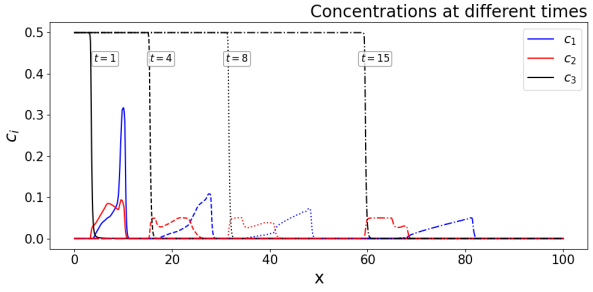
Evolution of the concentration profiles $ c_1 $ (blue), $ c_2 $ (red), and $ c_3 $ (black) for the second inlet profile in (5.7), with the displacer concentration set to $ c_3 = 0.5 $. The solutions are computed using the high-resolution compact implicit scheme with WENO reconstruction and are shown at $ t\approx 1, \, 4, \, 8 $ and $ T = 15 $, with $ u = 20 $ and $ \mathrm{Co}_{\max} = \tau u/h = 12 $




 DownLoad: