In this study, we aim to approximate the solution of a general class of stochastic differential equations (SDEs) driven by fractional Brownian motion with a Hurst parameter $ H > \frac{1}{2} $ and a square-root term in the diffusion coefficient. We employ the drift-implicit Euler-Maruyama (DIEM) method to approximate solutions of these SDEs and investigate its strong convergence properties. Despite the challenges posed by the non-Lipschitz diffusion coefficient, we demonstrate that, under reasonable monotonicity, regularity and moment assumptions on the drift function, the DIEM is mean-square convergent of order 1 for the Lamperti-transformed process, which is an optimal order. For the original square-root process $ Y = X^2 $, we obtain strong convergence of order 1 at the grid points. To demonstrate the practical relevance and computational efficiency of the method, we apply it to the fractional Cox-Ingersoll-Ross (CIR) model and discuss a fractional Heston-3/2 model whose reciprocal is a fractional CIR process. These applications underscore the potential of the proposed scheme in solving complex problems in computational statistics and finance, where fractional dynamics are used to model long-range dependencies and market memory.
Citation: Minoo Kamrani, Kristian Debrabant. Drift-implicit scheme for fractional stochastic volatility models with non-Lipschitz diffusion[J]. AIMS Mathematics, 2026, 11(11): 37735-37763. doi: 10.3934/math.20261459
In this study, we aim to approximate the solution of a general class of stochastic differential equations (SDEs) driven by fractional Brownian motion with a Hurst parameter $ H > \frac{1}{2} $ and a square-root term in the diffusion coefficient. We employ the drift-implicit Euler-Maruyama (DIEM) method to approximate solutions of these SDEs and investigate its strong convergence properties. Despite the challenges posed by the non-Lipschitz diffusion coefficient, we demonstrate that, under reasonable monotonicity, regularity and moment assumptions on the drift function, the DIEM is mean-square convergent of order 1 for the Lamperti-transformed process, which is an optimal order. For the original square-root process $ Y = X^2 $, we obtain strong convergence of order 1 at the grid points. To demonstrate the practical relevance and computational efficiency of the method, we apply it to the fractional Cox-Ingersoll-Ross (CIR) model and discuss a fractional Heston-3/2 model whose reciprocal is a fractional CIR process. These applications underscore the potential of the proposed scheme in solving complex problems in computational statistics and finance, where fractional dynamics are used to model long-range dependencies and market memory.

| [1] |
V. N. Afanas'ev, V. B. Kolmanovskii, V. R. Nosov, Mathematical theory of control systems design, Dordrecht: Springer, 1996. https://doi.org/10.1007/978-94-017-2203-2 |
| [2] |
S. Busenberg, K. L. Cooke, The effect of integral conditions in certain equations modelling epidemics and population growth, J. Math. Biol., 10 (1980), 13–32. https://doi.org/10.1007/BF00276393 doi: 10.1007/BF00276393
|
| [3] |
M. Kamrani, Numerical solution of stochastic fractional differential equations, Numer. Algorithms, 68 (2015), 81–93. https://doi.org/10.1007/s11075-014-9839-7 doi: 10.1007/s11075-014-9839-7
|
| [4] |
A. Alfonsi, Strong order one convergence of a drift implicit Euler scheme: application to the CIR process, Stat. Probab. Lett., 83 (2013), 602–607. https://doi.org/10.1016/j.spl.2012.10.034 doi: 10.1016/j.spl.2012.10.034
|
| [5] |
A. Berkaoui, M. Bossy, A. Diop, Euler scheme for SDEs with non-Lipschitz diffusion coefficient: strong convergence, ESAIM Probab. Stat., 12 (2008), 1–11. https://doi.org/10.1051/ps:2007030 doi: 10.1051/ps:2007030
|
| [6] |
D. J. Higham, X. R. Mao, A. M. Stuart, Strong convergence of Euler-type methods for nonlinear stochastic differential equations, SIAM J. Numer. Anal., 40 (2002), 1041–1063. https://doi.org/10.1137/S0036142901389530 doi: 10.1137/S0036142901389530
|
| [7] |
A. Alfonsi, On the discretization schemes for the CIR (and squared Bessel) processes, Monte Carlo Methods Appl., 11 (2005), 355–384. https://doi.org/10.1515/156939605777438569 doi: 10.1515/156939605777438569
|
| [8] |
J. C. Cox, J. E. Ingersoll Jr., S. A. Ross, A theory of the term structure of interest rates, Econometrica, 53 (1985), 385–407. https://doi.org/10.2307/1911242 doi: 10.2307/1911242
|
| [9] |
Y. Z. Hu, D. Nualart, X. M. Song, A singular stochastic differential equation driven by fractional Brownian motion, Stat. Probab. Lett., 78 (2008), 2075–2085. https://doi.org/10.1016/j.spl.2008.01.080 doi: 10.1016/j.spl.2008.01.080
|
| [10] |
D. Nualart, B. Saussereau, Malliavin calculus for stochastic differential equations driven by a fractional Brownian motion, Stoch. Process. Appl., 119 (2009), 391–409. https://doi.org/10.1016/j.spa.2008.02.016 doi: 10.1016/j.spa.2008.02.016
|
| [11] |
J. Gatheral, T. Jaisson, M. Rosenbaum, Volatility is rough, Quant. Finance, 18 (2018), 933–949. https://doi.org/10.1080/14697688.2017.1393551 doi: 10.1080/14697688.2017.1393551
|
| [12] |
X. H. Wang, W. L. Xiao, J. Yu, Modeling and forecasting realized volatility with the fractional Ornstein-Uhlenbeck process, J. Econom., 232 (2023), 389–415. https://doi.org/10.1016/j.jeconom.2021.08.001 doi: 10.1016/j.jeconom.2021.08.001
|
| [13] |
A. Chronopoulou, F. G. Viens, Estimation and pricing under long-memory stochastic volatility, Ann. Finance, 8 (2012), 379–403. https://doi.org/10.1007/s10436-010-0156-4 doi: 10.1007/s10436-010-0156-4
|
| [14] |
A. Chronopoulou, F. G. Viens, Stochastic volatility and option pricing with long-memory in discrete and continuous time, Quant. Finance, 12 (2012), 635–649. https://doi.org/10.1080/14697688.2012.664939 doi: 10.1080/14697688.2012.664939
|
| [15] |
F. Comte, E. Renault, Long memory in continuous-time stochastic volatility models, Math. Finance, 8 (1998), 291–323. https://doi.org/10.1111/1467-9965.00057 doi: 10.1111/1467-9965.00057
|
| [16] |
E. Alòs, Y. Yang, A fractional Heston model with $H>1/2$, Stochastics, 89 (2017), 384–399. https://doi.org/10.1080/17442508.2016.1218496 doi: 10.1080/17442508.2016.1218496
|
| [17] |
Y. Mishura, A. Yurchenko-Tytarenko, Fractional Cox-Ingersoll-Ross process with non-zero "mean", Mod. Stoch. Theory Appl., 5 (2018), 99–111. https://doi.org/10.15559/18-VMSTA97 doi: 10.15559/18-VMSTA97
|
| [18] |
Y. Mishura, A. Yurchenko-Tytarenko, Approximating expected value of an option with non-Lipschitz payoff in fractional Heston-type model, Int. J. Theoret. Appl. Finance, 23 (2020), 2050031. https://doi.org/10.1142/S0219024920500314 doi: 10.1142/S0219024920500314
|
| [19] |
Y. Mishura, G. Shevchenko, The rate of convergence for Euler approximations of solutions of stochastic differential equations driven by fractional Brownian motion, Stochastics, 80 (2008), 489–511. https://doi.org/10.1080/17442500802024892 doi: 10.1080/17442500802024892
|
| [20] |
A. Neuenkirch, Optimal approximation of SDE's with additive fractional noise, J. Complex., 22 (2006), 459–474. https://doi.org/10.1016/j.jco.2006.02.001 doi: 10.1016/j.jco.2006.02.001
|
| [21] |
A. Neuenkirch, I. Nourdin, Exact rate of convergence of some approximation schemes associated to SDEs driven by a fractional Brownian motion, J. Theoret. Probab., 20 (2007), 871–899. https://doi.org/10.1007/s10959-007-0083-0 doi: 10.1007/s10959-007-0083-0
|
| [22] |
X. Y. Gao, J. Q. Wang, Y. X. Wang, H. F. Yang, The truncated Euler-Maruyama method for CIR model driven by fractional Brownian motion, Stat. Probab. Lett., 189 (2022), 109573. https://doi.org/10.1016/j.spl.2022.109573 doi: 10.1016/j.spl.2022.109573
|
| [23] |
J. He, S. B. Gao, W. J. Zhan, Q. Guo, Truncated Euler-Maruyama method for stochastic differential equations driven by fractional Brownian motion with super-linear drift coefficient, Int. J. Comput. Math., 100 (2023), 2184–2195. https://doi.org/10.1080/00207160.2023.2266757 doi: 10.1080/00207160.2023.2266757
|
| [24] |
J. L. Hong, C. Y. Huang, M. Kamrani, X. Wang, Optimal strong convergence rate of a backward Euler type scheme for the Cox-Ingersoll-Ross model driven by fractional Brownian motion, Stoch. Process. Appl., 130 (2020), 2675–2692. https://doi.org/10.1016/j.spa.2019.07.014 doi: 10.1016/j.spa.2019.07.014
|
| [25] |
M. Kamrani, E. Hausenblas, An adaptive positive preserving numerical scheme based on splitting method for the solution of the CIR model, Math. Comput. Simul., 229 (2025), 673–689. https://doi.org/10.1016/j.matcom.2024.10.021 doi: 10.1016/j.matcom.2024.10.021
|
| [26] |
S. Q. Zhang, C. G. Yuan, Stochastic differential equations driven by fractional Brownian motion with locally Lipschitz drift and their implicit Euler approximation, Proc. Roy. Soc. Edinburgh Sect. A, 151 (2021), 1278–1304. https://doi.org/10.1017/prm.2020.60 doi: 10.1017/prm.2020.60
|
| [27] |
G. Di Nunno, Y. Mishura, A. Yurchenko-Tytarenko, Drift-implicit Euler scheme for sandwiched processes driven by Hölder noises, Numer. Algorithms, 93 (2023), 459–491. https://doi.org/10.1007/s11075-022-01424-6 doi: 10.1007/s11075-022-01424-6
|
| [28] |
R. B. Davies, D. S. Harte, Tests for Hurst effect, Biometrika, 74 (1987), 95–101. https://doi.org/10.1093/biomet/74.1.95 doi: 10.1093/biomet/74.1.95
|
| [29] |
P. E. Kloeden, E. Platen, Numerical solution of stochastic differential equations, Berlin, Heidelberg: Springer, 1992. https://doi.org/10.1007/978-3-662-12616-5 |
| [30] |
K. C. Chan, G. A. Karolyi, F. A. Longstaff, A. B. Sanders, An empirical comparison of alternative models of the short-term interest rate, J. Finance, 47 (1992), 1209–1227. https://doi.org/10.1111/j.1540-6261.1992.tb04011.x doi: 10.1111/j.1540-6261.1992.tb04011.x
|
| [31] |
S. L. Heston, A simple new formula for options with stochastic volatility, Course notes, Washington University, 1997. |
Figures(5) / Tables(5)

Minoo Kamrani, Kristian Debrabant. Drift-implicit scheme for fractional stochastic volatility models with non-Lipschitz diffusion[J]. AIMS Mathematics, 2026, 11(11): 37735-37763. doi: 10.3934/math.20261459

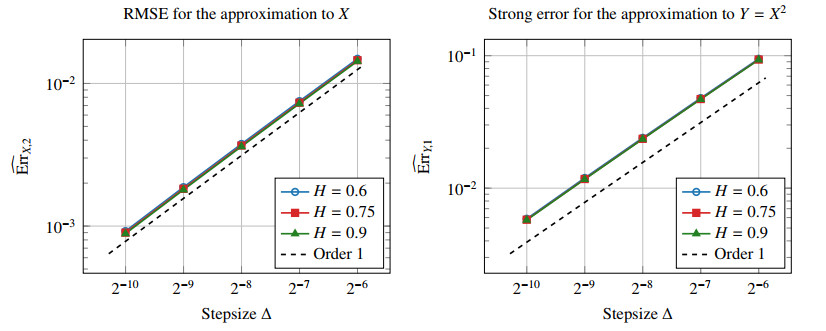
Monte Carlo estimates of the errors of the DIEM approximation for the transformed process (5.2) and original process (5.1) in Example 5.1
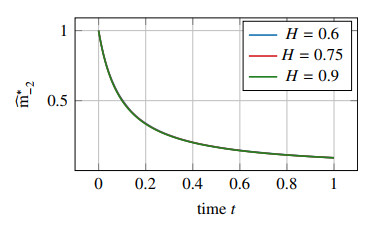
Monte Carlo estimates of the inverse second moment $ \mathbb{E}[X(t)^{-2}] = \mathbb{E}[Y(t)^{-1}] $ for Example 5.1. The results for the different Hurst parameters coincide visually
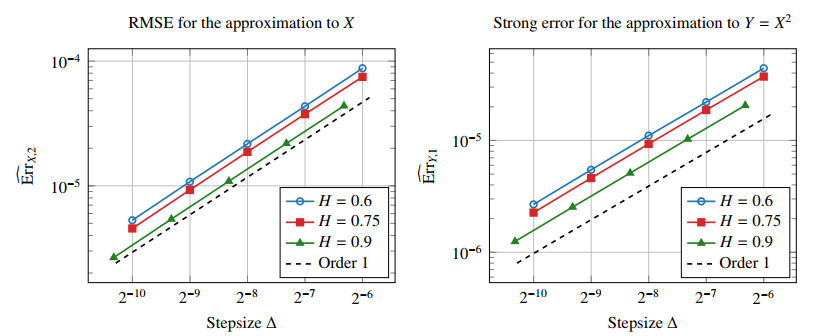
Monte Carlo estimates of the errors of the DIEM approximation for the transformed process (5.9) and original process (5.8) in Example 5.2
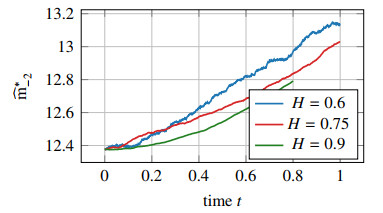
Monte Carlo estimates of the inverse second moment $ \mathbb{E}[X(t)^{-2}] = \mathbb{E}[Y(t)^{-1}] $ for Example 5.2
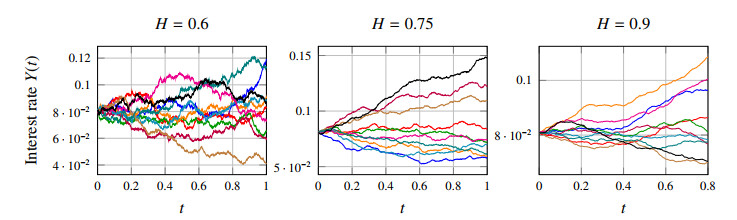
Ten simulated sample paths of the fractional CIR short-rate process for each of the three Hurst parameters considered in Example 5.2. The paths are generated using the fine-grid DIEM reference discretization




 DownLoad: