This paper presents a detailed dynamical analysis of a four-dimensional (4D) memristive chaotic system without equilibria and studies fractal transformations of its attractor as a geometric post-processing tool. The chaotic nature of the system was confirmed through the Lyapunov exponent spectrum, computed with an explicit statistical criterion for vanishing exponents, phase portraits, multistability, and offset boosting analysis. A Lyapunov-function analysis and long-time simulations characterized the boundedness of trajectories. Poincaré cross-sections and broadband spectral analysis revealed the rich geometric structure of the hidden attractors, and NIST SP 800-22 randomness tests validated the statistical quality of the generated sequences. Electronic circuit implementation validated the theoretical model using Multisim simulations. We applied inverse Julia map-based binary and ternary algorithms to phase space projections of the system, demonstrating systematic structural multiplication: after $ N $ iterations, the transformed set consisted of $ 2^N $ congruent copies of the original structure with exact $ 2^N $-fold rotational symmetry, which was proved analytically. The ternary extension operates in three-dimensional phase space and was formulated under two distinct hypercomplex multiplication rules, which are shown to yield fundamentally different geometric outcomes: anisotropic ribbon-like structures in one case and isotropic concentric configurations in the other. We introduced three novel Mandelbrot-based fractal transformation methods: the Mandelbrot orbit cloud, the Mandelbrot multiscroll expansion, and the fractal web. The work was a dynamical and geometric study; engineering applications of the transformed attractors are not considered here and are left for future work.
Citation: Michael I. Kopp, Inna Samuilik. Julia and Mandelbrot set-based fractal transformations applied to a 4D memristive chaotic system without equilibria[J]. AIMS Mathematics, 2026, 11(11): 37686-37734. doi: 10.3934/math.20261458
This paper presents a detailed dynamical analysis of a four-dimensional (4D) memristive chaotic system without equilibria and studies fractal transformations of its attractor as a geometric post-processing tool. The chaotic nature of the system was confirmed through the Lyapunov exponent spectrum, computed with an explicit statistical criterion for vanishing exponents, phase portraits, multistability, and offset boosting analysis. A Lyapunov-function analysis and long-time simulations characterized the boundedness of trajectories. Poincaré cross-sections and broadband spectral analysis revealed the rich geometric structure of the hidden attractors, and NIST SP 800-22 randomness tests validated the statistical quality of the generated sequences. Electronic circuit implementation validated the theoretical model using Multisim simulations. We applied inverse Julia map-based binary and ternary algorithms to phase space projections of the system, demonstrating systematic structural multiplication: after $ N $ iterations, the transformed set consisted of $ 2^N $ congruent copies of the original structure with exact $ 2^N $-fold rotational symmetry, which was proved analytically. The ternary extension operates in three-dimensional phase space and was formulated under two distinct hypercomplex multiplication rules, which are shown to yield fundamentally different geometric outcomes: anisotropic ribbon-like structures in one case and isotropic concentric configurations in the other. We introduced three novel Mandelbrot-based fractal transformation methods: the Mandelbrot orbit cloud, the Mandelbrot multiscroll expansion, and the fractal web. The work was a dynamical and geometric study; engineering applications of the transformed attractors are not considered here and are left for future work.

| [1] |
B. B. Mandelbrot, The fractal geometry of nature, New York: W. H. Freeman, 1982. |
| [2] |
H. O. Peitgen, H. Jürgens, D. Saupe, Chaos and fractals: new frontiers of science, 2 Eds., New York: Springer, 2004. https://doi.org/10.1007/b97624 |
| [3] |
J. C. Sprott, Chaos and time-series analysis, Oxford: Oxford University Press, 2003. |
| [4] |
L. O. Chua, Memristor–-The missing circuit element, IEEE Trans. Circuit Theory, 18 (1971), 507–519. https://doi.org/10.1109/TCT.1971.1083337 doi: 10.1109/TCT.1971.1083337
|
| [5] |
D. B. Strukov, G. S. Snider, D. R. Stewart, R. S. Williams, The missing memristor found, Nature, 453 (2008), 80–83. https://doi.org/10.1038/nature06932 doi: 10.1038/nature06932
|
| [6] |
Z. Wei, Dynamical behaviors of a chaotic system with no equilibria, Phys. Lett. A, 376 (2011), 102–108. https://doi.org/10.1016/j.physleta.2011.10.040 doi: 10.1016/j.physleta.2011.10.040
|
| [7] |
V. T. Pham, C. Volos, S. Vaidyanathan, T. P. Le, V. Y. Vu, A memristor-based hyperchaotic system with hidden attractors: dynamics, synchronization and circuital emulating, J. Eng. Sci. Technol. Rev., 8 (2015), 205–214. https://doi.org/10.25103/jestr.082.26 doi: 10.25103/jestr.082.26
|
| [8] |
K. Rajagopal, V. T. Pham, F. R. Tahir, A. Akgul, H. R. Abdolmohammadi, S. Jafari, A chaotic jerk system with non-hyperbolic equilibrium: Dynamics, effect of time delay and circuit realization, Pramana, 90 (2018), 52. https://doi.org/10.1007/s12043-018-1545-x doi: 10.1007/s12043-018-1545-x
|
| [9] |
X. C. Liu, Q. Tu, Coexisting and hidden attractors of memristive chaotic systems with and without equilibria, Eur. Phys. J. Plus, 137 (2022), 516. https://doi.org/10.1140/epjp/s13360-022-02720-9 doi: 10.1140/epjp/s13360-022-02720-9
|
| [10] |
A. Bayani, K. Rajagopal, A. J. M. Khalaf, S. Jafari, G. D. Leutcho, J. Kengne, Dynamical analysis of a new multistable chaotic system with hidden attractor: antimonotonicity, coexisting multiple attractors, and offset boosting, Phys. Lett. A, 383 (2019), 1450–1456. https://doi.org/10.1016/j.physleta.2019.02.005 doi: 10.1016/j.physleta.2019.02.005
|
| [11] |
S. Gu, Q. Peng, X. Leng, B. Du, A novel non-equilibrium memristor-based system with multi-wing attractors and multiple transient transitions, Chaos, 31 (2021), 033105. https://doi.org/10.1063/5.0039121 doi: 10.1063/5.0039121
|
| [12] |
M. I. Kopp, Chaos and complexity in a four-dimensional system with hyperbolic tangent nonlinearity and no equilibrium, TWMS J. Appl. Eng. Math., 15 (2025), 2584–2598. |
| [13] |
M. Kopp, Dynamical analysis, circuit design, and synchronization of a new 4D two-wing memristor-based hyperchaotic system with no equilibrium, TechRxiv, 2024. https://doi.org/10.36227/techrxiv.172548128.82541253/v1 |
| [14] |
M. I. Kopp, A new memristor-based 4D hyperchaotic system with seven terms and no equilibrium points, Nonlinear Dyn. Syst. Theory, 25 (2025), 288–298. |
| [15] |
M. I. Kopp, I. Samuilik, Hidden attractors in a new 4D memristor-based hyperchaotic system: dynamical analysis, circuit design, synchronization, and its applications, Mathematics, 13 (2025), 2838. https://doi.org/10.3390/math13172838 doi: 10.3390/math13172838
|
| [16] |
H. Jahanshahi, O. Orozco-López, J. M. Munoz-Pacheco, N. D. Alotaibi, C. Volos, Z. Wang, et al., Simulation and experimental validation of a non-equilibrium chaotic system, Chaos Soliton. Fract., 143 (2021), 110539. https://doi.org/10.1016/j.chaos.2020.110539 doi: 10.1016/j.chaos.2020.110539
|
| [17] |
Y. Li, C. Dong, H. Li, Design, dynamic analysis, and application of a novel four-dimensional memristor-based chaotic system with hidden attractors, Phys. Scr., 100 (2025), 045231. https://doi.org/10.1088/1402-4896/adbd8a doi: 10.1088/1402-4896/adbd8a
|
| [18] |
Q. Wang, H. Sang, P. Wang, X. Yu, Z. Yang, A novel 4D chaotic system coupling with dual-memristors and application in image encryption, Sci. Rep., 14 (2024), 29615. https://doi.org/10.1038/s41598-024-80445-8 doi: 10.1038/s41598-024-80445-8
|
| [19] |
Q. Lai, Z. Wan, L. K. Kengne, P. D. K. Kuate, C. Chen, Two-memristor-based chaotic system with infinite coexisting attractors, IEEE Trans. Circuits Syst. II, 68 (2021), 2197–2201. https://doi.org/10.1109/TCSII.2020.3044096 doi: 10.1109/TCSII.2020.3044096
|
| [20] |
S. Zhang, J. Zheng, X. Wang, Z. Zeng, Multi-scroll hidden attractor in memristive HR neuron model under electromagnetic radiation and its applications, Chaos, 31 (2021), 011101. https://doi.org/10.1063/5.0035595 doi: 10.1063/5.0035595
|
| [21] |
V. T. Pham, S. Jafari, S. Vaidyanathan, C. Volos, X. Wang, A novel memristive neural network with hidden attractors and its circuitry implementation, Sci. China Technol. Sci., 59 (2016), 358–363. https://doi.org/10.1007/s11431-015-5981-2 doi: 10.1007/s11431-015-5981-2
|
| [22] |
Z. Wan, Y. F. Pu, Q. Lai, Multiscroll hidden attractor in memristive autapse neuron model and its memristor-based scroll control and application in image encryption, Neural Networks, 188 (2025), 107473. https://doi.org/10.1016/j.neunet.2025.107473 doi: 10.1016/j.neunet.2025.107473
|
| [23] |
Z. Wan, Y. F. Pu, M. Qin, Q. Lai, Robust full-parameter control method: Constructing multiscroll HNN via memristor, Neural Networks, 192 (2025), 107878. https://doi.org/10.1016/j.neunet.2025.107878 doi: 10.1016/j.neunet.2025.107878
|
| [24] |
Z. Wan, Y. F. Pu, Y. Liu, Q. Lai, Z. Yang, State-based nonlinear mapping method for constructing conservative oscillator generating cellular chaotic sea with hardware implementation, Chaos Soliton. Fract., 211 (2026), 118789. https://doi.org/10.1016/j.chaos.2026.118789 doi: 10.1016/j.chaos.2026.118789
|
| [25] |
G. Julia, Mémoire sur l'itération des fonctions rationnelles, J. Math. Pures Appl., 1 (1918), 47–245. |
| [26] |
K. Bouallegue, A. Chaari, A. Toumi, Multi-scroll and multi-wing chaotic attractor generated with Julia process fractal, Chaos Soliton. Fract., 44 (2011), 79–85. https://doi.org/10.1016/j.chaos.2010.12.005 doi: 10.1016/j.chaos.2010.12.005
|
| [27] |
K. Bouallegue, A new fractal model of chromosome and DNA processes, In: S. Stavrinides, S. Banerjee, S. Caglar, M. Ozer, Chaos and complex systems, Berlin, Heidelberg: Springer, 2013,505–514. https://doi.org/10.1007/978-3-642-33914-1_71 |
| [28] |
K. Bouallegue, Gallery of chaotic attractors generated by fractal network, Int. J. Bifurcat. Chaos, 25 (2015), 1530002. https://doi.org/10.1142/S0218127415300025 doi: 10.1142/S0218127415300025
|
| [29] |
S. Dai, K. Sun, S. He, W. Ai, Complex chaotic attractor via fractal transformation, Entropy, 21 (2019), 1115. https://doi.org/10.3390/e21111115 doi: 10.3390/e21111115
|
| [30] |
X. Wang, L. Feng, H. Zhao, Fast image encryption algorithm based on parallel computing system, Inf. Sci., 486 (2019), 340–358. https://doi.org/10.1016/j.ins.2019.02.049 doi: 10.1016/j.ins.2019.02.049
|
| [31] |
S. Zhou, X. Wang, Y. Zhang, B. Ge, M. Wang, S. Gao, A novel image encryption cryptosystem based on true random numbers and chaotic systems, Multimedia Syst., 28 (2022), 95–112. https://doi.org/10.1007/s00530-021-00803-8 doi: 10.1007/s00530-021-00803-8
|
| [32] |
H. Liu, A. Kadir, C. Xu, Color image encryption with cipher feedback and coupling chaotic map, Int. J. Bifurcat. Chaos, 30 (2020), 2050173. https://doi.org/10.1142/S0218127420501734 doi: 10.1142/S0218127420501734
|
| [33] |
Y. Zhang, The unified image encryption algorithm based on chaos and cubic S-Box, Inf. Sci., 450 (2018), 361–377. https://doi.org/10.1016/j.ins.2018.03.055 doi: 10.1016/j.ins.2018.03.055
|
| [34] |
K. H. Sun, S. B. He, Y. He, L. Z. Yin, Complexity analysis of chaotic pseudo-random sequences based on spectral entropy algorithm, Acta Phys. Sin., 62 (2013), 010501. https://doi.org/10.7498/aps.62.010501 doi: 10.7498/aps.62.010501
|
| [35] |
M. Kaur, V. Kumar, A comprehensive review on image encryption techniques, Arch. Comput. Methods Eng., 27 (2020), 15–43. https://doi.org/10.1007/s11831-018-9298-8 doi: 10.1007/s11831-018-9298-8
|
| [36] |
M. W. Tian, S. R. Yan, X. X. Tian, S. Nojavan, K. Jermsittiparsert, Risk and profit-based bidding and offering strategies for pumped hydro storage in the energy market, J. Clean. Prod., 256 (2020), 120715. https://doi.org/10.1016/j.jclepro.2020.120715 doi: 10.1016/j.jclepro.2020.120715
|
| [37] |
F. Masood, J. Ahmad, S. A. Shah, S. S. Jamal, I. Hussain, A novel hybrid secure image encryption based on Julia set of fractals and 3D Lorenz chaotic map, Entropy, 22 (2020), 274. https://doi.org/10.3390/e22030274 doi: 10.3390/e22030274
|
| [38] |
S. Agarwal, Secure image transmission using fractal and 2D-chaotic map, J. Imaging, 4 (2018), 17. https://doi.org/10.3390/jimaging4010017 doi: 10.3390/jimaging4010017
|
| [39] |
M. Khan, F. Masood, A. Alghafis, Secure image encryption scheme based on fractals key with Fibonacci series and discrete dynamical system, Neural Comput. Appl., 32 (2020), 11837–11857. https://doi.org/10.1007/s00521-019-04667-y doi: 10.1007/s00521-019-04667-y
|
| [40] |
Y. Sun, R. Xu, L. Chen, X. Hu, Image compression and encryption scheme using fractal dictionary and Julia set, IET Image Process., 9 (2015), 173–183. https://doi.org/10.1049/iet-ipr.2014.0224 doi: 10.1049/iet-ipr.2014.0224
|
| [41] |
Y. Zhang, X. Guo, Control of Julia sets of the complex Hénon system, Nonlinear Dyn., 69 (2012), 185–192. https://doi.org/10.1007/s11071-011-0256-3 doi: 10.1007/s11071-011-0256-3
|
| [42] |
D. Wang, S. Liu, K. Liu, Y. Zhao, Control and synchronization of Julia sets generated by a class of complex time-delay rational map, J. Appl. Anal. Comput., 6 (2016), 1049–1063. https://doi.org/10.11948/2016068 doi: 10.11948/2016068
|
| [43] |
A. A. Elsadany, A. Aldurayhim, H. N. Agiza, A. Elsonbaty, On the fractional-order complex cosine map: fractal analysis, Julia set control and synchronization, Mathematics, 11 (2023), 727. https://doi.org/10.3390/math11030727 doi: 10.3390/math11030727
|
| [44] |
M. F. Danca, M. Fečkan, Mandelbrot set and Julia sets of fractional order, Nonlinear Dyn., 111 (2023), 9555–9570. https://doi.org/10.1007/s11071-023-08311-2 doi: 10.1007/s11071-023-08311-2
|
| [45] |
Y. Wang, X. Li, D. Wang, S. Liu, A brief note on fractal dynamics of fractional Mandelbrot sets, Appl. Math. Comput., 432 (2022), 127353. https://doi.org/10.1016/j.amc.2022.127353 doi: 10.1016/j.amc.2022.127353
|
| [46] |
M. F. Danca, Mandelbrot set as a particular Julia set of fractional order, equipotential lines and external rays of Mandelbrot and Julia sets of fractional order, Fractal Fract., 8 (2024), 69. https://doi.org/10.3390/fractalfract8010069 doi: 10.3390/fractalfract8010069
|
| [47] |
M. Kopp, I. Samuilik, Generation of new batik floral patterns via chaotic modulation and Julia–Mandelbrot fractal transformations, Front. Appl. Math. Stat., 12 (2026), 1826475. https://doi.org/10.3389/fams.2026.1826475 doi: 10.3389/fams.2026.1826475
|
| [48] |
B. Munmuangsaen, B. Srisuchinwong, A new five-term simple chaotic attractor, Phys. Lett. A, 373 (2009), 4038–4043. https://doi.org/10.1016/j.physleta.2009.08.068 doi: 10.1016/j.physleta.2009.08.068
|
| [49] |
G. A. Leonov, N. V. Kuznetsov, Hidden attractors in dynamical systems: From hidden oscillations in Hilbert–Kolmogorov, Aizerman, and Kalman problems to hidden chaotic attractor in Chua circuits, Int. J. Bifurcat. Chaos, 23 (2013), 1330002. https://doi.org/10.1142/S0218127413300024 doi: 10.1142/S0218127413300024
|
| [50] |
G. Benettin, L. Galgani, A. Giorgilli, J. M. Strelcyn, Lyapunov characteristic exponents for smooth dynamical systems and for Hamiltonian systems; a method for computing all of them. Part 1: theory, Meccanica, 15 (1980), 9–20. https://doi.org/10.1007/BF02128236 doi: 10.1007/BF02128236
|
| [51] |
A. Wolf, J. B. Swift, H. L. Swinney, J. A. Vastano, Determining Lyapunov exponents from a time series, Physica D, 16 (1985), 285–317. https://doi.org/10.1016/0167-2789(85)90011-9 doi: 10.1016/0167-2789(85)90011-9
|
| [52] |
S. Yang, H. He, M. F. Leung, Y. Tang, L. Yan, Fast fixed-time control for intra- and inter-layer synchronization of multi-layer networks, Axioms, 14 (2025), 795. https://doi.org/10.3390/axioms14110795 doi: 10.3390/axioms14110795
|
| [53] |
C. Yi, J. Li, J. Cai, Z. You, C. Jing, Event-triggered synchronization for multi-agent networked systems with time-varying coupling strength and non-differentiable delays, Math. Comput. Simulat., 236 (2025), 12–28. https://doi.org/10.1016/j.matcom.2025.03.029 doi: 10.1016/j.matcom.2025.03.029
|
| [54] |
J. Wen, Y. Feng, X. Tao, Y. Cao, Dynamical analysis of a new chaotic system: hidden attractor, coexisting-attractors, offset boosting, and DSP realization, IEEE Access, 9 (2021), 167920–167927. https://doi.org/10.1109/ACCESS.2021.3136249 doi: 10.1109/ACCESS.2021.3136249
|
| [55] |
F. Pareschi, R. Rovatti, G. Setti, On statistical tests for randomness included in the NIST SP800-22 test suite and based on the binomial distribution, IEEE T. Inf. Forensics Secur., 7 (2012), 491–505. https://doi.org/10.1109/TIFS.2012.2185227 doi: 10.1109/TIFS.2012.2185227
|
| [56] |
Q. Deng, C. Wang, H. Lin, Memristive Hopfield neural network dynamics with heterogeneous activation functions and its application, Chaos Soliton. Fract., 178 (2024), 114387. https://doi.org/10.1016/j.chaos.2023.114387 doi: 10.1016/j.chaos.2023.114387
|
| [57] |
N. Wang, M. Cui, M. Marwan, Y. Yang, H. Bao, H. H. C. Iu, et al., Automatic design of multi-fold hyperchaotic system using parallel fractal algorithm, IEEE Trans. Circuits Syst. II, 72 (2025), 1313–1317. https://doi.org/10.1109/TCSII.2025.3594405 doi: 10.1109/TCSII.2025.3594405
|
| [58] |
Y. Yang, J. Yang, C. Chen, M. Marwan, Generating multistructure attractor via modified fractal with nonautonomous switching and chaotic path planning application, AEU-Int. J. Electron. C., 211 (2026), 156331. https://doi.org/10.1016/j.aeue.2026.156331 doi: 10.1016/j.aeue.2026.156331
|
| [59] |
X. Du, L. Wang, D. Yan, S. Duan, A multiring Julia fractal chaotic system with separated-scroll attractors, IEEE Trans. VLSI Syst., 29 (2021), 2210–2219. https://doi.org/10.1109/TVLSI.2021.3106312 doi: 10.1109/TVLSI.2021.3106312
|
| [60] |
M. Green, The Buddhabrot technique, 1993. Available from: https://superliminal.com/fractals/bbrot/. |
Figures(29) / Tables(6)

Michael I. Kopp, Inna Samuilik. Julia and Mandelbrot set-based fractal transformations applied to a 4D memristive chaotic system without equilibria[J]. AIMS Mathematics, 2026, 11(11): 37686-37734. doi: 10.3934/math.20261458

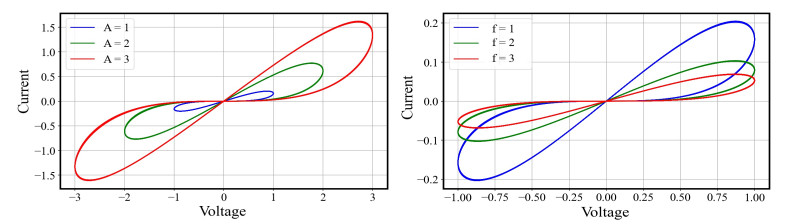
Pinched hysteresis loops of the memristor (2.2) driven by $ u_m = A\sin(2\pi f t) $ (dimensionless time and frequency): left, fixed frequency $ f = 1 $ and amplitudes $ A = 1, 2, 3 $; right, fixed amplitude $ A = 1 $ and frequencies $ f = 1, 2, 3 $
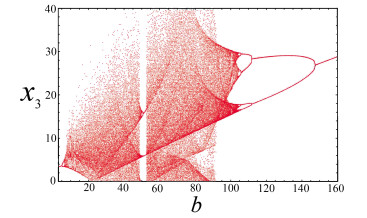
Bifurcation diagram of system (2.3) with respect to the parameter $ b $ for $ a = 5 $ and initial conditions (3.5), see page 9, shown for different ranges of $ b $
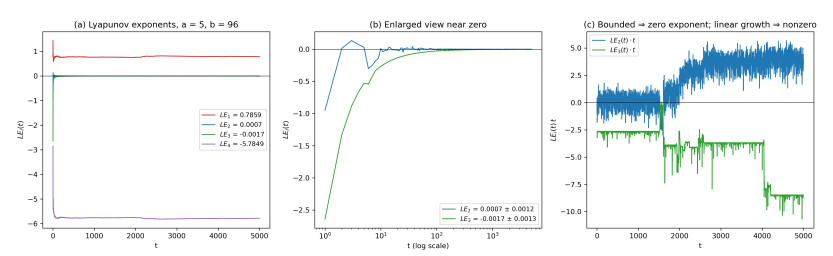
Convergence of the Lyapunov exponents of system (2.3) for $ a = 5 $, $ b = 96 $ and initial conditions (3.5) (transient $ t\le200 $ discarded, averaging time $ T = 5000 $): (a) all four exponents; (b) $ LE_2 $ and $ LE_3 $ on a logarithmic time axis; (c) the products $ LE_2(t)\, t $ and $ LE_3(t)\, t $, which remain bounded, as expected for vanishing exponents (a positive exponent $ \lambda $ would produce linear growth with slope $ \lambda $)
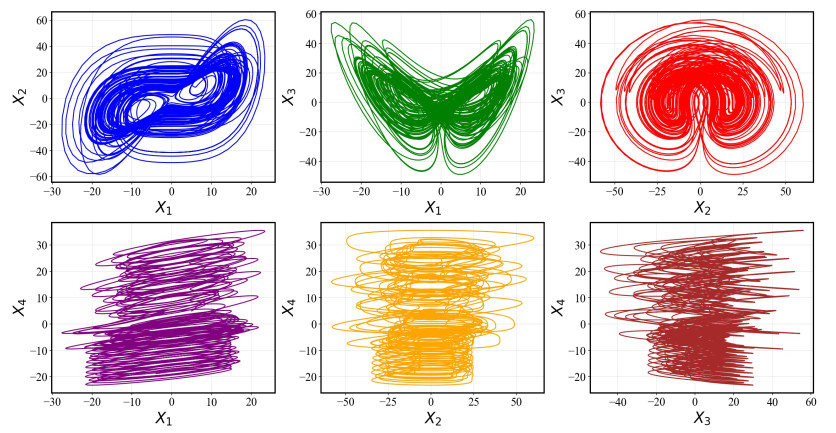
Phase portraits of the hidden chaotic attractor of system (2.3) for $ a = 5 $, $ b = 96 $ and initial conditions (3.5) in various planes. Since system (2.3) has no equilibria for $ b\neq0 $ (Section 3.1), the attractor is hidden by definition
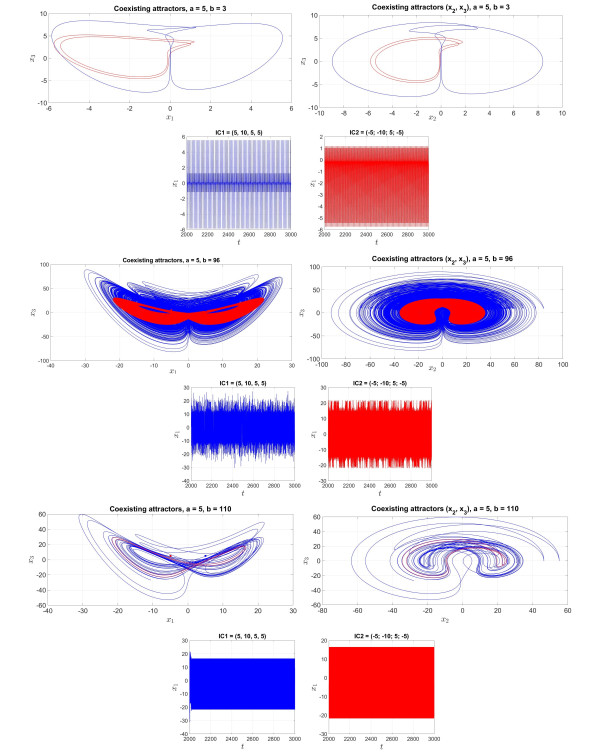
Coexisting attractors of system (2.3) for $ a = 5 $ and initial conditions $ {\mathbf B}_0 = (5, 10, 5, 5) $ (blue) and $ {\mathbf R}_0 = (-5, -10, 5, -5) $ (red): phase portraits in the $ (x_1, x_3) $ and $ (x_2, x_3) $ planes and time series of $ x_1(t) $. (a) $ b = 3 $, two coexisting periodic attractors; (b) $ b = 96 $, two coexisting chaotic attractors of different spatial extent; (c) $ b = 110 $, two coexisting aperiodic attractors of different spatial extent
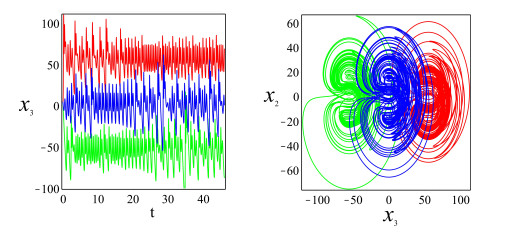
Time-domain signal $ x_3 $ and phase portraits in the $ x_3x_2 $ plane of system (2.3) with $ x_3\to x_3+k $ ($ a = 5 $, $ b = 96 $) for varying offset boosting levels: $ k = 0 $ (blue), $ k = 55 $ (green), and $ k = -55 $ (red)
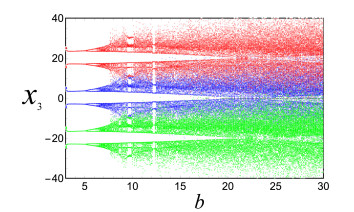
Bifurcation diagrams of system (2.3) with $ x_3\to x_3+k $ ($ a = 5 $) versus $ b $, showing multistability under offset boosting for different initial conditions and control parameters: $ k = 0 $ (blue), $ k = 20 $ (green), and $ k = -20 $ (red)
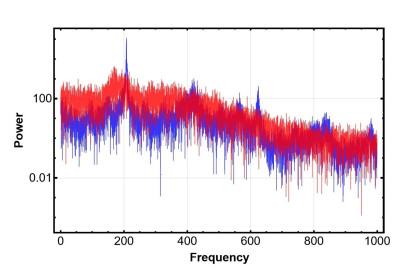
Power spectra of system (2.3) ($ a = 5 $, $ b = 96 $, initial conditions (3.5)) (blue), and system (2.1) (red)
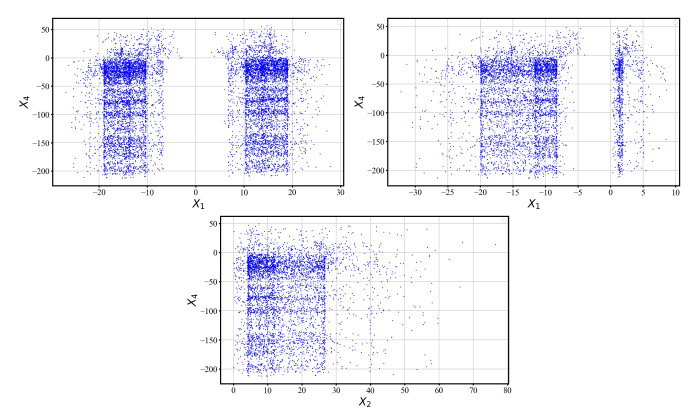
Poincaré sections of system (2.3) for $ a = 5 $, $ b = 96 $, and initial conditions (3.5): hyperplane $ x_3 = 2.5 $ projected onto $ (x_1, x_4) $; hyperplane $ x_2 = 5 $ projected onto $ (x_1, x_4) $; hyperplane $ x_1 = 0 $ projected onto $ (x_2, x_4) $
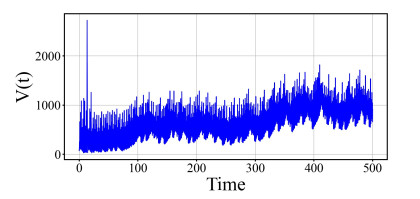
Time evolution of the quadratic function $ V(t) $ along the trajectory of system (2.3) for $ a = 5 $, $ b = 96 $, and initial conditions (3.5) on the interval $ t\in[0,600] $
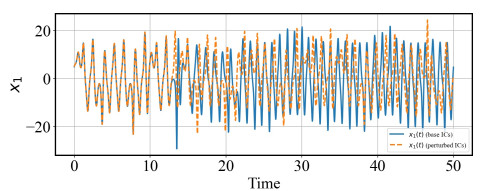
Temporal evolution of $ x_1(t) $ of system (2.3) ($ a = 5 $, $ b = 96 $) for two initial conditions differing by $ \Delta x_1(0) = 10^{-4} $, demonstrating the exponential divergence characteristic of chaotic dynamics
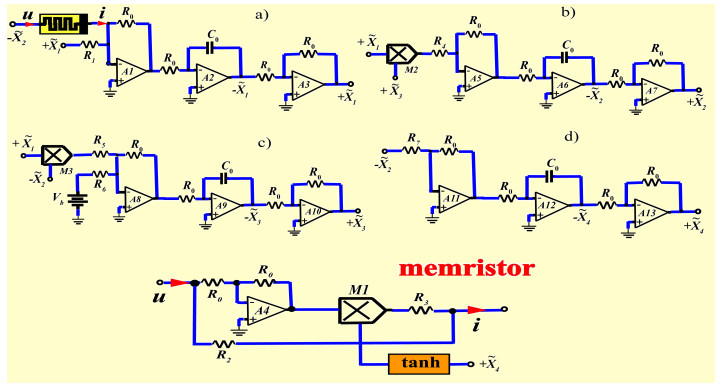
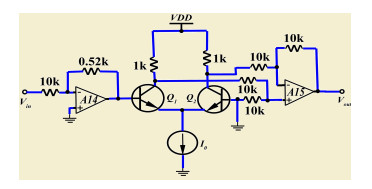
Circuit modules implemented based on a system of equations (4.4): a) $ \widetilde{X}_1 $, b) $ \widetilde{X}_2 $, c) $ \widetilde{X}_3 $, d) $ \widetilde{X}_4 $, and the memristor circuit module
Circuit scheme for realization of hyperbolic tangent function
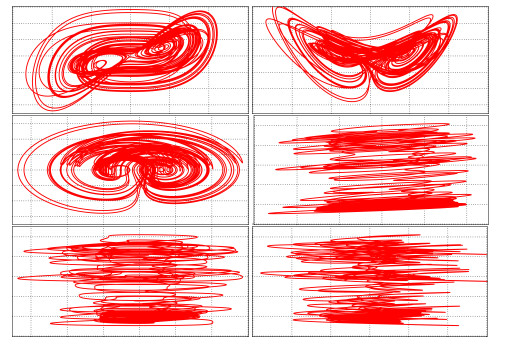
Phase portraits of circuit (4.4) implementing system (2.3) ($ a = 5 $, $ b = 96 $) as generated in Multisim oscilloscopes: a) $ \widetilde{X}_1\widetilde{X}_2 $, b) $ \widetilde{X}_1\widetilde{X}_3 $, c) $ \widetilde{X}_2\widetilde{X}_3 $, d) $ \widetilde{X}_1\widetilde{X}_4 $, e) $ \widetilde{X}_2\widetilde{X}_4 $, f) $ \widetilde{X}_3\widetilde{X}_4 $
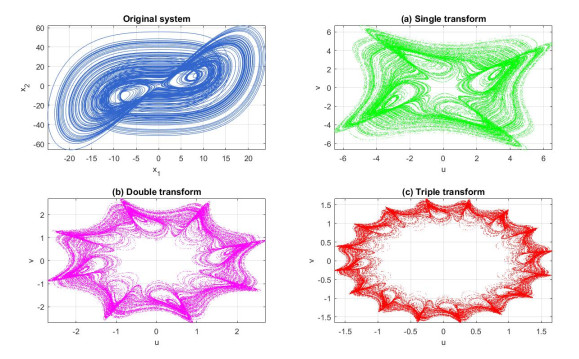
Binary Julia process applied to the $ (x_1, x_2) $ projection of the attractor of system (2.3) ($ a = 5 $, $ b = 96 $): original attractor (top left), (a) $ N = 1 $ (top right), (b) $ N = 2 $ (bottom left), and (c) $ N = 3 $ (bottom right). The original double-lobe structure evolves into 2, 4, and 8 symmetrically distributed regions
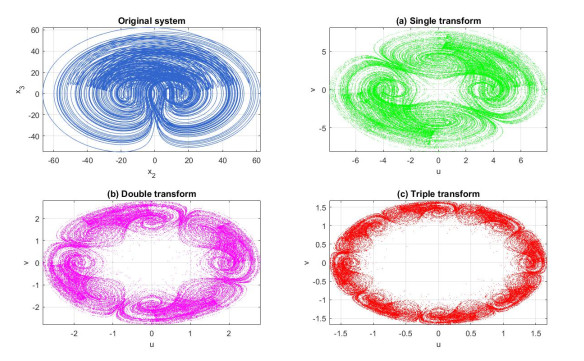
Binary Julia process applied to the $ (x_2, x_3) $ projection of the attractor of system (2.3) ($ a = 5 $, $ b = 96 $): original attractor (top left), (a) $ N = 1 $ (top right), (b) $ N = 2 $ (bottom left), and (c) $ N = 3 $ (bottom right). The circular attractor topology is preserved while the number of structures doubles with each transformation
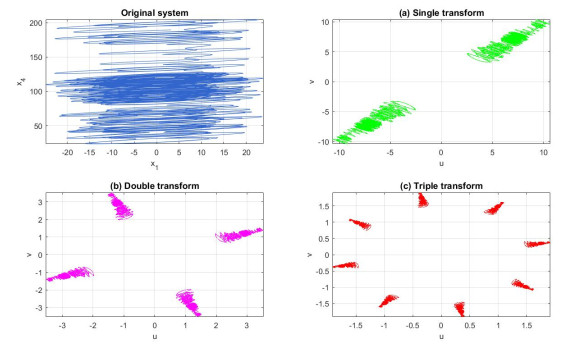
Binary Julia process applied to the $ (x_1, x_4) $ projection of the attractor of system (2.3) ($ a = 5 $, $ b = 96 $): original attractor (top left), (a) $ N = 1 $ (top right), (b) $ N = 2 $ (bottom left), and (c) $ N = 3 $ (bottom right). The band-like chaotic attractor fragments into separated clusters following the power growth law $ M_2 = M_1 \times 2^N $
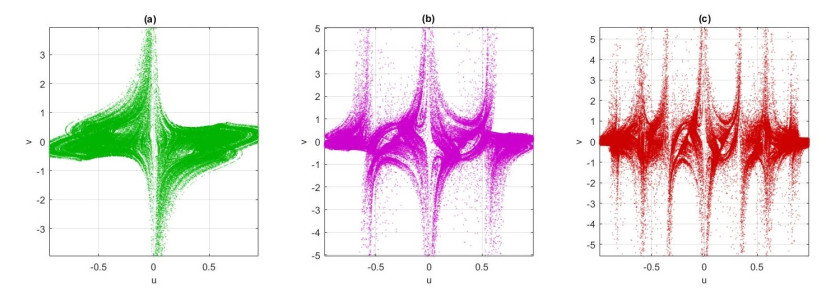
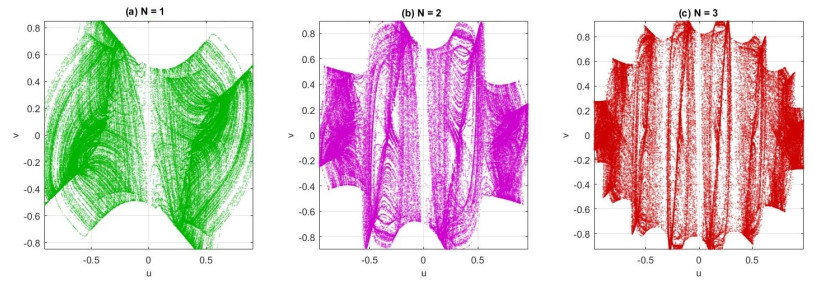
Projection of the ternary fractal transformation onto the $ (u, v) $ plane. Attractor of system (2.3) ($ a = 5 $, $ b = 96 $), $ ij = -1 $: (a) $ N = 1 $ (95,187 points, $ 99.3\% $); (b) $ N = 2 $ (94,603 points, $ 98.7\% $); (c) $ N = 3 $ (94,137 points, $ 98.2\% $). The progressive doubling of structural components is clearly visible, with each iteration creating bifurcations in the existing lobes while maintaining four-fold symmetry
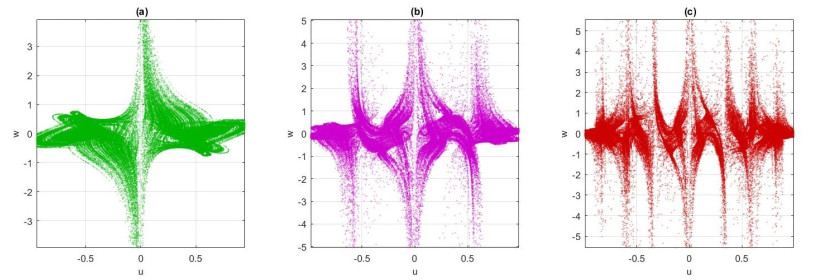
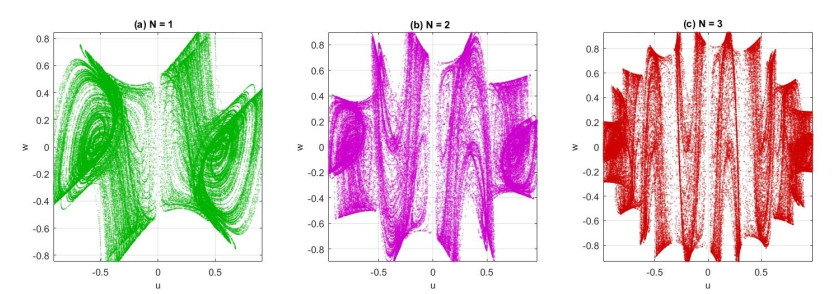
Projection of the ternary fractal transformation onto the $ (u, w) $ plane, attractor of system (2.3) ($ a = 5 $, $ b = 96 $), $ ij = -1 $: (a) $ N = 1 $ (95,187 points, $ 99.3\% $); (b) $ N = 2 $ (94,603 points, $ 98.7\% $); (c) $ N = 3 $ (94,137 points, $ 98.2\% $). The vertical structure mirrors the horizontal patterns observed in Figure 18, confirming the symmetric treatment of the $ x $ and $ z $ components in the transformation algorithm. Progressive bifurcation and increased vertical spread are evident with each iteration
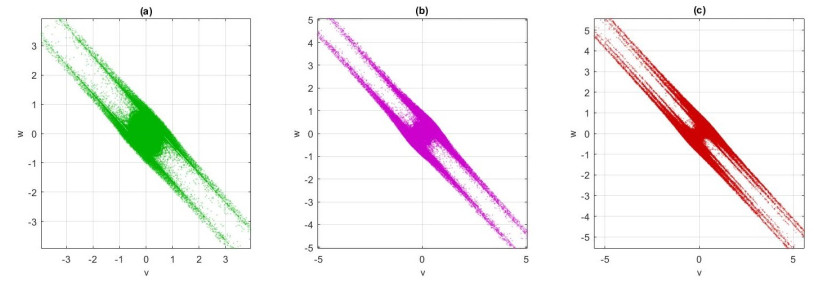
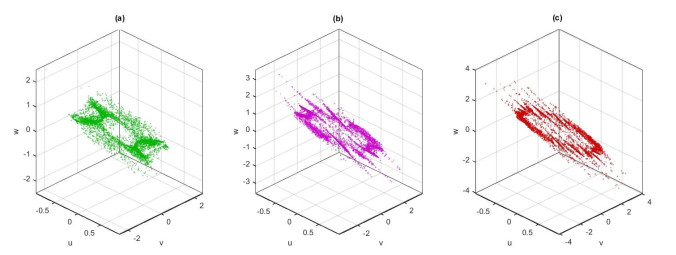
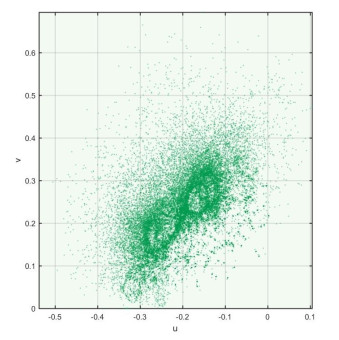
Projection of the ternary fractal transformation onto the $ (v, w) $ plane, attractor of system (2.3) ($ a = 5 $, $ b = 96 $), $ ij = -1 $: (a) $ N = 1 $ (95,187 points, $ 99.3\% $), showing a dense diagonal band structure; (b) $ N = 2 $ (94,603 points, $ 98.7\% $), exhibiting band widening and parallel striations; (c) $ N = 3 $ (94,137 points, $ 98.2\% $), revealing multiple parallel diagonal components. The diagonal alignment arises from the correlation between $ v $ and $ w $ components, both of which are inversely proportional to $ x_{n+1} $ in Eq (5.10). This projection uniquely captures the fractal organization in the transverse plane
Three-dimensional visualization of the ternary fractal transformation in $ (u, v, w) $ space, attractor of system (2.3) ($ a = 5 $, $ b = 96 $), $ ij = -1 $: (a) $ N = 1 $ (5010 of 95,187 points); (b) $ N = 2 $ (5256 of 94,603 points); (c) $ N = 3 $ (5230 of 94,137 points). The fractal nature of the structure is evident in the self-similar patterns at different scales
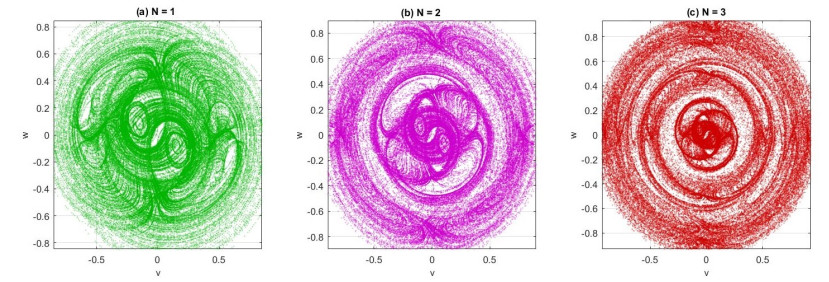
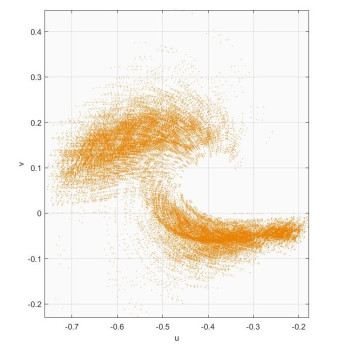
Projection onto the $ (v, w) $ plane using $ ij = 0 $, attractor of system (2.3) ($ a = 5 $, $ b = 96 $). In contrast to the diagonal band structure in Figure 20, this formulation generates concentric circular patterns. The single transformation (a) shows nested spiral structures, while successive transformations (b)-(c) create multiple concentric rings
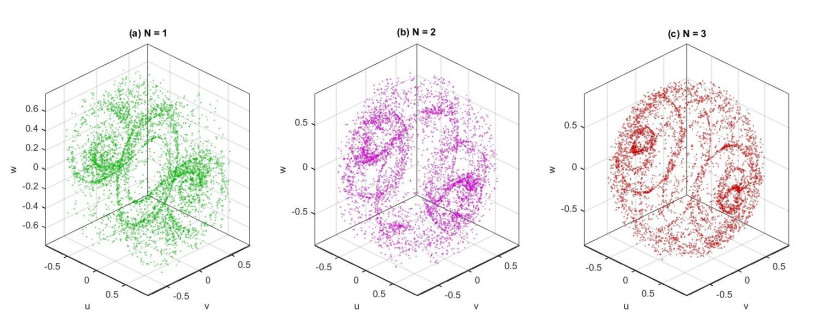
Three-dimensional visualization using $ ij = 0 $, attractor of system (2.3) ($ a = 5 $, $ b = 96 $). The structure exhibits a spiral torus-like geometry with circular cross-sections in the $ (v, w) $ plane, fundamentally different from the twisted ribbon structure observed with $ ij = -1 $ (Figure 21)
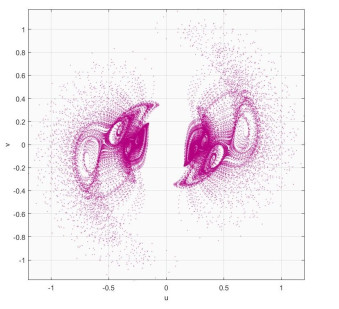
Projection onto the $ (u, v) $ plane using the ternary fractal transformation with $ ij = 0 $ [29], attractor of system (2.3) ($ a = 5 $, $ b = 96 $). (a) $ N = 1 $; (b) $ N = 2 $; (c) $ N = 3 $. Compared to Figure 18, this formulation produces a two-lobed rather than four-lobed structure, with pronounced bilateral symmetry about the $ v $ axis. Both rules yield two preimages per point; the difference in the number of lobes reflects their different symmetries (Remark 2)
Projection onto the $ (u, w) $ plane using $ ij = 0 $, attractor of system (2.3) ($ a = 5 $, $ b = 96 $). The structure mirrors that in Figure 24, with two primary lobes showing bilateral symmetry about the $ w $ axis. This symmetry pattern differs fundamentally from the four-lobed configuration observed with $ ij = -1 $ (Figure 19)
Mandelbrot orbit cloud transformation (Method A, $ N_{\text{iter}} = 15 $, $ T_{\text{div}} = 50 $) applied to the $ (x_1, x_2) $ projection of the attractor of system (2.3) ($ a = 5 $, $ b = 96 $)
Mandelbrot multiscroll (Method B, depth $ D = 2 $, $ K = 3 $) applied to the $ (x_1, x_2) $ projection of the attractor of system (2.3) ($ a = 5 $, $ b = 96 $)
Fractal web (Method C, $ N_{\text{iter}} = 12 $, $ Z_0 = \{0, \pm0.1, \pm0.1i\} $) applied to the $ (x_1, x_2) $ projection of the attractor of system (2.3) ($ a = 5 $, $ b = 96 $)
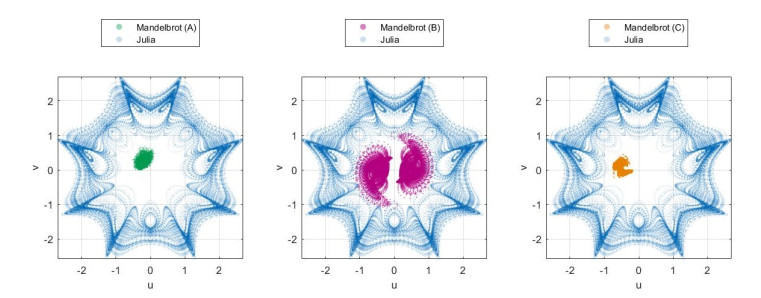
Comparative visualization of three Mandelbrot-based attractor generation Methods (A–C), applied to the $ (x_1, x_2) $ projection of the attractor of system (2.3) ($ a = 5 $, $ b = 96 $), alongside their corresponding Julia set counterparts. Each column presents a pair: Mandelbrot attractor (top) and its associated Julia set (bottom) for the respective parameter sampling or transformation method. This side-by-side arrangement highlights the intrinsic connection between the global parameter space structure (Mandelbrot) and the local dynamical behavior (Julia) for each algorithmic approach




 DownLoad: