We study lacunary statistically $ p $-upward quasi-Cauchy sequences, in which one-sided $ p $-step changes are controlled through their exceptional proportions on lacunary blocks, together with the associated compactness and continuity notions. The analysis shows that the parameters $ p $ and $ \theta $ play different roles at different levels of the theory. The corresponding compactness class is independent of both parameters and consists exactly of the subsets of $ \mathbb{R} $ that are bounded from below. By contrast, the sequence classes themselves depend on $ p $: We give exact conditions under which the lacunary $ p $-upward class coincides with its natural-density counterpart and prove that the class associated with $ p $ is contained in the class associated with $ q $ exactly when $ p $ divides $ q $. We also show directly, under the basic condition that the lacunary block lengths tend to infinity, that $ S_\theta $-$ p $-upward continuity implies uniform continuity on an arbitrary subset of $ \mathbb{R} $; on bounded domains, the converse holds as well. For finite blocks, we interpret the exceptional proportions as directional quantities rather than inferential statistics. They retain information that is lost under symmetric absolute differences, while their transformation and perturbation properties yield preservation results for the corresponding asymptotic sequence classes. A trend–seasonality model gives an explicit description of the interaction between the lag and the seasonal period, while the Mauna Loa atmospheric CO$ _2 $ series illustrates the resulting directional profiles and their sensitivity to the lag, threshold, block structure, and treatment of missing observations.
Citation: Serkan İlter, Seyit Koca. Lacunary statistical $ p $-upward quasi-Cauchy sequences and directional block analysis[J]. AIMS Mathematics, 2026, 11(11): 36571-36592. doi: 10.3934/math.20261414
We study lacunary statistically $ p $-upward quasi-Cauchy sequences, in which one-sided $ p $-step changes are controlled through their exceptional proportions on lacunary blocks, together with the associated compactness and continuity notions. The analysis shows that the parameters $ p $ and $ \theta $ play different roles at different levels of the theory. The corresponding compactness class is independent of both parameters and consists exactly of the subsets of $ \mathbb{R} $ that are bounded from below. By contrast, the sequence classes themselves depend on $ p $: We give exact conditions under which the lacunary $ p $-upward class coincides with its natural-density counterpart and prove that the class associated with $ p $ is contained in the class associated with $ q $ exactly when $ p $ divides $ q $. We also show directly, under the basic condition that the lacunary block lengths tend to infinity, that $ S_\theta $-$ p $-upward continuity implies uniform continuity on an arbitrary subset of $ \mathbb{R} $; on bounded domains, the converse holds as well. For finite blocks, we interpret the exceptional proportions as directional quantities rather than inferential statistics. They retain information that is lost under symmetric absolute differences, while their transformation and perturbation properties yield preservation results for the corresponding asymptotic sequence classes. A trend–seasonality model gives an explicit description of the interaction between the lag and the seasonal period, while the Mauna Loa atmospheric CO$ _2 $ series illustrates the resulting directional profiles and their sensitivity to the lag, threshold, block structure, and treatment of missing observations.

| [1] |
J. A. Fridy, C. Orhan, Lacunary statistical convergence, Pacific J. Math., 160 (1993), 43–51. https://doi.org/10.2140/pjm.1993.160.43 doi: 10.2140/pjm.1993.160.43
|
| [2] |
J. A. Fridy, C. Orhan, Lacunary statistical summability, J. Math. Anal. Appl., 173 (1993), 497–504. https://doi.org/10.1006/jmaa.1993.1082 doi: 10.1006/jmaa.1993.1082
|
| [3] |
H. Çakallı, Lacunary statistical convergence in topological groups, Indian J. Pure Appl. Math., 26 (1995), 113–119. |
| [4] |
Ş. Yıldız, Lacunary statistical $p$-quasi-Cauchy sequences, Maltepe J. Math., 1 (2019), 9–17. |
| [5] |
H. Çakallı, Beyond Cauchy and quasi-Cauchy sequences, Filomat, 32 (2018), 1035–1042. https://doi.org/10.2298/FIL1803035C doi: 10.2298/FIL1803035C
|
| [6] |
H. Çakallı, Statistical ward continuity, Appl. Math. Lett., 24 (2011), 1724–1728. https://doi.org/10.1016/j.aml.2011.04.029 doi: 10.1016/j.aml.2011.04.029
|
| [7] |
H. Çakallı, Statistical-quasi-Cauchy sequences, Math. Comput. Model., 54 (2011), 1620–1624. https://doi.org/10.1016/j.mcm.2011.04.037 doi: 10.1016/j.mcm.2011.04.037
|
| [8] |
H. Çakallı, O. Mucuk, Lacunary statistically upward and downward half quasi-Cauchy sequences, J. Math. Anal., 7 (2016), 12–23. |
| [9] |
H. Çakallı, Upward and downward statistical continuities, Filomat, 29 (2015), 2265–2273. https://doi.org/10.2298/FIL1510265C doi: 10.2298/FIL1510265C
|
| [10] |
D. Burton, J. Coleman, Quasi-Cauchy sequences, Amer. Math. Mon., 117 (2010), 328–333. https://doi.org/10.4169/000298910X480793 doi: 10.4169/000298910X480793
|
| [11] |
J. Connor, K. G. Grosse-Erdmann, Sequential definitions of continuity for real functions, Rocky Mountain J. Math., 33 (2003), 93–121. https://doi.org/10.1216/rmjm/1181069988 doi: 10.1216/rmjm/1181069988
|
| [12] |
I. Çanak, M. Dik, New types of continuities, Abstr. Appl. Anal., 2010 (2010), 258980. https://doi.org/10.1155/2010/258980 doi: 10.1155/2010/258980
|
| [13] |
A. Açıkgöz, Statistically $p$-upward quasi-Cauchy sequences and cone-valued continuity, 2026, arXiv: 2602.14125. https://doi.org/10.48550/arXiv.2602.14125 |
| [14] |
S. Seabold, J. Perktold, Statsmodels: Econometric and statistical modeling with Python, In: Proceedings of the 9th Python in science conference, 2010. https://doi.org/10.25080/Majora-92bf1922-011 |
| [15] |
C. D. Keeling, T. P. Whorf, Atmospheric CO$_2$ concentrations derived from flask air samples at sites in the SIO network, In: Trends: A compendium of data on global change, Carbon Dioxide Information Analysis Center, Oak Ridge National Laboratory, 2004. |
| [16] |
H. Çakallı, Variations on quasi-Cauchy sequences, Filomat, 29 (2015), 13–19. https://doi.org/10.2298/FIL1501013C doi: 10.2298/FIL1501013C
|
| [17] |
H. Çakallı, Slowly oscillating continuity, Abstr. Appl. Anal., 2008 (2008), 485706. https://doi.org/10.1155/2008/485706 doi: 10.1155/2008/485706
|
Figures(2) / Tables(5)

Serkan İlter, Seyit Koca. Lacunary statistical $ p $-upward quasi-Cauchy sequences and directional block analysis[J]. AIMS Mathematics, 2026, 11(11): 36571-36592. doi: 10.3934/math.20261414

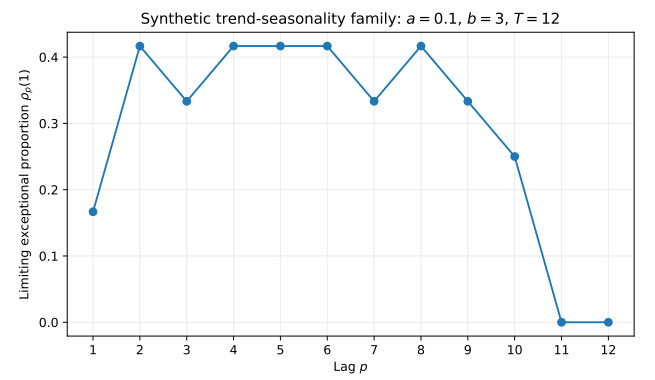
Exact lag profile $ \rho_p(1) $ for the trend–seasonality family with $ T = 12 $, $ a = 0.1 $, and $ b = 3 $. The full-period lag removes the seasonal component from the $ p $-step difference
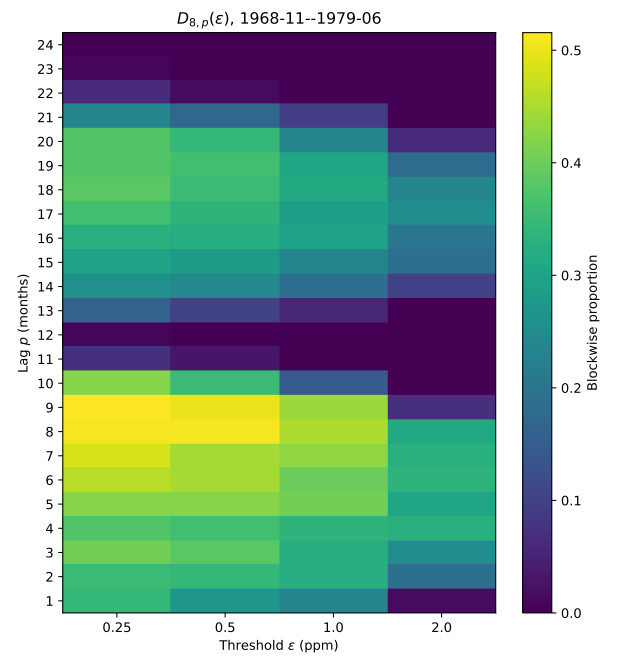
Lag–threshold map $ D_{8, p}^{X, +}(\varepsilon) $ for $ p = 1, \ldots, 24 $ and $ \varepsilon\in\{0.25, 0.5, 1, 2\} $ ppm




 DownLoad: