Generating reliable multi-step forecasts from autoregressive models with exogenous inputs (ARX) requires a principled treatment of predictive uncertainty together with a realistic specification of the disturbance distribution. This task becomes considerably more difficult when the innovations deviate from the Gaussian assumption that is typically imposed in the literature. We address this challenge by developing a Bayesian forecasting framework for ARX models whose disturbances are drawn from the scale-mixtures of normal (SMN) family, a broad class of symmetric, heavy-tailed distributions. Within an augmented-data setting, we derive closed-form full conditional distributions for the ARX coefficient vector and the disturbance scale under three prior specifications, conjugate normal-gamma, Zellner's $ g $-prior, and Jeffreys' prior, yielding multivariate normal and inverse-gamma conditionals, respectively. Beyond point forecasts, we construct the complete conditional predictive distribution of an arbitrary $ K $-step forecast vector. We show this conditional predictive distribution to be multivariate normal, with a mean vector that explicitly incorporates both the autoregressive recursion and the deterministic exogenous input contributions at future time points. For each SMN subfamily, we characterize the conditional distributions of the precision weights and shape parameters. When these distributions are non-standard, their updates are carried out via Metropolis–Hastings moves within the Gibbs sampling scheme. The resulting hybrid MCMC procedure is evaluated through Monte Carlo experiments spanning various ARX configurations and all non-Gaussian SMN cases, including a paired non-Bayesian benchmark, and subsequently applied to a macroeconomic forecasting problem involving conditional multi-step forecasts of US consumer price inflation.
Citation: Ayman A. Amin, Shuhrah A. Alghamdi. Bayesian forecasting of ARX models under scale-mixtures of normal disturbances: an application to macroeconomics[J]. AIMS Mathematics, 2026, 11(11): 36539-36570. doi: 10.3934/math.20261413
Generating reliable multi-step forecasts from autoregressive models with exogenous inputs (ARX) requires a principled treatment of predictive uncertainty together with a realistic specification of the disturbance distribution. This task becomes considerably more difficult when the innovations deviate from the Gaussian assumption that is typically imposed in the literature. We address this challenge by developing a Bayesian forecasting framework for ARX models whose disturbances are drawn from the scale-mixtures of normal (SMN) family, a broad class of symmetric, heavy-tailed distributions. Within an augmented-data setting, we derive closed-form full conditional distributions for the ARX coefficient vector and the disturbance scale under three prior specifications, conjugate normal-gamma, Zellner's $ g $-prior, and Jeffreys' prior, yielding multivariate normal and inverse-gamma conditionals, respectively. Beyond point forecasts, we construct the complete conditional predictive distribution of an arbitrary $ K $-step forecast vector. We show this conditional predictive distribution to be multivariate normal, with a mean vector that explicitly incorporates both the autoregressive recursion and the deterministic exogenous input contributions at future time points. For each SMN subfamily, we characterize the conditional distributions of the precision weights and shape parameters. When these distributions are non-standard, their updates are carried out via Metropolis–Hastings moves within the Gibbs sampling scheme. The resulting hybrid MCMC procedure is evaluated through Monte Carlo experiments spanning various ARX configurations and all non-Gaussian SMN cases, including a paired non-Bayesian benchmark, and subsequently applied to a macroeconomic forecasting problem involving conditional multi-step forecasts of US consumer price inflation.

| [1] |
L. Ljung, System identification: theory for the User, Englewood Cliffs, NJ: Prentice-Hall, 1987. |
| [2] |
G. E. P. Box, G. M. Jenkins, G. C. Reinsel, G. M. Ljung, Time series analysis: forecasting and control, 5 Eds., John Wiley & Sons, 2015. |
| [3] |
R. S. Tsay, Analysis of financial time series, 3 Eds., Hoboken, NJ, : John Wiley & Sons, 2010. http://doi.org/10.1002/9780470644560 |
| [4] |
J. H. Stock, M. W. Watson, Why has U.S. inflation become harder to forecast?, J. Money Credit Bank., 39 (2007), 3–33. http://doi.org/10.1111/j.1538-4616.2007.00014.x doi: 10.1111/j.1538-4616.2007.00014.x
|
| [5] |
R. J. Hyndman, G. Athanasopoulos, Forecasting: principles and practice, 3 Eds., Melbourne, Australia: OTexts, 2021. |
| [6] |
G. E. P. Box, G. Tiao, Bayesian inference in statistical analysis, Reading, MA: Addison-Wesley, 1973. |
| [7] |
L. D. Broemeling, Bayesian analysis of linear models, New York: Marcel Dekker, 1985. |
| [8] |
L. Broemeling, M. Land, On forecasting with univariate autoregressive processes: a Bayesian approach, Commun. Stat.-Theor. Meth., 13 (1984), 1305–1320. http://doi.org/10.1080/03610928408828758 doi: 10.1080/03610928408828758
|
| [9] |
S. Chib, E. Greenberg, Bayes inference in regression models with arma (p, q) errors, J. Econometrics, 64 (1994), 183–206. http://doi.org/10.1016/0304-4076(94)90063-9 doi: 10.1016/0304-4076(94)90063-9
|
| [10] |
R. E. McCulloch, R. S. Tsay, Bayesian analysis of autoregressive time series via the Gibbs sampler, J. Time Ser. Anal., 15 (1994), 235–250. http://doi.org/10.1111/j.1467-9892.1994.tb00188.x doi: 10.1111/j.1467-9892.1994.tb00188.x
|
| [11] |
M. A. Tanner, W. H. Wong, The calculation of posterior distributions by data augmentation, J. Amer. Stat. Assoc., 82 (1987), 528–540. http://doi.org/10.1080/01621459.1987.10478458 doi: 10.1080/01621459.1987.10478458
|
| [12] |
A. E. Gelfand, A. F. Smith, Sampling-based approaches to calculating marginal densities, J. Amer. Stat. Assoc., 85 (1990), 398–409. http://doi.org/10.1080/01621459.1990.10476213 doi: 10.1080/01621459.1990.10476213
|
| [13] |
J. Marriott, N. Ravishanker, A. E. Gelfand, Bayesian analysis of arma processes: complete sampling-based inferences under full likelihood, Department of Statistics, Stanford University, Technical Report No.471, 1993. |
| [14] |
G. Barnett, R. Kohn, S. Sheather, Bayesian estimation of an autoregressive model using Markov chain Monte Carlo, J. Econometrics, 74 (1996), 237–254. http://doi.org/10.1016/0304-4076(95)01744-5 doi: 10.1016/0304-4076(95)01744-5
|
| [15] |
A. Zellner, Bayesian and non-Bayesian analysis of the regression model with multivariate student-$t$ error terms, J. Amer. Stat. Assoc., 71 (1976), 400–405. http://doi.org/10.1080/01621459.1976.10480357 doi: 10.1080/01621459.1976.10480357
|
| [16] |
A. Harvey, A. Luati, Filtering with heavy tails, J. Amer. Stat. Assoc., 109 (2014), 1112–1122. http://doi.org/10.1080/01621459.2014.887011 doi: 10.1080/01621459.2014.887011
|
| [17] |
K. L. Lange, R. J. Little, J. M. G. Taylor, Robust statistical modeling using the $t$ distribution, J. Amer. Stat. Assoc., 84 (1989), 881–896. http://doi.org/10.1080/01621459.1989.10478852 doi: 10.1080/01621459.1989.10478852
|
| [18] |
D. F. Andrews, C. L. Mallows, Scale mixtures of normal distributions, J. Royal Stat. Soc. B, 36 (1974), 99–102. http://doi.org/10.1111/j.2517-6161.1974.tb00989.x doi: 10.1111/j.2517-6161.1974.tb00989.x
|
| [19] |
M. West, On scale mixtures of normal distributions, Biometrika, 74 (1987), 646–648. http://doi.org/10.1093/biomet/74.3.646 doi: 10.1093/biomet/74.3.646
|
| [20] |
G. Ferreira, L. M. Castro, V. H. Lachos, R. Dias, Bayesian modeling of autoregressive partial linear models with scale mixture of normal errors, J. Appl. Stat., 40 (2013), 1796–1816. http://doi.org/10.1080/02664763.2013.796349 doi: 10.1080/02664763.2013.796349
|
| [21] |
M. Maleki, A. R. Nematollahi, Autoregressive models with mixture of scale mixtures of Gaussian innovations, Iran. J. Sci. Technol. Trans. Sci., 41 (2017), 1099–1107. http://doi.org/10.1007/s40995-017-0237-6 doi: 10.1007/s40995-017-0237-6
|
| [22] |
A. A. Amin, Bayesian modeling and forecasting of seasonal autoregressive models with scale-mixtures of normal errors, Comput. Stat., 40 (2025), 3453–3475. http://doi.org/10.1007/s00180-025-01617-2 doi: 10.1007/s00180-025-01617-2
|
| [23] |
A. A. Amin, Full Bayesian analysis of seasonal autoregressive models under scale-mixtures of normal errors, J. Stat. Comput. Sim., 96 (2026), 184–204. http://doi.org/10.1080/00949655.2025.2556269 doi: 10.1080/00949655.2025.2556269
|
| [24] |
V. Peterka, Bayesian system identification, Automatica, 17 (1981), 41–53. http://doi.org/10.1016/0005-1098(81)90083-2 doi: 10.1016/0005-1098(81)90083-2
|
| [25] |
G. Pillonetto, F. Dinuzzo, T. Chen, G. De Nicolao, L. Ljung, Kernel methods in system identification, machine learning and function estimation: a survey, Automatica, 50 (2014), 657–682. http://doi.org/10.1016/j.automatica.2014.01.001 doi: 10.1016/j.automatica.2014.01.001
|
| [26] |
A. Cooper, D. Simpson, L. Kennedy, C. Forbes, A. Vehtari, Cross-validatory model selection for Bayesian autoregressions with exogenous regressors, Bayesian Anal., 20 (2025), 573–597. http://doi.org/10.1214/23-BA1409 doi: 10.1214/23-BA1409
|
| [27] |
A. A. Amin, A Kullback-Leibler divergence based comparison of approximate Bayesian estimations of arma models, Commun. Stat. Appl. Meth., 29 (2022), 471–486. http://doi.org/10.29220/CSAM.2022.29.4.471 doi: 10.29220/CSAM.2022.29.4.471
|
| [28] |
A. A. Amin, Kullback-Leibler divergence to evaluate posterior sensitivity to different priors for autoregressive time series models, Commun. Stat.-Simul. Comput., 48 (2019), 1277–1291. http://doi.org/10.1080/03610918.2017.1410709 doi: 10.1080/03610918.2017.1410709
|
| [29] |
M. A. Ismail, A. A. Amin, Gibbs sampling for SARMA models, Pakistan Journal of Statistics, 30 (2014), 153–168. |
| [30] |
A. A. Amin, Gibbs sampling for Bayesian prediction of sarma processes, Pak. J. Stat. Oper. Res., 15 (2019), 397–418. http://doi.org/10.18187/pjsor.v15i2.2174 doi: 10.18187/pjsor.v15i2.2174
|
| [31] |
A. A. Amin, Full Bayesian analysis of double seasonal autoregressive models with real applications, J. Appl. Stat., 51 (2024), 1524–1544. http://doi.org/10.1080/02664763.2023.2211754 doi: 10.1080/02664763.2023.2211754
|
| [32] |
G. Pillonetto, L. Ljung, Full Bayesian identification of linear dynamic systems using stable kernels, Proceedings of the National Academy of Sciences, 120 (2023), e2218197120. http://doi.org/10.1073/pnas.2218197120 doi: 10.1073/pnas.2218197120
|
| [33] |
X. Chen, S. Zhao, F. Liu, Robust identification of linear ARX models with recursive EM algorithm based on student's $t$-distribution, J. Franklin I., 358 (2021), 1103–1121. http://doi.org/10.1016/j.jfranklin.2020.06.003 doi: 10.1016/j.jfranklin.2020.06.003
|
| [34] |
X. Chen, S. Zhao, F. Liu, C. Tao, Laplace distribution based online identification of linear systems with robust recursive expectation–maximization algorithm, IEEE Trans. Ind. Inform., 19 (2023), 9028–9036. http://doi.org/10.1109/TII.2022.3225026 doi: 10.1109/TII.2022.3225026
|
| [35] |
X. Chen, J. Zhang, Parameter estimation of a linear ARX model with skewed heavy-tailed noise, IEEE Access, 14 (2026), 13582–13596. http://doi.org/10.1109/ACCESS.2026.3653893 doi: 10.1109/ACCESS.2026.3653893
|
| [36] |
C. Fernandez, E. Ley, M. F. J. Steel, Benchmark priors for Bayesian model averaging, J. Econometrics, 100 (2001), 381–427. http://doi.org/10.1016/S0304-4076(00)00076-2 doi: 10.1016/S0304-4076(00)00076-2
|
| [37] |
G. Koop, Bayesian econometrics, Chichester, UK: John Wiley & Sons, 2003. |
| [38] |
R. B. Litterman, Forecasting with Bayesian vector autoregressions—five years of experience, J. Bus. Econ. Stat., 4 (1986), 25–38. http://doi.org/10.1080/07350015.1986.10509491 doi: 10.1080/07350015.1986.10509491
|
| [39] |
F. Liang, R. Paulo, G. Molina, M. A. Clyde, J. O. Berger, Mixtures of g priors for Bayesian variable selection, J. Amer. Stat. Assoc., 103 (2008), 410–423. http://doi.org/10.1198/016214507000001337 doi: 10.1198/016214507000001337
|
| [40] |
C. R. B. Cabral, V. H. Lachos, M. R. Madruga, Bayesian analysis of skew-normal independent linear mixed models with heterogeneity in the random-effects population, J. Stat. Plan. Infer., 142 (2012), 181–200. http://doi.org/10.1016/j.jspi.2011.07.007 doi: 10.1016/j.jspi.2011.07.007
|
| [41] |
J. Geweke, Evaluating the accuracy of sampling-based approaches to the calculations of posterior moments, In: Bayesian statistics 4: Proceedings of the fourth Valencia international meeting, dedicated to the memory of Morris H. DeGroot, 1931–1989, Oxford University Press, 1992, 169-193. http://doi.org/10.1093/oso/9780198522669.003.0010 |
| [42] |
A. E. Raftery, S. M. Lewis, The number of iterations, convergence diagnostics and generic metropolis algorithms, In: Practical Markov Chain Monte Carlo, London, U.K.: Chapman and Hall, 1995,763–773. |
| [43] |
J. P. LeSage, Applied econometrics using MATLAB, Department of Economics, University of Toledo, 1999. |
| [44] |
J. H. Stock, M. W. Watson, Modeling inflation after the crisis, In: NBER Working paper series, National Bureau of Economic Research, Working paper 16488. http://doi.org/10.3386/w16488 |
| [45] |
D. J. Spiegelhalter, N. G. Best, B. P. Carlin, A. Van Der Linde, Bayesian measures of model complexity and fit, J. Royal Stat. Soc. B, 64 (2002), 583–639. http://doi.org/10.1111/1467-9868.00353 doi: 10.1111/1467-9868.00353
|
| [46] |
V. Curdia, A. Ferrero, G. C. Ng, A. Tambalotti, Has U.S. monetary policy tracked the efficient interest rate?, J. Monetary Econ., 70 (2015), 72–83. http://doi.org/10.1016/j.jmoneco.2014.09.004 doi: 10.1016/j.jmoneco.2014.09.004
|
Figures(4) / Tables(13)

Ayman A. Amin, Shuhrah A. Alghamdi. Bayesian forecasting of ARX models under scale-mixtures of normal disturbances: an application to macroeconomics[J]. AIMS Mathematics, 2026, 11(11): 36539-36570. doi: 10.3934/math.20261413

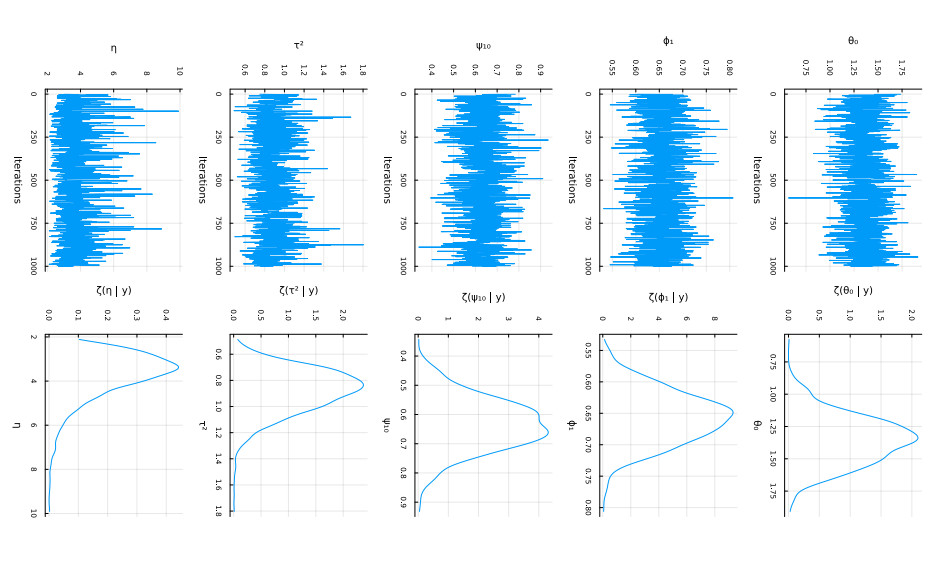
Trace plots and posterior densities of ARX parameters for a dataset simulated from Model Ⅰ
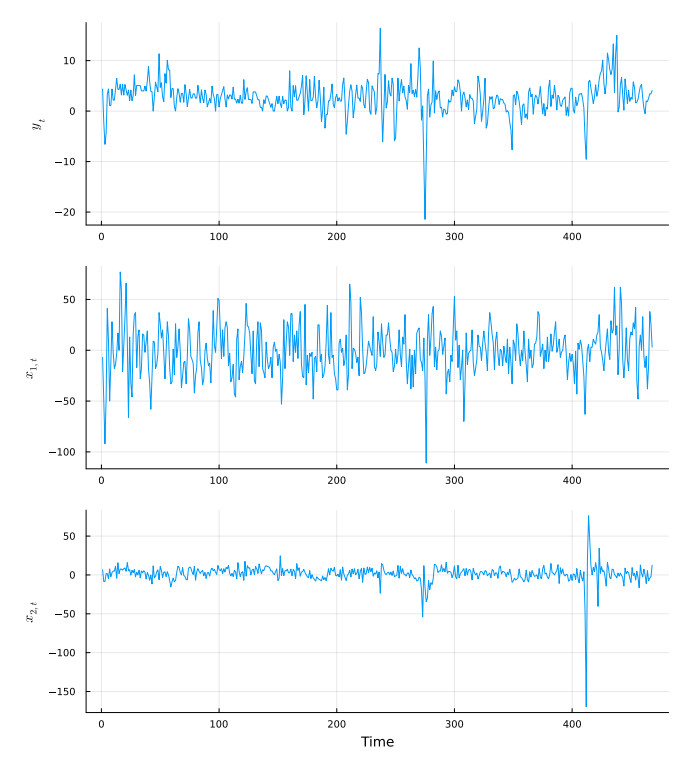
Monthly series used in the application: top, annualized CPI inflation $ y_t $; middle, monthly change in the 10-year Treasury yield $ x_{1, t} $; bottom, annualized industrial production growth $ x_{2, t} $
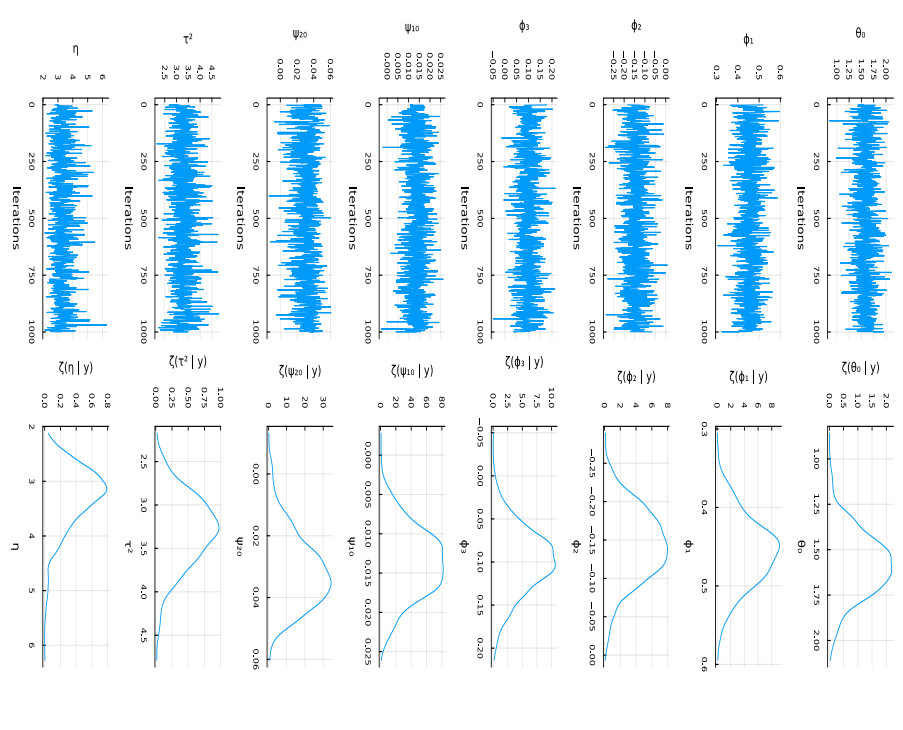
Trace plots and marginal posterior densities for the $ \mathrm{ARX}(3;\, 0, \, 0) $ model estimated on monthly US CPI inflation under SMN-$ t $ disturbances
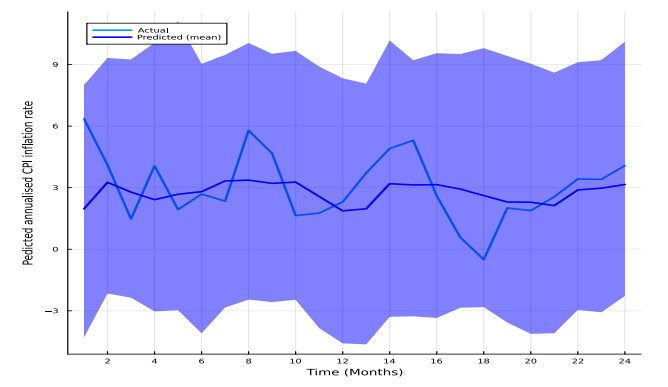
Predictions of annualized CPI inflation rates: The blue line represents actual values, the dark blue line represents the predictive mean, and the light blue shaded region indicates the 95% credible interval




 DownLoad: