This study extends the Aczél–Alsina operational and aggregation framework for $ (p, q) $-quasirung orthopair fuzzy information to a four-component bipolar setting. Aczél–Alsina operational laws are formulated for bipolar $ (p, q) $-quasirung orthopair fuzzy numbers, and the corresponding weighted averaging and weighted geometric aggregation operators are developed. The resulting operators are shown to preserve the bipolar $ (p, q) $-quasirung orthopair fuzzy structure and satisfy the required aggregation properties. In addition, complement duality between the weighted averaging and geometric operators is established. The effect of the Aczél–Alsina parameter is characterized theoretically, showing the opposite responses of the positive- and negative-pole score components and demonstrating that monotonicity of the overall pole-weighted score does not follow in general. An explicit pole importance parameter $ \alpha $ is incorporated into the ranking mechanism, and pole agreement, pole conflict, and the corresponding preference-switching threshold are characterized analytically. The proposed mechanisms are integrated into a multicriteria decision-making procedure and illustrated through a sustainable supplier selection problem. Numerical analyses examine the effects of the bipolar structure, criterion weights, and the parameters $ p $, $ q $, $ \lambda $, and $ \alpha $. The leading alternative remains unchanged across the examined $ p $, $ q $, $ \lambda $, and criterion weight scenarios, whereas changes in $ \alpha $ can alter the leading alternative when the negative pole is heavily discounted. The complete ranking of the lower-ranked alternatives remains sensitive to the aggregation operator and parameter settings.
Citation: Shatha Abdulhadi Saleh Alharbi, Kholood Mohammad Alsager. Aczél–Alsina aggregation operators for bipolar $ (p, q) $-quasirung orthopair fuzzy information with application to MCDM[J]. AIMS Mathematics, 2026, 11(11): 35957-36025. doi: 10.3934/math.20261394
This study extends the Aczél–Alsina operational and aggregation framework for $ (p, q) $-quasirung orthopair fuzzy information to a four-component bipolar setting. Aczél–Alsina operational laws are formulated for bipolar $ (p, q) $-quasirung orthopair fuzzy numbers, and the corresponding weighted averaging and weighted geometric aggregation operators are developed. The resulting operators are shown to preserve the bipolar $ (p, q) $-quasirung orthopair fuzzy structure and satisfy the required aggregation properties. In addition, complement duality between the weighted averaging and geometric operators is established. The effect of the Aczél–Alsina parameter is characterized theoretically, showing the opposite responses of the positive- and negative-pole score components and demonstrating that monotonicity of the overall pole-weighted score does not follow in general. An explicit pole importance parameter $ \alpha $ is incorporated into the ranking mechanism, and pole agreement, pole conflict, and the corresponding preference-switching threshold are characterized analytically. The proposed mechanisms are integrated into a multicriteria decision-making procedure and illustrated through a sustainable supplier selection problem. Numerical analyses examine the effects of the bipolar structure, criterion weights, and the parameters $ p $, $ q $, $ \lambda $, and $ \alpha $. The leading alternative remains unchanged across the examined $ p $, $ q $, $ \lambda $, and criterion weight scenarios, whereas changes in $ \alpha $ can alter the leading alternative when the negative pole is heavily discounted. The complete ranking of the lower-ranked alternatives remains sensitive to the aggregation operator and parameter settings.

| [1] |
L. A. Zadeh, Fuzzy sets, Inf. Control, 8 (1965), 338–353. https://doi.org/10.1016/S0019-9958(65)90241-X doi: 10.1016/S0019-9958(65)90241-X
|
| [2] |
K. T. Atanassov, Intuitionistic fuzzy sets, Fuzzy Sets Syst., 20 (1986), 87–96. https://doi.org/10.1016/S0165-0114(86)80034-3 doi: 10.1016/S0165-0114(86)80034-3
|
| [3] |
R. R. Yager, Pythagorean fuzzy subsets, 2013 Joint IFSA World Congress and NAFIPS Annual Meeting, 2013, 57–61. https://doi.org/10.1109/IFSA-NAFIPS.2013.6608375 |
| [4] |
R. R. Yager, A. M. Abbasov, Pythagorean membership grades, complex numbers, and decision making, Int. J. Intell. Syst., 28 (2013), 436–452. https://doi.org/10.1002/int.21584 doi: 10.1002/int.21584
|
| [5] |
R. R. Yager, Generalized orthopair fuzzy sets, IEEE Trans. Fuzzy Syst., 25 (2017), 1222–1230. https://doi.org/10.1109/TFUZZ.2016.2604005 doi: 10.1109/TFUZZ.2016.2604005
|
| [6] |
P. Liu, J. Liu, Some $q$-rung orthopair fuzzy Bonferroni mean operators and their application to multi-attribute group decision making, Int. J. Intell. Syst., 33 (2018), 315–347. https://doi.org/10.1002/int.21933 doi: 10.1002/int.21933
|
| [7] |
P. Liu, P. Wang, Some $q$-rung orthopair fuzzy aggregation operators and their applications to multiple-attribute decision making, Int. J. Intell. Syst., 33 (2018), 259–280. https://doi.org/10.1002/int.21927 doi: 10.1002/int.21927
|
| [8] |
G. Wei, H. Gao, Y. Wei, Some $q$-rung orthopair fuzzy Heronian mean operators in multiple attribute decision making, Int. J. Intell. Syst., 33 (2018), 1426–1458. https://doi.org/10.1002/int.21985 doi: 10.1002/int.21985
|
| [9] |
J. Wang, H. Gao, G. Wei, Y. Wei, Methods for multiple-attribute group decision making with $q$-rung interval-valued orthopair fuzzy information and their applications to the selection of green suppliers, Symmetry, 11 (2019), 56. https://doi.org/10.3390/sym11010056 doi: 10.3390/sym11010056
|
| [10] |
L. Xu, Y. Liu, H. Liu, Some improved $q$-rung orthopair fuzzy aggregation operators and their applications to multiattribute group decision-making, Math. Probl. Eng., 2019 (2019), 2036728. https://doi.org/10.1155/2019/2036728 doi: 10.1155/2019/2036728
|
| [11] |
W. Yang, Y. Pang, New $q$-rung orthopair fuzzy partitioned Bonferroni mean operators and their application in multiple attribute decision making, Int. J. Intell. Syst., 34 (2019), 439–476. https://doi.org/10.1002/int.22060 doi: 10.1002/int.22060
|
| [12] |
H. M. A. Farid, M. Riaz, Some generalized $q$-rung orthopair fuzzy Einstein interactive geometric aggregation operators with improved operational laws, Int. J. Intell. Syst., 36 (2021), 7239–7273. https://doi.org/10.1002/int.22587 doi: 10.1002/int.22587
|
| [13] |
M. Riaz, H. Garg, H. M. A. Farid, M. Aslam, Novel $q$-rung orthopair fuzzy interaction aggregation operators and their application to low-carbon green supply chain management, J. Intell. Fuzzy Syst., 41 (2021), 4109–4126. https://doi.org/10.3233/JIFS-210506 doi: 10.3233/JIFS-210506
|
| [14] |
T. Senapati, R. R. Yager, Fermatean fuzzy weighted averaging/geometric operators and its application in multi-criteria decision-making methods, Eng. Appl. Artif. Intell., 85 (2019), 112–121. https://doi.org/10.1016/j.engappai.2019.05.012 doi: 10.1016/j.engappai.2019.05.012
|
| [15] |
T. Senapati, R. R. Yager, Fermatean fuzzy sets, J. Amb. Intel. Hum. Comp., 11 (2020), 663–674. https://doi.org/10.1007/s12652-019-01377-0 doi: 10.1007/s12652-019-01377-0
|
| [16] |
M. R. Seikh, U. Mandal, Multiple attribute group decision making based on quasirung orthopair fuzzy sets: application to electric vehicle charging station site selection problem, Eng. Appl. Artif. Intell., 115 (2022), 105299. https://doi.org/10.1016/j.engappai.2022.105299 doi: 10.1016/j.engappai.2022.105299
|
| [17] |
T. Ahmad, M. Rahim, J. Yang, R. Alharbi, H. A. E. W. Khalifa, Development of $p, q$-quasirung orthopair fuzzy Hamacher aggregation operators and its application in decision-making problems, Heliyon, 10 (2024), e24726. https://doi.org/10.1016/j.heliyon.2024.e24726 doi: 10.1016/j.heliyon.2024.e24726
|
| [18] |
Z. Zhao, J. Ye, M. Rahim, F. Amin, S. Ahmad, M. Asim, et al., Quasirung orthopair fuzzy linguistic sets and their application to multi-criteria decision making, Sci. Rep., 14 (2024), 25513. https://doi.org/10.1038/s41598-024-76112-7 doi: 10.1038/s41598-024-76112-7
|
| [19] |
M. Ali, Y. Akhtar, M. Rahim, M. S. Yang, On circular $p, q$-quasirung orthopair fuzzy sets with their aggregation operators and application to green supplier selection, Complex Intell. Syst., 12 (2026), 115. https://doi.org/10.1007/s40747-026-02236-0 doi: 10.1007/s40747-026-02236-0
|
| [20] |
W. R. Zhang, Bipolar fuzzy sets and relations: a computational framework for cognitive modeling and multiagent decision analysis, Proceedings of NAFIPS/IFIS/NASA'94, 1994,305–309. https://doi.org/10.1109/IJCF.1994.375115 |
| [21] |
W. R. Zhang, (Yin) (Yang) bipolar fuzzy sets, Proceedings of the 1998 IEEE International Conference on Fuzzy Systems, 1998,835–840. https://doi.org/10.1109/FUZZY.1998.687599 |
| [22] |
K. M. Lee, K. M. Lee, K. J. Cios, Comparison of interval-valued fuzzy sets, intuitionistic fuzzy sets, and bipolar-valued fuzzy sets, Computing and Information Technologies, 2001,433–439. https://doi.org/10.1142/9789812810885_0055 |
| [23] |
S. Y. Musa, Z. A. Ameen, W. Alagal, B. A. Asaad, Bipolar $q$-fractional fuzzy aggregation operators for multi-criteria decision-making in optimal renewable energy selection, Energy Sci. Eng., 14 (2026), 3250–3271. https://doi.org/10.1002/ese3.70529 doi: 10.1002/ese3.70529
|
| [24] |
S. Abdullah, M. Aslam, K. Ullah, Bipolar fuzzy soft sets and its applications in decision-making problems, J. Intell. Fuzzy Syst., 27 (2014), 729–742. https://doi.org/10.3233/IFS-131031 doi: 10.3233/IFS-131031
|
| [25] |
I. Deli, M. Ali, F. Smarandache, Bipolar neutrosophic sets and their application based on multi-criteria decision-making problems, 2015 International Conference on Advanced Mechatronic Systems (ICAMechS), 2015,249–254. https://doi.org/10.1109/ICAMechS.2015.7287068 |
| [26] |
D. Ezhilmaran, K. Sankar, Morphism of bipolar intuitionistic fuzzy graphs, J. Discrete Math. Sci. Cryptography, 18 (2015), 605–621. https://doi.org/10.1080/09720529.2015.1013673 doi: 10.1080/09720529.2015.1013673
|
| [27] |
K. Mohana, R. Jansi, Bipolar Pythagorean fuzzy sets and their application based on multi-criteria decision-making problems, Int. J. Res. Adv. Technol., 6 (2018), 3754–3764. |
| [28] |
W. A. Mandal, Bipolar Pythagorean fuzzy sets and their application in multi-attribute decision making problems, Ann. Data Sci., 10 (2023), 555–587. https://doi.org/10.1007/s40745-020-00315-8 doi: 10.1007/s40745-020-00315-8
|
| [29] |
T. Mahmood, U. ur Rehman, A novel approach towards bipolar complex fuzzy sets and their applications in generalized similarity measures, Int. J. Intell. Syst., 37 (2022), 535–567. https://doi.org/10.1002/int.22639 doi: 10.1002/int.22639
|
| [30] |
H. Z. Ibrahim, Multi-attribute group decision-making based on bipolar $n, m$-rung orthopair fuzzy sets, Granular Comput., 8 (2023), 1819–1836. https://doi.org/10.1007/s41066-023-00405-x doi: 10.1007/s41066-023-00405-x
|
| [31] |
E. Natarajan, F. Augustin, R. Saraswathy, S. Narayanamoorthy, S. Salahshour, A. Ahmadian, et al., A bipolar intuitionistic fuzzy decision-making model for selection of effective diagnosis method of tuberculosis, Acta Trop., 252 (2024), 107132. https://doi.org/10.1016/j.actatropica.2024.107132 doi: 10.1016/j.actatropica.2024.107132
|
| [32] |
A. Fahmi, M. A. S. Hassan, A. Khan, T. Abdeljawad, D. K. Almutairi, A bipolar Fermatean fuzzy Hamacher approach to group decision-making for electric waste, Eur. J. Pure Appl. Math., 18 (2025), 5691. https://doi.org/10.29020/nybg.ejpam.v18i1.5691 doi: 10.29020/nybg.ejpam.v18i1.5691
|
| [33] |
H. Kamacı, S. Petchimuthu, Some similarity measures for interval-valued bipolar $q$-rung orthopair fuzzy sets and their application to supplier evaluation and selection in supply chain management, Environ. Dev. Sustain., 27 (2025), 21921–21960. https://doi.org/10.1007/s10668-022-02130-y doi: 10.1007/s10668-022-02130-y
|
| [34] |
I. Alshammari, Bipolar complex $q$-rung orthopair fuzzy aggregation operators for enhanced decision-making in uncertain environments, Sci. Rep., 16 (2026), 2865. https://doi.org/10.1038/s41598-025-32730-3 doi: 10.1038/s41598-025-32730-3
|
| [35] |
J. Aczél, C. Alsina, Characterizations of some classes of quasilinear functions with applications to triangular norms and to synthesizing judgements, Aequationes Math., 25 (1982), 313–315. https://doi.org/10.1007/BF02189626 doi: 10.1007/BF02189626
|
| [36] |
E. P. Klement, R. Mesiar, E. Pap, Triangular norms, Springer, 2000. https://doi.org/10.1007/978-94-015-9540-7 |
| [37] |
E. P. Klement, R. Mesiar, E. Pap, Triangular norms. Position paper Ⅰ: basic analytical and algebraic properties, Fuzzy Sets Syst., 143 (2004), 5–26. https://doi.org/10.1016/j.fss.2003.06.007 doi: 10.1016/j.fss.2003.06.007
|
| [38] |
T. Senapati, G. Chen, R. R. Yager, Aczél–Alsina aggregation operators and their application to intuitionistic fuzzy multiple attribute decision making, Int. J. Intell. Syst., 37 (2022), 1529–1551. https://doi.org/10.1002/int.22684 doi: 10.1002/int.22684
|
| [39] |
T. Senapati, Approaches to multi-attribute decision-making based on picture fuzzy Aczél–Alsina average aggregation operators, Comput. Appl. Math., 41 (2022), 40. https://doi.org/10.1007/s40314-021-01742-w doi: 10.1007/s40314-021-01742-w
|
| [40] |
I. U. Haq, T. Shaheen, W. Ali, T. Senapati, A novel SIR approach to closeness coefficient-based MAGDM problems using Pythagorean fuzzy Aczél-Alsina aggregation operators for investment policy, Discrete Dyn. Nat. Soc., 2022 (2022), 5172679. https://doi.org/10.1155/2022/5172679 doi: 10.1155/2022/5172679
|
| [41] |
T. Senapati, A. R. Mishra, A. Saha, V. Simic, P. Rani, R. Ali, Construction of interval-valued Pythagorean fuzzy Aczél–Alsina aggregation operators for decision making: a case study in emerging IT software company selection, Sādhanā, 47 (2022), 255. https://doi.org/10.1007/s12046-022-02002-1 doi: 10.1007/s12046-022-02002-1
|
| [42] |
I. U. Haq, T. Shaheen, W. Ali, H. Toor, T. Senapati, F. Pilla, et al., Novel Fermatean fuzzy Aczél–Alsina model for investment strategy selection, Mathematics, 11 (2023), 3211. https://doi.org/10.3390/math11143211 doi: 10.3390/math11143211
|
| [43] |
M. R. Khan, H. Wang, K. Ullah, H. Karamti, Construction material selection by using multi-attribute decision making based on $q$-rung orthopair fuzzy Aczél–Alsina aggregation operators, Appl. Sci., 12 (2022), 8537. https://doi.org/10.3390/app12178537 doi: 10.3390/app12178537
|
| [44] |
H. M. A. Farid, M. Riaz, $q$-rung orthopair fuzzy Aczél–Alsina aggregation operators with multi-criteria decision-making, Eng. Appl. Artif. Intell., 122 (2023), 106105. https://doi.org/10.1016/j.engappai.2023.106105 doi: 10.1016/j.engappai.2023.106105
|
| [45] |
T. Senapati, L. Martínez, G. Chen, Selection of appropriate global partner for companies using $q$-rung orthopair fuzzy Aczél–Alsina average aggregation operators, Int. J. Fuzzy Syst., 25 (2023), 980–996. https://doi.org/10.1007/s40815-022-01417-6 doi: 10.1007/s40815-022-01417-6
|
| [46] |
J. Ali, M. Naeem, Analysis and application of $p, q$-quasirung orthopair fuzzy Aczél–Alsina aggregation operators in multiple criteria decision-making, IEEE Access, 11 (2023), 49081–49101. https://doi.org/10.1109/ACCESS.2023.3274494 doi: 10.1109/ACCESS.2023.3274494
|
| [47] |
J. Ali, A. N. Al-Kenani, M. I. Syam, Prioritized Aczél–Alsina aggregation operators under $p, q$-quasirung orthopair fuzzy environment for sustainable supplier selection in new energy vehicle industry, Sci. Rep., 16 (2026), 268. https://doi.org/10.1038/s41598-025-29432-1 doi: 10.1038/s41598-025-29432-1
|
| [48] |
Z. Zararséz, New Aczél–Alsina components for bipolar fuzzy numbers and their use in multi-attribute decision making, Eng. Appl. Artif. Intell., 132 (2024), 108000. https://doi.org/10.1016/j.engappai.2024.108000 doi: 10.1016/j.engappai.2024.108000
|
| [49] |
J. Li, S. Yüksel, H. Dinçer, A. Mikhaylov, S. E. Barykin, Bipolar $q$-ROF hybrid decision making model with golden cut for analyzing the levelized cost of renewable energy alternatives, IEEE Access, 10 (2022), 42507–42517. https://doi.org/10.1109/ACCESS.2022.3168315 doi: 10.1109/ACCESS.2022.3168315
|
Figures(8) / Tables(15)

Shatha Abdulhadi Saleh Alharbi, Kholood Mohammad Alsager. Aczél–Alsina aggregation operators for bipolar $ (p, q) $-quasirung orthopair fuzzy information with application to MCDM[J]. AIMS Mathematics, 2026, 11(11): 35957-36025. doi: 10.3934/math.20261394

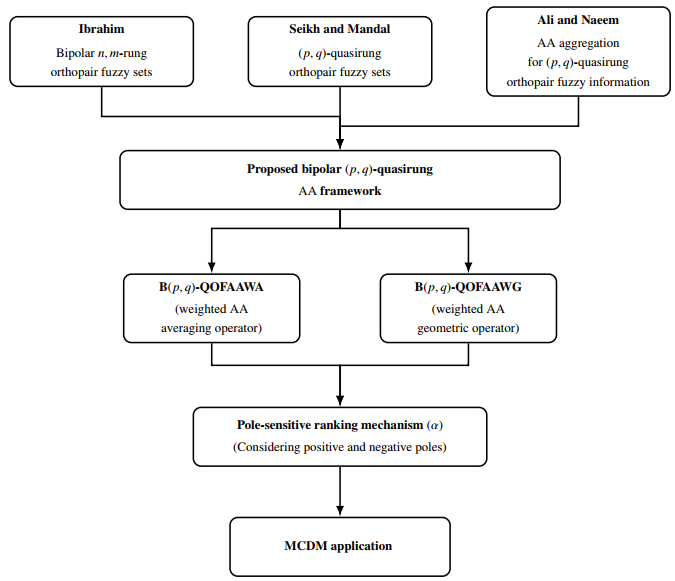
Conceptual structure of the proposed bipolar $ (p, q) $-quasirung $ \mathrm{AA} $ framework and its MCDM application
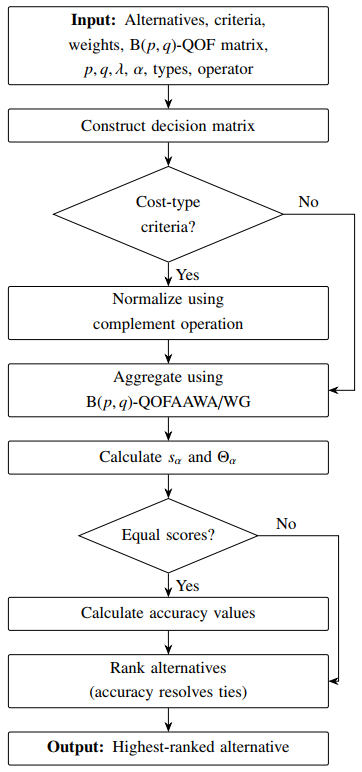
Flowchart of the proposed B$ (p, q) $-QOF-based MCDM procedure
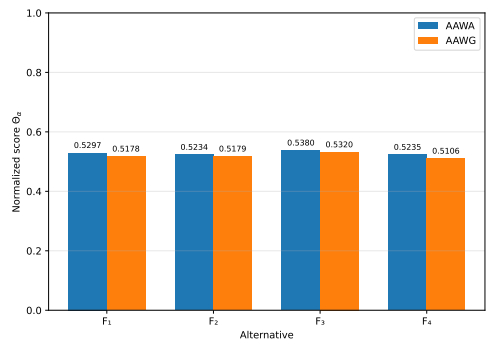
Comparison of the normalized score values produced by the $ \text{B}(p, q)\text{-QOFAAWA} $ and $ \text{B}(p, q)\text{-QOFAAWG} $ operators under the baseline setting
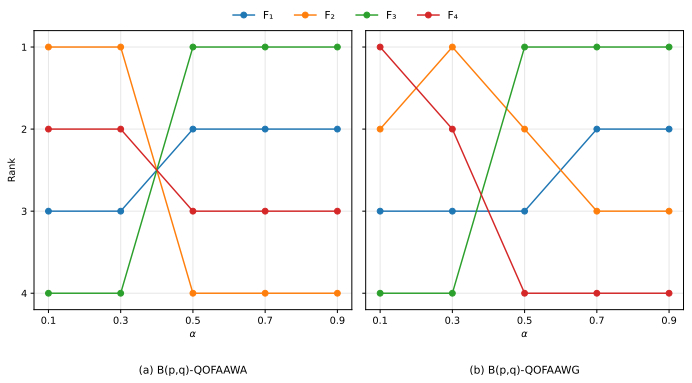
Sensitivity of rankings to the pole importance parameter $ \alpha $: (a) $ \text{B}(p, q)\text{-QOFAAWA} $; (b) $ \text{B}(p, q)\text{-QOFAAWG} $
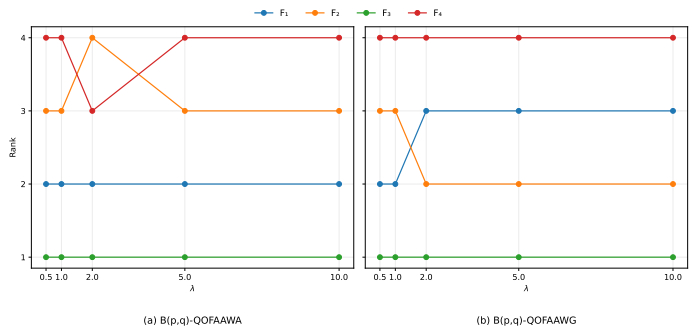
Ranking behavior for different values of the $ \mathrm{AA} $ parameter $ \lambda $
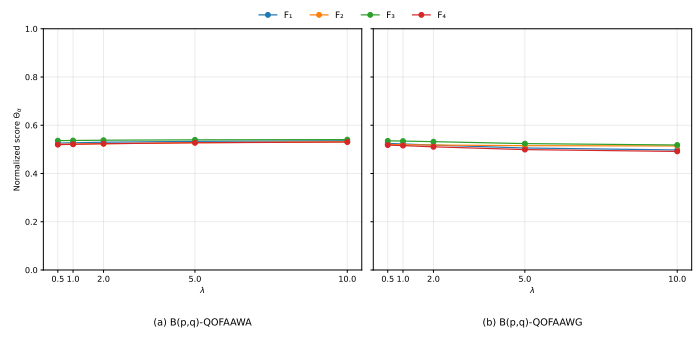
Variation of normalized score values with respect to $ \lambda $
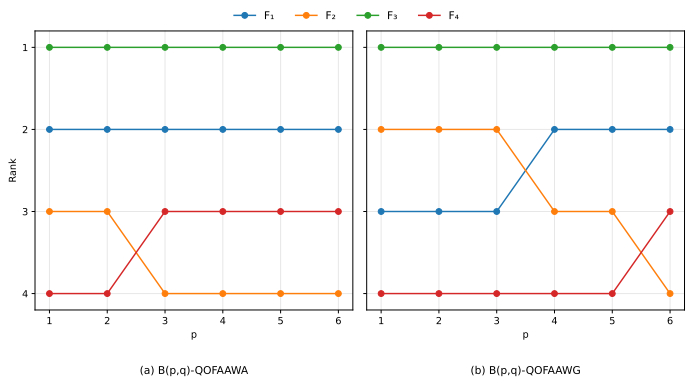
Ranking behavior for different values of $ p $ with $ q = 4 $ and $ \lambda = 2 $: (a) $ \text{B}(p, q)\text{-QOFAAWA} $; (b) $ \text{B}(p, q)\text{-QOFAAWG} $
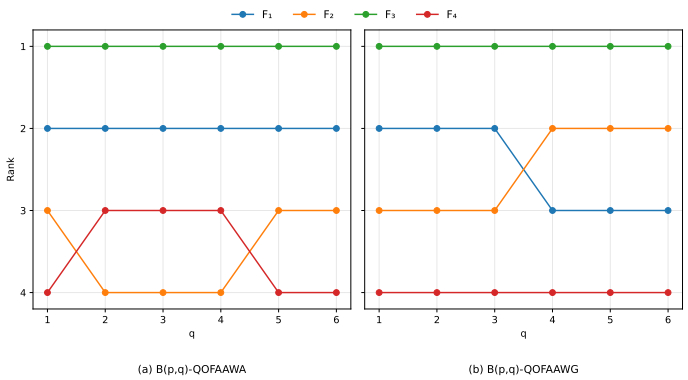
Ranking behavior for different values of $ q $ with $ p = 3 $ and $ \lambda = 2 $: (a) $ \text{B}(p, q)\text{-QOFAAWA} $; (b) $ \text{B}(p, q)\text{-QOFAAWG} $




 DownLoad: