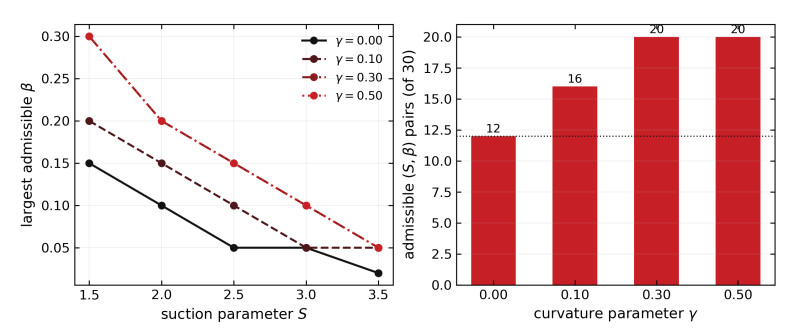
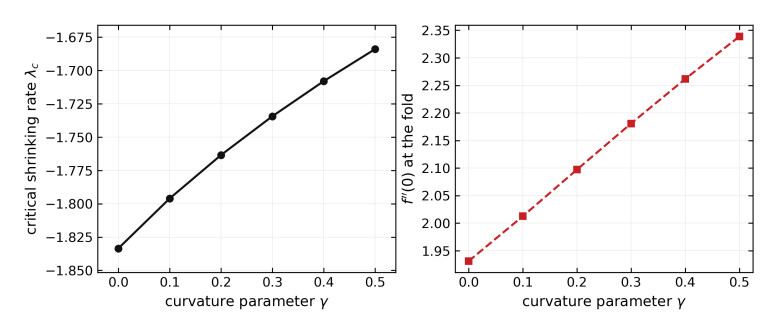
Wire coating, fiber drawing, and the extrusion of filled thermoplastics all draw a slender continuous filament through a hot, particle-laden viscoelastic melt, often in a packed die and under an imposed magnetic field. This paper formulates that configuration as a steady two-phase boundary layer flow of a radiative magnetohydrodynamic (MHD) dusty Maxwell nanofluid over a stretching or shrinking cylinder in a Darcy–Forchheimer porous medium, retaining a micrometer-scale dust phase with velocity and thermal slip alongside a Buongiorno nanoparticle description, nonlinear Rosseland radiation, and an Arrhenius reaction. Similarity reduction yields a tenth-order system in which transverse curvature enters through the parameter $ \gamma $, multiplying every diffusion operator by $ (1+2\gamma\eta) $ and adding a viscoelastic term with no plane-sheet analog. A collocation solver with fold-following continuation, verified against published stretching cylinder data to within $ 0.004\% $ at matched truncation, resolves both solution branches for the decelerating suction-assisted regime. Curvature is found to govern the problem principally through feasibility: Because the coefficient of the highest derivative is $ (1+2\gamma\eta)-\beta f^2 $, curvature relaxes the condition for a physically admissible solution, enlarging the admissible region of the suction–Deborah plane by about two-thirds at $ \gamma = 0.5 $ and doubling or tripling the largest attainable Deborah number at fixed suction. It also contracts the range of shrinking rates supporting dual solutions, moving the critical value from $ \lambda_c = -1.8336 $ on a plane sheet to $ -1.6840 $ at $ \gamma = 0.5 $, with the contraction strengthening as suction increases. A linear temporal stability analysis of the complete disturbance system confirms the upper branch to be stable and the lower to be unstable; the linearized operator is shown to be block lower-triangular, so the customary restriction to the momentum–dust subsystem is exact rather than assumed. Finally, a machine learning surrogate is assessed against classical alternatives on equal data. A Gaussian process built on 10 reference solutions attains $ 0.18\% $ accuracy for under three seconds of construction and repays itself after 11 evaluations, against roughly 875 for a network trained on the differential residual. The same Gaussian process degrades by nearly three orders of magnitude approaching the turning point, erring by $ 12.3\% $ at a distance of $ 0.036 $ from the fold, where the branch has a vertical tangent and smooth interpolation is the wrong hypothesis class. The case for embedding the governing equations in a surrogate rests on that neighborhood, and not on the cost.
Citation: Bilal Ahmad, Muhammad Abubakar, Amber Sultan, Syed Baqar Hussain, Yazeed Yasin Ghadi. Physics-informed machine learning approach for radiative MHD dusty Maxwell nanofluid flow over a stretching/shrinking surface in a non-Darcy porous medium: A case of dual solutions[J]. AIMS Mathematics, 2026, 11(11): 36026-36064. doi: 10.3934/math.20261395
Wire coating, fiber drawing, and the extrusion of filled thermoplastics all draw a slender continuous filament through a hot, particle-laden viscoelastic melt, often in a packed die and under an imposed magnetic field. This paper formulates that configuration as a steady two-phase boundary layer flow of a radiative magnetohydrodynamic (MHD) dusty Maxwell nanofluid over a stretching or shrinking cylinder in a Darcy–Forchheimer porous medium, retaining a micrometer-scale dust phase with velocity and thermal slip alongside a Buongiorno nanoparticle description, nonlinear Rosseland radiation, and an Arrhenius reaction. Similarity reduction yields a tenth-order system in which transverse curvature enters through the parameter $ \gamma $, multiplying every diffusion operator by $ (1+2\gamma\eta) $ and adding a viscoelastic term with no plane-sheet analog. A collocation solver with fold-following continuation, verified against published stretching cylinder data to within $ 0.004\% $ at matched truncation, resolves both solution branches for the decelerating suction-assisted regime. Curvature is found to govern the problem principally through feasibility: Because the coefficient of the highest derivative is $ (1+2\gamma\eta)-\beta f^2 $, curvature relaxes the condition for a physically admissible solution, enlarging the admissible region of the suction–Deborah plane by about two-thirds at $ \gamma = 0.5 $ and doubling or tripling the largest attainable Deborah number at fixed suction. It also contracts the range of shrinking rates supporting dual solutions, moving the critical value from $ \lambda_c = -1.8336 $ on a plane sheet to $ -1.6840 $ at $ \gamma = 0.5 $, with the contraction strengthening as suction increases. A linear temporal stability analysis of the complete disturbance system confirms the upper branch to be stable and the lower to be unstable; the linearized operator is shown to be block lower-triangular, so the customary restriction to the momentum–dust subsystem is exact rather than assumed. Finally, a machine learning surrogate is assessed against classical alternatives on equal data. A Gaussian process built on 10 reference solutions attains $ 0.18\% $ accuracy for under three seconds of construction and repays itself after 11 evaluations, against roughly 875 for a network trained on the differential residual. The same Gaussian process degrades by nearly three orders of magnitude approaching the turning point, erring by $ 12.3\% $ at a distance of $ 0.036 $ from the fold, where the branch has a vertical tangent and smooth interpolation is the wrong hypothesis class. The case for embedding the governing equations in a surrogate rests on that neighborhood, and not on the cost.

| [1] |
M. Raissi, P. Perdikaris, G. E. Karniadakis, Physics-informed neural networks: A deep learning framework for solving forward and inverse problems involving nonlinear partial differential equations, J. Comput. Phys., 378 (2019), 686–707. https://doi.org/10.1016/j.jcp.2018.10.045 doi: 10.1016/j.jcp.2018.10.045
|
| [2] |
S. Cai, Z. Mao, Z. Wang, M. Yin, G. E. Karniadakis, Physics-informed neural networks (PINNs) for fluid mechanics: A review, Acta Mech. Sinica, 37 (2021), 1727–1738. https://doi.org/10.1007/s10409-021-01148-1 doi: 10.1007/s10409-021-01148-1
|
| [3] |
V. Poply, P. Singh, K. K. Chaudhary, Analysis of laminar boundary layer flow along a stretching cylinder in the presence of thermal radiation, WSEAS Tran. Fluid Mech., 8 (2013), 159–164. |
| [4] |
P. T. Manjunatha, B. J. Gireesha, B. C. Prasannakumara, Thermal analysis of conducting dusty fluid flow in a porous medium over a stretching cylinder in the presence of non-uniform source/sink, Int. J. Mech. Mater. Eng., 9 (2014), 13. |
| [5] |
Hashim, M. Khan, A. S. Alshomrani, Characteristics of melting heat transfer during flow of Carreau fluid induced by a stretching cylinder, Eur. Phys. J. E, 40 (2017), 1–9. |
| [6] |
A. Mahdy, F. M. Hady, R. A. Mohamed, O. A. Abo-zaid, Activation energy effectiveness in dusty Carreau fluid flow along a stretched cylinder due to nonuniform thermal conductivity property and temperature-dependent heat source/sink, Heat Transfer, 50 (2021), 5760–5778. https://doi.org/10.1002/htj.22147 doi: 10.1002/htj.22147
|
| [7] |
N. Abbas, W. Shatanawi, F. Hasan, T. A. M. Shatnawi, Numerical analysis of Darcy resistant Sutterby nanofluid flow with effect of radiation and chemical reaction over stretching cylinder: Induced magnetic field, AIMS Math., 8 (2023), 11202–11220. https://doi.org/10.3934/math.2023567 doi: 10.3934/math.2023567
|
| [8] |
R. K. Alhefthi, I. Shahzadi, H. A. Khan, N. Khan, M. S. Hashmi, M. Inc, Convective boundary layer flow of MHD tangent hyperbolic nanofluid over stratified sheet with chemical reaction, AIMS Math., 9 (2024), 16901–16923. https://doi.org/10.3934/math.2024821 doi: 10.3934/math.2024821
|
| [9] |
K. Sadeghy, H. Hajibeygi, S. M. Taghavi, Stagnation-point flow of upper-convected Maxwell fluids, Int. J. Non-Lin. Mech., 41 (2006), 1242–1247. https://doi.org/10.1016/j.ijnonlinmec.2006.08.005 doi: 10.1016/j.ijnonlinmec.2006.08.005
|
| [10] |
J. Buongiorno, Convective transport in nanofluids, J. Heat Tran., 128 (2006), 240–250. https://doi.org/10.1115/1.2150834 doi: 10.1115/1.2150834
|
| [11] |
W. A. Khan, I. Pop, Boundary-layer flow of a nanofluid past a stretching sheet, Int. J. Heat Mass Tran., 53 (2010), 2477–2483. https://doi.org/10.1016/j.ijheatmasstransfer.2010.01.032 doi: 10.1016/j.ijheatmasstransfer.2010.01.032
|
| [12] |
B. Mahanthesh, J. Mackolil, M. Radhika, Significance of quadratic thermal radiation and quadratic convection on boundary layer two-phase flow of a dusty nanoliquid past a vertical plate, Int. Commun. Heat Mass Tran., 120 (2021), 105029. https://doi.org/10.1016/j.icheatmasstransfer.2020.105029 doi: 10.1016/j.icheatmasstransfer.2020.105029
|
| [13] |
M. Ramzan, N. Shaheen, J. D. Chung, S. Kadry, Y. M. Chu, F. Howari, Impact of Newtonian heating and Fourier and Fick's laws on a magnetohydrodynamic dusty Casson nanofluid flow with variable heat source/sink over a stretching cylinder, Sci. Rep., 11 (2021), 2357. https://doi.org/10.1038/s41598-021-81747-x doi: 10.1038/s41598-021-81747-x
|
| [14] |
M. Miklavčič, C. Y. Wang, Viscous flow due to a shrinking sheet, Q. Appl. Math., 64 (2006), 283–290. https://doi.org/10.1090/s0033-569x-06-01002-5 doi: 10.1090/s0033-569x-06-01002-5
|
| [15] |
Y. Ouyang, M. F. Md Basir, K. Naganthran, I. Pop, Dual solutions in Maxwell ternary nanofluid flow with viscous dissipation and velocity slip past a stretching/shrinking sheet, Alex. Eng. J., 105 (2024), 437–448. https://doi.org/10.1016/j.aej.2024.07.093 doi: 10.1016/j.aej.2024.07.093
|
| [16] |
U. Yashkun, L. A. Lund, M. A. Fadhel, N. A. Shah, Velocity slip effect on magnetized Casson nanofluid over shrinking/stretching cylinder: Duality and stability analysis, Phys. Scripta, 99 (2024), 025203. https://doi.org/10.1088/1402-4896/ad1795 doi: 10.1088/1402-4896/ad1795
|
| [17] |
J. H. Merkin, On dual solutions occurring in mixed convection in a porous medium, J. Eng. Math., 20 (1986), 171–179. https://doi.org/10.1007/bf00042775 doi: 10.1007/bf00042775
|
| [18] |
P. D. Weidman, D. G. Kubitschek, A. M. J. Davis, The effect of transpiration on self-similar boundary layer flow over moving surfaces, Int. J. Eng. Sci., 44 (2006), 730–737. https://doi.org/10.1016/j.ijengsci.2006.04.005 doi: 10.1016/j.ijengsci.2006.04.005
|
| [19] |
G. E. Karniadakis, I. G. Kevrekidis, L. Lu, P. Perdikaris, S. Wang, L. Yang, Physics-informed machine learning, Nat. Rev. Phys., 3 (2021), 422–440. https://doi.org/10.1038/s42254-021-00314-5 doi: 10.1038/s42254-021-00314-5
|
| [20] |
Z. Zou, Z. Wang, G. E. Karniadakis, Learning and discovering multiple solutions using physics-informed neural networks with random initialization and deep ensemble, P. Roy. Soc. A- Math. Phys., 481 (2025). https://doi.org/10.1098/rspa.2025.0205 doi: 10.1098/rspa.2025.0205
|
| [21] |
G. Ramasekhar, S. Alkarni, N. A. Shah, Machine learning approach of Casson hybrid nanofluid flow over a heated stretching surface, AIMS Math., 9 (2024), 18746–18762. https://doi.org/10.3934/math.2024912 doi: 10.3934/math.2024912
|
| [22] |
A. H. Alharbi, E. H. Boussaha, A. M. Alhartomi, H. Salhi, R. Alrdadi, M. Kezzar, M. R. Sari, AI-driven analysis of Darcy–Forchheimer EMHD boundary layer flow in thermal hybrid nanofluids, AIMS Math., 10 (2025), 27129–27151. https://doi.org/10.3934/math.20251192 doi: 10.3934/math.20251192
|
| [23] |
S. Wang, Y. Teng, P. Perdikaris, Understanding and mitigating gradient flow pathologies in physics-informed neural networks, SIAM J. Sci. Comput., 43 (2021), A3055–A3081. https://doi.org/10.1137/20M1318043 doi: 10.1137/20M1318043
|
| [24] |
X. Huang, F. Wang, B. Zhang, H. Liu, Enriched physics-informed neural networks for dynamic Poisson–Nernst–Planck systems, Math. Comput. Simulat., 237 (2025), 231–246. https://doi.org/10.1016/j.matcom.2025.04.037 doi: 10.1016/j.matcom.2025.04.037
|
| [25] |
X. Li, F. Wang, R. Wang, S. Zhao, D. Yang, Fundamental solution neural networks for solving inverse Cauchy problems for the Laplace and biharmonic equations, Comput. Math. Appl., 201 (2026), 1–17. https://doi.org/10.1016/j.camwa.2025.09.032 doi: 10.1016/j.camwa.2025.09.032
|
Figures(19) / Tables(18)

Bilal Ahmad, Muhammad Abubakar, Amber Sultan, Syed Baqar Hussain, Yazeed Yasin Ghadi. Physics-informed machine learning approach for radiative MHD dusty Maxwell nanofluid flow over a stretching/shrinking surface in a non-Darcy porous medium: A case of dual solutions[J]. AIMS Mathematics, 2026, 11(11): 36026-36064. doi: 10.3934/math.20261395

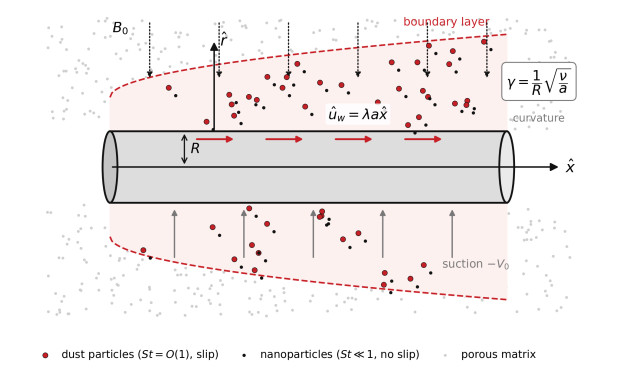
Stretching/shrinking cylinder of radius $ R $ in a non-Darcy porous medium, carrying a dusty Maxwell nanofluid under a transverse magnetic field with radial suction
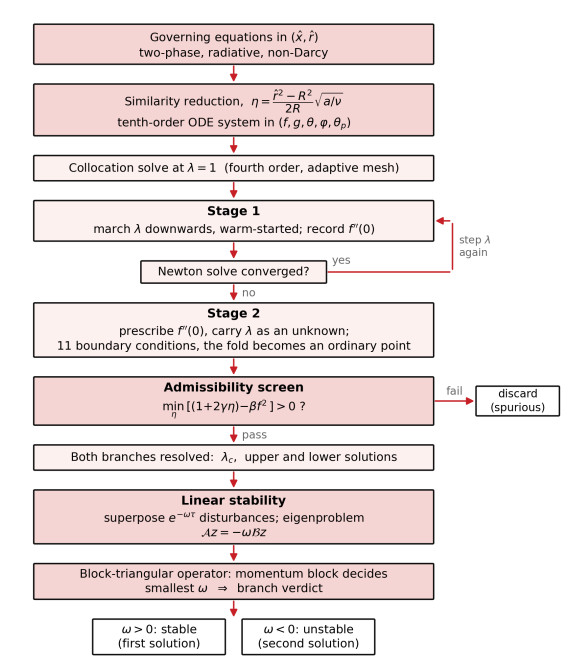
The numerical procedure. Stage 1 marches $ \lambda $ downwards until the Newton solver fails near the fold; Stage 2 exchanges the roles of $ \lambda $ and $ f''(0) $ so that the turning point becomes an ordinary point of the solution curve. Every accepted solution is screened on the Maxwell admissibility margin before entering the stability analysis
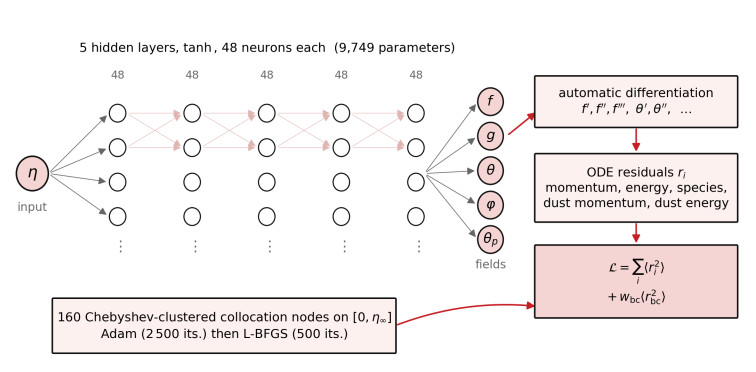
Surrogate architecture. A single input $ \eta $ maps through five $ \tanh $ layers to the five primitive fields; derivatives are obtained by automatic differentiation, so the five ODE residuals are evaluated exactly rather than by finite differences and combined with the boundary residuals into the training objective
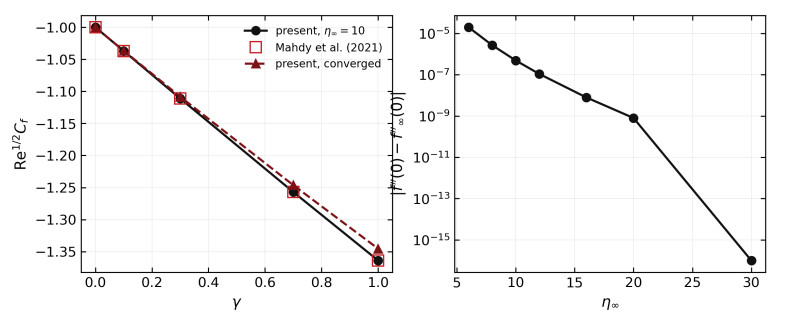
Left: Skin friction against curvature, comparing the present solver at matched truncation and at convergence with the published values. Right: Convergence of $ f''(0) $ with the truncation $ \eta_\infty $ for the full tenth-order system
Left: Largest admissible Maxwell parameter against suction, at four curvatures. Right: The number of admissible $ (S, \beta) $ combinations out of the 30 tested; the dotted line marks the plane sheet value
Critical shrinking rate $ \lambda_c $ (left) and the skin friction at the turning point (right) against the curvature parameter
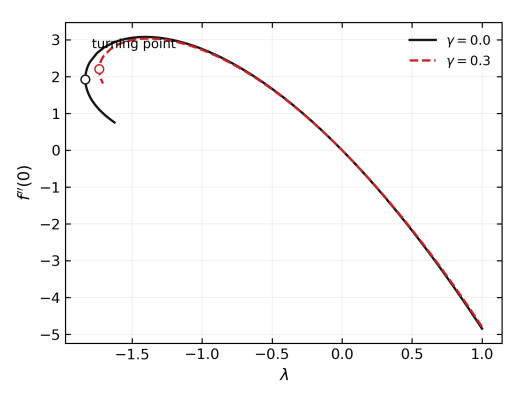
Solution curves $ f''(0) $ against $ \lambda $ at two curvatures. Open circles mark the turning points. The upper portion of each curve is the first (stable) solution; the lower portion is the second (unstable) solution
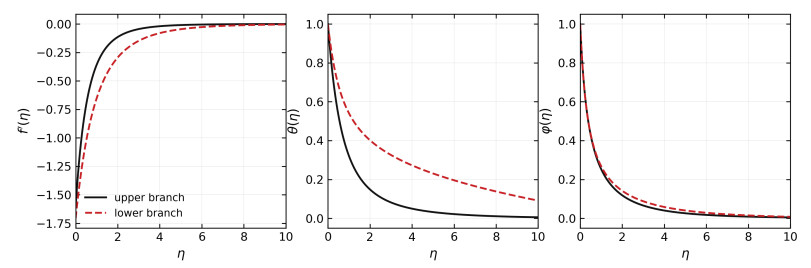
Velocity, temperature, and concentration profiles on both branches at $ \gamma = 0.3 $. The two solutions are taken at the traced points nearest $ 0.92\lambda_c $ on their respective branches, with $ \lambda = -1.600 $ on the upper and $ \lambda = -1.707 $ on the lower; the lower branch occupies only a narrow interval above $ \lambda_c $, so an exact match in $ \lambda $ is not available. The second solution carries a markedly thicker velocity and thermal layer
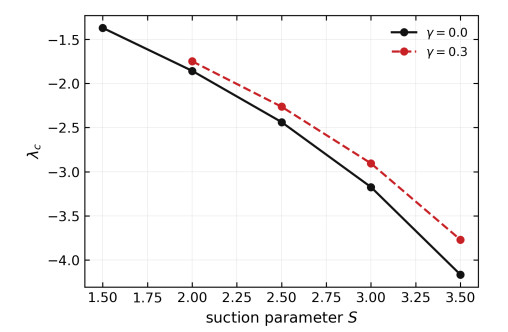
Critical shrinking rate against suction at two curvatures
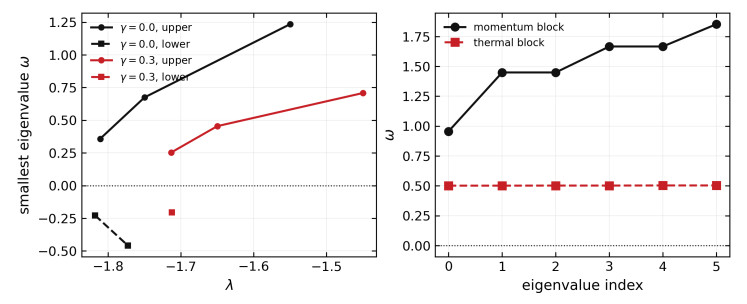
Left: Smallest eigenvalue against $ \lambda $ on both branches at two curvatures; the dotted line is $ \omega = 0 $. Right: The leading eigenvalues of the momentum and thermal blocks at $ \gamma = 0.3 $, $ \lambda = -1.0 $, showing that the thermal block is bounded away from zero
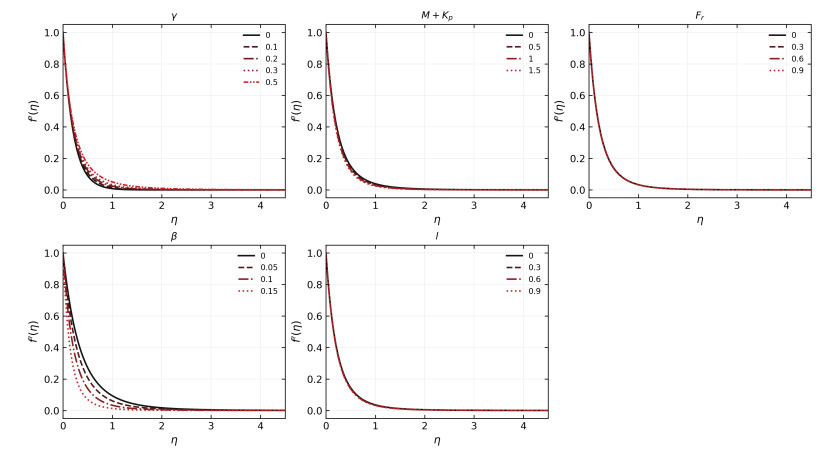
Fluid axial velocity for the curvature, resistance, Forchheimer, Maxwell, and dust loading groups
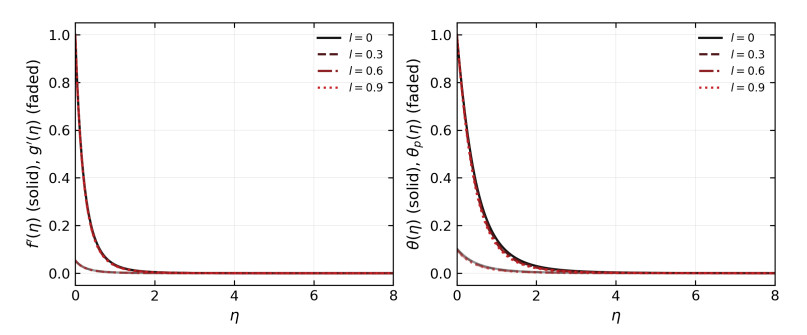
Fluid and dust fields at several loadings; dust quantities are shown faded. The particulate phase lags the carrier in both velocity and temperature
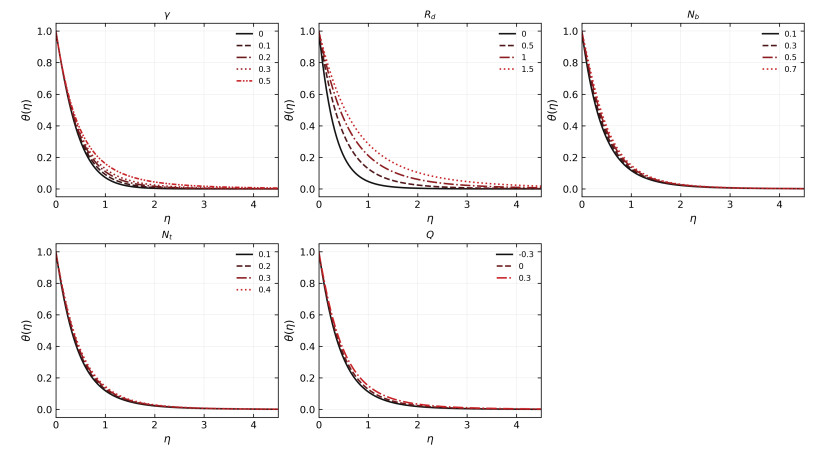
Fluid temperature for the curvature, radiation, Brownian, thermophoresis, and heat source groups
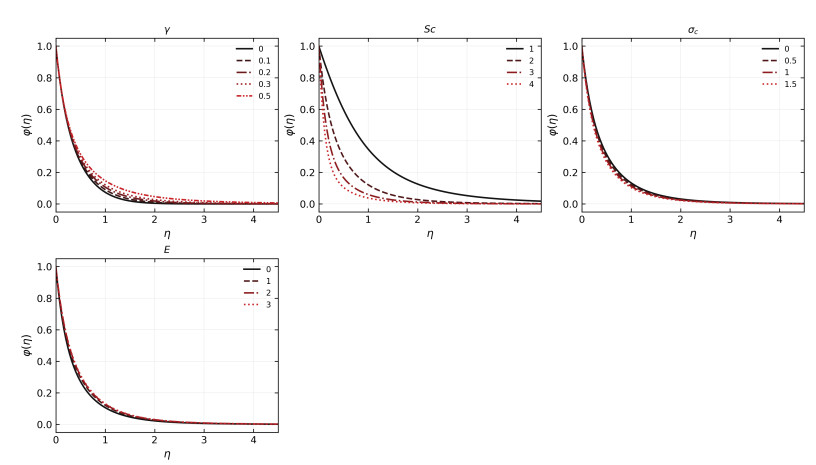
Nanoparticle concentration for the curvature, Schmidt, reaction rate, and activation energy groups
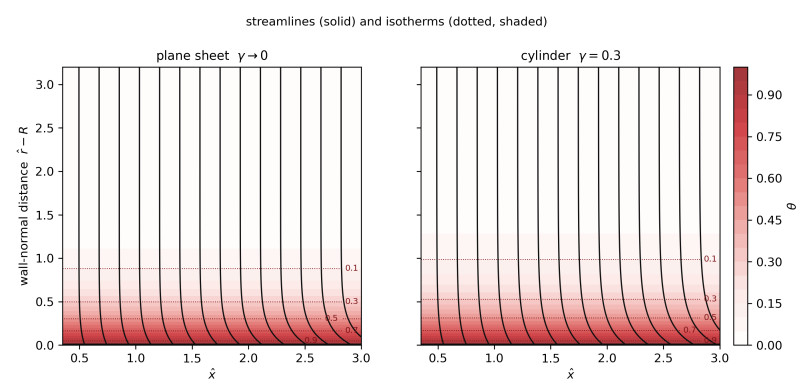
Streamlines (solid) and isotherms (dotted, with red shading) in the physical plane at $ \lambda = 1 $, $ S = 2 $, and $ \beta = 0.1 $. Left: Plane sheet. Right: Cylinder at $ \gamma = 0.3 $. The vertical coordinate is the wall-normal distance $ \hat r-R $
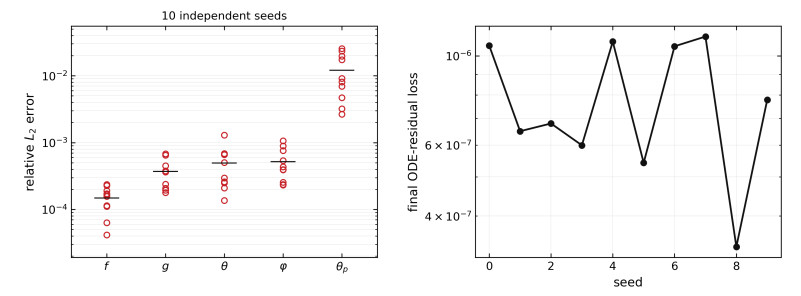
Left: Relative $ L_2 $ error for each state variable over 10 seeds; horizontal bars mark the means. Right: The final ODE residual loss by seed
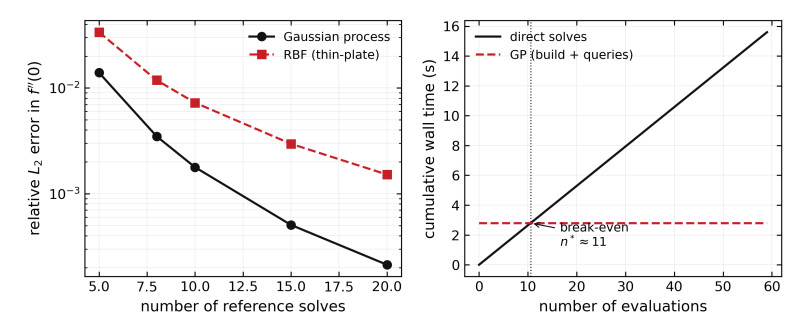
Left: Accuracy of the classical surrogates for $ f''(0) $ against the number of reference solutions. Right: Cumulative cost of repeated direct solution compared with building a Gaussian process on 10 solutions and querying it; the surrogate repays its construction after about 11 evaluations
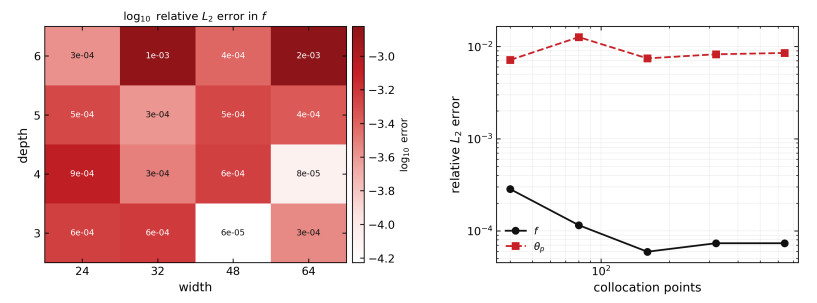
Left: Relative $ L_2 $ error in $ f $ over the depth-by-width grid. Right: Collocation density convergence for $ f $ and $ \theta_p $
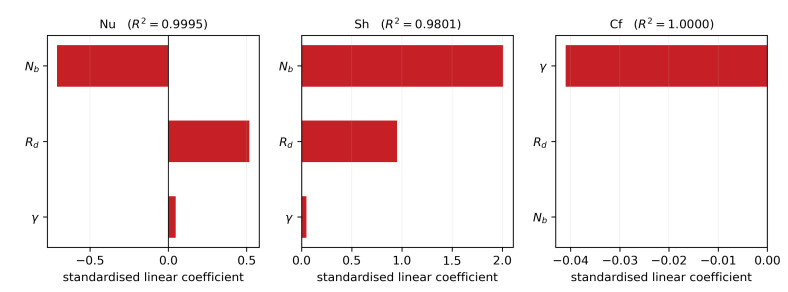
Standardized linear coefficients for each response, ordered by magnitude. Bars are a sensitivity ranking, not effect estimates with confidence intervals




 DownLoad: