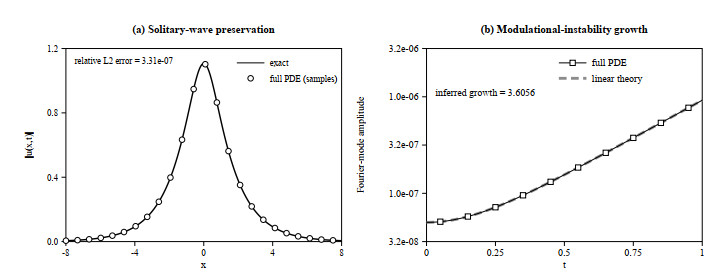
We study a generalized $ (2{+}1) $-dimensional Davey–Stewartson system with arbitrary-power and double-power nonlinearities. For a general propagation direction, the amplitude coordinate $ \rho = |u|^p $ reduces the traveling-wave problem to a planar system that is singular at $ \rho = 0 $ for every real $ p > 1 $. A time rescaling yields a polynomial system with an invariant boundary. We clarify the physical domain and uniqueness properties of this regularization, rederive the known arbitrary-power first integral on $ \rho > 0 $, and classify seven complete configurations of positive interior roots, including the no-positive-root case and two double-root boundaries. A representative $ p = 2 $ solitary wave is verified analytically and by direct pseudospectral simulation of the original partial differential equations, with relative $ L^2 $ error $ 3.31\times10^{-7} $ at $ t = 1 $. Linearization about a continuous wave gives a directional modulational-instability criterion that separates the effects of local nonlinearities and mean-field coupling. A two-dimensional simulation with oblique perturbation vector $ (2, 1) $ gives growth rate $ 3.60555 $, agreeing with the theoretical value $ \sqrt{13} $ at $ p = 2 $; a separate $ p = 3/2 $ test also agrees with its prediction. Equal-magnitude oblique perturbations can grow or oscillate solely because of their orientation. Boundary-reaching orbit segments are identified, but extending them by zero generally does not produce classical compactly supported solutions. A weak-solution analysis and nonlinear stability theory remain open.
Citation: Chun Tong. Boundary geometry and directional modulational instability in a generalized $ (2{+}1) $-dimensional Davey-Stewartson system[J]. AIMS Mathematics, 2026, 11(10): 35818-35831. doi: 10.3934/math.20261388
We study a generalized $ (2{+}1) $-dimensional Davey–Stewartson system with arbitrary-power and double-power nonlinearities. For a general propagation direction, the amplitude coordinate $ \rho = |u|^p $ reduces the traveling-wave problem to a planar system that is singular at $ \rho = 0 $ for every real $ p > 1 $. A time rescaling yields a polynomial system with an invariant boundary. We clarify the physical domain and uniqueness properties of this regularization, rederive the known arbitrary-power first integral on $ \rho > 0 $, and classify seven complete configurations of positive interior roots, including the no-positive-root case and two double-root boundaries. A representative $ p = 2 $ solitary wave is verified analytically and by direct pseudospectral simulation of the original partial differential equations, with relative $ L^2 $ error $ 3.31\times10^{-7} $ at $ t = 1 $. Linearization about a continuous wave gives a directional modulational-instability criterion that separates the effects of local nonlinearities and mean-field coupling. A two-dimensional simulation with oblique perturbation vector $ (2, 1) $ gives growth rate $ 3.60555 $, agreeing with the theoretical value $ \sqrt{13} $ at $ p = 2 $; a separate $ p = 3/2 $ test also agrees with its prediction. Equal-magnitude oblique perturbations can grow or oscillate solely because of their orientation. Boundary-reaching orbit segments are identified, but extending them by zero generally does not produce classical compactly supported solutions. A weak-solution analysis and nonlinear stability theory remain open.

| [1] |
A. Davey, K. Stewartson, On three-dimensional packets of surface waves, Proc. R. Soc. A, 338 (1974), 101–110. https://doi.org/10.1098/rspa.1974.0076 doi: 10.1098/rspa.1974.0076
|
| [2] |
M. J. Ablowitz, P. A. Clarkson, Solitons, nonlinear evolution equations and inverse scattering, Cambridge: Cambridge University Press, 1991. https://doi.org/10.1017/CBO9780511623998 |
| [3] |
E. S. Selima, A. R. Seadawy, X. Yao, The nonlinear dispersive Davey-Stewartson system for surface waves propagation in shallow water and its stability, Eur. Phys. J. Plus, 131 (2016), 425. https://doi.org/10.1140/epjp/i2016-16425-7 doi: 10.1140/epjp/i2016-16425-7
|
| [4] |
E. S. Selima, Y. Mao, X. Yao, A. M. Morad, T. Abdelhamid, B. I. Selim, Applicable symbolic computations on dynamics of small-amplitude long waves and Davey-Stewartson equations in finite water depth, Appl. Math. Model., 57 (2018), 376–390. https://doi.org/10.1016/j.apm.2018.01.017 doi: 10.1016/j.apm.2018.01.017
|
| [5] |
D. Anker, N. C. Freeman, On the soliton solutions of the Davey-Stewartson equation for long waves, Proc. R. Soc. A, 360 (1978), 529–540. https://doi.org/10.1098/rspa.1978.0083 doi: 10.1098/rspa.1978.0083
|
| [6] |
Y. Ohta, J. Yang, Rogue waves in the Davey-Stewartson Ⅰ equation, Phys. Rev. E, 86 (2012), 036604. https://doi.org/10.1103/PhysRevE.86.036604 doi: 10.1103/PhysRevE.86.036604
|
| [7] |
J. Rao, A. S. Fokas, J. He, Doubly localized two-dimensional rogue waves in the Davey-Stewartson Ⅰ equation, J. Nonlinear Sci., 31 (2021), 67. https://doi.org/10.1007/s00332-021-09720-6 doi: 10.1007/s00332-021-09720-6
|
| [8] |
M. A. U. Khan, M. Sadaf, G. Akram, A. Birhanu, K. Rehan, Y. S. Hamed, Soliton solutions of nonlinear coupled Davey-Stewartson Fokas system using modified auxiliary equation method and extended $(G'/G^2)$-expansion method, Sci. Rep., 14 (2024), 21949. https://doi.org/10.1038/s41598-024-72571-0 doi: 10.1038/s41598-024-72571-0
|
| [9] |
M. M. Tariq, M. B. Riaz, T. Kozubek, M. Aziz-ur-Rehman, Exploring chaos and stability: dynamic insights into the stochastic Davey-Stewartson system through advanced sensitivity analysis, Model. Earth Syst. Environ., 11 (2025), 83. https://doi.org/10.1007/s40808-024-02229-3 doi: 10.1007/s40808-024-02229-3
|
| [10] |
B. Yang, J. Yang, Rogue curves in the Davey-Stewartson Ⅰ equation, Chaos, 34 (2024), 073148. https://doi.org/10.1063/5.0210867 doi: 10.1063/5.0210867
|
| [11] |
Q. Yuan, Y. Zhang, B. Yang, Large-time asymptotic wave dynamics of rogue curves in the Davey-Stewartson Ⅰ equation, Commun. Theor. Phys., 78 (2026), 035005. https://doi.org/10.1088/1572-9494/ae1fe3 doi: 10.1088/1572-9494/ae1fe3
|
| [12] |
B. Yang, J. Yang, Spatially-bounded rogue waves in the Davey-Stewartson Ⅰ equation, Journal of Nonlinear Waves, 2 (2026), e3. https://doi.org/10.1017/jnw.2026.10030 doi: 10.1017/jnw.2026.10030
|
| [13] |
B. Zhang, M. Xiong, L. Chen, Many new exact solutions for generalized Davey-Stewartson equation with arbitrary power nonlinearities using novel $(G'/G)$-expansion method, Journal of Advances in Applied Mathematics, 4 (2019), 10–21. https://doi.org/10.22606/jaam.2019.41002 doi: 10.22606/jaam.2019.41002
|
| [14] |
S. Arshed, N. Raza, M. Alansari, Soliton solutions of the generalized Davey-Stewartson equation with full nonlinearities via three integrating schemes, Ain Shams Eng. J., 12 (2021), 3091–3098. https://doi.org/10.1016/j.asej.2020.10.030 doi: 10.1016/j.asej.2020.10.030
|
| [15] |
Y. Wang, B. Zhang, B. Cao, The exact solutions of generalized Davey-Stewartson equations with arbitrary power nonlinearities using the dynamical system and the first integral methods, Open Math., 20 (2022), 894–910. https://doi.org/10.1515/math-2022-0469 doi: 10.1515/math-2022-0469
|
Figures(2) / Tables(3)

Chun Tong. Boundary geometry and directional modulational instability in a generalized $ (2{+}1) $-dimensional Davey-Stewartson system[J]. AIMS Mathematics, 2026, 11(10): 35818-35831. doi: 10.3934/math.20261388

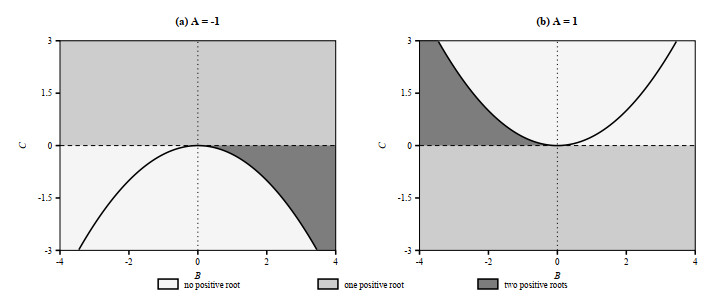
Number of positive roots of $ f(\rho) = A\rho^2+B\rho+C $ for (a) $ A = -1 $ and (b) $ A = 1 $. The solid parabola is $ \Delta = 0 $, the dashed line is $ C = 0 $, and the dotted line is $ B = 0 $. For $ A = -1 $, a single positive root is a center and two positive roots are ordered saddle-center. For $ A = 1 $, a single positive root is a saddle and two positive roots are ordered center-saddle. The grayscale shading is keyed below the panels
Direct simulations of the original PDE. (a) The exact $ p = 2 $ solitary amplitude (6.6) (black solid line) and the numerical amplitude at $ t = 1 $ (open circles) for the parameters (6.5). (b) Growth of the oblique $ (q_x, q_y) = (2, 1) $ Fourier sideband for $ p = 2 $, $ \mathcal A = 1 $, and $ \gamma = \delta = \alpha = \beta = 1 $: the full-PDE result is shown by a black solid line with open squares, and the linear prediction $ a_1(0)\cosh(\sqrt{13}\, t) $ by a thick gray dashed line. Only selected numerical samples are marked. The agreement causes the curves to overlap at plotting resolution; the distinct markers and explicit legends identify both data sets in grayscale




 DownLoad: