We study the long-time behaviour of a Poiseuille-type flow of a weakly conducting incompressible polymeric fluid governed by the Pokrovskii-Vinogradov model. Under the Poiseuille ansatz, the electrohydrodynamic system separates into velocity-stress and charge-potential subsystems. In the constant-relaxation regime with zero initial transverse normal stress, the velocity-shear subsystem reduces to a damped wave equation. If the pressure gradient has a finite limit and the residual forcing vanishes, the unique energy solution converges in $ H_0^1(0, 1)\times L_2(0, 1) $ to the corresponding stationary state. For the homogeneous deviation problem, a modified Lyapunov functional yields exponential stability, while modal analysis determines the supremal decay rate. The same representation provides a fading-memory estimate and a standard $ L_\infty $ input-to-state stability bound. Under additional regularity, the shear and streamwise normal stresses converge in $ L_2(0, 1) $, and the transverse normal stress remains zero. Staggered-grid computations support the predicted decay rates. The results concern streamwise-independent perturbations and constant coefficients.
Citation: Xuelin Guan. Stability of a Poiseuille-type velocity-stress subsystem for an electrohydrodynamic polymeric fluid[J]. AIMS Mathematics, 2026, 11(10): 35832-35854. doi: 10.3934/math.20261389
We study the long-time behaviour of a Poiseuille-type flow of a weakly conducting incompressible polymeric fluid governed by the Pokrovskii-Vinogradov model. Under the Poiseuille ansatz, the electrohydrodynamic system separates into velocity-stress and charge-potential subsystems. In the constant-relaxation regime with zero initial transverse normal stress, the velocity-shear subsystem reduces to a damped wave equation. If the pressure gradient has a finite limit and the residual forcing vanishes, the unique energy solution converges in $ H_0^1(0, 1)\times L_2(0, 1) $ to the corresponding stationary state. For the homogeneous deviation problem, a modified Lyapunov functional yields exponential stability, while modal analysis determines the supremal decay rate. The same representation provides a fading-memory estimate and a standard $ L_\infty $ input-to-state stability bound. Under additional regularity, the shear and streamwise normal stresses converge in $ L_2(0, 1) $, and the transverse normal stress remains zero. Staggered-grid computations support the predicted decay rates. The results concern streamwise-independent perturbations and constant coefficients.

| [1] |
V. N. Pokrovskii, The mesoscopic theory of polymer dynamics, Dordrecht: Springer, 2010. https://doi.org/10.1007/978-90-481-2231-8 |
| [2] |
Yu. A. Altukhov, A. S. Gusev, G. V. Pyshnograi, K. B. Koshelev, Introduction to the mesoscopic theory of fluid polymer systems, Barnaul: AltGPA, 2012. |
| [3] |
B. Semisalov, V. Belyaev, L. Bryndin, A. Gorynin, A. Blokhin, S. Golushko, et al., Verified simulation of the stationary polymer fluid flows in the channel with elliptical cross-section, Appl. Math. Comput., 430 (2022), 127294. https://doi.org/10.1016/j.amc.2022.127294 doi: 10.1016/j.amc.2022.127294
|
| [4] |
A. M. Blokhin, A. S. Rudometova, Stationary solutions of the equations for nonisothermal electroconvection of a weakly conducting incompressible polymeric liquid, J. Appl. Ind. Math., 9 (2015), 147–156. https://doi.org/10.1134/S1990478915020015 doi: 10.1134/S1990478915020015
|
| [5] |
E. V. Mishchenko, X. Guan, On the numerical determination of the volume charge and electric potential in nonstationary EHD flows of incompressible polymeric fluids (in Russian), Vestn. Tver. Gos. Univ. Ser. Prikl. Mat., 1 (2025), 33–50. https://doi.org/10.26456/vtpmk727 doi: 10.26456/vtpmk727
|
| [6] |
N. V. Bambaeva, A. M. Blokhin, Stationary solutions of equations of incompressible viscoelastic polymer liquid, Comput. Math. Math. Phys., 54 (2014), 874–899. https://doi.org/10.1134/S0965542514050054 doi: 10.1134/S0965542514050054
|
| [7] |
A. M. Blokhin, B. V. Semisalov, Finding steady Poiseuille-type flows for incompressible polymeric fluids by the relaxation method, Comput. Math. Math. Phys., 62 (2022), 302–315. https://doi.org/10.1134/S0965542522020051 doi: 10.1134/S0965542522020051
|
| [8] |
A. M. Blokhin, D. L. Tkachev, Linear asymptotic instability of a stationary flow of a polymeric medium in a plane channel in the case of periodic perturbations, J. Appl. Ind. Math., 8 (2014), 467–478. https://doi.org/10.1134/S1990478914040036 doi: 10.1134/S1990478914040036
|
| [9] |
D. L. Tkachev, The spectrum and Lyapunov linear instability of the stationary state for polymer fluid flows: the Vinogradov-Pokrovskii model, Sib. Math. J., 64 (2023), 407–423. https://doi.org/10.1134/S0037446623020131 doi: 10.1134/S0037446623020131
|
| [10] |
A. M. Blokhin, D. L. Tkachev, Lyapunov instability of stationary flows of a polymeric fluid in a channel with perforated walls, Sb. Math., 213 (2022), 283–299. https://doi.org/10.1070/SM9507 doi: 10.1070/SM9507
|
| [11] |
A. M. Blokhin, A. V. Yegitov, D. L. Tkachev, Asymptotics of the spectrum of a linearized problem of the stability of a stationary flow of an incompressible polymer fluid with a space charge, Comput. Math. Math. Phys., 58 (2018), 102–117. https://doi.org/10.1134/S0965542518010037 doi: 10.1134/S0965542518010037
|
| [12] |
A. M. Blokhin, D. L. Tkachev, Stability of the Poiseuille-type flow for an MHD model of an incompressible polymeric fluid, Eur. J. Mech. B/Fluids, 80 (2020), 112–121. https://doi.org/10.1016/j.euromechflu.2019.12.006 doi: 10.1016/j.euromechflu.2019.12.006
|
| [13] |
J. G. Oldroyd, On the formulation of rheological equations of state, Proc. R. Soc. Lond. A, 200 (1950), 523–541. https://doi.org/10.1098/rspa.1950.0035 doi: 10.1098/rspa.1950.0035
|
| [14] |
N. D. Waters, M. J. King, Unsteady flow of an elastico-viscous liquid, Rheol. Acta, 9 (1970), 345–355. https://doi.org/10.1007/BF01975401 doi: 10.1007/BF01975401
|
| [15] |
T. Hayat, A. M. Siddiqui, S. Asghar, Some simple flows of an Oldroyd-B fluid, Int. J. Eng. Sci., 39 (2001), 135–147. https://doi.org/10.1016/S0020-7225(00)00026-4 doi: 10.1016/S0020-7225(00)00026-4
|
| [16] |
D. Vieru, M. Nazar, C. Fetecau, C. Fetecau, New exact solutions corresponding to the first problem of Stokes for Oldroyd-B fluids, Comput. Math. Appl., 55 (2008), 1644–1652. https://doi.org/10.1016/j.camwa.2007.04.040 doi: 10.1016/j.camwa.2007.04.040
|
| [17] |
A. S. R. Duarte, A. I. P. Miranda, P. J. Oliveira, Numerical and analytical modeling of unsteady viscoelastic flows: the start-up and pulsating test case problems, J. Non-Newton. Fluid Mech., 154 (2008), 153–169. https://doi.org/10.1016/j.jnnfm.2008.04.009 doi: 10.1016/j.jnnfm.2008.04.009
|
| [18] |
E. V. Mishchenko, X. Guan, Unsteady Poiseuille-type flow of a Vinogradov-Pokrovskii polymer fluid in a flat channel: an explicit modal solution and its convergence, Fluids, 11 (2026), 184. https://doi.org/10.3390/fluids11070184 doi: 10.3390/fluids11070184
|
| [19] |
A. Mironchenko, C. Prieur, Input-to-state stability of infinite-dimensional systems: recent results and open questions, SIAM Rev., 62 (2020), 529–614. https://doi.org/10.1137/19M1291248 doi: 10.1137/19M1291248
|
| [20] |
E. Hairer, S. P. Nørsett, G. Wanner, Solving ordinary differential equations I: nonstiff problems, Berlin: Springer, 1993. https://doi.org/10.1007/978-3-540-78862-1 |
| [21] |
Y. Mo, H. Wang, S. Li, W. Yu, The distributed biased min-consensus protocol revisited: pre-specified finite-time control strategies and small-gain-based analysis, IEEE Trans. Autom. Control, 70 (2025), 8210–8225. https://doi.org/10.1109/TAC.2025.3581845 doi: 10.1109/TAC.2025.3581845
|
Figures(2) / Tables(3)

Xuelin Guan. Stability of a Poiseuille-type velocity-stress subsystem for an electrohydrodynamic polymeric fluid[J]. AIMS Mathematics, 2026, 11(10): 35832-35854. doi: 10.3934/math.20261389

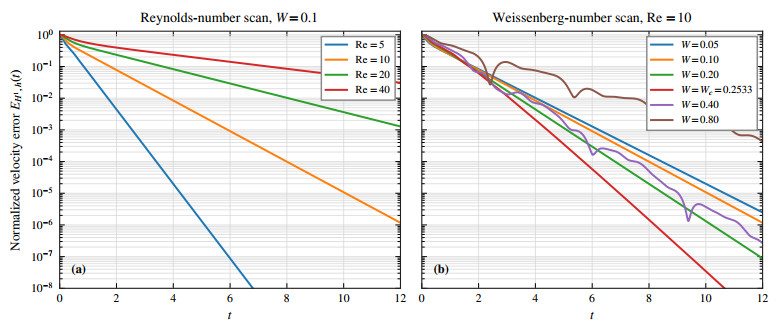
Normalised $ H_0^1 $ velocity errors obtained from the independent staggered-grid solver: (a) Reynolds-number scan; (b) Weissenberg-number scan
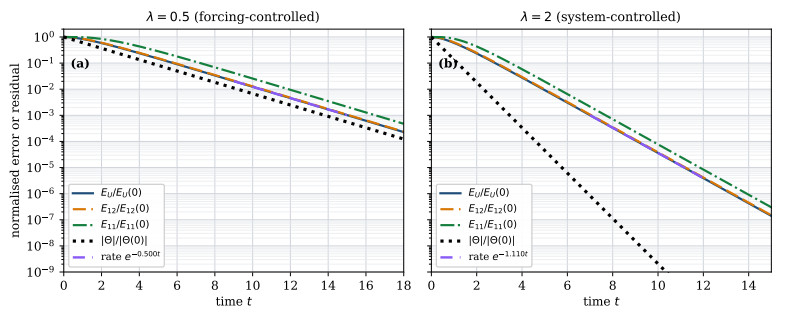
Normalised velocity and stress errors for the nontrivially forced start-up: (a) $ \lambda = 0.5 $, for which the forcing controls the convergence; (b) $ \lambda = 2 $, for which the intrinsic exponent $ \sigma_\ast $ controls the convergence. The thick dotted curve is $ |\Theta(t)|/|\Theta(0)| = e^{-\lambda t} $, and the dashed reference segments have the rates predicted by (5.4)




 DownLoad: