Poisson noise is an inherent signal-dependent distortion commonly encountered in low-dose medical imaging and microscopic imaging, which poses significant challenges for image restoration models, particularly in balancing effective noise removal and fine detail preservation. In this paper, we propose a Poisson image denoising method that integrates high-order total variation (HOTV) regularization with low-rank regularization. The proposed method combines the advantages of HOTV regularization to avoid staircase artifacts and low-rank prior to retain a large amount of image details. We then employ an alternating minimization method to solve the proposed Poisson image denoising model with the combination of Chambolle's dual projection algorithm and the non-negative Garrote thresholding algorithm. Experiments on natural and medical images validate the efficacy of our method, demonstrating its superiority over multiple state-of-the-art Poisson denoising approaches in both quantitative metrics and visual perception.
Citation: Binbin Hao, Zixuan Fang, Jing Pan, Jianguang Zhu. Poisson image denoising via high-order total variation and low-rank minimization[J]. AIMS Mathematics, 2026, 11(10): 25795-25817. doi: 10.3934/math.20261387
Poisson noise is an inherent signal-dependent distortion commonly encountered in low-dose medical imaging and microscopic imaging, which poses significant challenges for image restoration models, particularly in balancing effective noise removal and fine detail preservation. In this paper, we propose a Poisson image denoising method that integrates high-order total variation (HOTV) regularization with low-rank regularization. The proposed method combines the advantages of HOTV regularization to avoid staircase artifacts and low-rank prior to retain a large amount of image details. We then employ an alternating minimization method to solve the proposed Poisson image denoising model with the combination of Chambolle's dual projection algorithm and the non-negative Garrote thresholding algorithm. Experiments on natural and medical images validate the efficacy of our method, demonstrating its superiority over multiple state-of-the-art Poisson denoising approaches in both quantitative metrics and visual perception.

| [1] |
J. L. Starck, F. Murtagh, Astronomical image and data analysis, 2 Eds., Berlin: Springer, 2006. https://doi.org/10.1007/978-3-540-33025-7 |
| [2] |
J. B. Pawley, Handbook of biological confocal microscopy, 3 Eds., New York: Springer, 2006. http://dx.doi.org/10.1007/978-0-387-45524-2 |
| [3] |
M. Bertero, P. Boccacci, B. Desiderà, G. Vicidomini, Image deblurring with Poisson data: From cells to galaxies, Inverse Probl., 25 (2009), 123006. http://dx.doi.org/10.1088/0266-5611/25/12/123006 doi: 10.1088/0266-5611/25/12/123006
|
| [4] |
P. Sarder, A. Nehorai, Deconvolution methods for 3-D fluorescence microscopy images, IEEE Signal Process. Mag., 23 (2006), 32–45. http://dx.doi.org/10.1109/MSP.2006.1628876 doi: 10.1109/MSP.2006.1628876
|
| [5] |
A. Buades, B. Coll, J. Morel, A review of image denoising algorithms, with a new one, Multiscale Model. Simul., 4 (2005), 490–530. http://dx.doi.org/10.1137/040616024 doi: 10.1137/040616024
|
| [6] |
K. Dabov, A. Foi, V. Katkovnik, K. Egiazarian, Image denoising by sparse 3-D transform-domain collaborative filtering, IEEE Trans. Image Process., 16 (2007), 2080–2095. http://dx.doi.org/10.1109/TIP.2007.901238 doi: 10.1109/TIP.2007.901238
|
| [7] |
L. I. Rudin, S. Osher, E. Fatemi, Nonlinear total variation based noise removal algorithms, Phys. D, 60 (1992), 259–268. http://dx.doi.org/10.1016/0167-2789(92)90242-F doi: 10.1016/0167-2789(92)90242-F
|
| [8] |
A. Padcharoen, D. Kitkuan, P. Kumam, J. Rilwan, W. Kumam, Accelerated alternating minimization algorithm for Poisson noisy image recovery, Inverse Probl. Sci. Eng., 28 (2020), 1031–1056. http://dx.doi.org/10.1080/17415977.2019.1709454 doi: 10.1080/17415977.2019.1709454
|
| [9] |
T. Adam, R. Paramesran, K. Ratnavelu, A combined higher order non-convex total variation with overlapping group sparsity for Poisson noise removal, Comp. Appl. Math., 41 (2022), 130. http://dx.doi.org/10.1007/s40314-022-01828-z doi: 10.1007/s40314-022-01828-z
|
| [10] |
X. Zhang, An adaptive anisotropic diffusion model integrating total variation and non-local means for image denoising, AIMS Mathematics, 10 (2025), 28207–28220. http://dx.doi.org/10.3934/math.20251240 doi: 10.3934/math.20251240
|
| [11] |
T. Le, R. Chartrand, T. J. Asaki, A variational approach to reconstructing images corrupted by Poisson noise, J. Math. Imaging Vis., 27 (2007), 257–263. http://dx.doi.org/10.1007/s10851-007-0652-y doi: 10.1007/s10851-007-0652-y
|
| [12] |
S. Setzer, G. Steidl, T. Teuber, Deblurring Poissonian images by split bregman techniques, J. Vis. Commun. Image Represent., 21 (2010), 193–199. http://dx.doi.org/10.1016/j.jvcir.2009.10.006 doi: 10.1016/j.jvcir.2009.10.006
|
| [13] |
J. Liu, T. Huang, X. Lv, S. Wang, High-order total variation-based Poissonian image deconvolution with spatially adapted regularization parameter, Appl. Math. Modell., 45 (2017), 516–529. http://dx.doi.org/10.1016/j.apm.2017.01.009 doi: 10.1016/j.apm.2017.01.009
|
| [14] |
X. Yu, Y. Peng, P. Lou, B. Huang, Poisson noise removal based on non-convex hybrid regularizers, J. Comput. Appl. Math., 457 (2025), 116289. http://dx.doi.org/10.1016/j.cam.2024.116289 doi: 10.1016/j.cam.2024.116289
|
| [15] |
L. Jiang, J. Huang, X. G. Lv, J. Liu, Alternating direction method for the high-order total variation-based poisson noise removal problem, Numer. Algor., 69 (2015), 495–516. http://dx.doi.org/10.1007/s11075-014-9908-y doi: 10.1007/s11075-014-9908-y
|
| [16] |
M. R. Chowdhury, J. Zhang, J. Qin, Y. Lou, Poisson image denoising based on fractional-order total variation, Inverse Probl. Imaging, 14 (2020), 77–96. http://dx.doi.org/10.3934/ipi.2019064 doi: 10.3934/ipi.2019064
|
| [17] |
A. Ben-Loghfyry, A. Hakim, A novel robust fractional-time anisotropic diffusion for multi-frame image super-resolution, Adv. Comput. Math., 49 (2023), 79. http://dx.doi.org/10.1007/s10444-023-10079-3 doi: 10.1007/s10444-023-10079-3
|
| [18] |
A. Ben-Loghfyry, A fractional-time PDE-constrained parameter identification for inverse image noise removal problem, J. Franklin Inst., 362 (2025), 107443. http://dx.doi.org/10.1016/j.jfranklin.2024.107443 doi: 10.1016/j.jfranklin.2024.107443
|
| [19] |
A. Ben-Loghfyry, A. Charkaoui, A novel Perona-Malik model driven by fractional regularized diffusion mechanism with caputo derivative applied to magnetic resonance image processing, J. Franklin Inst., 362 (2025), 107950. http://dx.doi.org/10.1016/j.jfranklin.2025.107950 doi: 10.1016/j.jfranklin.2025.107950
|
| [20] |
P. Kumar G., R. R. Sahay, Low rank Poisson denoising (LRPD): A low rank approach using split bregman algorithm for poisson noise removal from images, In: IEEE/CVF Conference on computer vision and pattern recognition workshops, 2019, 1907–1916. http://dx.doi.org/10.1109/CVPRW.2019.00242 |
| [21] |
W. S. Dong, G. Shi, X. Li, Nonlocal image restoration with bilateral variance estimation: A low-rank approach, IEEE Trans. Image Process., 22 (2013), 700–711. http://dx.doi.org/10.1109/TIP.2012.2221729 doi: 10.1109/TIP.2012.2221729
|
| [22] |
H. Ji, C. Liu, Z. Shen, Y. Xu, Robust video denoising using low rank matrix completion, In: IEEE Conference on computer vision and pattern recognition, 2010, 1791–1798. https://doi.org/10.1109/CVPR.2010.5539849 |
| [23] |
S. H. Gu, Q. Xie, D. Y. Meng, W. M. Zuo, X. C. Feng, L. Zhang, Weighted nuclear norm minimization and its applications to low level vision, Int. J. Comput. Vis., 121 (2017), 183–208. http://dx.doi.org/10.1007/s11263-016-0930-5 doi: 10.1007/s11263-016-0930-5
|
| [24] |
L. Y. Ma, L. Xu, T. Y. Zeng, Low rank prior and total variation regularization for image deblurring, J. Sci. Comput., 70 (2017), 1336–1357. http://dx.doi.org/10.1007/s10915-016-0282-x doi: 10.1007/s10915-016-0282-x
|
| [25] |
M. C. Zhao, Y. W. Wen, M. Ng, H. W. Li, A nonlocal low rank model for poisson noise removal, Inverse Probl. Imag., 15 (2021), 519–537. http://dx.doi.org/10.3934/ipi.2021003 doi: 10.3934/ipi.2021003
|
| [26] |
J. Zhu, W. Gao, Y. Wei, B. Hao, Joint group sparse coding and weighted nuclear norm for poisson denoising, J. Comput. Appl. Math., 470 (2025), 116695. http://dx.doi.org/10.1016/j.cam.2025.116695 doi: 10.1016/j.cam.2025.116695
|
| [27] |
H. Liang, R. Liu, Z. Wang, J. Ma, X. Tian, Variational bayesian deep network for blind poisson denoising, Pattern Recogn., 143 (2023), 109810 http://dx.doi.org/10.1016/j.patcog.2023.109810 doi: 10.1016/j.patcog.2023.109810
|
| [28] |
S. Liu, T. Zhang, R. Deng, X. Liu, H. Liu, Physics-guided deep learning framework with attention for image denoising, Vis. Comput., 41 (2025), 6671–6685. http://dx.doi.org/10.1007/s00371-025-03967-w doi: 10.1007/s00371-025-03967-w
|
| [29] |
C. Wu, X. Tai, Augmented lagrangian method, dual methods, and split bregman iteration for rof, vectorial tv, and high order models, SIAM J. Imaging Sci., 3 (2010), 300–339. http://dx.doi.org/10.1137/090767558 doi: 10.1137/090767558
|
| [30] |
A. Chambolle, An algorithm for total variation minimization and applications, J. Math. Imaging Vis., 20 (2004), 89–97. http://dx.doi.org/10.1023/B:JMIV.0000011325.36760.1e doi: 10.1023/B:JMIV.0000011325.36760.1e
|
| [31] |
X. G. Lv, Y. Z. Song, S. X. Wang, L. Jiang, Image restoration with a high-order total variation minimization method, Appl. Math. Modell., 37 (2013), 8210–8224. http://dx.doi.org/10.1016/j.apm.2013.03.028 doi: 10.1016/j.apm.2013.03.028
|
| [32] |
M. K. Ng, F. Wang, X. Yuan, Inexact alternating direction methods for image recovery, SIAM J. Sci. Comput., 33 (2011), 1643–1668. http://dx.doi.org/10.1137/100807697 doi: 10.1137/100807697
|
Figures(10) / Tables(8)

Binbin Hao, Zixuan Fang, Jing Pan, Jianguang Zhu. Poisson image denoising via high-order total variation and low-rank minimization[J]. AIMS Mathematics, 2026, 11(10): 25795-25817. doi: 10.3934/math.20261387

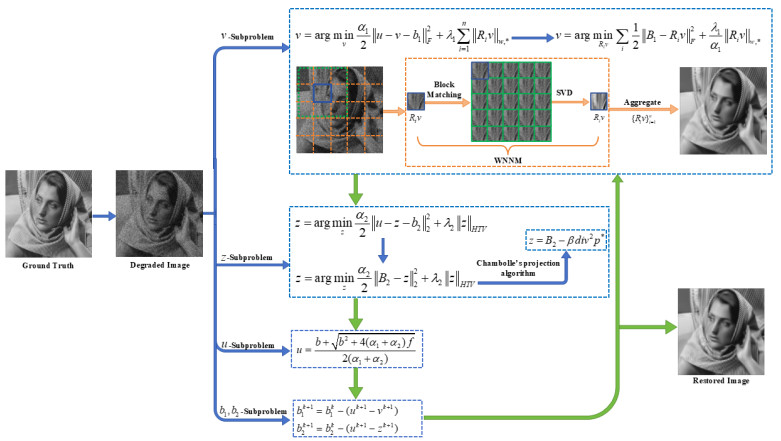
Flowchart of the proposed model for Poisson image denoising
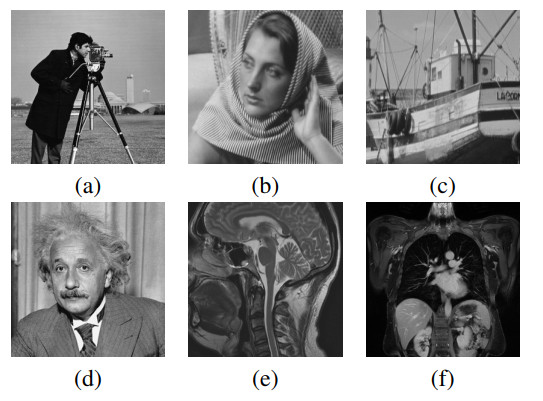
Test images: (a) Cameraman ($ 256\times256 $), (b) Barbara ($ 256\times256 $), (c) Boat ($ 256\times256 $), (d) Einstein ($ 256\times256 $), (e) Brain ($ 442\times442 $), (f) Liver ($ 320\times320 $). "Brain" and "Liver" are resized to $ 256\times256 $ for all experiments
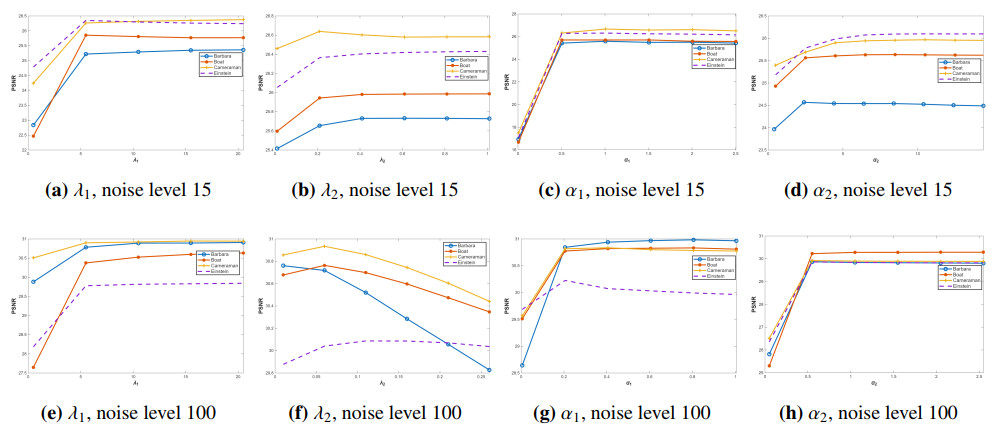
PSNR values versus regularization parameters $ \lambda_1 $ and $ \lambda_2 $, and penalty parameters $ \alpha_1 $ and $ \alpha_2 $, under different noise levels for different images
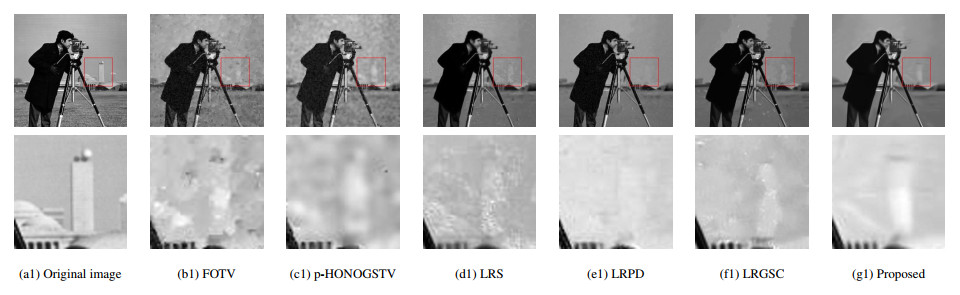
The recovery results of different methods with peak = 15 on Cameraman
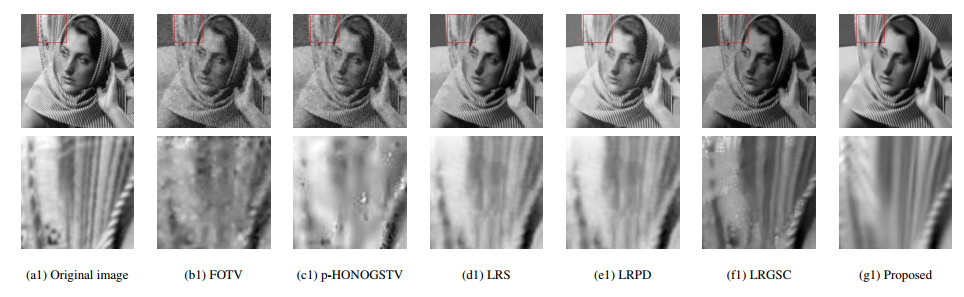
The recovery results of different methods with peak = 30 on Barbara
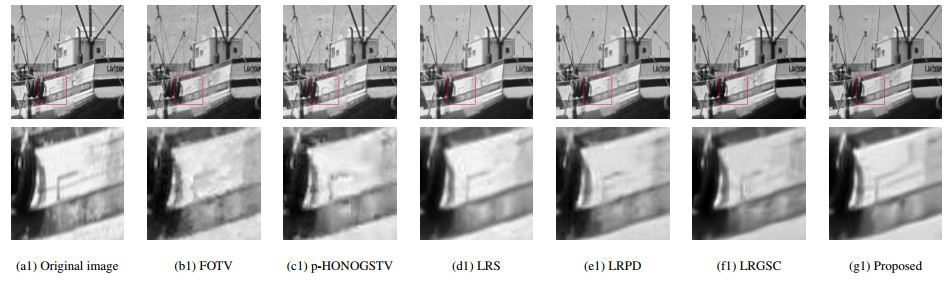
The recovery results of different methods with peak = 100 on Boat
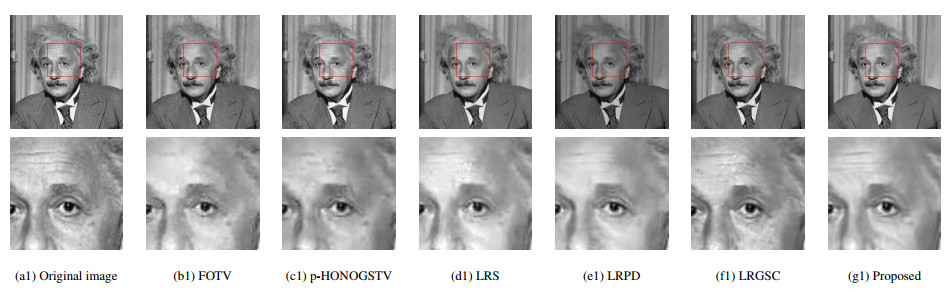
The recovery results of different methods with peak = 155 on Einstein
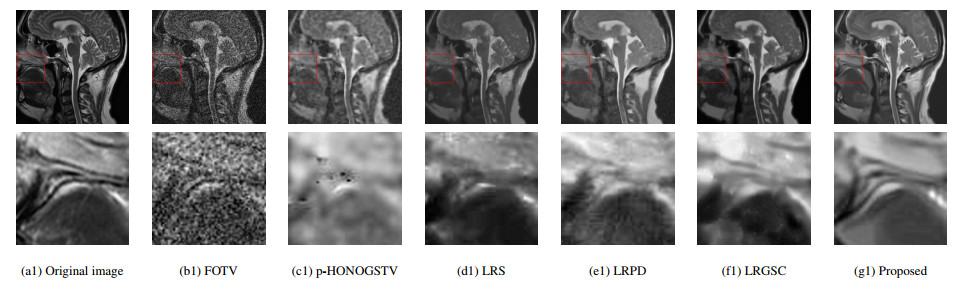
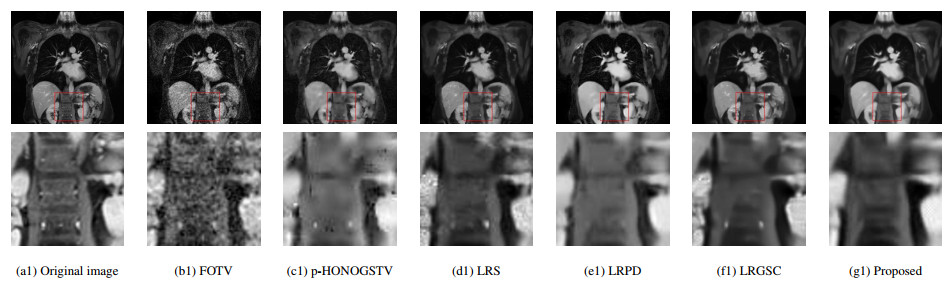
The recovery results of different methods with peak = 15 on Brain
The recovery results of different methods with peak = 30 on Liver
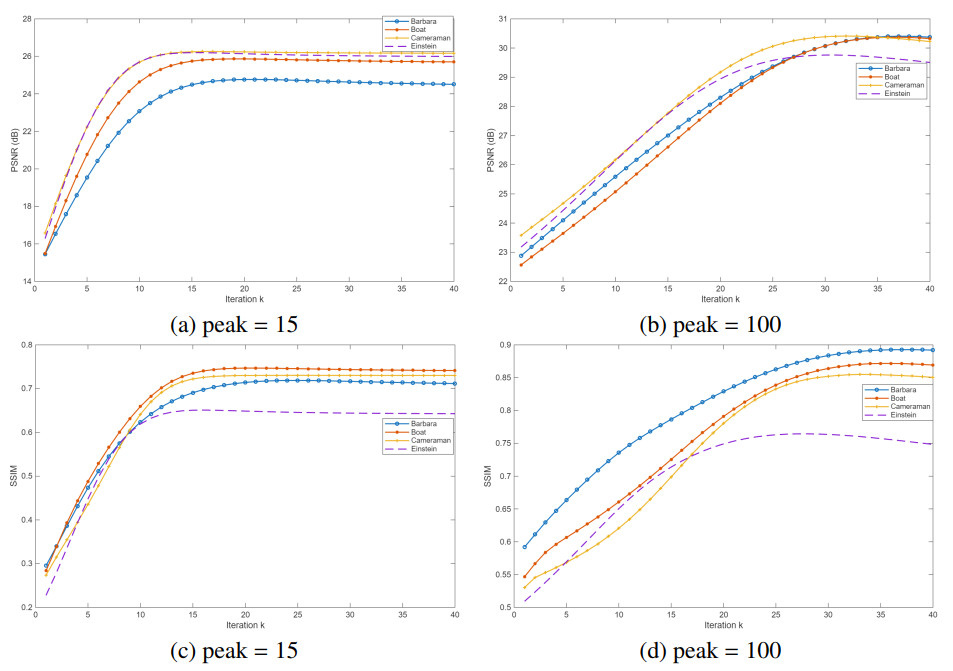
The convergence curves of PSNR and SSIM relative to the iterations under the noise level peak = 15 and peak = 100




 DownLoad: