This study analyses the two-dimensional (2D) magnetohydrodynamics (MHD) boundary layer flow, heat/mass transfer, and bioconvection of a Sutterby tetra-hybrid nanofluid over a nonlinear porous stretching sheet with motile microorganisms. Copper, silver, ferrosoferric oxide, and zinc nanoparticles are dispersed in ethylene glycol, with effective properties evaluated through a sequential mixture rule, and rheology are captured by the Sutterby relation with Deborah's $ \Gamma $ and the power-law $ n $. Thermal radiation, Brownian motion, thermophoresis, chemical reaction, and motile microorganisms are included. Similarity reduces the problem to a ninth-order ordinary differential equation system, solved by collocation and validated against an independent method and three exact solutions, improving on Crane's benchmark to within $ 3.8\times10^{-10} $. Magnetic and porosity parameters increase the skin friction and decrease the Nusselt number; the Sutterby parameters soften the velocity gradient yet, once wall stress correction included, increase the reported skin friction. Increasing tetra-hybrid loading increases both the friction and Nusselt number by enhancing the conductivity. Radiation and thermophoresis alter the concentration field, and bioconvection Schmidt and Péclet numbers raise the density of microorganisms. The results are relevant to bio-nanofluid thermal systems such as microfluidic cooling and bioconvective coating.
Citation: R. T. Matoog, R. Sarathy, R. Revathi, Sultan Hassan Hakmi. MHD flow and thermal enhancement of Sutterby tetra-hybrid nanofluids over a nonlinear porous stretching sheet with motile microorganisms attributable to bioconvection effect[J]. AIMS Mathematics, 2026, 11(10): 35756-35794. doi: 10.3934/math.20261386
This study analyses the two-dimensional (2D) magnetohydrodynamics (MHD) boundary layer flow, heat/mass transfer, and bioconvection of a Sutterby tetra-hybrid nanofluid over a nonlinear porous stretching sheet with motile microorganisms. Copper, silver, ferrosoferric oxide, and zinc nanoparticles are dispersed in ethylene glycol, with effective properties evaluated through a sequential mixture rule, and rheology are captured by the Sutterby relation with Deborah's $ \Gamma $ and the power-law $ n $. Thermal radiation, Brownian motion, thermophoresis, chemical reaction, and motile microorganisms are included. Similarity reduces the problem to a ninth-order ordinary differential equation system, solved by collocation and validated against an independent method and three exact solutions, improving on Crane's benchmark to within $ 3.8\times10^{-10} $. Magnetic and porosity parameters increase the skin friction and decrease the Nusselt number; the Sutterby parameters soften the velocity gradient yet, once wall stress correction included, increase the reported skin friction. Increasing tetra-hybrid loading increases both the friction and Nusselt number by enhancing the conductivity. Radiation and thermophoresis alter the concentration field, and bioconvection Schmidt and Péclet numbers raise the density of microorganisms. The results are relevant to bio-nanofluid thermal systems such as microfluidic cooling and bioconvective coating.

| [1] |
B. C. Sakiadis, Boundary-layer behavior on continuous solid surfaces: Ⅰ. Boundary-layer equations for two-dimensional and axisymmetric flow, AIChE J., 7 (1961), 26–28. https://doi.org/10.1002/aic.690070108 doi: 10.1002/aic.690070108
|
| [2] |
L. J. Crane, Flow past a stretching plate, Z. Angew. Math. Phys., 21 (1970), 645–647. https://doi.org/10.1007/BF01587695 |
| [3] |
D. Yadav, A. M. Mohamad, H. Al Khatri, M. K. Awasthi, R. Ragoju, A. Al Sulti, et al., Flow and heat transfer analysis of magnetohydrodynamic Jeffrey fluid flow over a nonlinear porous stretching sheet under the effect of temperature-dependent viscosity, Model. Simul. Eng., 2026 (2026), 4535010. https://doi.org/10.1155/mse/4535010 doi: 10.1155/mse/4535010
|
| [4] |
J. Kierzenka, L. F. Shampine, A BVP solver based on residual control and the MATLAB PSE, ACM Trans. Math. Softw., 27 (2001), 299–316. https://doi.org/10.1145/502800.502801 doi: 10.1145/502800.502801
|
| [5] |
L. F. Shampine, J. Kierzenka, Solving boundary value problems for ordinary differential equations in MATLAB with bvp4c, In: Tutorial Notes 2000, 2000. |
| [6] |
J. L. Sutterby, Laminar converging flow of dilute polymer solutions in conical sections: Part Ⅰ. Viscosity data, new viscosity model, tube flow solution, AIChE J., 12 (1966), 63–68. https://doi.org/10.1002/aic.690120114 doi: 10.1002/aic.690120114
|
| [7] |
M. M. Fayyadh, K. Naganthran, M. F. M. Basir, I. Hashim, R. Roslan, Radiative MHD Sutterby nanofluid flow past a moving sheet: Scaling group analysis, Mathematics, 8 (2020), 1430. https://doi.org/10.3390/math8091430 doi: 10.3390/math8091430
|
| [8] |
B. Ishtiaq, S. Nadeem, J. Alzabut, Effects of variable magnetic field and partial slips on the dynamics of Sutterby nanofluid due to biaxially exponential and nonlinear stretchable sheets, Heliyon, 9 (2023), e17921. https://doi.org/10.1016/j.heliyon.2023.e17921 doi: 10.1016/j.heliyon.2023.e17921
|
| [9] |
J. Buongiorno, Convective transport in nanofluids, J. Heat Transfer., 128 (2006), 240–250. https://doi.org/10.1115/1.2150834 doi: 10.1115/1.2150834
|
| [10] |
K. A. M. Alharbi, U. Farooq, H. Waqa, M. Imran, S. Noreen, A. Akgul, et al., Numerical solution of Maxwell–Sutterby nanofluid flow inside a stretching sheet with thermal radiation, exponential heat source/sink, and bioconvection, Int. J. Thermofluids, 18 (2023), 100339. https://doi.org/10.1016/j.ijft.2023.100339 doi: 10.1016/j.ijft.2023.100339
|
| [11] |
U. Ullah, S. I. A. Shah, K. S. Nisar, H. Khan, N. Ullah, M. Yousaf, Numerical computation for dual stratification of slip flow of Sutterby nanofluids with heat generation features, Front. Mater., 10 (2023), 1139284. https://doi.org/10.3389/fmats.2023.1139284 doi: 10.3389/fmats.2023.1139284
|
| [12] |
R. Revathi, T. Poornima, Unsteady convection and Stefan blowing influence on Sutterby nanofluid past stretching surface, BioNanoSci., 14 (2024), 2475–2490. https://doi.org/10.1007/s12668-024-01427-8 doi: 10.1007/s12668-024-01427-8
|
| [13] |
A. T. Moltot, E. H. Gorfie, G. A. Zergaw, H. Dessie, Unsteady MHD flow of tangent hyperbolic ternary hybrid nanofluid in a Darcy–Forchheimer porous medium over a permeable stretching sheet with variable thermal conductivity, F1000Res., 14 (2025), 152. https://doi.org/10.12688/f1000research.158629.2 doi: 10.12688/f1000research.158629.2
|
| [14] |
N. Joshi, H. Upreti, A. K. Pandey, MHD darcy–forchheimer Cu-Ag/H2O-C2H6O2 hybrid nanofluid flow via a porous stretching sheet with suction/blowing and viscous dissipation, Int. J. Comput. Methods Eng. Sci. Mech., 23 (2022), 527–535. https://doi.org/10.1080/15502287.2022.2030426 doi: 10.1080/15502287.2022.2030426
|
| [15] |
S. Rao, P. N. Deka, Numerical analysis of MHD hybrid nanofluid flow on a porous stretching sheet with thermal radiation, Int. J. Appl. Comput. Math., 10 (2024), 95. https://doi.org/10.1007/s40819-024-01734-4 doi: 10.1007/s40819-024-01734-4
|
| [16] |
T. Maranna, G. M. Sachin, U. S. Mahabaleshwar, L. M. Pérez, I. V. Shevchuk, Impact of Navier's slip and MHD on a hybrid nanofluid flow over a porous stretching/shrinking sheet with heat transfer, Fluids, 9 (2024), 180. https://doi.org/10.3390/fluids9080180 doi: 10.3390/fluids9080180
|
| [17] |
M. A. Memon, K. Jacob, H. B. Lanjwani, E. E. Mahmoud, Darcy–Forchheimer MHD micropolar water based hybrid nanofluid flow, heat and mass transfer features past on stretching/shrinking surface with slip and radiation effects, Results Eng., 23 (2024), 102534. https://doi.org/10.1016/j.rineng.2024.102534 doi: 10.1016/j.rineng.2024.102534
|
| [18] |
Y. Mehmood, A. Alsinai, I. Summan, M. Bilal, Numerical study of unsteady thin film flow of power-law tetra hybrid nanofluid with velocity slip effect over a stretching sheet using sodium alginate as base fluid, Discov. Appl. Sci., 6 (2024), 640. https://doi.org/10.1007/s42452-024-06367-2 doi: 10.1007/s42452-024-06367-2
|
| [19] |
P. M. Rajeswari, P. De, Shape factor and sensitivity analysis on stagnation point of bioconvective tetra-hybrid nanofluid over porous stretched vertical cylinder, BioNanoSci., 14 (2024), 3035–3058. https://doi.org/10.1007/s12668-024-01586-8 doi: 10.1007/s12668-024-01586-8
|
| [20] |
F. A. A. Elsebaee, M. Bilal, S. R. Mahmoud, M. Balubaid, M. Shuaib, J. K. Asamoah, et al., Motile micro-organism based trihybrid nanofluid flow with an application of magnetic effect across a slender stretching sheet: Numerical approach, AIP Adv., 13 (2023), 035237. https://doi.org/10.1063/5.0144191 doi: 10.1063/5.0144191
|
| [21] |
L. Ali, A. Mariam, N. Salamat, S. Abdal, S. Hussain, Heat transfer analysis on a stretching cylinder with Williamson hybrid nanofluid: Effects of convective boundary conditions, Darcy–Forchheimer resistance, and Cattaneo–Christov heat flux, Discover Nano, 21 (2026), 333. https://doi.org/10.1186/s11671-026-04770-9 doi: 10.1186/s11671-026-04770-9
|
| [22] |
A. Mishra, G. Pathak, A. Kumar, Computational analysis of bioconvection of MoS2-SiO2-GO/H2O ternary hybrid nanofluid containing gyrotactic microorganisms over an exponentially stretching sheet with chemical reaction, BioNanoSci., 14 (2024), 748–769. https://doi.org/10.1007/s12668-023-01279-8 doi: 10.1007/s12668-023-01279-8
|
| [23] |
S. A. A. Shah, N. A. Ahammad, E. M. T. El Din, F. Gamaoun, A. U. Awan, B. Ali, Bio-convection effects on Prandtl hybrid nanofluid flow with chemical reaction and motile microorganism over a stretching sheet, Nanomaterials, 12 (2022), 2174. https://doi.org/10.3390/nano12132174 doi: 10.3390/nano12132174
|
| [24] |
F. M. Alharbi, M. Naeem, M. Zubair, M. Jawad, W. U. Jan, R. Jan, Bioconvection due to gyrotactic microorganisms in couple stress hybrid nanofluid laminar mixed convection incompressible flow with magnetic nanoparticles and chemical reaction as carrier for targeted drug delivery through porous stretching sheet, Molecules, 26 (2021), 3954. https://doi.org/10.3390/molecules26133954 doi: 10.3390/molecules26133954
|
| [25] |
A. V. Kuznetsov, The onset of nanofluid bioconvection in a suspension containing both nanoparticles and gyrotactic microorganisms, Int. Commun. Heat Mass Transf., 37 (2010), 1421–1425. https://doi.org/10.1016/j.icheatmasstransfer.2010.08.015 doi: 10.1016/j.icheatmasstransfer.2010.08.015
|
| [26] |
A. V. Kuznetsov, D. A. Nield, The Cheng–Minkowycz problem for natural convective boundary layer flow in a porous medium saturated by a nanofluid: A revised model, Int. J. Heat Mass Transf., 65 (2013), 682–685. https://doi.org/10.1016/j.ijheatmasstransfer.2013.06.054 doi: 10.1016/j.ijheatmasstransfer.2013.06.054
|
| [27] |
A. V. Kuznetsov, The onset of thermo-bioconvection in a shallow fluid saturated porous layer heated from below in a suspension of oxytactic microorganisms, Eur. J. Mech. B/Fluids, 25 (2006), 223–233. https://doi.org/10.1016/j.euromechflu.2005.06.003 doi: 10.1016/j.euromechflu.2005.06.003
|
| [28] |
A. V. Kuznetsov, Non-oscillatory and oscillatory nanofluid bio-thermal convection in a horizontal layer of finite depth, Eur. J. Mech. B/Fluids, 30 (2011), 156–165. https://doi.org/10.1016/j.euromechflu.2010.10.007 doi: 10.1016/j.euromechflu.2010.10.007
|
| [29] |
A. V. Kuznetsov, P. Geng, The interaction of bioconvection caused by gyrotactic micro-organisms and settling of small solid particles, Int. J. Numer. Methods Heat Fluid Flow, 15 (2005), 328–347. https://doi.org/10.1108/09615530510590597 doi: 10.1108/09615530510590597
|
| [30] |
A. V. Kuznetsov, A. A. Avramenko, Effect of small particles on the stability of bioconvection in a suspension of gyrotactic microorganisms in a layer of finite depth, Int. Commun. Heat Mass Transf., 31 (2004), 1–10. https://doi.org/10.1016/S0735-1933(03)00196-9 doi: 10.1016/S0735-1933(03)00196-9
|
| [31] |
K. Das, P. R. Duari, P. K. Kundu, Nanofluid bioconvection in presence of gyrotactic microorganisms and chemical reaction in a porous medium, J. Mech. Sci. Technol., 29 (2015), 4841–4849. https://doi.org/10.1007/s12206-015-1031-z doi: 10.1007/s12206-015-1031-z
|
| [32] |
A. V. Kuznetsov, Nanofluid bioconvection in water-based suspensions containing nanoparticles and oxytactic microorganisms: Oscillatory instability, Nanoscale Res. Lett., 6 (2011), 100. https://doi.org/10.1186/1556-276X-6-100 doi: 10.1186/1556-276X-6-100
|
| [33] |
S. Ahmad, M. Ashraf, K. Ali, Heat and mass transfer flow of gyrotactic microorganisms and nanoparticles through a porous medium, Int. J. Heat Technol., 38 (2020), 395–402. https://doi.org/10.18280/ijht.380215 doi: 10.18280/ijht.380215
|
| [34] |
H. Waqas, S. U. Khan, S. A. Shehzad, M. Imran, Radiative flow of Maxwell nanofluid containing gyrotactic microorganism and energy activation with convective Nield conditions, Heat Transf. Asian Res., 48 (2019), 1663–1687. https://doi.org/10.1002/htj.21451 doi: 10.1002/htj.21451
|
| [35] |
S. Nadeem, R. Ul Haq, N. S. Akbar, C. Lee, Z. H. Khan, Numerical study of boundary layer flow and heat transfer of Oldroyd-B nanofluid towards a stretching sheet, PLoS ONE, 8 (2013), e69811. https://doi.org/10.1371/journal.pone.0069811 doi: 10.1371/journal.pone.0069811
|
| [36] |
L. Ali, B. Ali, M. B. Ghori, Melting effect on Cattaneo–Christov and thermal radiation features for aligned MHD nanofluid flow comprising microorganisms to leading edge: FEM approach, Comput. Math. Appl., 109 (2022), 260–269. https://doi.org/10.1016/j.camwa.2022.01.009 doi: 10.1016/j.camwa.2022.01.009
|
| [37] |
J. C. Maxwell, A treatise on electricity and magnetism, Oxford University Press, 1998. https://doi.org/10.1093/oso/9780198503743.001.0001 |
| [38] |
H. C. Brinkman, The viscosity of concentrated suspensions and solutions, J. Chem. Phys., 20 (1952), 571. https://doi.org/10.1063/1.1700493 doi: 10.1063/1.1700493
|
| [39] |
R. L. Hamilton, O. K. Crosser, Thermal conductivity of heterogeneous two-component systems, Ind. Eng. Chem. Fundam., 1 (1962), 187–191. https://doi.org/10.1021/i160003a005 doi: 10.1021/i160003a005
|
| [40] |
P. Virtanen, R. Gommers, T. E. Oliphant, M. Haberland, T. Reddy, D. Cournapeau, et al., SciPy 1.0: Fundamental algorithms for scientific computing in Python, Nat. Methods, 17 (2020), 261–272. https://doi.org/10.1038/s41592-019-0686-2 doi: 10.1038/s41592-019-0686-2
|
| [41] |
U. M. Ascher, R. M. M. Mattheij, R. D. Russell, Numerical solution of boundary value problems for ordinary differential equations, Society for Industrial and Applied Mathematics (SIAM), 1995. https://doi.org/10.1137/1.9781611971231 |
| [42] |
J. R. Cash, A variable order deferred correction algorithm for the numerical solution of nonlinear two-point boundary value problems, Comput. Math. Appl., 9 (1983), 257–265. https://doi.org/10.1016/0898-1221(83)90129-3 doi: 10.1016/0898-1221(83)90129-3
|
| [43] |
T. Y. Na, Computational methods in engineering boundary value problems, In: Mathematics in science and engineering, New York: Academic Press, 145 (1979). |
| [44] |
R. Cortell, Viscous flow and heat transfer over a nonlinearly stretching sheet, Appl. Math. Comput., 184 (2007), 864–873. https://doi.org/10.1016/j.amc.2006.06.077 doi: 10.1016/j.amc.2006.06.077
|
| [45] |
T. C. Chiam, Hydromagnetic flow over a surface stretching with a power-law velocity, Int. J. Eng. Sci., 33 (1995), 429–435. https://doi.org/10.1016/0020-7225(94)00066-S doi: 10.1016/0020-7225(94)00066-S
|
| [46] |
T. Hayat, Z. Abbas, M. Sajid, S. Asghar, The influence of thermal radiation on MHD flow of a second-grade fluid, Int. J. Heat Mass Transf., 50 (2007), 931–941. https://doi.org/10.1016/j.ijheatmasstransfer.2006.08.014 doi: 10.1016/j.ijheatmasstransfer.2006.08.014
|
| [47] |
A. S. Rashed, E. H. Nasr, S. M. Mabrouk, Influence of gyrotactic microorganisms on bioconvection in electromagnetohydrodynamic hybrid nanofluid through a permeable sheet, Computation, 12 (2024), 17. https://doi.org/10.3390/computation12010017 doi: 10.3390/computation12010017
|
| [48] |
W. A. Khan, I. Pop, Boundary-layer flow of a nanofluid past a stretching sheet, Int. J. Heat Mass Transf., 53 (2010), 2477–2483. https://doi.org/10.1016/j.ijheatmasstransfer.2010.01.032 doi: 10.1016/j.ijheatmasstransfer.2010.01.032
|
| [49] |
P. Rana, R. Bhargava, Flow and heat transfer of a nanofluid over a nonlinearly stretching sheet: A numerical study, Commun. Nonlinear Sci. Numer. Simul., 17 (2012), 212–226. https://doi.org/10.1016/j.cnsns.2011.05.009 doi: 10.1016/j.cnsns.2011.05.009
|
Figures(17) / Tables(5)

R. T. Matoog, R. Sarathy, R. Revathi, Sultan Hassan Hakmi. MHD flow and thermal enhancement of Sutterby tetra-hybrid nanofluids over a nonlinear porous stretching sheet with motile microorganisms attributable to bioconvection effect[J]. AIMS Mathematics, 2026, 11(10): 35756-35794. doi: 10.3934/math.20261386

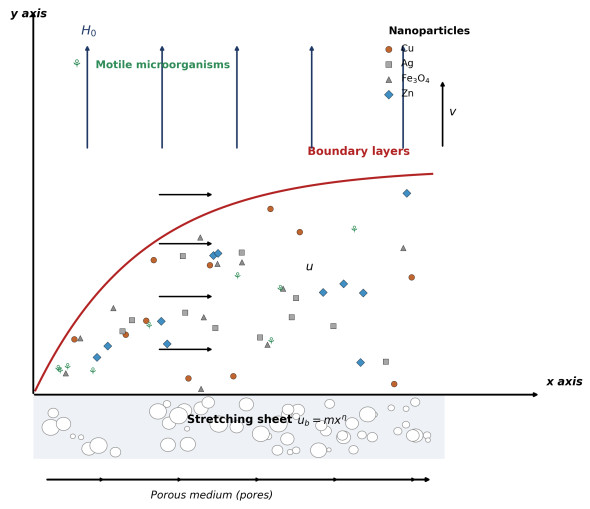
Physical model and coordinate system for the MHD Sutterby tetra-hybrid nanofluid flow over a nonlinear porous stretching sheet with motile microorganisms
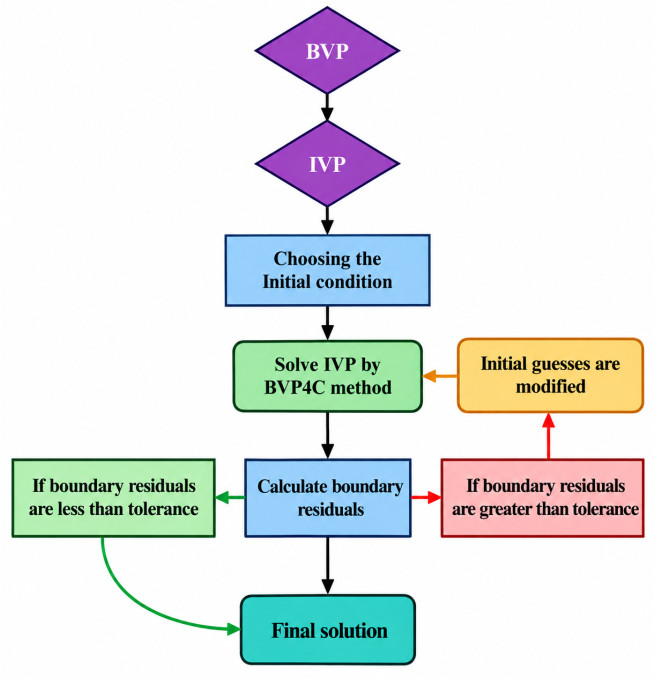
Flowchart of the residual-controlled $\texttt{bvp4c}$/collocation numerical solution procedure used to solve the governing boundary-value problem
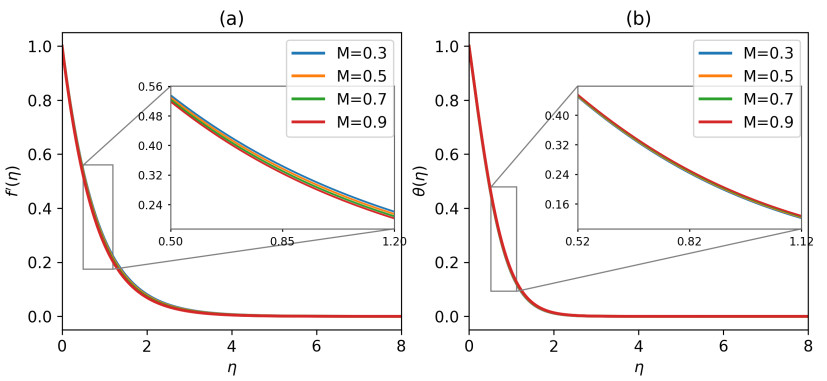
Effect of the magnetic field parameter $ M $ on (a) velocity $ f'(\eta) $ and (b) temperature $ \theta(\eta) $
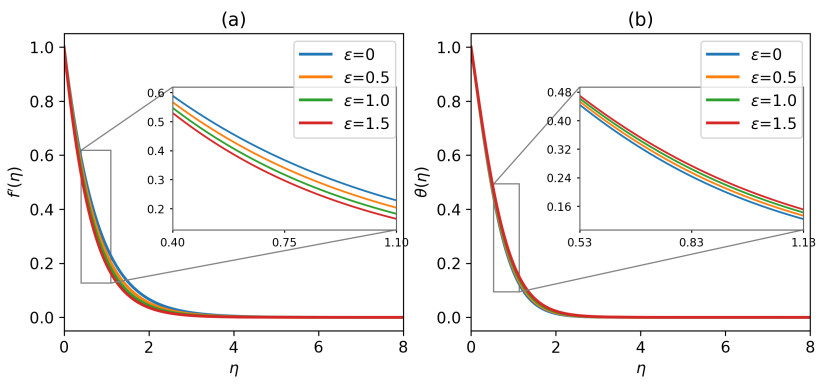
Effect of the porosity parameter $ \varepsilon $ on (a) velocity $ f'(\eta) $ and (b) temperature $ \theta(\eta) $
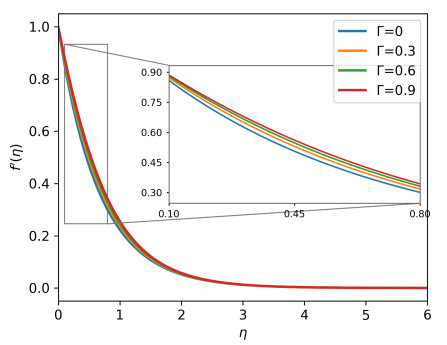
Effect of the Sutterby fluid parameter $ \Gamma $ on the velocity $ f'(\eta) $
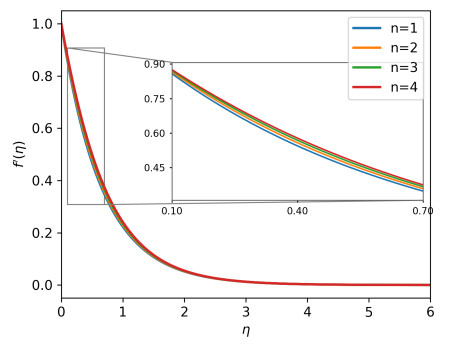
Effect of the Sutterby power-law index $ n $ on the velocity $ f'(\eta) $
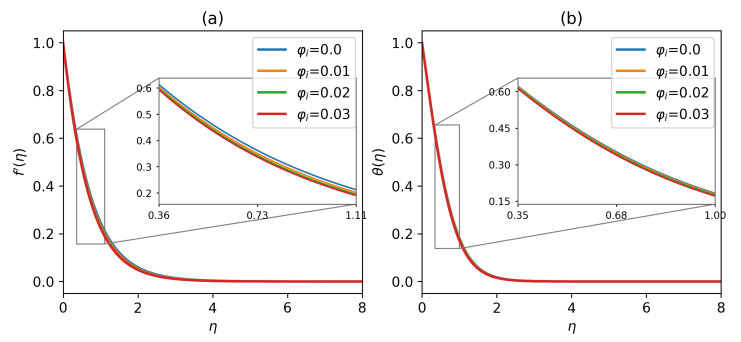
Effect of equal tetra-hybrid nanoparticle loading $ \varphi_i $ ($ i = 1 $–$ 4 $) on (a) velocity $ f'(\eta) $ and (b) temperature $ \theta(\eta) $
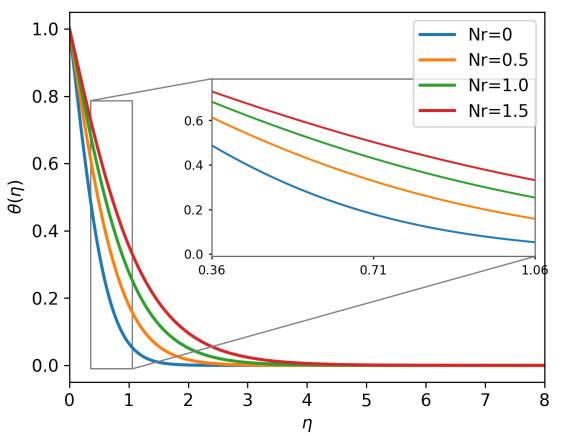
Effect of the thermal radiation parameter $ Nr $ on temperature $ \theta(\eta) $
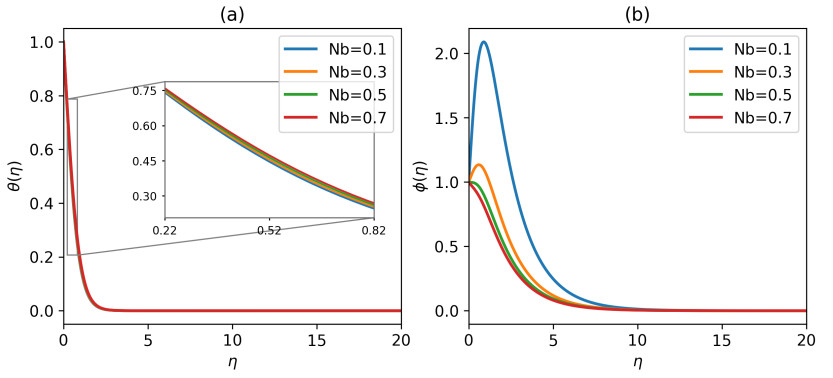
Effect of the Brownian motion parameter $ Nb $ on (a) temperature $ \theta(\eta) $ and (b) concentration $ \phi(\eta) $, plotted to $ \eta = 20 $, over which every curve is confirmed to converge fully to its far-field value (Table 2)
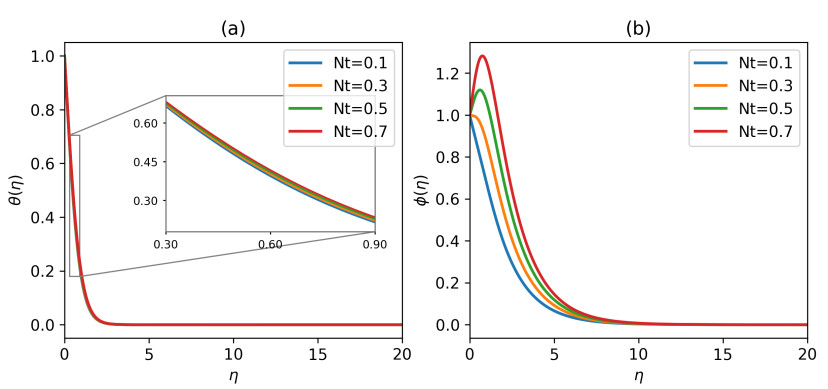
Effect of the thermophoresis parameter $ Nt $ on (a) temperature $ \theta(\eta) $ and (b) concentration $ \phi(\eta) $, plotted to $ \eta = 20 $, over which every curve is confirmed to converge fully to its far-field value (Table 2)
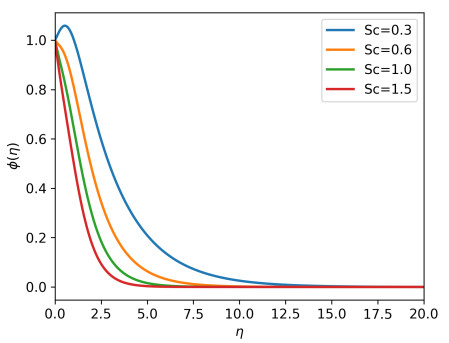
Effect of the Schmidt number $ Sc $ on the concentration $ \phi(\eta) $, plotted to $ \eta = 20 $, over which every curve converges fully to zero
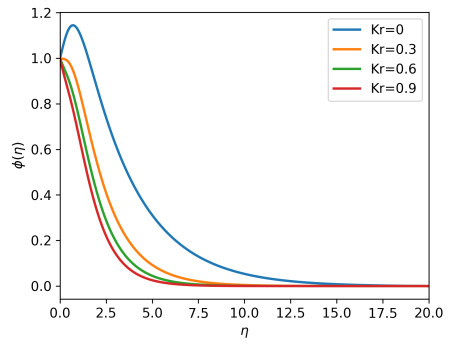
Effect of the chemical reaction parameter $ Kr $ on the concentration $ \phi(\eta) $, plotted to $ \eta = 20 $, over which every curve converges fully to zero
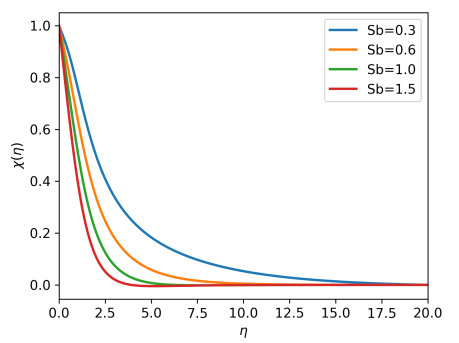
Effect of the bioconvection Schmidt number $ Sb $ on motile microorganism density $ \chi(\eta) $, plotted to $ \eta = 20 $, over which every curve converges fully to zero
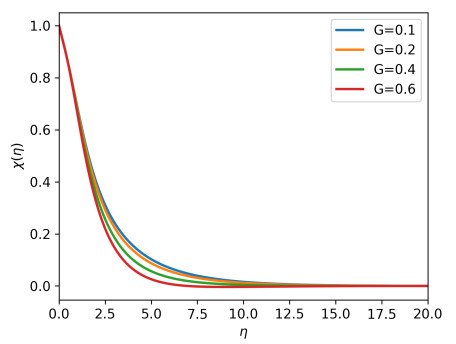
Effect of the microorganism concentration difference parameter $ G $ on motile microorganism density $ \chi(\eta) $, plotted to $ \eta = 20 $, over which every curve converges fully to zero
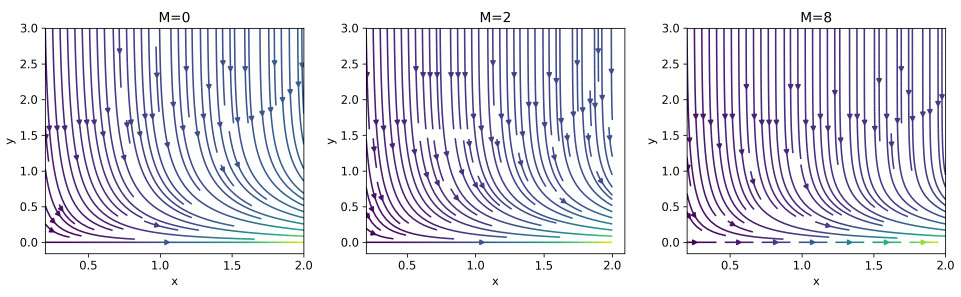
Physical plane streamlines colored by magnitude of velocity for $ M = 0 $, $ 2 $, and $ 8 $ (base case values of all other parameters)
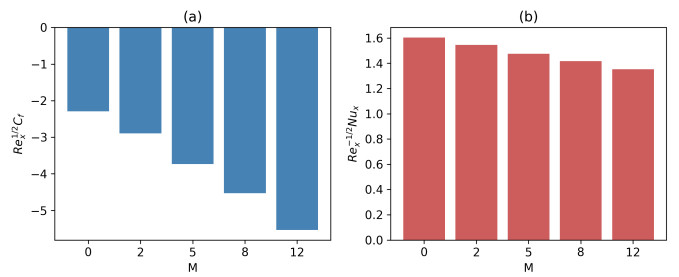
Bar chart of (a) the skin friction coefficient $ Re_x^{1/2}C_f $ and (b) Nusselt number $ Re_x^{-1/2}Nu_x $ for a varying magnetic field parameter $ M $
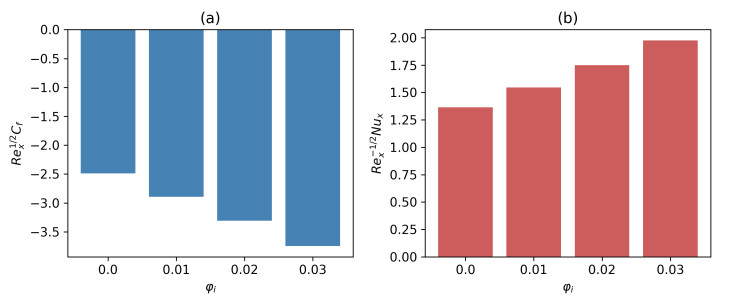
Bar chart of (a) the skin friction coefficient $ Re_x^{1/2}C_f $ and (b) Nusselt number $ Re_x^{-1/2}Nu_x $ for a varying tetra-hybrid nanoparticle loading $ \varphi_i $ ($ i = 1 $–$ 4 $, equal loading)




 DownLoad: