We study the influence of the instantaneous appearance of a time-like Killing vector (TKV) in self-gravitating fluid spheres during their evolution. For doing so, we resort to the concept of the asymmetry factor, which allows the existence of any specific type of symmetry (e.g., a TKV), exclusively, for a given value of the time-like coordinate. We consider adiabatic and dissipative fluids. The analysis of different relevant physical variables in this process shows the imprints of the emergence of the TKV at some point of the evolution. Particular attention is paid to the relationship appearing between the TKV and the complexity factor describing the degree of complexity of the fluid, bringing out for the first time a link between complexity and symmetry.
Citation: Luis Herrera. Complexity and symmetry: the asymmetry factor approach[J]. AIMS Mathematics, 2026, 11(10): 35737-35755. doi: 10.3934/math.20261385
We study the influence of the instantaneous appearance of a time-like Killing vector (TKV) in self-gravitating fluid spheres during their evolution. For doing so, we resort to the concept of the asymmetry factor, which allows the existence of any specific type of symmetry (e.g., a TKV), exclusively, for a given value of the time-like coordinate. We consider adiabatic and dissipative fluids. The analysis of different relevant physical variables in this process shows the imprints of the emergence of the TKV at some point of the evolution. Particular attention is paid to the relationship appearing between the TKV and the complexity factor describing the degree of complexity of the fluid, bringing out for the first time a link between complexity and symmetry.

| [1] |
L. Herrera, A. Di Prisco, J. Ospino, The imprints of the instantaneous appearance of a conformal Killing vector field on the evolution of self-gravitating fluid spheres, Eur. Phys. J. C, 86 (2026), 452. https://doi.org/10.1140/epjc/s10052-026-15697-x doi: 10.1140/epjc/s10052-026-15697-x
|
| [2] |
L. Herrera, New definition of complexity for self–gravitating fluid distributions: the spherically symmetric case, Phys. Rev. D, 97 (2018), 044010. https://doi.org/10.1103/PhysRevD.97.044010 doi: 10.1103/PhysRevD.97.044010
|
| [3] |
L. Herrera, A. Di Prisco, J. Ospino, Definition of complexity for dynamical spherically symmetric dissipative self–gravitating fluid distributions, Phys. Rev. D, 98 (2018), 104059. https://doi.org/10.1103/PhysRevD.98.104059 doi: 10.1103/PhysRevD.98.104059
|
| [4] |
C. Tsallis, Complexity: what is it? Particles, 9 (2026), 33. https://doi.org/10.3390/particles9020033 doi: 10.3390/particles9020033
|
| [5] |
R. Lopez-Ruiz, H. L. Mancini, X. Calbet, A statistical measure of complexity, Phys. Lett. A, 209 (1995), 321–326. https://doi.org/10.1016/0375-9601(95)00867-5 doi: 10.1016/0375-9601(95)00867-5
|
| [6] |
X. Calbet, R. Lopez-Ruiz, Tendency towards maximum complexity in a nonequilibrium isolated system, Phys. Rev. E, 63 (2001), 066116. https://doi.org/10.1103/PhysRevE.63.066116 doi: 10.1103/PhysRevE.63.066116
|
| [7] |
R. G. Catalan, J. Garay, R. Lopez-Ruiz, Features of the extension of a statistical measure of complexity to continuous systems, Phys. Rev. E, 66 (2002), 011102. https://doi.org/10.1103/PhysRevE.66.011102 doi: 10.1103/PhysRevE.66.011102
|
| [8] |
J. Sañudo, R. Lopez-Ruiz, Statistical complexity and Fisher-Shannon information in the H-atom, Phys. Lett. A, 372 (2008), 5283–5286. https://doi.org/10.1016/j.physleta.2008.06.012 doi: 10.1016/j.physleta.2008.06.012
|
| [9] |
M. de Avellar, R. de Souza, J. Horvath, D. Paret, Information theoretical methods as discerning quantifiers of the equations of state of neutron stars, Phys. Lett. A, 378 (2014), 3481–3487. https://doi.org/10.1016/j.physleta.2014.10.011 doi: 10.1016/j.physleta.2014.10.011
|
| [10] |
L. Herrera, A. Di Prisco, The evolution of self-gravitating radiating geodesic fluid spheres instantaneously admitting a time-like Killing, Entropy, 28 (2026), 684. https://doi.org/10.3390/e28060684 doi: 10.3390/e28060684
|
| [11] |
L. Herrera, J. Ospino, A. Di Prisco, E. Fuenmayor, O. Troconis, Structure and evolution of self–gravitating objects and the orthogonal splitting of the Riemann tensor, Phys. Rev. D, 79 (2009), 064025. https://doi.org/10.1103/PhysRevD.79.064025 doi: 10.1103/PhysRevD.79.064025
|
| [12] |
R. Chan, Collapse of a radiating star with shear, Mon. Not. R. Astron. Soc., 288 (1997), 589–595. https://doi.org/10.1093/mnras/288.3.589 doi: 10.1093/mnras/288.3.589
|
| [13] |
W. Israel, Singular hypersurfaces and thin shells in general relativity, Nuovo Cimento B (1965–1970), 44 (1966), 1–14. https://doi.org/10.1007/BF02710419 doi: 10.1007/BF02710419
|
| [14] |
W. Israel, Nonstationary irreversible thermodynamics: a causal relativistic theory, Ann. Phys., 100 (1976), 310–331. https://doi.org/10.1016/0003-4916(76)90064-6 doi: 10.1016/0003-4916(76)90064-6
|
| [15] |
W. Israel, J. Stewart, Thermodynamic of nonstationary and transient effects in a relativistic gas, Phys. Lett. A, 58 (1976), 213–215. https://doi.org/10.1016/0375-9601(76)90075-X doi: 10.1016/0375-9601(76)90075-X
|
| [16] |
W. Israel, J. Stewart, Transient relativistic thermodynamics and kinetic theory, Ann. Phys., 118 (1979), 341–372. https://doi.org/10.1016/0003-4916(79)90130-1 doi: 10.1016/0003-4916(79)90130-1
|
| [17] |
J. Triginer, D. Pavon, On the thermodynamics of tilted and collisionless gases in Friedmann-Robertson-Walker spacetimes, Class. Quantum Grav., 12 (1995), 199. https://doi.org/10.1088/0264-9381/12/1/017 doi: 10.1088/0264-9381/12/1/017
|
| [18] |
L. Herrera, A. Di Prisco, J. Ospino, Expansion-free dissipative fluid spheres: analytical models, Symmetry, 15 (2023), 754. https://doi.org/10.3390/sym15030754 doi: 10.3390/sym15030754
|
| [19] |
R. Peierls, Quantum theory of solids, London: Oxford University Press, (1955). https://doi.org/10.1093/acprof: oso/9780198507819.001.0001 |
| [20] |
W. Band, L. Meyer, Second sound and the heat conductivity in helium Ⅱ, Phys. Rev., 73 (1948), 226. https://doi.org/10.1103/PhysRev.73.226 doi: 10.1103/PhysRev.73.226
|
| [21] |
E. Flowers, N. Itoh, Transport properties of dense matter 2, Astrophys. J., 230 (1979), 847. https://doi.org/10.1086/157145 doi: 10.1086/157145
|
| [22] |
E. Flowers, N. Itoh, Transport properties of dense matter 3: analytic formulas for thermal conductivity, Astrophys. J., 250 (1981), 750–752. https://doi.org/10.1086/159423 doi: 10.1086/159423
|
| [23] |
N. Shibazaki, F. Lamb, Neutron star evolution with internal heating, Aststrophys. J., 346 (1989), 808–822. |
| [24] |
M. Harwit, Astrophysical concepts, New York: Springer-Verlag, 1998. https://doi.org/10.1007/978-0-387-33228-4 |
| [25] |
L. Herrera, D. Pavón, Hyperbolic theories of dissipation: why and when do we need them, Physica A, 307 (2002), 121–130. https://doi.org/10.1016/S0378-4371(01)00614-8 doi: 10.1016/S0378-4371(01)00614-8
|
Figures(4)

Luis Herrera. Complexity and symmetry: the asymmetry factor approach[J]. AIMS Mathematics, 2026, 11(10): 35737-35755. doi: 10.3934/math.20261385

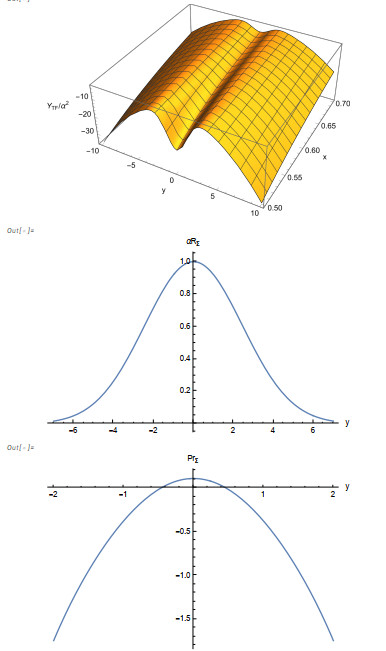
$ Y_{TF}/\alpha^2 $ as a function of $ y $ and $ x $ in the interval $ (y, -10, 10) $, $ (x, .5, .7) $; $ \alpha R_\Sigma $ in the interval $ (y, -7, 7) $; $ P_{r\Sigma} $ in the interval $ (y, -2, 2) $ for the non-dissipative case
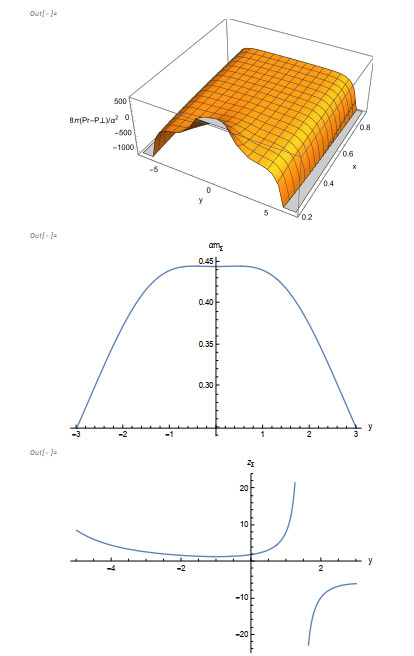
$ 8\pi(P_r-P_\bot)/\alpha^2 $ as a function of $ y $ and $ x $ in the interval $ (y, -7, 7) $, $ (x, .2, .9) $; $ \alpha m_\Sigma $ and $ z_\Sigma $ in the interval $ (y, -3, 3) $ and $ (y, -5, 3) $, respectively, for the non-dissipative case
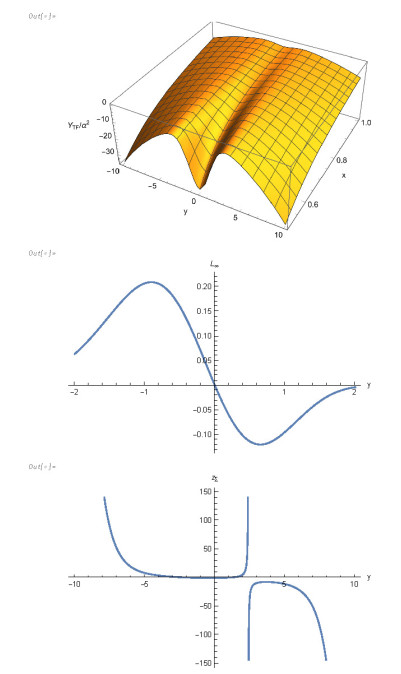
$ Y_{TF}/\alpha^2 $ as a function of $ y $, and $ x $ in the interval $ (y, -10, 10) $, $ (x, .5, 1) $; $ L_\infty $ and $ z_\Sigma $ in the interval $ (y, -2, 2) $, and $ (y, -10, 10) $, respectively, for the dissipative case
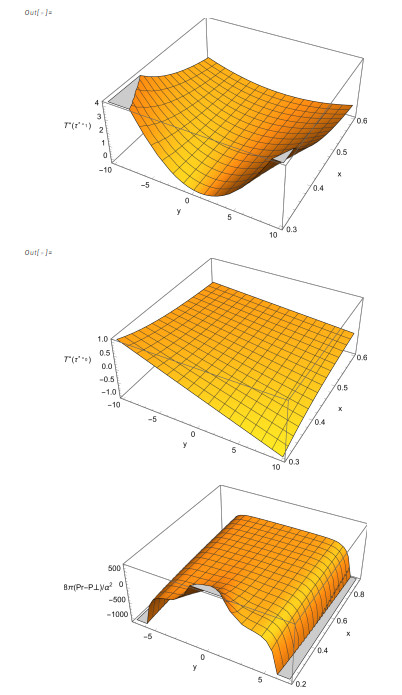
$ T^\ast $ as a function of $ y $ and $ x $ in the interval $ (y, -10, 10) $, $ (x, .3, .6) $ for $ \tau^\ast = 1 $ and $ \tau^\ast = 0 $; $ 8\pi(P_r-P_\bot)/\alpha^2 $ as a function of $ y $ and $ x $ in the interval $ (y, -5, 5) $, $ (x, .2, .7) $; for the dissipative case




 DownLoad: