Avian influenza persists as an infectious threat across wild and domestic bird populations. This paper develops deterministic SEIR models to study avian influenza transmission in a bird population. We first formulate a non-delayed model with a general saturated incidence function and derive the basic reproduction number ($ \mathcal{R}_0 $). The analysis shows that the disease-free equilibrium is locally and globally asymptotically stable when $ \mathcal{R}_0\leq 1 $. When $ \mathcal{R}_0 > 1 $, a unique endemic equilibrium exists and is locally and globally asymptotically stable. The model is then extended by including three distributed-time delays that describe the delayed transition into the exposed, infectious, and recovered classes. This delayed formulation reflects variability in latency, infectious progression, and recovery among infected birds. The delayed model is shown to be mathematically well posed through the non-negativity and boundedness of its solutions. The delayed reproduction number ($ \mathcal{R}_d $) is derived, and suitable Lyapunov functionals are constructed to establish the global threshold dynamics. In particular, the disease-free equilibrium is globally asymptotically stable when $ \mathcal{R}_d\leq 1 $, whereas the endemic equilibrium is globally asymptotically stable when $ \mathcal{R}_d > 1 $. Numerical simulations support the theoretical results and show how distributed delays affect the persistence of avian influenza in the bird population. Sensitivity analysis identifies the parameters that have the strongest influence on $ \mathcal{R}_d $. In addition, the control simulations indicate that sufficiently strong transmission-blocking measures can reduce $ \mathcal{R}_d $ and shift the system from endemic persistence to disease elimination.
Citation: Mohammed H. Alharbi. Threshold dynamics of a distributed-delay SEIR model for avian influenza transmission in bird populations[J]. AIMS Mathematics, 2026, 11(10): 35631-35654. doi: 10.3934/math.20261382
Avian influenza persists as an infectious threat across wild and domestic bird populations. This paper develops deterministic SEIR models to study avian influenza transmission in a bird population. We first formulate a non-delayed model with a general saturated incidence function and derive the basic reproduction number ($ \mathcal{R}_0 $). The analysis shows that the disease-free equilibrium is locally and globally asymptotically stable when $ \mathcal{R}_0\leq 1 $. When $ \mathcal{R}_0 > 1 $, a unique endemic equilibrium exists and is locally and globally asymptotically stable. The model is then extended by including three distributed-time delays that describe the delayed transition into the exposed, infectious, and recovered classes. This delayed formulation reflects variability in latency, infectious progression, and recovery among infected birds. The delayed model is shown to be mathematically well posed through the non-negativity and boundedness of its solutions. The delayed reproduction number ($ \mathcal{R}_d $) is derived, and suitable Lyapunov functionals are constructed to establish the global threshold dynamics. In particular, the disease-free equilibrium is globally asymptotically stable when $ \mathcal{R}_d\leq 1 $, whereas the endemic equilibrium is globally asymptotically stable when $ \mathcal{R}_d > 1 $. Numerical simulations support the theoretical results and show how distributed delays affect the persistence of avian influenza in the bird population. Sensitivity analysis identifies the parameters that have the strongest influence on $ \mathcal{R}_d $. In addition, the control simulations indicate that sufficiently strong transmission-blocking measures can reduce $ \mathcal{R}_d $ and shift the system from endemic persistence to disease elimination.

| [1] |
A. Blagodatski, K. Trutneva, O. Glazova, O. Mityaeva, L. Shevkova, E. Kegeles, et al., Avian influenza in wild birds and poultry: dissemination pathways, monitoring methods, and virus ecology, Pathogens, 10 (2021), 630. http://dx.doi.org/10.3390/pathogens10050630 doi: 10.3390/pathogens10050630
|
| [2] |
World Organisation for Animal Health, Avian influenza, 2026. Available from: https://www.woah.org/en/disease/avian-influenza/. |
| [3] |
A. Mena, M. E. von Fricken, B. D. Anderson, The impact of highly pathogenic avian influenza H5N1 in the United States: a scoping review of past detections and present outbreaks, Viruses, 17 (2025), 307. http://dx.doi.org/10.3390/v17030307 doi: 10.3390/v17030307
|
| [4] |
USDA Animal and Plant Health Inspection Service, Avian influenza, 2026. Available from: https://www.aphis.usda.gov/livestock-poultry-disease/avian/avian-influenza. |
| [5] |
Centers for Disease Control and Prevention, About bird flu, 2024. Available from: https://www.cdc.gov/bird-flu/about/index.html. |
| [6] |
Centers for Disease Control and Prevention, Current situation: bird flu in dairy cows, 2025. Available from: https://www.cdc.gov/bird-flu/situation-summary/mammals.html. |
| [7] |
U. AbuBakar, L. Amrani, F. A. Kamarulzaman, S. A. Karsani, P. Hassandarvish, J. E. Khairat, Avian influenza virus tropism in humans, Viruses, 15 (2023), 833. http://dx.doi.org/10.3390/v15040833 doi: 10.3390/v15040833
|
| [8] |
World Organisation for Animal Health, Avian influenza vaccination: Why it should not be a barrier to safe trade, 2023. Available from: https://www.woah.org/app/uploads/2023/12/en-woah-policybrief-avianinfluenzavaccinationandtrade.pdf. |
| [9] |
EFSA Panel on Animal Health and Animal Welfare, Vaccination of poultry against highly pathogenic avian influenza – part 1. Available vaccines and vaccination strategies, EFSA J., 21 (2023), e8271. http://dx.doi.org/10.2903/j.efsa.2023.8271 doi: 10.2903/j.efsa.2023.8271
|
| [10] |
USDA Animal and Plant Health Inspection Service, HPAI poultry innovation grand challenge, 2026. Available from: https://www.aphis.usda.gov/funding/highly-pathogenic-avian-influenza-hpai-poultry-innovation-grand-challenge. |
| [11] |
Food and Agriculture Organization of the United Nations, Avian influenza, 2026. Available from: https://www.fao.org/animal-health/animal-diseases/avian-influenza/en. |
| [12] |
S. Lambert, B. Bauzile, A. Mugnier, B. Durand, T. Vergne, M. C. Paul, A systematic review of mechanistic models used to study avian influenza virus transmission and control, Vet. Res., 54 (2023), 96. http://dx.doi.org/10.1186/s13567-023-01219-0 doi: 10.1186/s13567-023-01219-0
|
| [13] |
P. S. Pandit, D. A. Bunn, S. A. Pande, S. S. Aly, Modeling highly pathogenic avian influenza transmission in wild birds and poultry in West Bengal, India, Sci. Rep., 3 (2013), 2175. http://dx.doi.org/10.1038/srep02175 doi: 10.1038/srep02175
|
| [14] |
N. Tuncer, M. Martcheva, Modeling seasonality in avian influenza H5N1, J. Biol. Syst., 21 (2013), 1340004. http://dx.doi.org/10.1142/S0218339013400044 doi: 10.1142/S0218339013400044
|
| [15] |
T. Kang, Q. Zhang, H. Wang, Optimal control of an avian influenza model with multiple time delays in state and control variables, Discrete Cont. Dyn. Syst. - Ser. B, 26 (2021), 4147–4171. http://dx.doi.org/10.3934/dcdsb.2020278 doi: 10.3934/dcdsb.2020278
|
| [16] |
World Organisation for Animal Health, Chapter 3.3.4: Avian influenza, including infection with high pathogenicity avian influenza viruses, In: Manual of diagnostic tests and vaccines for terrestrial animals, WOAH, Paris, 2021. Available from: https://www.woah.org/fileadmin/Home/eng/Health_standards/tahm/3.03.04_AI.pdf. |
| [17] |
Merck Veterinary Manual, Avian influenza in poultry and wild birds, Merck & Co., Rahway, NJ, 2026. Available from: https://www.merckvetmanual.com/poultry/avian-influenza-in-poultry-and-wild-birds/avian-influenza-in-poultry-and-wild-birds. |
| [18] |
H. H. Almuashi, M. El Hajji, Global dynamics of a dual-target HIV model with time delays and treatment implications, Mathematics, 14 (2026), 6. http://dx.doi.org/10.3390/math14010006 doi: 10.3390/math14010006
|
| [19] |
F. K. Alalhareth, A. A. Alharbi, M. H. Alharbi, M. El Hajji, Modeling Guinea worm disease with time delays: threshold dynamics, treatments and sensitivity analysis in heterogeneous populations, AIMS Math., 11 (2026), 11116–11153. http://dx.doi.org/10.3934/math.2026458 doi: 10.3934/math.2026458
|
| [20] |
M. El Hajji, Y. A. Al-Faidi, M. H. Alharbi, Modeling dual-colony Nosema transmission in honeybees: the role of distributed delays and antiviral treatment, AIMS Math., 11 (2026), 2645–2681. http://dx.doi.org/10.3934/math.2026107 doi: 10.3934/math.2026107
|
| [21] |
N. A. Almuallem, M. El Hajji, Global dynamics of a multi-population water pollutant model with distributed delays, Mathematics, 14 (2026), 20. http://dx.doi.org/10.3390/math14010020 doi: 10.3390/math14010020
|
| [22] |
O. Diekmann, J. A. P. Heesterbeek, J. A. J. Metz, On the definition and the computation of the basic reproduction ratio $\mathcal{R}_0$ in models for infectious diseases in heterogeneous populations, J. Math. Biol., 28 (1990), 365–382. http://dx.doi.org/10.1007/BF00178324 doi: 10.1007/BF00178324
|
| [23] |
P. van den Driessche, J. Watmough, Reproduction numbers and sub-threshold endemic equilibria for compartmental models of disease transmission, Math. Biosci., 180 (2002), 29–48. http://dx.doi.org/10.1016/S0025-5564(02)00108-6 doi: 10.1016/S0025-5564(02)00108-6
|
| [24] |
J. K. Hale, A. S. Somolinos, Competition for fluctuating nutrient, J. Math. Biol., 18 (1983), 255–280. http://dx.doi.org/10.1007/BF00276091 doi: 10.1007/BF00276091
|
| [25] |
H. K. Khalil, Nonlinear systems, 2 Eds., Prentice Hall, 1996. |
| [26] |
J. P. LaSalle, The stability of dynamical systems, Philadelphia: Society for Industrial and Applied Mathematics, 1976. http://dx.doi.org/10.1137/1.9781611970432 |
| [27] |
A. M. Elaiw, E. A. Almohaimeed, A. D. Hobiny, Stability of HHV-8 and HIV-1 co-infection model with latent reservoirs and multiple distributed delays, AIMS Math., 9 (2024), 19195–19239. http://dx.doi.org/10.3934/math.2024936 doi: 10.3934/math.2024936
|
| [28] |
Y. N. Kyrychko, K. B. Blyuss, Global properties of a delayed SIR model with temporary immunity and nonlinear incidence rate, Nonlinear Anal.: Real World Appl., 6 (2005), 495–507. http://dx.doi.org/10.1016/j.nonrwa.2004.10.001 doi: 10.1016/j.nonrwa.2004.10.001
|
| [29] |
S. A. Gourley, Y. Kuang, A delay reaction-diffusion model of the spread of bacteriophage infection, SIAM J. Appl. Math., 65 (2004), 550–566. http://dx.doi.org/10.1137/S0036139903436613 doi: 10.1137/S0036139903436613
|
| [30] |
N. Chitnis, J. M. Hyman, J. M. Cushing, Determining important parameters in the spread of malaria through the sensitivity analysis of a mathematical model, Bull. Math. Biol., 70 (2008), 1272–1296. http://dx.doi.org/10.1007/s11538-008-9299-0 doi: 10.1007/s11538-008-9299-0
|
| [31] |
C. J. Silva, D. F. M. Torres, Optimal control for a tuberculosis model with reinfection and post-exposure interventions, Math. Biosci., 244 (2013), 154–164. http://dx.doi.org/10.1016/j.mbs.2013.05.005 doi: 10.1016/j.mbs.2013.05.005
|
| [32] |
A. Sorokin, I. Goryanin, FBA-PRCC. Partial Rank Correlation Coefficient (PRCC) global sensitivity analysis (GSA) in application to constraint-based models, Biomolecules, 13 (2023), 500. http://dx.doi.org/10.3390/biom13030500 doi: 10.3390/biom13030500
|
| [33] |
S. Marino, I. B. Hogue, C. J. Ray, D. E. Kirschner, A methodology for performing global uncertainty and sensitivity analysis in systems biology, J. Theor. Biol., 254 (2008), 178–196. http://dx.doi.org/10.1016/j.jtbi.2008.04.011 doi: 10.1016/j.jtbi.2008.04.011
|
| [34] |
S. M. Blower, H. Dowlatabadi, Sensitivity and uncertainty analysis of complex models of disease transmission: an HIV model, as an example, Int. Stat. Rev., 62 (1994), 229–243. http://dx.doi.org/10.2307/1403510 doi: 10.2307/1403510
|
| [35] |
W. J. Conover, Practical nonparametric statistics, 2 Eds., New York: John Wiley & Sons, 1980. |
Figures(9) / Tables(5)

Mohammed H. Alharbi. Threshold dynamics of a distributed-delay SEIR model for avian influenza transmission in bird populations[J]. AIMS Mathematics, 2026, 11(10): 35631-35654. doi: 10.3934/math.20261382

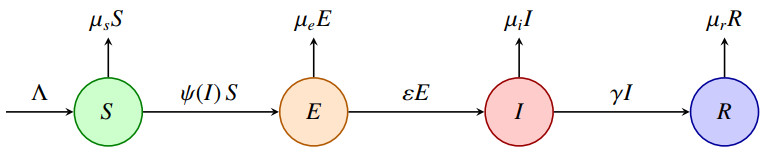
Flow diagram of the avian influenza transmission model in a bird population
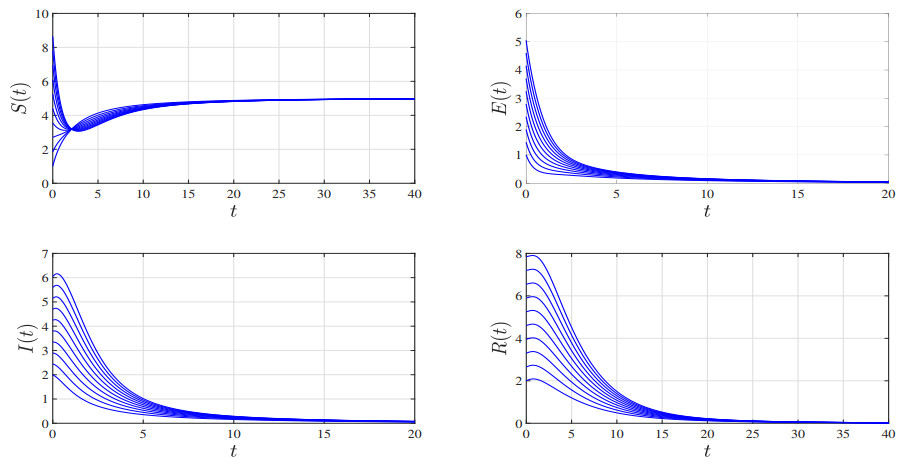
Numerical solutions of the non-delayed avian influenza model (3.1) for different initial bird populations when $ \mathcal{R}_0 = 0.859 < 1 $
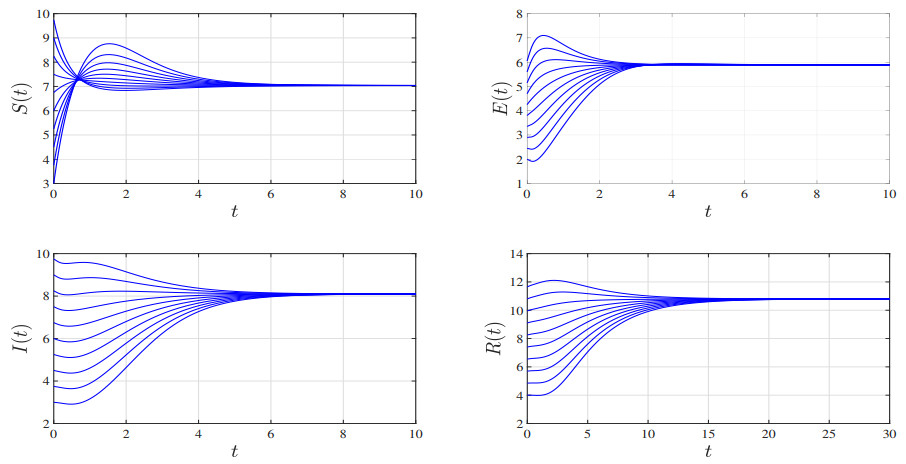
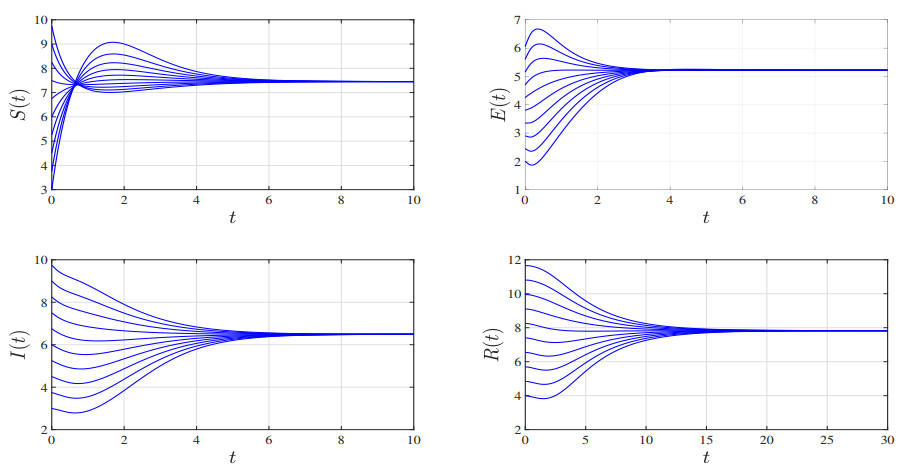
Numerical solutions of the non-delayed avian influenza model (3.1) for different initial bird populations when $ \mathcal{R}_0 = 11.4583 > 1 $
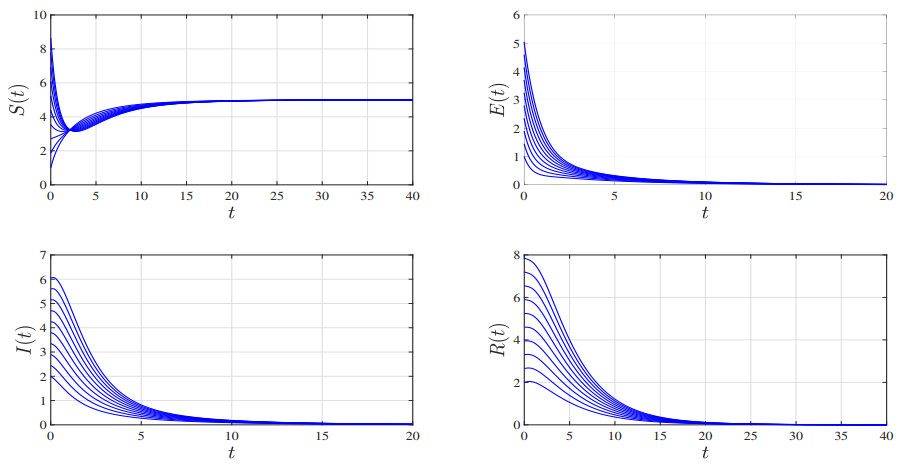
Numerical solutions of the delayed avian influenza model (5.1) for different initial conditions when $ \mathcal{R}_d = 0.704 < 1 $
Numerical solutions of the delayed avian influenza model (5.1) for different initial conditions when $ \mathcal{R}_d = 9.381 > 1 $
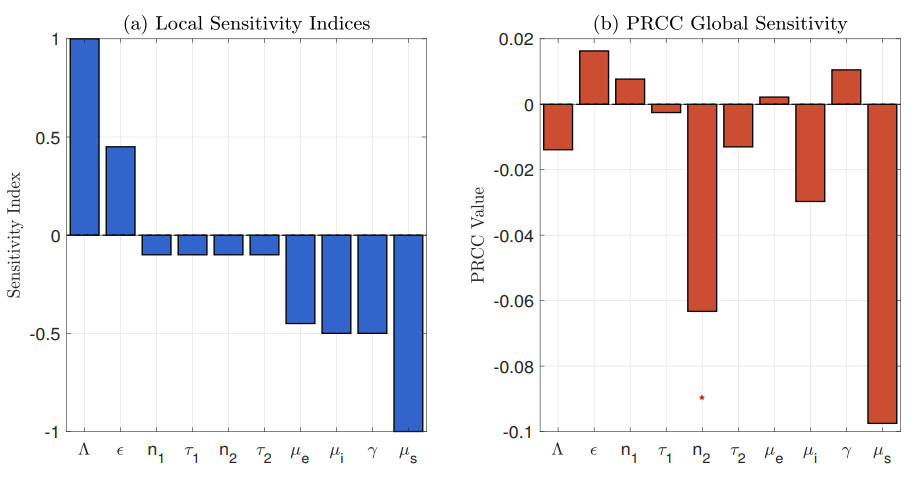
Local sensitivity indices and PRCC values of $ \mathcal{R}_d $ with respect to the main parameters of the delayed avian influenza model
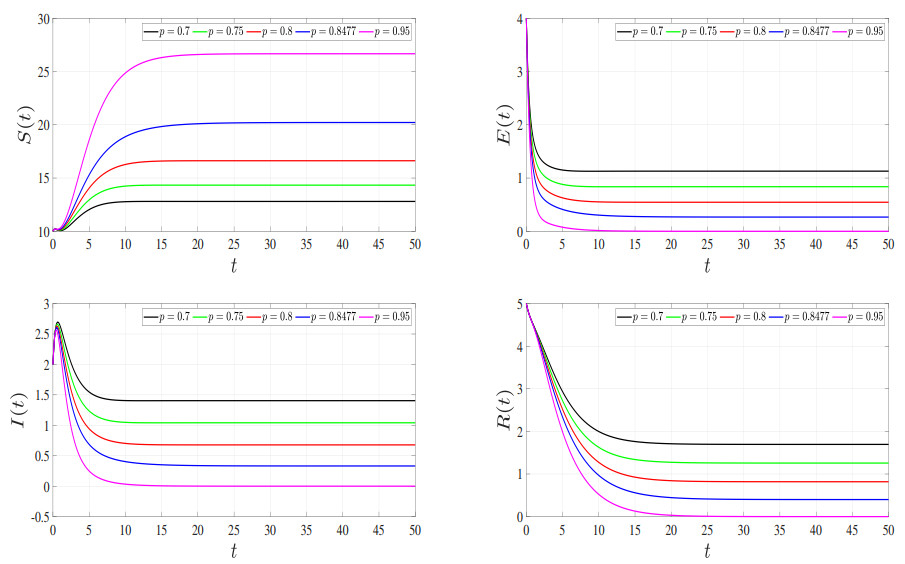
Effect of infection-blocking control efficacy $ p $ on the four bird classes in the delayed avian influenza model
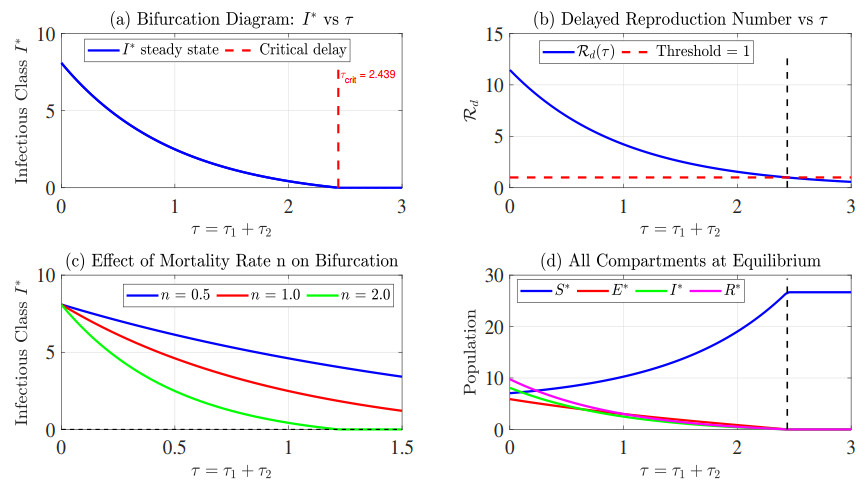
Bifurcation diagram of the infectious class $ I^* $ at equilibrium as a function of the total delay $ \tau = \tau_1 + \tau_2 $, with $ \tau_1 = \tau_2 = \tau/2 $
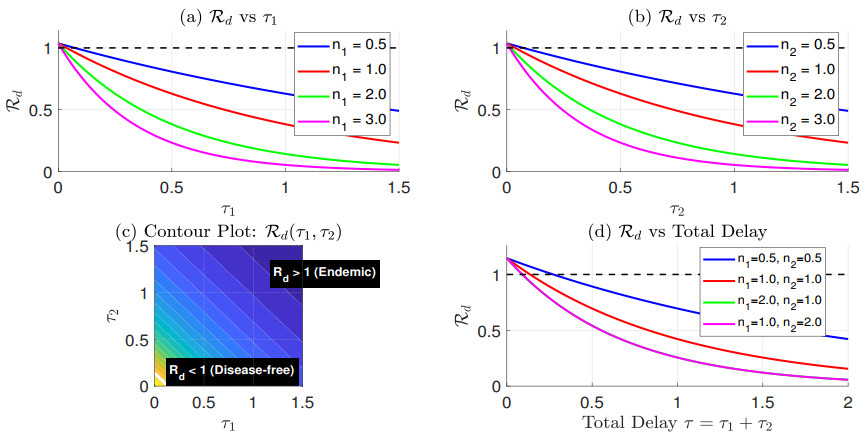
Variation of the delayed basic reproduction number $ \mathcal{R}_d $ with respect to time delays. (a) $ \mathcal{R}_d $ as a function of $ \tau_1 $ for different values of $ n_1 $, with $ \tau_2 = 0.1 $ and $ n_2 = 1 $. (b) $ \mathcal{R}_d $ as a function of $ \tau_2 $ for different values of $ n_2 $, with $ \tau_1 = 0.1 $ and $ n_1 = 1 $. (c) Contour plot of $ \mathcal{R}_d $ as a function of both $ \tau_1 $ and $ \tau_2 $ with $ n_1 = n_2 = 1 $




 DownLoad: