The distribution $ \mathscr{P}(M) $ of the total atomic magnetic quantum number $ M $ is a fundamental quantity for the computation of atomic structure and spectra. It enables one to deduce the distribution $ \mathscr{Q}(J) $ of the total angular momentum $ J $, which determines the sizes of the Hamiltonian blocks. Various techniques have been developed to obtain $ \mathscr{P}(M) $, based on recurrence relations, group theory, or $ q $-binomial coefficients (Gaussian polynomials). In this work, we derived new recurrence relations for $ \mathscr{P}(M) $ based on identities that have not yet been exploited for this purpose, including a $ q $-analogue of the so-called "Star of David" theorem. We showed that classical combinatorial identities, when extended to Gaussian polynomials and combined with generating-function differentiation, systematically yielded new recurrence relations for the magnetic quantum number distribution. While these new relations may not uniformly surpass existing algorithms in raw computational efficiency, they offer significant theoretical novelty by connecting advanced $ q $-combinatorial theorems to atomic physics. Furthermore, because the recurrence relations involved a distinct stencil over the index set (and thus different subsets of $ M $-values), they provided valuable cross-validation tools to test the consistency and reliability of large-scale calculations.
Citation: Jean-Christophe Pain. Magnetic quantum number distribution from $ q $-binomial identities[J]. AIMS Mathematics, 2026, 11(10): 35698-35717. doi: 10.3934/math.20261383
The distribution $ \mathscr{P}(M) $ of the total atomic magnetic quantum number $ M $ is a fundamental quantity for the computation of atomic structure and spectra. It enables one to deduce the distribution $ \mathscr{Q}(J) $ of the total angular momentum $ J $, which determines the sizes of the Hamiltonian blocks. Various techniques have been developed to obtain $ \mathscr{P}(M) $, based on recurrence relations, group theory, or $ q $-binomial coefficients (Gaussian polynomials). In this work, we derived new recurrence relations for $ \mathscr{P}(M) $ based on identities that have not yet been exploited for this purpose, including a $ q $-analogue of the so-called "Star of David" theorem. We showed that classical combinatorial identities, when extended to Gaussian polynomials and combined with generating-function differentiation, systematically yielded new recurrence relations for the magnetic quantum number distribution. While these new relations may not uniformly surpass existing algorithms in raw computational efficiency, they offer significant theoretical novelty by connecting advanced $ q $-combinatorial theorems to atomic physics. Furthermore, because the recurrence relations involved a distinct stencil over the index set (and thus different subsets of $ M $-values), they provided valuable cross-validation tools to test the consistency and reliability of large-scale calculations.

| [1] |
Y. M. Zhao, A. Arima, Number of states with a given angular momentum for identical fermions and bosons, Phys. Rev. C, 68 (2003), 044310. http://doi.org/10.1103/PhysRevC.68.044310 doi: 10.1103/PhysRevC.68.044310
|
| [2] |
L. Zamick, A. Escuderos, Alternate derivation of Ginocchio-Haxton relation [(2j+3)/6], Phys. Rev. C, 71 (2005), 054308. http://doi.org/10.1103/PhysRevC.71.054308 doi: 10.1103/PhysRevC.71.054308
|
| [3] |
L. Zamick, A. Escuderos, Odd-J pairing in nuclei, Phys. Rev. C, 87 (2013), 044302. http://doi.org/10.1103/PhysRevC.87.044302 |
| [4] |
X. Yin, Y. M. Zhao, Number of states with given spin $I$ and isospin $T$ for n fermions in a j orbit, Chinese Phys. C, 46 (2022), 114101. http://doi.org/10.1088/1674-1137/ac7eb3 doi: 10.1088/1674-1137/ac7eb3
|
| [5] |
J. Katriel, A. Novoselsky, Term multiplicities in the LS-coupling scheme, J. Phys. A: Math. Gen., 22 (1989), 1245–1251. http://doi.org/10.1088/0305-4470/22/9/014 doi: 10.1088/0305-4470/22/9/014
|
| [6] |
B. T. Thole, P. Carra, F. Sette, G. van der Laan, X-ray circular dichroism as a probe of orbital magnetization, Phys. Rev. Lett., 68, (1992), 1943–1946. http://doi.org/10.1103/PhysRevLett.68.1943 |
| [7] |
P. Carra, B. T. Thole, M. Altarelli, X. Wang, X-ray circular dichroism and local magnetic fields, Phys. Rev. Lett., 70 (1993), 694–697. http://doi.org/10.1103/PhysRevLett.70.694 doi: 10.1103/PhysRevLett.70.694
|
| [8] |
J. G. Cleary, B. G. Wybourne, Statistical group theory and the distribution of angular momentum states, J. Math. Phys., 12 (1971), 45–52. http://doi.org/10.1063/1.1665484 doi: 10.1063/1.1665484
|
| [9] |
M. G. Hirst, B. G. Wybourne, Statistical group theory and the distribution of angular momentum states: Ⅱ, J. Phys. A: Math. Gen., 19 (1986), 1545–1549. http://doi.org/10.1088/0305-4470/19/9/025 doi: 10.1088/0305-4470/19/9/025
|
| [10] |
B. V. Carlson, A. C. Merchant, Hybrid method for calculating exciton state and level densities, Phys. Rev. C, 40 (1989), 2265–2270. http://doi.org/10.1103/PhysRevC.40.2265 doi: 10.1103/PhysRevC.40.2265
|
| [11] |
P. R. Subramanian, V. Devanathan, Trace techniques for angular momentum operators, J. Phys. A: Math. Nucl. Gen., 7 (1974), 1995–2007. http://doi.org/10.1088/0305-4470/7/16/004 doi: 10.1088/0305-4470/7/16/004
|
| [12] |
P. P. Raychev, Y. F. Smirnov, On the generalization of Molien functions to supergroups, J. Phys. A: Math. Gen., 23 (1990), 4417–4425. http://doi.org/10.1088/0305-4470/23/20/004 doi: 10.1088/0305-4470/23/20/004
|
| [13] |
J. Planelles, F. Rajadell, J. Karwowski, V. Mas, A diagrammatic approach to statistical spectroscopy of many-fermion Hamiltonians, Phys. Rep., 267 (1996), 161–194. https://doi.org/10.1016/0370-1573(95)00061-5 doi: 10.1016/0370-1573(95)00061-5
|
| [14] |
J. C. Pain, Total number of J levels for identical particles in a single-j shell using coefficients of fractional parentage, Phys. Rev. C, 99 (2019), 054321. http://doi.org/10.1103/PhysRevC.99.054321 doi: 10.1103/PhysRevC.99.054321
|
| [15] |
L. Comtet, Advanced combinatorics; the art of finite and infinite expansions, Dordrecht, Boston: D. Reidel Pub. Co., 1974. https://doi.org/10.1007/978-94-010-2196-8 |
| [16] |
G. E. Andrews, The theory of partitions, Cambridge: Cambridge University Press, 1984. http://doi.org/10.1017/CBO9780511608650 |
| [17] |
R. P. Stanley, Enumerative combinatorics, 2 Eds., Cambridge: Cambridge University Press, 2011. http://doi.org/10.1017/CBO9781139058520 |
| [18] |
M. Poirier, J. C. Pain, Angular momentum distribution in a relativistic configuration: magnetic quantum number analysis, J. Phys. B: At. Mol. Opt. Phys., 54 (2021), 145002. http://doi.org/10.1088/1361-6455/ac10f9 doi: 10.1088/1361-6455/ac10f9
|
| [19] |
M. Poirier, J. C. Pain, Distribution of the total angular momentum in relativistic configurations, J. Phys. B: At. Mol. Opt. Phys., 54 (2021), 145006. http://doi.org/10.1088/1361-6455/ac17cb doi: 10.1088/1361-6455/ac17cb
|
| [20] |
M. Poirier, J. C. Pain, Exact expressions of the distributions of total magnetic quantum number and angular momentum in single-j orbits: a general technique for any number of fermions, Phys. Rev. C, 109 (2024), 024306. http://doi.org/10.1103/PhysRevC.109.024306 doi: 10.1103/PhysRevC.109.024306
|
| [21] |
J. C. Pain, Statistics of quantum numbers for non-equivalent fermions in single-j shells, Atoms, 13 (2025), 25. http://doi.org/10.3390/atoms13040025 doi: 10.3390/atoms13040025
|
| [22] |
J. C. Pain, X. Blanc, Statistics of multi-electron states and J-levels in atomic configurations, J. Phys. B: At. Mol. Opt. Phys., 58 (2025), 175002. http://doi.org/10.1088/1361-6455/ae0220 doi: 10.1088/1361-6455/ae0220
|
| [23] |
D. K. Sunko, D. Svrtan, Generating function for angular momentum multiplicities, Phys. Rev. C, 31 (1985), 1929–1933. http://doi.org/10.1103/PhysRevC.31.1929 doi: 10.1103/PhysRevC.31.1929
|
| [24] |
M. Poirier, J. C. Pain, Exact expressions for the number of levels in single-$j$ orbits for three, four, and five fermions, Phys. Rev. C, 104 (2021), 064324. http://doi.org/10.1103/PhysRevC.104.064324 doi: 10.1103/PhysRevC.104.064324
|
| [25] |
M. Ayman-Mursaleen, Quadratic function preserving wavelet type Baskakov operators for enhanced function approximation, Comput. Appl. Math., 44 (2025), 395. http://doi.org/10.1007/s40314-025-03357-x doi: 10.1007/s40314-025-03357-x
|
| [26] |
M. Nasiruzzaman, M. A. O. Tom, S. Serra-Capizzano, N. Rao, M. Ayman-Mursaleen, Approximation results for Beta Jakimovski-Leviatan type operators via $q$-analogue, Filomat, 37 (2023), 8389–8404. http://doi.org/10.2298/FIL2324389N doi: 10.2298/FIL2324389N
|
| [27] |
V. E. Hoggatt Jr., W. Hansell, The hidden hexagon squares, Fib. Quart., 9 (1971), 120. http://doi.org/10.1080/00150517.1971.12431015 |
| [28] |
H. W. Gould, A new greatest common divisor property of the binomial coefficients, Fibonacci Quart., 10 (1972), 579–584. http://doi.org/10.1080/00150517.1972.12430879 doi: 10.1080/00150517.1972.12430879
|
| [29] |
A. P. Hillman, V. E. Hoggatt Jr., A proof of Gould's Pascal hexagon conjecture, Fibonacci Quart., 10 (1972), 565–568. http://doi.org/10.1080/00150517.1972.12430876 doi: 10.1080/00150517.1972.12430876
|
| [30] |
D. Singmaster, Notes on binomial coefficients IV - Proof of a conjecture of Gould on the GCD's of two triples of binomial coefficients, Fibonacci Quart., 11 (1973), 282–283. http://doi.org/10.1080/00150517.1973.12430827 doi: 10.1080/00150517.1973.12430827
|
| [31] |
E. G. Straus, On the greatest common divisor of some binomial coefficients, Fibonacci Quart., 11 (1973), 25–26. http://doi.org/10.1080/00150517.1973.12430862 doi: 10.1080/00150517.1973.12430862
|
| [32] |
S. Hitotumatu, D. Sato, The Star of David theorem (Ⅰ), Fibonacci Quart., 13 (1975), 70. http://doi.org/10.1080/00150517.1975.12430691 doi: 10.1080/00150517.1975.12430691
|
| [33] |
E. Korntved, Extensions to the GCD Star of David theorem, Fibonacci Quart., 32 (1994), 160–166. http://doi.org/10.1080/00150517.1994.12429242 doi: 10.1080/00150517.1994.12429242
|
| [34] |
Y. Sun, The Star of David rule, Linear Algebra Appl., 429 (2008), 1954–1961. http://doi.org/10.1016/j.laa.2008.05.027 |
| [35] |
B. Gordon, D. Sato, E. G. Straus, Binomial coefficients whose products are perfect $k$-th powers, Pacific J. Math., 118 (1985), 393–400. http://doi.org/10.2140/pjm.1985.118.393 doi: 10.2140/pjm.1985.118.393
|
| [36] |
T. X. He, A. G. Shannon P. J. S. Shiue, Some identities of Gaussian binomial coefficients, Ann. Math. Inform., 55 (2022), 76–87. http://doi.org/10.33039/ami.2021.12.001 doi: 10.33039/ami.2021.12.001
|
| [37] |
S. Ando, D. Sato, On the proof of GCD and LCM equalities concerning the generalized binomial and multinomial coefficients, In: Applications of Fibonacci numbers, Dordrecht: Springer, 1991. http://doi.org/10.1007/978-94-011-3586-3_2 |
| [38] |
W. Zudilin, Congruences for $q$-binomial coefficients, Ann. Comb., 23 (2019), 1123–1135. http://doi.org/10.1007/s00026-019-00461-8 doi: 10.1007/s00026-019-00461-8
|
Figures(2)

Jean-Christophe Pain. Magnetic quantum number distribution from $ q $-binomial identities[J]. AIMS Mathematics, 2026, 11(10): 35698-35717. doi: 10.3934/math.20261383

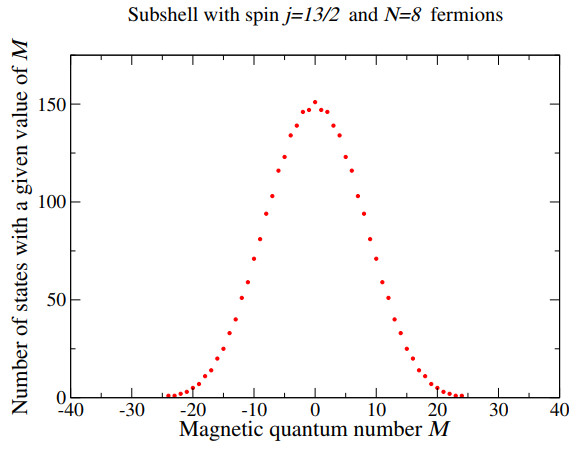
Example of a distribution $ \mathscr{P}(M) $ (more precisely $ \mathscr{P}_{14, 8}(M) $) in the case of $ j = 13/2 $ and $ N = 8 $ fermions. One has $ M_{\mathrm{min}} = 0 $ and the support of the distribution is bounded by $ -M_{\mathrm{min}} = -24 $ and $ M_{\mathrm{max}} = 24 $
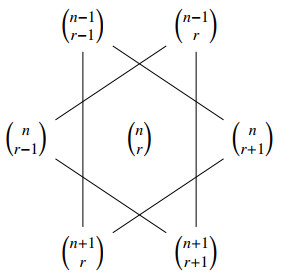
Star of David




 DownLoad: