In this study, we present new results on the solution of higher-order, nonlinear Emden–Fowler equations (EFEs) of arbitrary order $ N $, which frequently arise across various physical domains, including astrophysics, fluid dynamics, and thermal explosions. These equations are characterized by strong local singularities and complex composite nonlinearities, making accurate analytical or stable numerical treatments highly challenging. We develop an improved variational iteration method (IVIM) which enhances the classical variational iteration framework by introducing a dynamic, residual-minimizing parameter-selection rule. This optimal selection rule establishes a rigorous error-dampening feedback layer directly inside the integration kernel, systematically accelerating computational efficiency while ensuring stable error contractive properties for higher-order continuous and multisingular systems. To establish the validity, accuracy, and reproducibility of the proposed approach, we provide a thorough quantitative evaluation across second-order, third-order, fourth-order, and sixth-order frameworks evaluated over a uniform discrete spatial grid. A comprehensive comparative analysis conducted against both the classical, unrelaxed variational iteration method (VIM) and the homotopy perturbation method (HPM) demonstrates that IVIM systematically bounds consecutive grid-based Cauchy iterate errors down to an exceptionally accurate baseline (reaching as low as $ 0.0056 $ in volatile higher-order configurations) while reducing CPU runtime execution costs by up to an order of magnitude. These results verify that IVIM operates as a robust, mathematically sound, and computationally dominant tool for tackling complex higher-order nonlinear singular physical systems.
Citation: Sattam Alharbi, Taruni Alekhya Sarvasuddi, Prashanth Maroju, Ramandeep Behl. An improved variational iteration method with convergence analysis for solving higher-order nonlinear Emden–Fowler equations[J]. AIMS Mathematics, 2026, 11(10): 35631-35654. doi: 10.3934/math.20261381
In this study, we present new results on the solution of higher-order, nonlinear Emden–Fowler equations (EFEs) of arbitrary order $ N $, which frequently arise across various physical domains, including astrophysics, fluid dynamics, and thermal explosions. These equations are characterized by strong local singularities and complex composite nonlinearities, making accurate analytical or stable numerical treatments highly challenging. We develop an improved variational iteration method (IVIM) which enhances the classical variational iteration framework by introducing a dynamic, residual-minimizing parameter-selection rule. This optimal selection rule establishes a rigorous error-dampening feedback layer directly inside the integration kernel, systematically accelerating computational efficiency while ensuring stable error contractive properties for higher-order continuous and multisingular systems. To establish the validity, accuracy, and reproducibility of the proposed approach, we provide a thorough quantitative evaluation across second-order, third-order, fourth-order, and sixth-order frameworks evaluated over a uniform discrete spatial grid. A comprehensive comparative analysis conducted against both the classical, unrelaxed variational iteration method (VIM) and the homotopy perturbation method (HPM) demonstrates that IVIM systematically bounds consecutive grid-based Cauchy iterate errors down to an exceptionally accurate baseline (reaching as low as $ 0.0056 $ in volatile higher-order configurations) while reducing CPU runtime execution costs by up to an order of magnitude. These results verify that IVIM operates as a robust, mathematically sound, and computationally dominant tool for tackling complex higher-order nonlinear singular physical systems.

| [1] |
V. B. Mandelzweig, F. Tabakin, Quasilinearization approach to nonlinear problems in physics with application to nonlinear ODEs, Comput. Phys. Commun., 141 (2001), 268–281. https://doi.org/10.1016/S0010-4655(01)00415-5 doi: 10.1016/S0010-4655(01)00415-5
|
| [2] |
T. Luo, Z. Xin, H. Zeng, Nonlinear asymptotic stability of the Lane-Emden solutions for the viscous gaseous star problem with degenerate density dependent viscosities, Commun. Math. Phys., 347 (2016), 657–702. https://doi.org/10.1007/s00220-016-2753-1 doi: 10.1007/s00220-016-2753-1
|
| [3] |
D. Flockerzi, K. Sundmacher, On coupled Lane–Emden equations arising in dusty fluid models, J. Phys.: Conf. Ser., 268 (2011), 012006. 10.1088/1742-6596/268/1/012006 doi: 10.1088/1742-6596/268/1/012006
|
| [4] |
R. Rach, J. S. Duan, A. M. Wazwaz, Solving coupled Lane–Emden boundary value problems in catalytic diffusion reactions by the Adomian decomposition method, J. Math. Chem., 52 (2014), 255–267. https://doi.org/10.1007/s10910-013-0260-6 doi: 10.1007/s10910-013-0260-6
|
| [5] |
J. Džurina, S. R. Grace, I. Jadlovská, T. Li, Oscillation criteria for second‐order Emden–Fowler delay differential equations with a sublinear neutral term, Math. Nachr., 293 (2020), 910–922. https://doi.org/10.1002/mana.201800196 doi: 10.1002/mana.201800196
|
| [6] |
J. A. Khan, M. A. Z. Raja, M. M. Rashidi, M. I. Syam, A. M. Wazwaz, Nature-inspired computing approach for solving non-linear singular Emden–Fowler problem arising in electromagnetic theory, Connection Sci., 27 (2015), 377–396. https://doi.org/10.1080/09540091.2015.1092499 doi: 10.1080/09540091.2015.1092499
|
| [7] |
A. H. Bhrawy, A. S. Alofi, R. A. Van Gorder, An efficient collocation method for a class of boundary value problems arising in mathematical physics and geometry, Abstract Appl. Anal., 2014 (2014), 463749. https://doi.org/10.1155/2014/425648 doi: 10.1155/2014/425648
|
| [8] |
J. I. Ramos, Linearization methods in classical and quantum mechanics, Comput. Phys. Commun., 153 (2003), 199–208. https://doi.org/10.1016/S0010-4655(03)00226-1 doi: 10.1016/S0010-4655(03)00226-1
|
| [9] |
M. Dehghan, F. Shakeri, Solution of an integro-differential equation arising in oscillating magnetic fields using He's homotopy perturbation method, Prog. Electromagn. Res., 78 (2008), 361–376. https://doi.org/10.2528/PIER07090403 doi: 10.2528/PIER07090403
|
| [10] |
A. Taghavi, S. Pearce, A solution to the Lane–Emden equation in the theory of stellar structure utilizing the Tau method, Math. Meth. Appl. Sci., 36 (2013), 1240–1247. https://doi.org/10.1002/mma.2676 doi: 10.1002/mma.2676
|
| [11] |
M. Ghergu, V. Rădulescu, On a class of singular Gierer–Meinhardt systems arising in morphogenesis, C. R. Math., 344 (2007), 163–168. https://doi.org/10.1016/j.crma.2006.12.008 doi: 10.1016/j.crma.2006.12.008
|
| [12] |
V. Rădulescu, D. Repovš, Combined effects in nonlinear problems arising in the study of anisotropic continuous media, Nonlinear Anal.-Theor., 75 (2012), 1524–1530. https://doi.org/10.1016/j.na.2011.01.037 doi: 10.1016/j.na.2011.01.037
|
| [13] |
V. K. Baranwal, R. K. Pandey, M. P. Tripathi, O. P. Singh, An analytic algorithm for time fractional nonlinear reaction–diffusion equation based on a new iterative method, Commun. Nonlinear Sci., 17 (2012), 3906–3921. https://doi.org/10.1016/j.cnsns.2012.02.015 doi: 10.1016/j.cnsns.2012.02.015
|
| [14] |
A. Dezhbord, T. Lotfi, K. Mahdiani, A numerical approach for solving the high-order nonlinear singular Emden–Fowler type equations, Adv. Differ. Equ., 2018 (2018), 161. https://doi.org/10.1186/s13662-018-1529-7 doi: 10.1186/s13662-018-1529-7
|
| [15] |
A. M. Wazwaz, The variational iteration method for solving nonlinear singular boundary value problems arising in various physical models, Commun. Nonlinear Sci., 16 (2011), 3881–3886. https://doi.org/10.1016/j.cnsns.2011.02.026 doi: 10.1016/j.cnsns.2011.02.026
|
| [16] |
H. Tari, D. D. Ganji, H. Babazadeh, The application of He's variational iteration method to nonlinear equations arising in heat transfer, Phys. Lett. A, 363 (2007), 213–217. https://doi.org/10.1016/j.physleta.2006.11.005 doi: 10.1016/j.physleta.2006.11.005
|
| [17] |
M. H. Ahmed, Comparison between variational iteration method and Gegenbauer–Galerkin method for solving two dimensional nonlinear Volterra integral equations of the second kind, AIP Adv., 15 (2025), 125306. https://doi.org/10.1063/5.0307047 doi: 10.1063/5.0307047
|
| [18] |
H. Z. Liu, A modification to the first integral method and its applications, Appl. Math. Comput., 419 (2022), 126855. https://doi.org/10.1016/j.amc.2021.126855 doi: 10.1016/j.amc.2021.126855
|
| [19] |
J. H. He, Variational iteration method–a kind of non-linear analytical technique: some examples, Int. J. Nonlin Mech., 34 (1999), 699–708. 10.1016/S0020-7462(98)00048-1 doi: 10.1016/S0020-7462(98)00048-1
|
| [20] |
J. H. He, Variational iteration method for autonomous ordinary differential systems, Appl. Math. Comput., 114 (2000), 115–123. https://doi.org/10.1016/S0096-3003(99)00104-6 doi: 10.1016/S0096-3003(99)00104-6
|
| [21] |
R. O. Awonusika, Analytical solutions of generalised Emden–Fowler initial and boundary value problems of higher order, Int. J. Appl. Comput. Math., 10 (2024), 43. https://doi.org/10.1007/s40819-024-01676-x doi: 10.1007/s40819-024-01676-x
|
| [22] |
V. K. Sinha, P. Maroju, Numerical algorithm for solving real-life application problems of Lane–Emden type equation, J. Comput. Sci., 75 (2024), 102185. https://doi.org/10.1016/j.jocs.2023.102185 doi: 10.1016/j.jocs.2023.102185
|
| [23] |
N. Das, R. Singh, A. M. Wazwaz, J. Kumar, An algorithm based on the variational iteration technique for the Bratu-type and the Lane–Emden problems, J. Math. Chem., 54 (2016), 527–551. https://doi.org/10.1007/s10910-015-0575-6 doi: 10.1007/s10910-015-0575-6
|
| [24] |
Z. Sabir, M. G. Sakar, M. Yeskindirova, O. Saldir, Numerical investigations to design a novel model based on the fifth order system of Emden–Fowler equations, Theor. Appl. Mech. Lett., 10 (2020), 333–342. https://doi.org/10.1016/j.taml.2020.01.049 doi: 10.1016/j.taml.2020.01.049
|
| [25] |
T. A. Abassy, M. A. El-Tawil, H. El Zoheiry, Toward a modified variational iteration method, J. Comput. Appl. Math., 207 (2007), 137–147. https://doi.org/10.1016/j.cam.2006.07.019 doi: 10.1016/j.cam.2006.07.019
|
| [26] |
S. T. Mohyud-Din, M. A. Noor, K. I. Noor, Modified variational iteration method for Schrodinger equations, Math. Comput. Appl., 15 (2010), 309–317. https://doi.org/10.3390/mca15030309 doi: 10.3390/mca15030309
|
| [27] |
M. S. H. Chowdhury, I. Hashim, Solutions of Emden–Fowler equations by homotopy-perturbation method, Nonlinear Anal.-Real, 10 (2009), 104–115. https://doi.org/10.1016/j.nonrwa.2007.08.017 doi: 10.1016/j.nonrwa.2007.08.017
|
| [28] |
Y. Liu, S. N. Kurra, Solving Blasius equation using HVIM, World Acad. Sci. Eng. Technol., 65 (2012), 4578–581. |
| [29] |
X. Chen, Z. Wang, Convergence of regularized time-stepping methods for differential variational inequalities, SIAM J. Optim., 23 (2013), 1647–1671. https://doi.org/10.1137/120875223 doi: 10.1137/120875223
|
Figures(4) / Tables(8)

Sattam Alharbi, Taruni Alekhya Sarvasuddi, Prashanth Maroju, Ramandeep Behl. An improved variational iteration method with convergence analysis for solving higher-order nonlinear Emden–Fowler equations[J]. AIMS Mathematics, 2026, 11(10): 35631-35654. doi: 10.3934/math.20261381

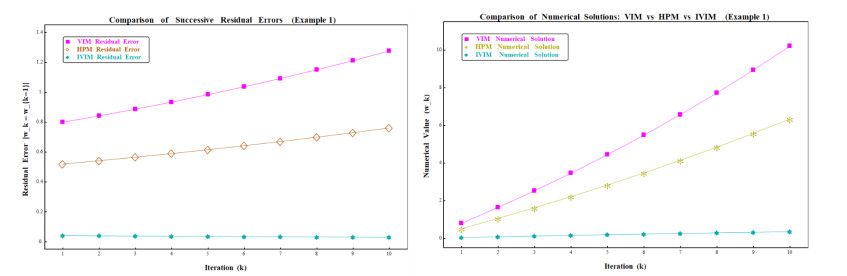
Comparison of the second-order problem: (a) Residual errors obtained using the VIM, HPM, and IVIM; (b) Numerical solutions obtained using the VIM, HPM, and IVIM
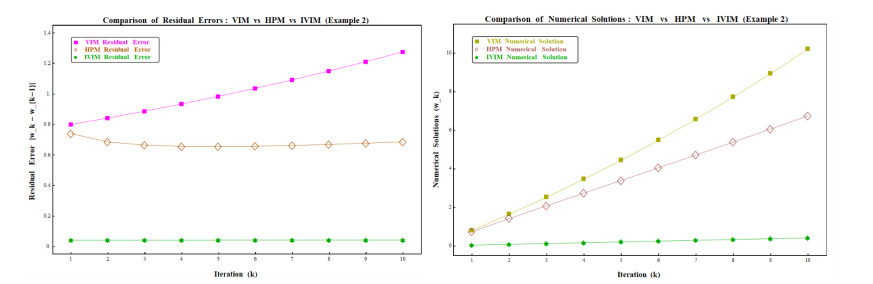
Comparison of the third-order problem: (a) Residual errors obtained using the VIM, HPM, and IVIM; (b) Numerical solutions obtained using the VIM, HPM, and IVIM
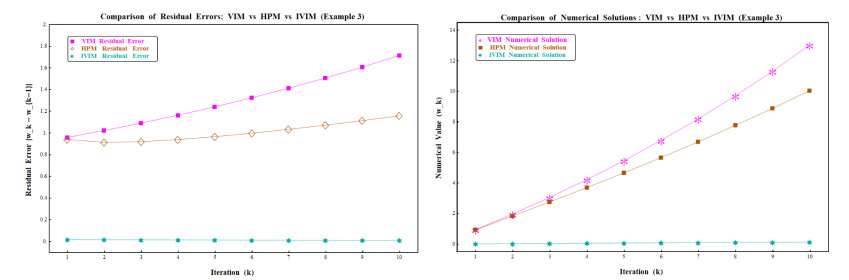
Comparison of the fourth-order problem: (a) Residual errors obtained using the VIM, HPM, and IVIM; (b) Numerical solutions obtained using the VIM, HPM, and IVIM
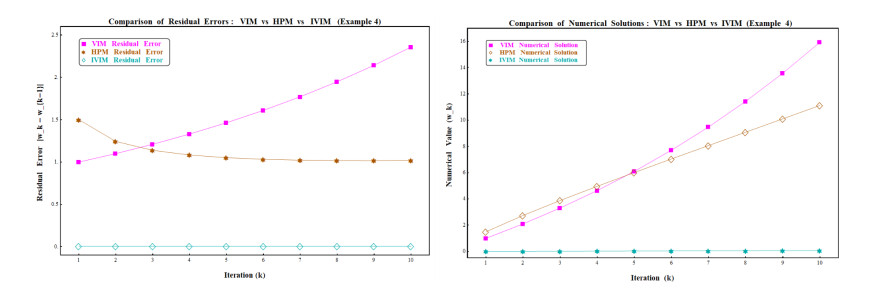
Comparison of the sixth-order problem: (a) Residual errors obtained using the VIM and IVIM; (b) Numerical solutions obtained using the VIM and IVIM




 DownLoad: