We introduce a Caputo–generalized conformable fractional (Caputo–GCF) derivative that separates the fractional order $ \sigma $ from an independently tunable structural memory parameter $ \nu+\zeta $, and recovers the classical Caputo, Riemann–Liouville and (formally, in a limiting sense) Hadamard derivatives as special cases. Linearity, boundedness and continuity of the operator are established. Applying it to a delayed fractional-order neural network, we prove existence and uniqueness of the equilibrium point and derive two explicit finite-time stability criteria — a Hölder-based criterion for $ 0 < \sigma\le\tfrac12 $ and a Cauchy–Schwarz-based criterion for $ \tfrac12 < \sigma < 1 $ — that explicitly quantify the roles of $ \sigma $, $ \nu+\zeta $, the delay, and the coupling matrices. Numerical experiments confirm the theoretical bounds and show faster empirical settling and smaller final error than the classical Caputo and GCF operators on a representative example. Applications to anomaly detection (Controlled Anomalies Time-Series dataset), delayed UAV attitude stabilization, and secure neural dynamics under bounded cyber disturbances further illustrate the framework's applicability.
Citation: Abeer Aljohani. A new Caputo–generalized conformable fractional derivative with applications to finite-time stability and secure neural systems[J]. AIMS Mathematics, 2026, 11(10): 35578-35630. doi: 10.3934/math.20261380
We introduce a Caputo–generalized conformable fractional (Caputo–GCF) derivative that separates the fractional order $ \sigma $ from an independently tunable structural memory parameter $ \nu+\zeta $, and recovers the classical Caputo, Riemann–Liouville and (formally, in a limiting sense) Hadamard derivatives as special cases. Linearity, boundedness and continuity of the operator are established. Applying it to a delayed fractional-order neural network, we prove existence and uniqueness of the equilibrium point and derive two explicit finite-time stability criteria — a Hölder-based criterion for $ 0 < \sigma\le\tfrac12 $ and a Cauchy–Schwarz-based criterion for $ \tfrac12 < \sigma < 1 $ — that explicitly quantify the roles of $ \sigma $, $ \nu+\zeta $, the delay, and the coupling matrices. Numerical experiments confirm the theoretical bounds and show faster empirical settling and smaller final error than the classical Caputo and GCF operators on a representative example. Applications to anomaly detection (Controlled Anomalies Time-Series dataset), delayed UAV attitude stabilization, and secure neural dynamics under bounded cyber disturbances further illustrate the framework's applicability.

| [1] |
T. Zhang, L. Wang, Y. Zhang, J. Deng, Finite-time stability for fractional-order fuzzy neural network with mixed delays and inertial terms, AIMS Math., 9 (2024), 19176–19194. https://doi.org/10.3934/math.2024935 doi: 10.3934/math.2024935
|
| [2] |
T. Hu, Z. He, X. Zhang, S. Zhong, Finite-time stability for fractional-order complex-valued neural networks with time delay, Appl. Math. Comput., 365 (2020), 124715. https://doi.org/10.1016/j.amc.2019.124715 doi: 10.1016/j.amc.2019.124715
|
| [3] |
N. T. Thanh, P. Niamsup, V. N. Phat, New results on finite-time stability of fractional-order neural networks with time-varying delay, Neural Comput. Appl., 33 (2021), 17489–17496. https://doi.org/10.1007/s00521-021-06339-2 doi: 10.1007/s00521-021-06339-2
|
| [4] |
T. Hamadneh, A. Hioual, O. Alsayyed, Y. A. Al-Khassawneh, A. Al-Husban, A. Ouannas, Finite time stability results for neural networks described by variable-order fractional difference equations, Fractal Fract., 7 (2023), 616. https://doi.org/10.3390/fractalfract7080616 doi: 10.3390/fractalfract7080616
|
| [5] |
A. Ben Makhlouf, D. Baleanu, Finite time stability of fractional order systems of neutral type, Fractal Fract., 6 (2022), 289. https://doi.org/10.3390/fractalfract6060289 doi: 10.3390/fractalfract6060289
|
| [6] |
S. K. Panda, T. Abdeljawad, A. M. Nagy, On uniform stability and numerical simulations of complex valued neural networks involving generalized Caputo fractional order, Sci. Rep., 14 (2024), 4073. https://doi.org/10.1038/s41598-024-53670-4 doi: 10.1038/s41598-024-53670-4
|
| [7] |
S. Jose, V. Parthiban, Finite-time synchronization of fractional order neural networks via sampled data control with time delay, J. Math. Comput. Sci., 35 (2024), 374–387. https://doi.org/10.22436/jmcs.035.04.01 doi: 10.22436/jmcs.035.04.01
|
| [8] |
M. Rhaima, L. Chen, L. Mchiri, A. Ben Makhlouf, Finite time stability of $\rho$-Caputo neural network systems, Asian J. Control, 27 (2025), 459-469. https://doi.org/10.1002/asjc.3447 doi: 10.1002/asjc.3447
|
| [9] |
G. Palanisamy, U. Kandasamy, F. A. Rihan, S. Ben Said, Fractional-order stochastic delayed neural networks with impulses: mean square finite-time contractive synchronization, Sci. Rep., 16 (2026), 1999. https://doi.org/10.1038/s41598-025-31768-7 doi: 10.1038/s41598-025-31768-7
|
| [10] |
E. Demirci, F. Karakoç, A. Kütahyalıoğlu, Mittag-Leffler stability of neural networks with Caputo–Hadamard fractional derivative, Math. Methods Appl. Sci., 47 (2024), 10091–10100. https://doi.org/10.1002/mma.10111 doi: 10.1002/mma.10111
|
| [11] |
H. L. Li, C. Hu, L. Zhang, H. Jiang, J. Cao, Complete and finite-time synchronization of fractional-order fuzzy neural networks via nonlinear feedback control, Fuzzy Sets Syst., 443 (2022), 50–69. https://doi.org/10.1016/j.fss.2021.11.004 doi: 10.1016/j.fss.2021.11.004
|
| [12] |
R. Agarwal, S. Hristova, D. O'Regan, Stability of generalized proportional Caputo fractional differential equations by Lyapunov functions, Fractal Fract., 6 (2022), 34. https://doi.org/10.3390/fractalfract6010034 doi: 10.3390/fractalfract6010034
|
| [13] |
D. Bäßler, T. Kortus, G. Gühring, Unsupervised anomaly detection in multivariate time series with online evolving spiking neural networks, Mach. Learn., 111 (2022), 1377–1408. https://doi.org/10.1007/s10994-022-06129-4 doi: 10.1007/s10994-022-06129-4
|
| [14] |
L. Kirichenko, Y. Koval, S. Yakovlev, D. Chumachenko, Anomaly detection in fractal time series with LSTM autoencoders, Mathematics, 12 (2024), 3079. https://doi.org/10.3390/math12193079 doi: 10.3390/math12193079
|
| [15] |
F. Wang, Y. Jiang, R. Zhang, A. Wei, J. Xie, X. Pang, A survey of deep anomaly detection in multivariate time series: taxonomy, applications, and directions, Sensors, 25 (2025), 190. https://doi.org/10.3390/s25010190 doi: 10.3390/s25010190
|
| [16] |
F. Du, J. G. Lu, Finite-time stability of fractional-order fuzzy cellular neural networks with time delays, Fuzzy Sets Syst., 438 (2022), 107–120. https://doi.org/10.1016/j.fss.2021.08.011 doi: 10.1016/j.fss.2021.08.011
|
| [17] |
F. Du, J. G. Lu, Adaptive finite-time synchronization of fractional-order delayed fuzzy cellular neural networks, Fuzzy Sets Syst., 466 (2023), 108480. https://doi.org/10.1016/j.fss.2023.02.001 doi: 10.1016/j.fss.2023.02.001
|
| [18] |
X. Li, X. Liu, S. Zhang, New criteria on the finite-time stability of fractional-order BAM neural networks with time delay, Neural Comput. Appl., 34 (2022), 4501–4517. https://doi.org/10.1007/s00521-021-06605-3 doi: 10.1007/s00521-021-06605-3
|
| [19] |
Z. Yang, J. Zhang, Y. Niu, Finite-time stability of fractional-order bidirectional associative memory neural networks with mixed time-varying delays, J. Appl. Math. Comput., 63 (2020), 501–522. https://doi.org/10.1007/s12190-020-01327-6 doi: 10.1007/s12190-020-01327-6
|
| [20] |
O. Naifar, A. Ben Makhlouf, L. Mchiri, M. Rhaima, Finite time stability for Hadamard fractional-order systems, Ain Shams Eng. J., 16 (2025), 103263. https://doi.org/10.1016/j.asej.2025.103263 doi: 10.1016/j.asej.2025.103263
|
| [21] |
A. Al-Jaser, F. Alharbi, D. Chalishajar, B. Qaraad, Functional differential equations with non-canonical operator: oscillatory features of solutions, Axioms, 14 (2025), 588. https://doi.org/10.3390/axioms14080588 doi: 10.3390/axioms14080588
|
| [22] |
C. Anusha, C. Ravichandran, F. Aljuaydi, K. S. Nisar, D. Chalishajar, Stability and solutions of adjoint nonlinear impulsive neutral mixed integral equations in dynamic systems, J. Appl. Math. Comput., 71 (2025), 7521–7541. https://doi.org/10.1007/s12190-025-02579-w doi: 10.1007/s12190-025-02579-w
|
| [23] |
D. Chalishajar, D. Kasinathan, R. Kasinathan, R. Kasinathan, Viscoelastic Kelvin–Voigt model on Ulam–Hyer's stability and T-controllability for a coupled integro fractional stochastic systems with integral boundary conditions via integral contractors, Chaos Soliton. Fract., 191 (2025), 115785. https://doi.org/10.1016/j.chaos.2024.115785 doi: 10.1016/j.chaos.2024.115785
|
| [24] |
D. Chalishajar, D. Kasinathan, R. Kasinathan, R. Kasinathan, Ulam–Hyers–Rassias stability of Hilfer fractional stochastic impulsive differential equations with non-local condition via time-changed Brownian motion followed by the currency options pricing model, Chaos Soliton. Fract., 197 (2025), 116468. https://doi.org/10.1016/j.chaos.2025.116468 doi: 10.1016/j.chaos.2025.116468
|
| [25] |
Z. Yan, Y. Song, J. H. Park, Finite-time stability and stabilization for stochastic Markov jump systems with mode-dependent time delays, ISA Trans., 68 (2017), 141–149. https://doi.org/10.1016/j.isatra.2017.01.018 doi: 10.1016/j.isatra.2017.01.018
|
| [26] |
Z. Yan, G. Chang, Z. Xing, R. Xu, J. Cheng, Annular finite-time stability and stabilization in probability for nonlinear stochastic Markov jump systems with impulsive effects, Int. J. Robust Nonlinear Control, 36 (2025), 245–255. https://doi.org/10.1002/rnc.70137 doi: 10.1002/rnc.70137
|
| [27] |
B. Gopinath, A benign and malignant pattern identification in cytopathological images of thyroid nodules using Gabor filter and neural networks, Asian J. Converg. Technol., 4 (2018), 414. |
| [28] |
Q. X. Zhu, J. D. Cao, Mean-square exponential input-to-state stability of stochastic delayed neural networks, Neurocomputing, 131 (2014), 157–163. https://doi.org/10.1016/j.neucom.2013.10.029 doi: 10.1016/j.neucom.2013.10.029
|
| [29] |
C. Xu, L. Chen, Effect of leakage delay on the almost periodic solutions of fuzzy cellular neural networks, J. Exp. Theor. Artif. Intell., 30 (2018), 993–1011. https://doi.org/10.1080/0952813X.2018.1509895 doi: 10.1080/0952813X.2018.1509895
|
| [30] |
T. U. Khan, M. A. Khan, Generalized conformable fractional operators, J. Comput. Appl. Math., 346 (2019), 378–389. https://doi.org/10.1016/j.cam.2018.07.018 doi: 10.1016/j.cam.2018.07.018
|
| [31] |
Y. Ke, C. Miao, Stability analysis of fractional-order Cohen–Grossberg neural networks with time delay, Int. J. Comput. Math., 92 (2015), 1102–1113. https://doi.org/10.1080/00207160.2014.935734 doi: 10.1080/00207160.2014.935734
|
| [32] |
M. Kuczma, An introduction to the theory of functional equations and inequalities: Cauchy's equation and Jensen's inequality, Basel: Birkhäuser, 2009. https://doi.org/10.1007/978-3-7643-8749-5 |
| [33] |
G. H. Hardy, J. E. Littlewood, G. Pólya, Inequalities, Cambridge: Cambridge University Press, 1952. |
| [34] |
P. Fleith, Controlled anomalies time-series dataset, Hugging Face, 2024. Available from: https://huggingface.co/datasets/patrickfleith/controlled-anomalies-time-series-dataset. |
Figures(9) / Tables(12)

Abeer Aljohani. A new Caputo–generalized conformable fractional derivative with applications to finite-time stability and secure neural systems[J]. AIMS Mathematics, 2026, 11(10): 35578-35630. doi: 10.3934/math.20261380

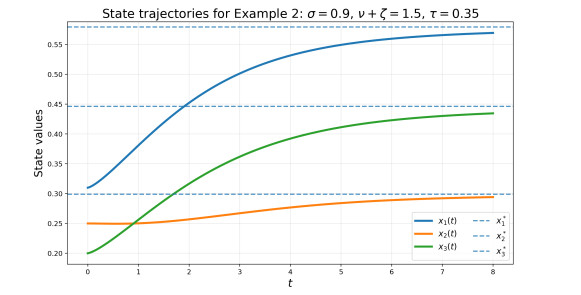
State trajectories of the three-dimensional Caputo–GCF delayed neural network in Example 2 for $\sigma = 0.9$, $\nu+\zeta = 1.5$, and $\tau = 0.35$
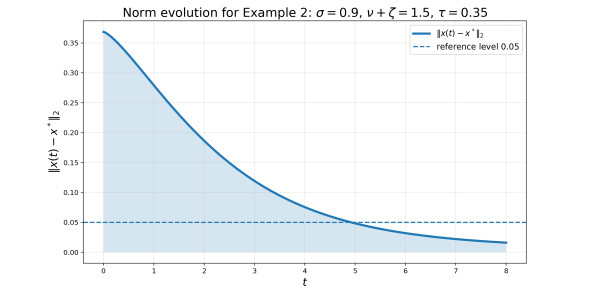
Norm evolution $\|x(t)-x^*\|_2$ for the Caputo–GCF delayed neural network in Example 2 with $\sigma = 0.9$, $\nu+\zeta = 1.5$, and $\tau = 0.35$
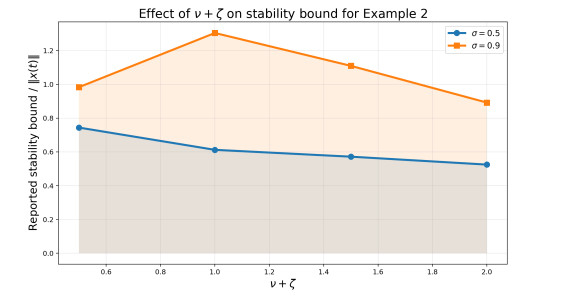
Effect of the structural memory parameter $\nu+\zeta$ on the reported stability bound for Example 2
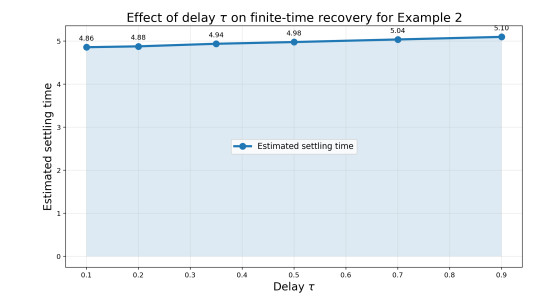
Effect of the delay parameter $\tau$ on the estimated settling time for Example 2 with $\sigma = 0.9$ and $\nu+\zeta = 1.5$
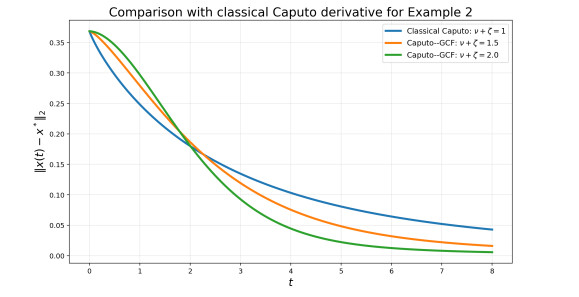
Comparison between the classical Caputo derivative and the proposed Caputo–GCF derivative for Example 2 with $\sigma = 0.9$ and $\tau = 0.35$
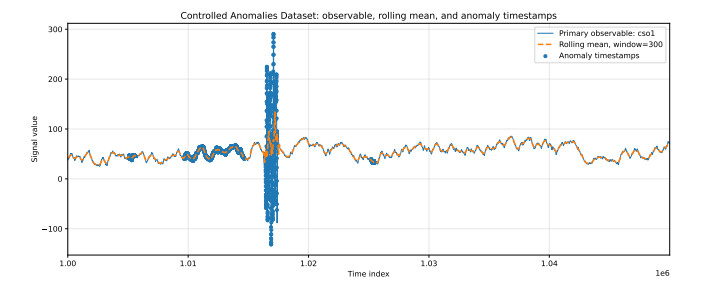
Visualization of the Controlled Anomalies Time-Series dataset in the selected test region. The plot shows the primary observable $\texttt{cso1}$, its rolling mean, and the detected anomaly timestamps. The large deviation around the anomaly interval indicates a sudden disturbance in the observed signal, while the rolling mean shows the local trend of the time series
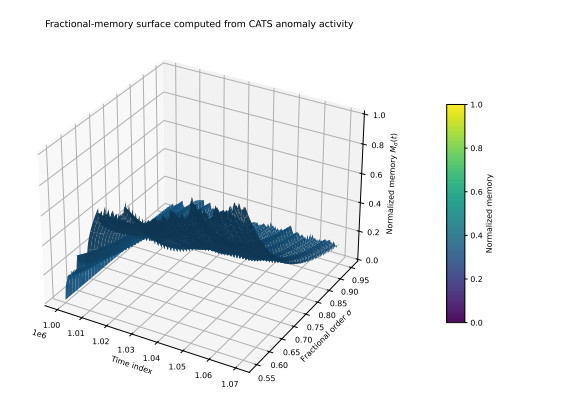
Fractional-memory surface computed from the CATS anomaly activity. The anomaly-intensity sequence $ \rho(t) $ is obtained from the anomaly activity of the dataset and convolved with the power-law memory kernel $ (t-k+1)^{-\sigma} $ for $ \sigma\in[0.55, 0.95] $. Smaller values of $ \sigma $ preserve anomaly effects for a longer time, while larger values of $ \sigma $ lead to faster memory decay
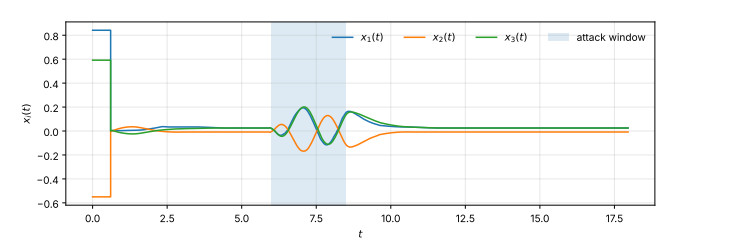
State trajectories under a bounded cyber disturbance (shaded interval)
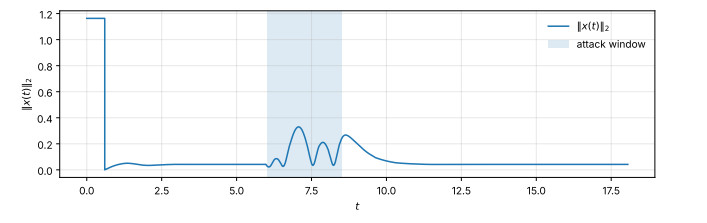
Evolution of the security energy $ \|x(t)\|_2 $ showing finite-time recovery




 DownLoad: