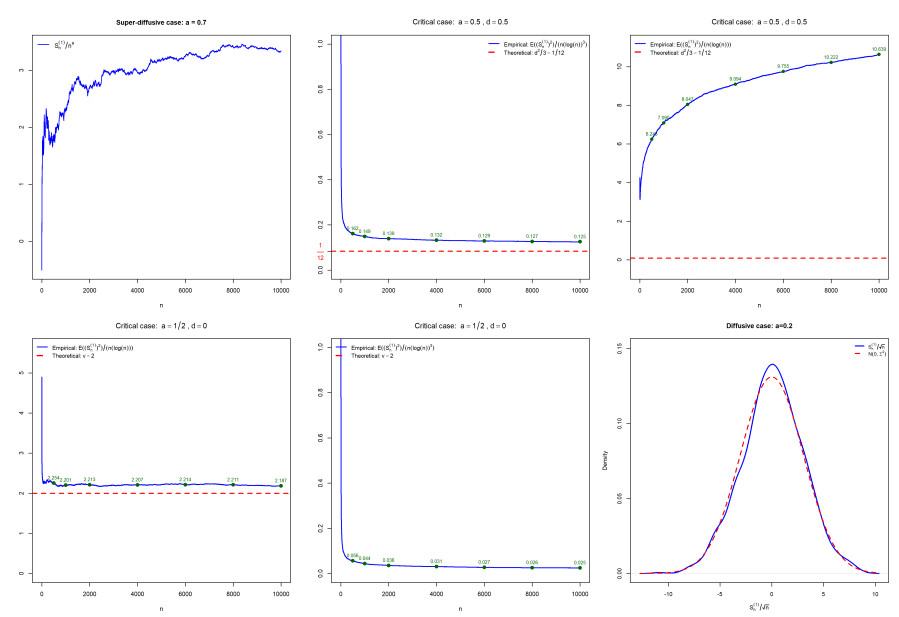
We study two interacting elephant random walks. The second has memory $ \alpha_2 = 2p_2-1\in(-1, 1] $: It repeats a uniformly sampled past step with probability $ p_2 $ and reverses it otherwise. With probability $ \beta $, the first copies a past step of the second, multiplies it by an independent amplitude of mean $ m_L $ and second moment $ v $, and repeats or reverses it with memory $ \alpha_1 = 2p_1-1 $; otherwise, it does the same with its own past and memory $ \alpha_3 = 2p_3-1 $. Its effective memory is $ \gamma = \alpha_3(1-\beta) $, and the mean coupling is $ d = \beta\alpha_1 m_L $. In the resonant regime $ \gamma = \alpha_2 $, and under the moment assumptions stated in Theorem 3.1, the first position is driven by the source $ d\, S_n^{(2)}/n $. If $ \gamma > 1/2 $ and $ d\neq 0 $, $ S_n^{(1)}/(n^{\gamma}\log n) $ converges almost surely to $ d\, L $, where $ L $ is the limit of the second walk. If $ \gamma = 1/2 $ and $ d\neq 0 $, $ S_n^{(1)}/\sqrt{n(\log n)^{3}} $ converges in law to $ \mathcal N(0, d^{2}/3) $. If $ -1 < \gamma < 1/2 $ and $ \mathbb{E}[|L_1|^{2+\delta}] < \infty $ for some $ \delta > 0 $, the $ \sqrt n $ fluctuations are jointly Gaussian, and the variance of the first coordinate is $ v/(1-2\gamma)+2d^{2}/(1-2\gamma)^{3} $. If $ d = 0 $ and $ \gamma = 1/2 $, under a moment of order $ 2+\delta $, the scale returns to $ \sqrt{n\log n} $, with variance $ v $. The case $ \gamma\neq\alpha_2 $ is left to a companion manuscript, which is not used in the proofs.
Citation: Rafik Aguech, Mohamed Abdelkader. Limit theorems for a resonant interacting elephant random walk with random amplitudes[J]. AIMS Mathematics, 2026, 11(10): 35551-35577. doi: 10.3934/math.20261379
We study two interacting elephant random walks. The second has memory $ \alpha_2 = 2p_2-1\in(-1, 1] $: It repeats a uniformly sampled past step with probability $ p_2 $ and reverses it otherwise. With probability $ \beta $, the first copies a past step of the second, multiplies it by an independent amplitude of mean $ m_L $ and second moment $ v $, and repeats or reverses it with memory $ \alpha_1 = 2p_1-1 $; otherwise, it does the same with its own past and memory $ \alpha_3 = 2p_3-1 $. Its effective memory is $ \gamma = \alpha_3(1-\beta) $, and the mean coupling is $ d = \beta\alpha_1 m_L $. In the resonant regime $ \gamma = \alpha_2 $, and under the moment assumptions stated in Theorem 3.1, the first position is driven by the source $ d\, S_n^{(2)}/n $. If $ \gamma > 1/2 $ and $ d\neq 0 $, $ S_n^{(1)}/(n^{\gamma}\log n) $ converges almost surely to $ d\, L $, where $ L $ is the limit of the second walk. If $ \gamma = 1/2 $ and $ d\neq 0 $, $ S_n^{(1)}/\sqrt{n(\log n)^{3}} $ converges in law to $ \mathcal N(0, d^{2}/3) $. If $ -1 < \gamma < 1/2 $ and $ \mathbb{E}[|L_1|^{2+\delta}] < \infty $ for some $ \delta > 0 $, the $ \sqrt n $ fluctuations are jointly Gaussian, and the variance of the first coordinate is $ v/(1-2\gamma)+2d^{2}/(1-2\gamma)^{3} $. If $ d = 0 $ and $ \gamma = 1/2 $, under a moment of order $ 2+\delta $, the scale returns to $ \sqrt{n\log n} $, with variance $ v $. The case $ \gamma\neq\alpha_2 $ is left to a companion manuscript, which is not used in the proofs.

| [1] |
G. M. Schütz, S. Trimper, Elephants can always remember: Exact long-range memory effects in a non-Markovian random walk, Phys. Rev. E, 70 (2004), 045101. https://doi.org/10.1103/PhysRevE.70.045101 doi: 10.1103/PhysRevE.70.045101
|
| [2] |
B. Bercu, A martingale approach for the elephant random walk, J. Phys. A: Math. Theor., 51 (2018), 015201. https://doi.org/10.1088/1751-8121/aa95a6 doi: 10.1088/1751-8121/aa95a6
|
| [3] |
C. F. Coletti, R. Gava, G. M. Schütz, Central limit theorem and related results for the elephant random walk, J. Math. Phys., 58 (2017), 053303. https://doi.org/10.1063/1.4983566 doi: 10.1063/1.4983566
|
| [4] |
J. Dedecker, X. Fan, H. Hu, F. Merlevède, Rates of convergence in the central limit theorem for the elephant random walk with random step sizes, J. Stat. Phys., 190 (2023), 154. https://doi.org/10.1007/s10955-023-03168-6 doi: 10.1007/s10955-023-03168-6
|
| [5] |
R. Aguech, S. Qin, How two elephants can learn from each other, Stoch. Process. Appl., 201 (2026), 105040. https://doi.org/10.1016/j.spa.2026.105040 doi: 10.1016/j.spa.2026.105040
|
| [6] |
R. Pemantle, A survey of random processes with reinforcement, Probab. Surv., 4 (2007), 1–79. https://doi.org/10.1214/07-PS094 doi: 10.1214/07-PS094
|
| [7] |
R. Metzler, J. H. Jeon, A. G. Cherstvy, E. Barkai, Anomalous diffusion models and their properties: non-stationarity, non-ergodicity, and ageing at the centenary of single particle tracking, Phys. Chem. Chem. Phys., 16 (2014), 24128–24164. https://doi.org/10.1039/C4CP03465A doi: 10.1039/C4CP03465A
|
| [8] |
A. Masó-Puigdellosas, D. Campos, V. Méndez, Anomalous diffusion in random-walks with memory-induced relocations, Front. Phys., 7 (2019), 112. https://doi.org/10.3389/fphy.2019.00112 doi: 10.3389/fphy.2019.00112
|
| [9] |
M. Abdelkader, R. Aguech, Two elephant random walks interacted, AIMS Math., 11 (2026), 26097–26119. https://doi.org/10.3934/math.20261045 doi: 10.3934/math.20261045
|
| [10] |
M. Abdelkader, R. Aguech, Phase transitions and scaling in an interacting elephant random walk with random amplitudes, AIMS Math., 11 (2026), 31412–31433. https://doi.org/10.3934/math.20261240 doi: 10.3934/math.20261240
|
| [11] |
L. X. Zhang, Central limit theorems of a recursive stochastic algorithm with applications to adaptive designs, Ann. Appl. Probab., 26 (2016), 3630–3658. https://doi.org/10.1214/16-AAP1187 doi: 10.1214/16-AAP1187
|
| [12] |
D. Das, Elephant random walks with graph based shared memory: First and second order asymptotics, 2024, arXiv: 2410.22969. https://doi.org/10.48550/arXiv.2410.22969 |
| [13] |
W. F. Stout, Almost sure convergence, New York: Academic Press, 1974. |
| [14] |
D. A. Freedman, On tail probabilities for martingales, Ann. Probab., 3 (1975), 100–118. https://doi.org/10.1214/aop/1176996452 doi: 10.1214/aop/1176996452
|
| [15] |
X. Fan, Exact rates of convergence in some martingale central limit theorems, J. Math. Anal. Appl., 469 (2019), 1028–1044. https://doi.org/10.1016/j.jmaa.2018.09.049 doi: 10.1016/j.jmaa.2018.09.049
|
| [16] |
P. Hall, C. C. Heyde, Martingale limit theory and its application, New York: Academic Press, 1980. https://doi.org/10.1016/C2013-0-10818-5 |
Figures(1) / Tables(4)

Rafik Aguech, Mohamed Abdelkader. Limit theorems for a resonant interacting elephant random walk with random amplitudes[J]. AIMS Mathematics, 2026, 11(10): 35551-35577. doi: 10.3934/math.20261379

Numerical illustration of the asymptotic regimes in Theorem 3.1: Superdiffusive, critical, and diffusive cases when $ N = 10, 000 $, and $ M = 1000 $




 DownLoad: