This paper presented an implementation-oriented framework for constructing Deoxyribonucleic Acid (DNA) sequences using Bose-Chaudhuri-Hocquenghem (BCH) codes over the Eisenstein field $ \mathbb{Z}_2[\omega] $, where $ \omega $ was a primitive cube root of unity satisfying $ \omega^2+\omega+1 = 0 $. While $ \mathbb{Z}_2[\omega] $ was isomorphic to the familiar Galois field $ GF(4) $, we demonstrated that the Eisenstein representation offered distinct advantages for DNA coding applications. These included an intuitive algebraic structure that provided a mapping to Watson-Crick complementarity through the operation $ x \mapsto x+1 $, simple arithmetic operations that facilitated efficient hardware and software implementation, and a geometric interpretation via the complex plane that may enhance pedagogical accessibility. The four elements $ \{0, 1, \omega, 1+\omega\} $ were bijectively mapped to the nucleotide bases $ \{A, C, G, T\} $ in a manner that respected complementary pairing. We constructed BCH codes via field extensions $ \mathbb{Z}_2[\omega]^m $ based on irreducible polynomials, and presented a complete decoding algorithm adapted to the Eisenstein setting. The methodology incorporated biological constraints, including guanine–cytosine content (GC-content) balance and homopolymer restrictions. Experimental results demonstrated that our implementation achieved error correction performance identical to Galois field GF(4)-based BCH codes, as expected from the algebraic isomorphism, while offering implementation benefits in terms of arithmetic simplicity and reduced hardware resource utilization. Synthesis results on a Xilinx Artix-7 field-programmable gate array (FPGA) showed a 34% reduction in Look-Up Table (LUT) usage and a 17% improvement in maximum clock frequency for the Eisenstein-based decoder compared to the GF(4)-based implementation. Simulation results showed decoding success rates exceeding 99% for all tested configurations, with code rates ranging from 46.67% to 96.86%. The framework served as a bridge between number-theoretic constructions and practical DNA data storage systems.
Citation: Muhammad Sajjad, Nawaf A. Alqwaifly. DNA sequences from BCH codes over Eisenstein field and their decoding algorithm[J]. AIMS Mathematics, 2026, 11(10): 35529-35550. doi: 10.3934/math.20261378
This paper presented an implementation-oriented framework for constructing Deoxyribonucleic Acid (DNA) sequences using Bose-Chaudhuri-Hocquenghem (BCH) codes over the Eisenstein field $ \mathbb{Z}_2[\omega] $, where $ \omega $ was a primitive cube root of unity satisfying $ \omega^2+\omega+1 = 0 $. While $ \mathbb{Z}_2[\omega] $ was isomorphic to the familiar Galois field $ GF(4) $, we demonstrated that the Eisenstein representation offered distinct advantages for DNA coding applications. These included an intuitive algebraic structure that provided a mapping to Watson-Crick complementarity through the operation $ x \mapsto x+1 $, simple arithmetic operations that facilitated efficient hardware and software implementation, and a geometric interpretation via the complex plane that may enhance pedagogical accessibility. The four elements $ \{0, 1, \omega, 1+\omega\} $ were bijectively mapped to the nucleotide bases $ \{A, C, G, T\} $ in a manner that respected complementary pairing. We constructed BCH codes via field extensions $ \mathbb{Z}_2[\omega]^m $ based on irreducible polynomials, and presented a complete decoding algorithm adapted to the Eisenstein setting. The methodology incorporated biological constraints, including guanine–cytosine content (GC-content) balance and homopolymer restrictions. Experimental results demonstrated that our implementation achieved error correction performance identical to Galois field GF(4)-based BCH codes, as expected from the algebraic isomorphism, while offering implementation benefits in terms of arithmetic simplicity and reduced hardware resource utilization. Synthesis results on a Xilinx Artix-7 field-programmable gate array (FPGA) showed a 34% reduction in Look-Up Table (LUT) usage and a 17% improvement in maximum clock frequency for the Eisenstein-based decoder compared to the GF(4)-based implementation. Simulation results showed decoding success rates exceeding 99% for all tested configurations, with code rates ranging from 46.67% to 96.86%. The framework served as a bridge between number-theoretic constructions and practical DNA data storage systems.

| [1] |
G. M. Church, Y. Gao, S. Kosuri, Next-generation digital information storage in DNA, Science, 337 (2012), 1628. https://doi.org/10.1126/science.1226355 doi: 10.1126/science.1226355
|
| [2] |
N. Goldman, P. Bertone, S. Chen, C. Dessimoz, E. M. LeProust, B. Sipos, et al., Towards practical, high-capacity, low-maintenance information storage in synthesized DNA, Nature, 494 (2013), 77–80. https://doi.org/10.1038/nature11875 doi: 10.1038/nature11875
|
| [3] |
F. J. MacWilliams, N. J. A. Sloane, The theory of error-correcting codes, In: North-Holland mathematical library, 16 (1977), 1–762. |
| [4] |
L. Shu, Error control coding: Fundamentals and applications, Pearson-Prentice Hall, 2004. |
| [5] |
L. C. B. Faria, A. S. L. Rocha, J. H. Kleinschmidt, R. Palazzo Jr., M. D. C. Silva-Filho, DNA sequences generated by BCH codes over GF(4), Electron. Lett., 46 (2010), 202–203. https://doi.org/10.1049/el.2010.3397 doi: 10.1049/el.2010.3397
|
| [6] |
L. S. Liebovitch, Y. Tao, A. T. Todorov, L. Levine, Is there an error correcting code in the base sequence in DNA?, Biophys. J., 71 (1996), 1539–1544. https://doi.org/10.1016/S0006-3495(96)79356-6 doi: 10.1016/S0006-3495(96)79356-6
|
| [7] |
E. E. May, M. A. Vouk, D. L. Bitzer, D. I. Rosnick, An error-correcting code framework for genetic sequence analysis, J. Franklin Inst., 341 (2004), 89–109. https://doi.org/10.1016/j.jfranklin.2003.12.009 doi: 10.1016/j.jfranklin.2003.12.009
|
| [8] |
M. Sajjad, T. Shah, Q. Xin, B. Almutairi, Eisenstein field BCH codes construction and decoding, AIMS Mathematics, 8 (2023), 29453–29473. https://doi.org/10.3934/math.20231508 doi: 10.3934/math.20231508
|
| [9] |
K. Huber, Codes over Eisenstein-Jacobi integers, Contemp. Math., 168 (1994), 165–179. https://doi.org/10.1090/conm/168/01696 doi: 10.1090/conm/168/01696
|
| [10] |
Y. Wang, M. Noor-A-Rahim, E. Gunawan, Y. L. Guan, C. L. Poh, Construction of bio-constrained code for DNA data storage, IEEE Commun. Lett., 23 (2019), 963–966. https://doi.org/10.1109/LCOMM.2019.2912572 doi: 10.1109/LCOMM.2019.2912572
|
| [11] |
Z. Dawy, P. Hanus, J. Weindl, J. Dingel, F. Morcos, On genomic coding theory, Eur. Trans. Telecommun., 18 (2007), 873–879. https://doi.org/10.1002/ett.1201 doi: 10.1002/ett.1201
|
| [12] |
M. Sajjad, M. S. Abid, M. Alammari, R. J. Serna, Structural insights and decoding strategies for BCH codes over quasi-Galois rings, Eur. J. Pure Appl. Math., 18 (2025), 6414. https://doi.org/10.29020/nybg.ejpam.v18i3.6414 doi: 10.29020/nybg.ejpam.v18i3.6414
|
| [13] |
A. S. L. L. Rocha, L. C. B. Faria, J. H. Kleinschmidt, R. Palazzo, M. C. Silva-Filho, DNA sequences generated by Z4-linear codes, In: 2010 IEEE International symposium on information theory, Austin: IEEE, 2010, 1320–1324. https://doi.org/10.1109/ISIT.2010.5513747 |
Figures(1) / Tables(8)

Muhammad Sajjad, Nawaf A. Alqwaifly. DNA sequences from BCH codes over Eisenstein field and their decoding algorithm[J]. AIMS Mathematics, 2026, 11(10): 35529-35550. doi: 10.3934/math.20261378

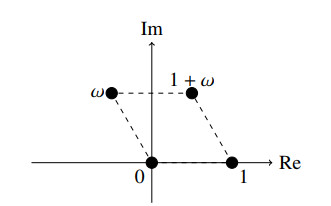
Geometric representation of $ \mathbb{Z}_2[\omega] $ in the complex plane. The four elements form a parallelogram, with addition corresponding to vector addition modulo 2 and multiplication by $ \omega $ corresponding to a $ 120^\circ $ rotation




 DownLoad: