This paper proposes the unit-inverted Dagum distribution (UIDD), a novel three-parameter probability model for analyzing bounded lifetime and reliability data. The UIDD is developed through a transformation of the inverted Dagum distribution onto the unit interval $ (0, 1) $, yielding a flexible model capable of representing diverse distributional shapes and accommodating varying degrees of skewness and tail behavior. The mathematical and statistical properties of the proposed distribution are systematically investigated, including its survival and hazard rate functions, moments, quantile function, order statistics, mean residual life, mean inactivity time, vitality function, and Rényi and Tsallis entropies. Maximum likelihood estimation is employed to estimate the unknown parameters under both complete and right-censored sampling schemes. The finite-sample behavior of the resulting estimators is examined through an extensive Monte Carlo simulation study, with particular attention to their bias and mean squared error. The simulation findings reveal an overall reduction in both measures as the sample size increases, indicating improved estimation accuracy. The practical performance of the UIDD is assessed using a real right-censored lifetime dataset and benchmarked against several established probability distributions. The empirical results demonstrate that the proposed model provides the best fit among the competing distributions according to the selected information criteria and goodness-of-fit measures. These findings establish the UIDD as a promising and versatile alternative for modeling bounded lifetime observations, with potential applications to other unit-interval data, including proportions, rates, and normalized measurements.
Citation: Khaoula Aidi, Amer Ibrahim Al-Omari, Ghadah Alomani. Unit-inverted Dagum distribution: statistical properties, estimation, and applications[J]. AIMS Mathematics, 2026, 11(10): 35502-35528. doi: 10.3934/math.20261377
This paper proposes the unit-inverted Dagum distribution (UIDD), a novel three-parameter probability model for analyzing bounded lifetime and reliability data. The UIDD is developed through a transformation of the inverted Dagum distribution onto the unit interval $ (0, 1) $, yielding a flexible model capable of representing diverse distributional shapes and accommodating varying degrees of skewness and tail behavior. The mathematical and statistical properties of the proposed distribution are systematically investigated, including its survival and hazard rate functions, moments, quantile function, order statistics, mean residual life, mean inactivity time, vitality function, and Rényi and Tsallis entropies. Maximum likelihood estimation is employed to estimate the unknown parameters under both complete and right-censored sampling schemes. The finite-sample behavior of the resulting estimators is examined through an extensive Monte Carlo simulation study, with particular attention to their bias and mean squared error. The simulation findings reveal an overall reduction in both measures as the sample size increases, indicating improved estimation accuracy. The practical performance of the UIDD is assessed using a real right-censored lifetime dataset and benchmarked against several established probability distributions. The empirical results demonstrate that the proposed model provides the best fit among the competing distributions according to the selected information criteria and goodness-of-fit measures. These findings establish the UIDD as a promising and versatile alternative for modeling bounded lifetime observations, with potential applications to other unit-interval data, including proportions, rates, and normalized measurements.

| [1] |
G. Alomani, A. I. Al-Omari, Lomax–Bilal distribution within the Bilal-G family: theoretical properties and applications, Mathematics, 14 (2026), 3120. https://doi.org/10.3390/math14173120 doi: 10.3390/math14173120
|
| [2] |
A. I. Al-Omari, A. R. A. Alanzi, S. S. Alshqaq, The unit two parameters Mirra distribution: reliability analysis, properties, estimation and applications, Alex. Eng. J., 82 (2024), 238–253. https://doi.org/10.1016/j.aej.2024.02.063 doi: 10.1016/j.aej.2024.02.063
|
| [3] |
K. Aidi, A. I. Al-Omari, R. Alsultan, The power Zeghdoudi distribution: properties, estimation and applications to real right censored data, Appl. Sci., 12 (2022), 12081. https://doi.org/10.3390/app122312081 doi: 10.3390/app122312081
|
| [4] |
Y. Wang, B. Zhou, C. Fu, X. Xu, Modeling cure fractions in interval-censored competing risks data: an AFT mixture approach, Electron. Res. Arch., 34 (2026), 6573–6613. https://doi.org/10.3934/era.2026288 doi: 10.3934/era.2026288
|
| [5] |
S. G. Nassr, O. Abo-Kasem, R. H. Khashab, E. Alshawarbeh, S. S. Alshqaq, N. M. Elharoun, Reliability analysis of inverted exponentiated Rayleigh parameters via progressive hybrid censoring data with applications in medical data, PLOS One, 20 (2025), e0336169. https://doi.org/10.1371/journal.pone.0336169 doi: 10.1371/journal.pone.0336169
|
| [6] |
Y. Yu, J. Gong, K. Zhu, Analytical solution for parameter estimation of Weibull distributions with interval-censored data, J. Data Sci. Intell. Syst., 4 (2026), 349–364. https://doi.org/10.47852/bonviewjdsis52024661 doi: 10.47852/bonviewjdsis52024661
|
| [7] |
R. Badwan, R. Pakyari, Analyzing competing risks with progressively type-Ⅱ censored data in Dagum distributions, Axioms, 14 (2025), 508. https://doi.org/10.3390/axioms14070508 doi: 10.3390/axioms14070508
|
| [8] |
A. S. Hassan, G. A. Alomani, A. I. Al-Omari, M. M. Hassan, Modeling engineering and medical lifetime data using a flexible extension of the XShanker distribution under censoring, Sci. Rep., 16 (2026), 24355. https://doi.org/10.1038/s41598-026-52861-5 doi: 10.1038/s41598-026-52861-5
|
| [9] |
E. A. Elsherpieny, A. Abdel-Hakim, Statistical analysis of Alpha-power exponential distribution using unified Hybrid censored data and its applications, Comput. J. Math. Stat. Sci., 4 (2025), 283–315. https://doi.org/10.21608/cjmss.2025.346134.1094 doi: 10.21608/cjmss.2025.346134.1094
|
| [10] |
S. Gündüz, M. Ç. Korkmaz, A new unit distribution based on the unbounded Johnson distribution rule: the unit Johnson SU distribution, Pak. J. Stat. Oper. Res., 16 (2020), 471–490. https://doi.org/10.18187/pjsor.v16i3.3421 doi: 10.18187/pjsor.v16i3.3421
|
| [11] |
I. E. Ragab, N. Alsadat, O. S. Balogun, M. Elgarhy, Unit extended exponential distribution with applications, J. Radiat. Res. Appl. Sci., 17 (2024), 101118. https://doi.org/10.1016/j.jrras.2024.101118 doi: 10.1016/j.jrras.2024.101118
|
| [12] |
S. O. Bashiru, M. Kayid, R. Mahmoud, O. S. Balogun, M. M. A. El-Raouf, A. M. Gemeay, Introducing the unit Zeghdoudi distribution as a novel statistical model for analyzing proportional data, J. Radiat. Res. Appl. Sci., 18 (2025), 101204. https://doi.org/10.1016/j.jrras.2024.101204 doi: 10.1016/j.jrras.2024.101204
|
| [13] |
I. Elbatal, G. Aryal, Transmuted Dagum distribution with applications, Chil. J. Stat., 6 (2015), 31–45. |
| [14] |
S. Sağlam, E. Cankut, K. Karakaya, Unit new two-parameter Aradhana distribution: theory, estimation and applications, J. Sci. Arts, 26 (2026), 49–68. https://doi.org/10.46939/j.sci.arts-26.1-a05 doi: 10.46939/j.sci.arts-26.1-a05
|
| [15] |
A. R. El-Alosey, A. T. Hammad, A. M. Gemeay, A novel unit exponential regression model with improved estimation method under multicollinearity, Comput. Stat., 41 (2026), 70. https://doi.org/10.1007/s00180-026-01741-7 doi: 10.1007/s00180-026-01741-7
|
| [16] |
S. Dey, B. Al-Zahrani, S. Basloom, Dagum distribution: properties and different methods of estimation, Int. J. Stat. Probab., 6 (2017), 74–92. https://doi.org/10.5539/ijsp.v6n2p74 doi: 10.5539/ijsp.v6n2p74
|
| [17] |
A. A. Osi, S. A. Sabo, I. Z. Musa, Inverted Dagum distribution: properties and application to lifetime dataset, Reliab. Theory Appl., 19 (2024), 595–604. |
| [18] |
A. Rényi, On measures of information and entropy, University of California Press, 1961. |
| [19] |
V. Bagdonavicius, M. Nikulin, Chi-squared goodness-of-fit test for right censored data, Int. J. Appl. Math. Stat., 24 (2011), 30–50. |
| [20] |
K. Aidi, S. Dey, D. Kumar, N. Seddik-Ameur, Different classical methods of estimation and chi-squared goodness-of-fit test for unit generalized inverse Weibull distribution, Austrian J. Stat., 50 (2021), 77–100. https://doi.org/10.17713/ajs.v50i5.1181 doi: 10.17713/ajs.v50i5.1181
|
| [21] |
M. Yousof, H. Al-Nefaie, K. Aidi, M. M. Ali, A modified chi-square type test for distributional validity with applications to right censored reliability and medical data, Pak. J. Stat. Oper. Res., 17 (2021), 1121–1133. https://doi.org/10.18187/pjsor.v17i4.3899 doi: 10.18187/pjsor.v17i4.3899
|
| [22] |
A. M. Isa, S. O. Bashiru, A. Kaigama, A. A. Khalaf, Topp-Leone exponentiated Burr XII distribution: theory and application to real-life data sets, Iraqi Stat. J., 1 (2024), 63–72. https://doi.org/10.62933/fsf12e55 doi: 10.62933/fsf12e55
|
| [23] |
V. Ravi, P. D. Gilbert, BB: an R package for solving a large system of nonlinear equations and for optimizing a high-dimensional nonlinear objective function, J. Stat. Softw., 32 (2009), 1–26. https://doi.org/10.18637/jss.v032.i04 doi: 10.18637/jss.v032.i04
|
| [24] |
K. Xu, M. Xie, L. C. Tang, S. L. Ho, Application of neural networks in forecasting engine systems reliability, Appl. Soft Comput., 2 (2003), 255–268. https://doi.org/10.1016/s1568-4946(02)00059-5 doi: 10.1016/s1568-4946(02)00059-5
|
| [25] |
M. J. Crowder, A. C. Kimber, R. L. Smith, T. J. Sweeting, Statistical analysis of reliability data, Chapman & Hall/CRC, 1991. Avaible from: https://api.pageplace.de/preview/DT0400.9781351414623_A31720786/preview-9781351414623_A31720786.pdf. |
Figures(6) / Tables(5)

Khaoula Aidi, Amer Ibrahim Al-Omari, Ghadah Alomani. Unit-inverted Dagum distribution: statistical properties, estimation, and applications[J]. AIMS Mathematics, 2026, 11(10): 35502-35528. doi: 10.3934/math.20261377

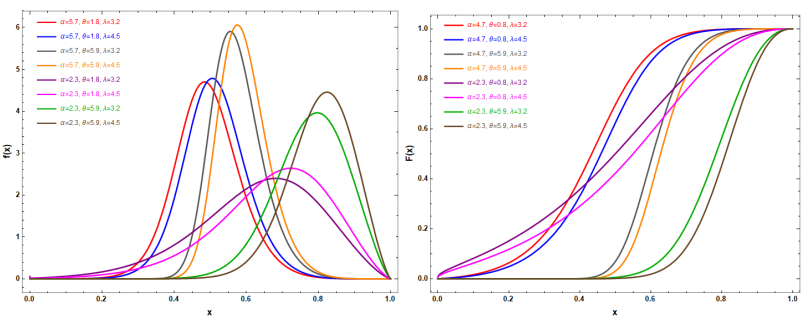
The PDF and CDF plots of the UIDD for some parameter values
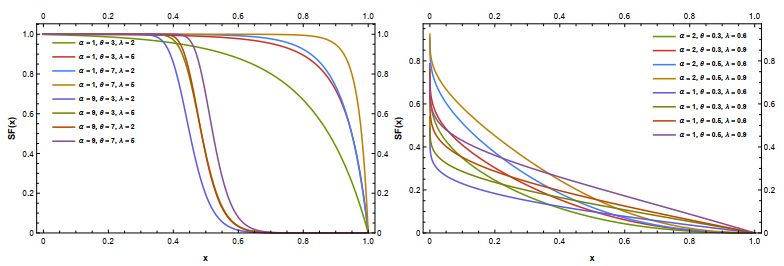
The SF plots of the UIDD for some parameter values
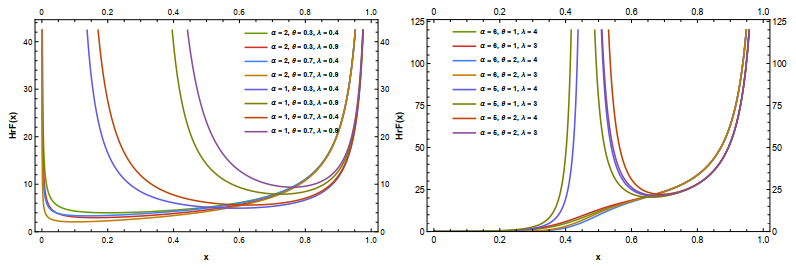
The HrF plots of the UIDD for some parameter values
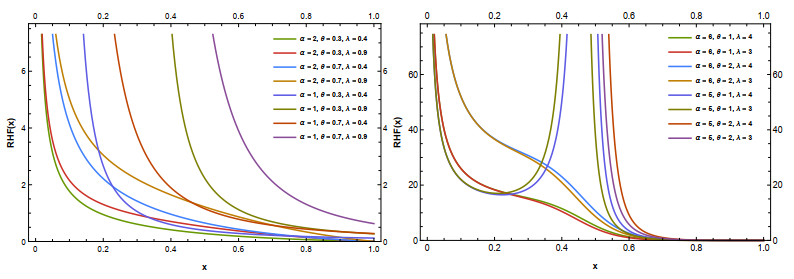
The RHF plots of the UIDD for some parameter values
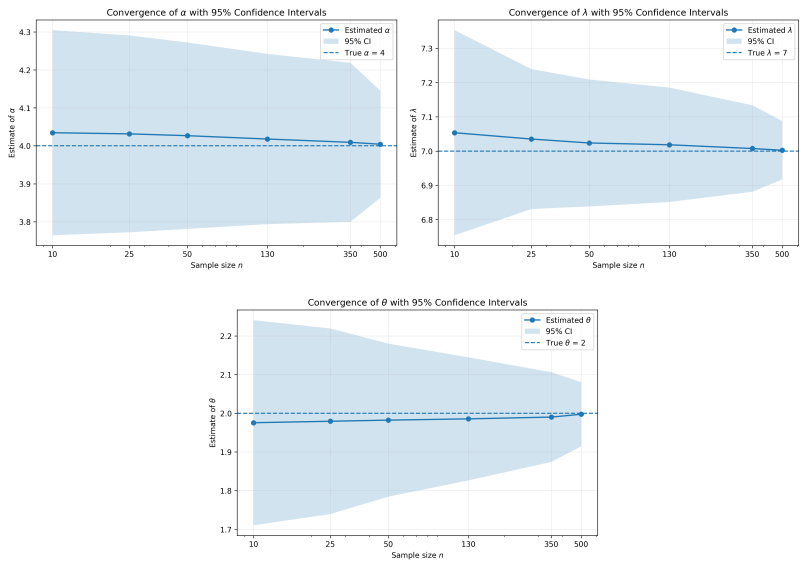
Plot convergence graphs of the estimators vs. the true parameters with a 95% CI
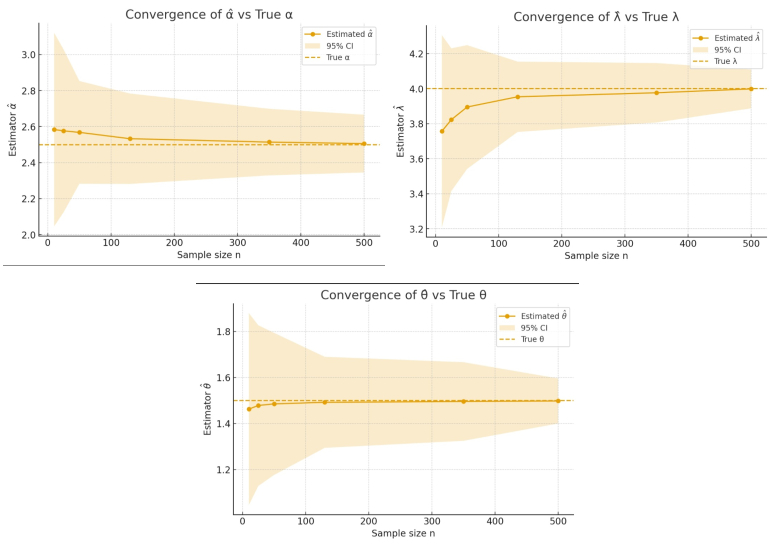
Plot convergence graphs of the estimators vs. the true parameters with 95% CI




 DownLoad: