This paper develops a game-theoretic framework for multiple-attribute group decision-making (MAGDM) under an interval-valued intuitionistic fuzzy (IVIF) environment. First, a generalized score function (GSF) is proposed for intuitionistic fuzzy numbers (IFNs) and extended to interval-valued intuitionistic fuzzy numbers (IVIFNs). By incorporating indeterminacy through two flexible parameters, the GSF improves the discrimination and sensitivity of alternative evaluations under uncertain information. Its effectiveness is validated through seven benchmark cases in which the existing score and accuracy functions fail to distinguish the considered IFNs and IVIFNs. In all cases, the GSF yields distinct rankings, resolving the ambiguities. An IVIF MAGDM algorithm is then developed for problems with unknown attribute weights. The aggregated IVIF decision matrix is formulated as the payoff matrix of a two-player zero-sum matrix game (TMG), enabling determination of the attribute weights from assessments of multiple decision-makers. The game models are defined for membership intervals excluding 1 and nonmembership intervals excluding 0, while these boundary cases lie outside the admissible domain of the formulation. An IVIF expected score function is introduced to evaluate the overall performance of alternatives, followed by the GSF to obtain their final ranking. The framework preserves the IVIF structure throughout the decision-making process, with scalarization restricted to the final ranking stage, thereby retaining the inherent uncertainty and hesitation of the original decision assessments. The applicability of the approach is demonstrated through a sustainable air-conditioning system selection problem. Comparative analysis with four existing approaches shows exact agreement with one method and slight differences from the others. Sensitivity analysis with respect to the preference parameter $ \omega $ confirms that the obtained ranking remains unchanged for $ \omega = 0.2 $, $ 0.5 $, and $ 0.8 $, indicating 100% ranking stability. These findings demonstrate the discrimination capability of the GSF and the robustness and reliability of the IVIF MAGDM framework.
Citation: Sandeep Kumar, Reshu Tyagi, Saiful R Mondal. Advancing group decision-making with an interval-valued intuitionistic fuzzy game model and a novel score function: application to sustainable AC system ranking[J]. AIMS Mathematics, 2026, 11(10): 35156-35199. doi: 10.3934/math.20261367
This paper develops a game-theoretic framework for multiple-attribute group decision-making (MAGDM) under an interval-valued intuitionistic fuzzy (IVIF) environment. First, a generalized score function (GSF) is proposed for intuitionistic fuzzy numbers (IFNs) and extended to interval-valued intuitionistic fuzzy numbers (IVIFNs). By incorporating indeterminacy through two flexible parameters, the GSF improves the discrimination and sensitivity of alternative evaluations under uncertain information. Its effectiveness is validated through seven benchmark cases in which the existing score and accuracy functions fail to distinguish the considered IFNs and IVIFNs. In all cases, the GSF yields distinct rankings, resolving the ambiguities. An IVIF MAGDM algorithm is then developed for problems with unknown attribute weights. The aggregated IVIF decision matrix is formulated as the payoff matrix of a two-player zero-sum matrix game (TMG), enabling determination of the attribute weights from assessments of multiple decision-makers. The game models are defined for membership intervals excluding 1 and nonmembership intervals excluding 0, while these boundary cases lie outside the admissible domain of the formulation. An IVIF expected score function is introduced to evaluate the overall performance of alternatives, followed by the GSF to obtain their final ranking. The framework preserves the IVIF structure throughout the decision-making process, with scalarization restricted to the final ranking stage, thereby retaining the inherent uncertainty and hesitation of the original decision assessments. The applicability of the approach is demonstrated through a sustainable air-conditioning system selection problem. Comparative analysis with four existing approaches shows exact agreement with one method and slight differences from the others. Sensitivity analysis with respect to the preference parameter $ \omega $ confirms that the obtained ranking remains unchanged for $ \omega = 0.2 $, $ 0.5 $, and $ 0.8 $, indicating 100% ranking stability. These findings demonstrate the discrimination capability of the GSF and the robustness and reliability of the IVIF MAGDM framework.

| [1] |
T. Li, L. Zhang, Z. Zhang, The consistency and consensus analysis for group decision-making with incomplete linguistic interval-valued intuitionistic fuzzy preference relations, Appl. Intell., 53 (2023), 23500–23521. https://doi.org/10.1007/s10489-023-04605-5 doi: 10.1007/s10489-023-04605-5
|
| [2] |
Y. Qin, Q. Qi, P. Shi, P. J. Scott, X. Jiang, A novel weighted averaging operator of linguistic interval-valued intuitionistic fuzzy numbers for cognitively inspired decision-making, Cogn. Comput., 15 (2023), 2101–2119. https://doi.org/10.1007/s12559-023-10167-y doi: 10.1007/s12559-023-10167-y
|
| [3] |
K. T. Atanassov, lntuitionistic fuzzy sets, Fuzzy Set. Syst., 20 (1986), 87–96. https://doi.org/10.1016/S0165-0114(86)80034-3 |
| [4] |
K. Atanassov, G. Gargov, Interval-valued intuitionistic fuzzy sets, Fuzzy Set. Syst., 31 (1989), 343–349. https://doi.org/10.1016/0165-0114(89)90205-4 doi: 10.1016/0165-0114(89)90205-4
|
| [5] |
S.-J. Chen, C.-L. Hwang, Fuzzy multiple attribute decision making: methods and applications, Heidelberg: Springer, 1992. https://doi.org/10.1007/978-3-642-46768-4 |
| [6] |
Y.-W. Chen, M. Larbani, Two-person zero-sum game approach for fuzzy multiple attribute decision making problems, Fuzzy Set. Syst., 157 (2006), 34–51. https://doi.org/10.1016/j.fss.2005.06.004 doi: 10.1016/j.fss.2005.06.004
|
| [7] |
J. H. Park, I. Y. Park, Y. C. Kwun, X. Tan, Extension of the topsis method for decision making problems under interval-valued intuitionistic fuzzy environment, Appl. Math. Model., 35 (2011), 2544–2556. https://doi.org/10.1016/j.apm.2010.11.025 doi: 10.1016/j.apm.2010.11.025
|
| [8] |
A. Al-Barakati, P. Rani, Assessment of healthcare waste treatment methods using an interval-valued intuitionistic fuzzy double normalization-based multiple aggregation approach, Environ. Dev. Sustain., 26 (2024), 19397–19424. https://doi.org/10.1007/s10668-023-03154-8 doi: 10.1007/s10668-023-03154-8
|
| [9] |
L. Bian, C. Che, Enhanced combined techniques for interval-valued intuitionistic fuzzy multiple-attribute group decision-making and applications to quality evaluation of large-scale multi-view 3d reconstruction, IEEE Access, 11 (2023), 120502–120515. https://doi.org/10.1109/ACCESS.2023.3327310 doi: 10.1109/ACCESS.2023.3327310
|
| [10] |
N. Chai, W. Zhou, Z. Jiang, Sustainable supplier selection using an intuitionistic and interval-valued fuzzy mcdm approach based on cumulative prospect theory, Inform. Sciences, 626 (2023), 710–737. https://doi.org/10.1016/j.ins.2023.01.070 doi: 10.1016/j.ins.2023.01.070
|
| [11] |
J. Xu, J. Y. Dong, S. P. Wan, J. Gao, Multiple attribute decision making with triangular intuitionistic fuzzy numbers based on zero-sum game approach, Iran. J. Fuzzy Syst., 16 (2019), 97–112. https://doi.org/10.22111/ijfs.2019.4648 doi: 10.22111/ijfs.2019.4648
|
| [12] |
A. Singh, A. Gupta, A. Mehra, Matrix games with 2-tuple linguistic information, Ann. Oper. Res., 287 (2020), 895–910. https://doi.org/10.1007/s10479-018-2810-6 doi: 10.1007/s10479-018-2810-6
|
| [13] |
S. Kumar, M. Kumar, A game theoretic approach to solve multiple group decision making problems with interval-valued intuitionistic fuzzy decision matrices, Int. J. Manag. Sci. Eng. Manag., 16 (2021), 34–42. https://doi.org/10.1080/17509653.2020.1852125 doi: 10.1080/17509653.2020.1852125
|
| [14] |
Z. Wang, K. W. Li, J. Xu, A mathematical programming approach to multi-attribute decision making with interval-valued intuitionistic fuzzy assessment information, Expert Syst. Appl., 38 (2011), 12462–12469. https://doi.org/10.1016/j.eswa.2011.04.027 doi: 10.1016/j.eswa.2011.04.027
|
| [15] |
S.-P. Wan, D.-F. Li, Fuzzy mathematical programming approach to heterogeneous multiattribute decision-making with interval-valued intuitionistic fuzzy truth degrees, Inform. Sciences, 325 (2015), 484–503. https://doi.org/10.1016/j.ins.2015.07.014 doi: 10.1016/j.ins.2015.07.014
|
| [16] |
H. Garg, A new generalized improved score function of interval-valued intuitionistic fuzzy sets and applications in expert systems, Appl. Soft Comput., 38 (2016), 988–999. https://doi.org/10.1016/j.asoc.2015.10.040 doi: 10.1016/j.asoc.2015.10.040
|
| [17] |
Y. Yang, Z.-S. Chen, Y.-L. Li, H.-X. Lv, Commentary on "a new generalized improved score function of interval-valued intuitionistic fuzzy sets and applications in expert systems", Appl. Soft Comput., 49 (2016), 611–615. https://doi.org/10.1016/j.asoc.2016.08.050 doi: 10.1016/j.asoc.2016.08.050
|
| [18] |
Z.-Y. Bai, An interval-valued intuitionistic fuzzy topsis method based on an improved score function, Sci. World J., 2013 (2013), 879089. https://doi.org/10.1155/2013/879089 doi: 10.1155/2013/879089
|
| [19] |
S.-M. Chen, Z.-C. Huang, Multiattribute decision making based on interval-valued intuitionistic fuzzy values and linear programming methodology, Inform. Sciences, 381 (2017), 341–351. https://doi.org/10.1016/j.ins.2016.11.010 doi: 10.1016/j.ins.2016.11.010
|
| [20] |
C. Y. Wang, S. M. Chen, Multiple attribute decision-making based on interval-valued intuitionistic fuzzy sets, linear programming methodology, and the extended topsis method, Inform. Sciences, 397–398 (2017), 155–167. https://doi.org/10.1016/j.ins.2017.02.045 |
| [21] |
C.-Y. Wang, S.-M. Chen, An improved multiattribute decision making method based on new score function of interval-valued intuitionistic fuzzy values and linear programming methodology, Inform. Sciences, 411 (2017), 176–184. https://doi.org/10.1016/j.ins.2017.05.022 doi: 10.1016/j.ins.2017.05.022
|
| [22] |
K. Kumar, H. Garg, Topsis method based on the connection number of set pair analysis under interval-valued intuitionistic fuzzy set environment, Comp. Appl. Math., 37 (2018), 1319–1329. https://doi.org/10.1007/s40314-016-0402-0 doi: 10.1007/s40314-016-0402-0
|
| [23] |
V. L. G. Nayagam, S. Jeevaraj, P. Dhanasekaran, An intuitionistic fuzzy multi-criteria decision-making method based on non-hesitance score for interval-valued intuitionistic fuzzy sets, Soft Comput., 21 (2017), 7077–7082. https://doi.org/10.1007/s00500-016-2249-0 doi: 10.1007/s00500-016-2249-0
|
| [24] |
J. Selvaraj, A. Majumdar, A new ranking method for interval-valued intuitionistic fuzzy numbers and its application in multi-criteria decision-making, Mathematics, 9 (2021), 2647. https://doi.org/10.3390/math9212647 doi: 10.3390/math9212647
|
| [25] |
S. Kumar, S. Rani, M. Kumar, A new order function for interval-valued intuitionistic fuzzy numbers and its application in group decision making, Fuzzy Inform. Eng., 13 (2021), 111–126. https://doi.org/10.1080/16168658.2021.1936961 doi: 10.1080/16168658.2021.1936961
|
| [26] |
S.-M. Chen, C.-A. Tsai, Multiattribute decision making using novel score function of interval-valued intuitionistic fuzzy values and the means and the variances of score matrices, Inform. Sciences, 577 (2021), 748–768. https://doi.org/10.1016/j.ins.2021.07.055 doi: 10.1016/j.ins.2021.07.055
|
| [27] |
Z. Wang, F. Xiao, W. Ding, Interval-valued intuitionistic fuzzy jenson-shannon divergence and its application in multi-attribute decision making, Appl. Intell., 52 (2022), 16168–16184. https://doi.org/10.1007/s10489-022-03347-0 doi: 10.1007/s10489-022-03347-0
|
| [28] |
S.-M. Chen, M.-H. Hsu, Multiple attribute decision making based on novel score function of interval-valued intuitionistic fuzzy values, score matrix, and nonlinear programming model, Inform. Sciences, 645 (2023), 119332. https://doi.org/10.1016/j.ins.2023.119332 doi: 10.1016/j.ins.2023.119332
|
| [29] |
J. Jana, S. K. Roy, Linguistic pythagorean hesitant fuzzy matrix game and its application in multi-criteria decision making, Appl. Intell., 53 (2023), 1–22. https://doi.org/10.1007/s10489-022-03442-2 doi: 10.1007/s10489-022-03442-2
|
| [30] |
Y. Wu, M. Chen, M. Chadli, Zero-sum-game-based distributed fuzzy adaptive self-triggered control of swarm uavs under intermittent communication and dos attacks, IEEE Trans. Fuzzy Syst., 32 (2024), 5371–5384. https://doi.org/10.1109/TFUZZ.2024.3423709 doi: 10.1109/TFUZZ.2024.3423709
|
| [31] |
S. Jiafu, D. Wang, B. Xu, F. Zhang, N. Zhang, An interval-valued intuitionistic fuzzy group decision-making method for evaluating online knowledge payment products, Appl. Soft Comput., 150 (2024), 111046. https://doi.org/10.1016/j.asoc.2023.111046 doi: 10.1016/j.asoc.2023.111046
|
| [32] |
S. S. Nirmalsingh, P. J. Robinson, Solving madm problems based on matrix games with a new defuzzification method for triangular intuitionistic fuzzy numbers, International Journal for Research in Applied Science and Engineering Technology, 12 (2024), 971–979. https://doi.org/10.22214/ijraset.2024.64250 doi: 10.22214/ijraset.2024.64250
|
| [33] |
Y. Deng, W. Wu, S. Tong, Model-free policy iteration optimal control of fuzzy systems via a two-player zero-sum game, Int. J. Syst. Sci., 56 (2025), 3958–3970. https://doi.org/10.1080/00207721.2025.2480192 doi: 10.1080/00207721.2025.2480192
|
| [34] |
Y. Zeng, Z. A. Hussein, M. H. Chyad, A. Farhadi, J. Yu, H. Rahbarimagham, Integrating type-2 fuzzy logic controllers with digital twin and neural networks for advanced hydropower system management, Sci. Rep., 15 (2025), 5140. https://doi.org/10.1038/s41598-025-89866-5 doi: 10.1038/s41598-025-89866-5
|
| [35] |
S. Kumar, H. Garg, A novel two-level fuzzy set theoretic approach to solve multi-objective matrix games and its applications, Ann. Oper. Res., in press. https://doi.org/10.1007/s10479-025-06524-9 |
| [36] |
X. Xie, S. Sathasivam, H. Ma, An interval-valued intuitionistic fuzzy group decision-making approach based on projection measurement extended vikor for patent quality evaluation, PLoS One, 20 (2025), e0323019. https://doi.org/10.1371/journal.pone.0323019 doi: 10.1371/journal.pone.0323019
|
| [37] |
X. Xie, S. Sathasivam, Research on the interval–valued intuitionistic fuzzy multi–attribute decision–making model based on topsis extended by projection measure, International Journal of Information Technology & Decision Making, 25 (2026), 735–763. https://doi.org/10.1142/S021962202550066 doi: 10.1142/S021962202550066
|
| [38] |
X. Wu, Q. Liu, L. Liu, M.-S. Yang, X. Zhang, New jensen–shannon divergence measures for intuitionistic fuzzy sets with the construction of a parametric intuitionistic fuzzy topsis, Complex Intell. Syst., 11 (2025), 134. https://doi.org/10.1007/s40747-024-01761-0 doi: 10.1007/s40747-024-01761-0
|
| [39] |
Ö. N. Bilişik, N. H. Duman, E. Taş, A novel interval-valued intuitionistic fuzzy critic-topsis methodology: an application for transportation mode selection problem for a glass production company, Expert Syst. Appl., 235 (2024), 121134. https://doi.org/10.1016/j.eswa.2023.121134 doi: 10.1016/j.eswa.2023.121134
|
| [40] |
Y. Qin, S. R. M. Hashim, J. Sulaiman, A new distance measure and corresponding topsis method for interval-valued intuitionistic fuzzy sets in multi-attribute decision-making, AIMS Math., 8 (2023), 26459–26483. https://doi.org/10.3934/math.20231351 doi: 10.3934/math.20231351
|
| [41] |
M. Arshi, A. Hadi-Vencheh, A. Aazami, T. Hamlehvar, The multiple attribute group decision-making problems with interval-valued intuitionistic fuzzy numbers: a linear programming approach, Journal of Optimization in Industrial Engineering, 18 (2025), 151–161. https://doi.org/10.71720/joie.2025.1196756 doi: 10.71720/joie.2025.1196756
|
| [42] |
G.-F. Yu, D.-F. Li, A novel intuitionistic fuzzy goal programming method for heterogeneous madm with application to regional green manufacturing level evaluation under multi-source information, Comput. Ind. Eng., 174 (2022), 108796. https://doi.org/10.1016/j.cie.2022.108796 doi: 10.1016/j.cie.2022.108796
|
| [43] |
W. Wang, X. Liu, An extended linmap method for multi-attribute group decision making under interval-valued intuitionistic fuzzy environment, Procedia Computer Science, 17 (2013), 490–497. https://doi.org/10.1016/j.procs.2013.05.063 doi: 10.1016/j.procs.2013.05.063
|
| [44] |
D.-F. Li, G.-H. Chen, Z.-G. Huang, Linear programming method for multiattribute group decision making using if sets, Inform. Sciences, 180 (2010), 1591–1609. https://doi.org/10.1016/j.ins.2010.01.017 doi: 10.1016/j.ins.2010.01.017
|
| [45] |
S. Kumar, R. Tyagi, A novel score function for picture fuzzy numbers and its based entropy method to multiple attribute decision-making, In: Soft computing for problem solving, Singapore: Springer, 2023,719–729. https://doi.org/10.1007/978-981-19-6525-8_55 |
| [46] |
J. Zheng, M. Dong, Interval-valued intuitionistic fuzzy multi-attribute decision-making based on entropy and bidirectional projection, Int. J. Comput. Intell. Syst., 18 (2025), 39. https://doi.org/10.1007/s44196-025-00763-1 doi: 10.1007/s44196-025-00763-1
|
| [47] |
J. Wang, Q. Cai, G. Wei, N. Liao, An extended edas approach based on cumulative prospect theory for multiple attributes group decision making with interval-valued intuitionistic fuzzy information, Informatica, 35 (2024), 421–452. https://doi.org/10.15388/24-INFOR547 doi: 10.15388/24-INFOR547
|
| [48] |
C. Suo, X. Li, Y. Li, Distance-based knowledge measure and entropy for interval-valued intuitionistic fuzzy sets, Mathematics, 11 (2023), 3468. https://doi.org/10.3390/math11163468 doi: 10.3390/math11163468
|
| [49] |
C. Yue, R. Huang, D. Towey, Z. Xian, G. Wu, An entropy-based group decision-making approach for software quality evaluation, Expert Syst. Appl., 238 (2024), 121979. https://doi.org/10.1016/j.eswa.2023.121979 doi: 10.1016/j.eswa.2023.121979
|
| [50] |
S. Fu, Y.-Z. Xiao, H.-J. Zhou, Interval-valued intuitionistic fuzzy multi-attribute group decision-making method considering risk preference of decision-makers and its application, Sci. Rep., 12 (2022), 11597. https://doi.org/10.1038/s41598-022-15815-1 doi: 10.1038/s41598-022-15815-1
|
| [51] |
A. Ohlan, Novel entropy and distance measures for interval-valued intuitionistic fuzzy sets with application in multi-criteria group decision-making, Int. J. Gen. Syst., 51 (2022), 413–440. https://doi.org/10.1080/03081079.2022.2036138 doi: 10.1080/03081079.2022.2036138
|
| [52] |
S. Kumar, R. Tyagi, A vikor approach based on connection numbers for linguistic intuitionistic fuzzy decision-making: applications to coal mine safety and cyclone disaster management, Transactions on Fuzzy Sets and Systems, 6 (2027), 138–156. https://doi.org/10.71602/tfss.2027.1214680 doi: 10.71602/tfss.2027.1214680
|
| [53] |
C. Yue, Picture fuzzy normalized projection and extended vikor approach to software reliability assessment, Appl. Soft Comput., 88 (2020), 106056. https://doi.org/10.1016/j.asoc.2019.106056 doi: 10.1016/j.asoc.2019.106056
|
| [54] |
R. Baki, B. Ecer, A. Aktas, A decision framework for supplier selection in digital supply chains of e-commerce platforms using interval-valued intuitionistic fuzzy vikor methodology, J. Theor. Appl. Electron. Commer. Res., 20 (2025), 23. https://doi.org/10.3390/jtaer20010023 doi: 10.3390/jtaer20010023
|
| [55] |
Y. Huang, M. Tang, Enhanced exptodim framework based on vikor for interval-valued intuitionistic fuzzy multiple-attribute group decision-making and applications to for college english blended teaching quality evaluation, Soft Comput., 29 (2025), 4559–4570. https://doi.org/10.1007/s00500-025-10778-7 doi: 10.1007/s00500-025-10778-7
|
| [56] |
F. Dammak, L. Baccour, A. M. Alimi, A new ranking method for topsis and vikor under interval valued intuitionistic fuzzy sets and possibility measures, Journal of Intelligent & Fuzzy Systems, 38 (2020), 4459–4469. https://doi.org/10.3233/JIFS-191223 doi: 10.3233/JIFS-191223
|
| [57] |
X. Xie, S. Sathasivam, H. Ma, Z. Yue, A novel group decision-making method based on extended vikor and interval-valued intuitionistic fuzzy, IEEE Access, 12 (2024), 153330–153345. https://doi.org/10.1109/ACCESS.2024.3471871 doi: 10.1109/ACCESS.2024.3471871
|
| [58] |
H. A. Dağıstanlı, An interval-valued intuitionistic fuzzy VIKOR approach for R & D project selection in defense industry investment decisions, Journal of Soft Computing and Decision Analytics, 2 (2024), 1–13. https://doi.org/10.31181/jscda21202428 doi: 10.31181/jscda21202428
|
| [59] |
S. Kumar, S. R. Mondal, R. Tyagi, A novel p-norm-based ranking algorithm for multiple-attribute decision making using interval-valued intuitionistic fuzzy sets and its applications, Axioms, 14 (2025), 722. https://doi.org/10.3390/axioms14100722 doi: 10.3390/axioms14100722
|
| [60] |
S. Kumar, H. Garg, R. Tyagi, Two decision-making algorithms for interval-valued intuitionistic fuzzy information with generalized score function and its application to prioritizing sustainable cryptocurrencies, Applied and Computational Mathematics, 25 (1) (2026), 139–169. https://doi.org/10.30546/1683-6154.25.1.2026.139 |
| [61] |
S. Kumar, R. Tyagi, Set pair analysis based algorithm for ivif decision-making with mean and variance, In: Optimization techniques and applications, Singapore: Springer, 2026,199–211. https://doi.org/10.1007/978-981-95-5044-9_15 |
| [62] |
S.-M. Chen, C.-Y. Hsieh, X.-Y. Zou, Multiattribute decision making system based on interval-valued intuitionistic fuzzy weights of attributes, Int. J. Pattern Recogn. Artif. Intell., 40 (2026), 2659002. https://doi.org/10.1142/S0218001426590020 doi: 10.1142/S0218001426590020
|
| [63] |
K. Patra, S. Sen, S. K. Mondal, An improved similarity measure for interval-valued intuitionistic fuzzy numbers and its application to multi-attribute decision-making problem, Mathematics, 14 (2026), 374. https://doi.org/10.3390/math14020374 doi: 10.3390/math14020374
|
| [64] |
Z. S. Xu, Methods for aggregating interval-valued intuitionistic fuzzy information and their application to decision-making, Control and Decision, 22 (2007), 215–219. |
| [65] |
G. W. Wei, X. R. Wang, Some geometric aggregation operators on interval-valued intuitionistic fuzzy sets and their application to group decision-making, In: 2007 International conference on computational intelligence and security (CIS 2007), Harbin, China, 2007,495–499. https://doi.org/10.1109/CIS.2007.84 |
| [66] |
R. Yao, H. Guo, Multiattribute group decision making based on novel score function considering both the angle and fuzzy information under interval-valued intuitionistic fuzzy environment, Inform. Sciences, 644 (2023), 119233. https://doi.org/10.1016/j.ins.2023.119233 doi: 10.1016/j.ins.2023.119233
|
| [67] |
D.-F. Li, Mathematical-programming approach to matrix games with payoffs represented by atanassov's interval-valued intuitionistic fuzzy sets, IEEE Trans. Fuzzy Syst., 18 (2010), 1112–1128. https://doi.org/10.1109/TFUZZ.2010.2065812 doi: 10.1109/TFUZZ.2010.2065812
|
| [68] |
Z. S. Xu, Intuitionistic fuzzy aggregation operators, IEEE Trans. Fuzzy Syst., 15 (2007), 1179–1187. https://doi.org/10.1109/TFUZZ.2006.890678 doi: 10.1109/TFUZZ.2006.890678
|
| [69] |
S.-M. Chen, J.-M. Tan, Handling multicriteria fuzzy decision-making problems based on vague set theory, Fuzzy Set. Syst., 67 (1994), 163–172. https://doi.org/10.1016/0165-0114(94)90084-1 doi: 10.1016/0165-0114(94)90084-1
|
| [70] |
D. H. Hong, C.-H. Choi, Multicriteria fuzzy decision-making problems based on vague set theory, Fuzzy Set. Syst., 114 (2000), 103–113. https://doi.org/10.1016/S0165-0114(98)00271-1 doi: 10.1016/S0165-0114(98)00271-1
|
| [71] |
J. H. Park, K. M. Lim, J. Park, Y. C. Kwun, Distances between interval-valued intuitionistic fuzzy sets, J. Phys.: Conf. Ser., 96 (2008), 012089. https://doi.org/10.1088/1742-6596/96/1/012089 doi: 10.1088/1742-6596/96/1/012089
|
| [72] |
Z. S. Xu, J. Chen, On geometric aggregation over interval-valued intuitionistic fuzzy information, In: Fourth international conference on fuzzy systems and knowledge discovery (FSKD 2007), Haikou, China, 2007,466–471. https://doi.org/10.1109/FSKD.2007.427 |
| [73] |
J. Ye, Multicriteria fuzzy decision-making method based on a novel accuracy function under interval-valued intuitionistic fuzzy environment, Expert Syst. Appl., 36 (2009), 6899–6902. https://doi.org/10.1016/j.eswa.2008.08.042 doi: 10.1016/j.eswa.2008.08.042
|
| [74] |
V. L. G. Nayagam, S. Muralikrishnan, G. Sivaraman, Multi-criteria decision-making method based on interval-valued intuitionistic fuzzy sets, Expert Syst. Appl., 38 (2011), 1464–1467. https://doi.org/10.1016/j.eswa.2010.07.055 doi: 10.1016/j.eswa.2010.07.055
|
| [75] |
R. D. Luce, H. Raiffa, Games and decisions: introduction and critical survey, New York: John Wiley & Sons, 1957. |
| [76] |
Z. Xu, An overview of methods for determining owa weights, Int. J. Intell. Syst., 20 (2005) 843–865. https://doi.org/10.1002/int.20097 |
| [77] |
R. R. Yager, On ordered weighted averaging aggregation operators in multicriteria decision-making, IEEE Trans. Syst. Man Cyber., 18 (1988), 183–190. https://doi.org/10.1109/21.87068 doi: 10.1109/21.87068
|
| [78] |
S. Cherif, N. Baklouti, H. Hagras, A. M. Alimi, Novel intuitionistic-based interval type-2 fuzzy similarity measures with application to clustering, IEEE Trans. Fuzzy Syst., 30 (2022), 1260–1271. https://doi.org/10.1109/TFUZZ.2021.3057697 doi: 10.1109/TFUZZ.2021.3057697
|
Figures(1) / Tables(21)

Sandeep Kumar, Reshu Tyagi, Saiful R Mondal. Advancing group decision-making with an interval-valued intuitionistic fuzzy game model and a novel score function: application to sustainable AC system ranking[J]. AIMS Mathematics, 2026, 11(10): 35156-35199. doi: 10.3934/math.20261367

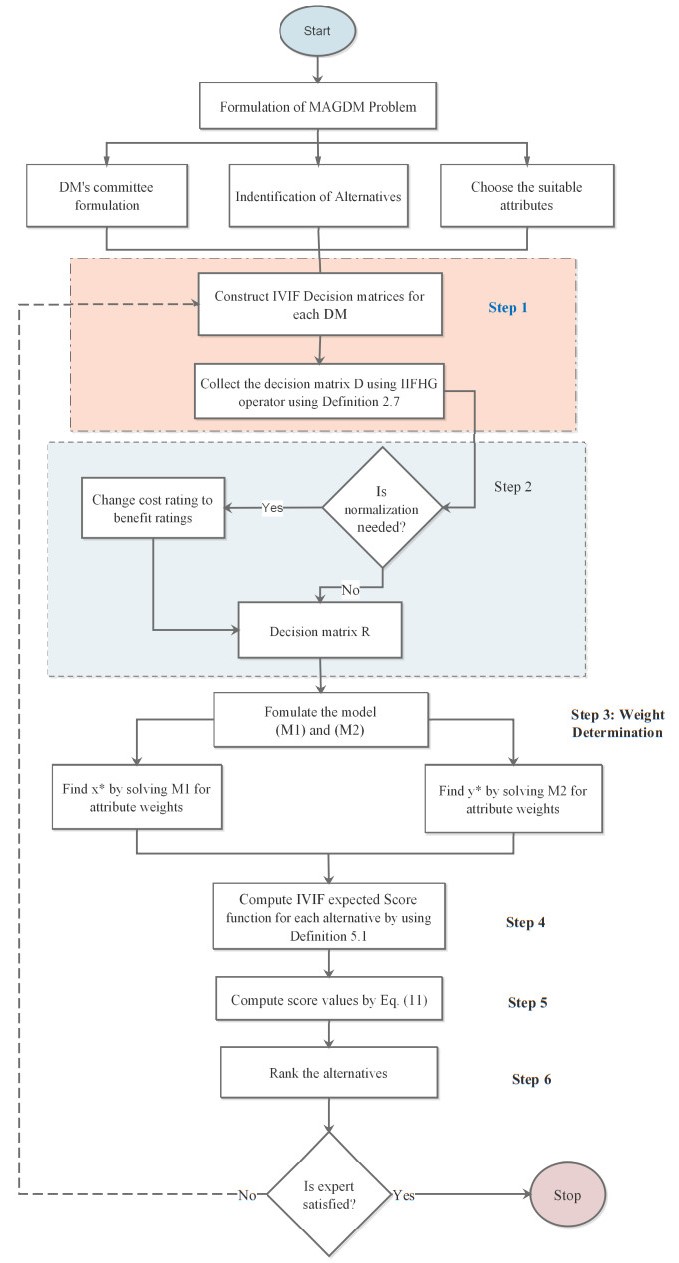
Flowchart of the proposed methodology




 DownLoad: