This study proposes VarFedFuse, an optimization-driven Bayesian federated variational fusion framework for privacy-preserving and uncertainty-aware drought monitoring from heterogeneous environmental observations. The framework integrates local Bayesian variational inference, uncertainty-weighted federated posterior aggregation, graph-attention-based adaptive sensor weighting, and transformer-based temporal encoding. Using the law of total variance, the framework further decomposes predictive uncertainty into data uncertainty, uncertainty propagated through the fused latent drought representation, and model-parameter uncertainty, providing non-overlapping, interpretable sources of prediction uncertainty. We evaluated the proposed framework using multi-source environmental observations collected from five drought-prone regions representing North America, Western Europe, the Mediterranean, Central Asia, and Sub-Saharan Africa. We used multi-source observations of the vegetation condition, land-surface temperature, precipitation, temperature, potential evapotranspiration, and soil moisture, along with Standardized Precipitation Evapotranspiration Index (SPEI)-based drought conditions as the prediction target. VarFedFuse was evaluated against centralized deep fusion (CDF), federated averaging (FedAvg), Bayesian committee machine (BCM), uncertainty-aware federated learning (UAFL), and variational federated learning (VFL). VarFedFuse achieved an RMSE of $ 0.48\pm0.03 $, classification accuracy of $ 74.8\pm0.9\% $, and extreme-drought recall of $ 78.2\pm1.7\% $, compared with $ 0.53\pm0.02 $, $ 72.1\pm1.0\% $, and $ 76.3\pm2.0\% $, respectively, for the strongest competing VFL baseline. It also achieved an expected calibration error of $ 0.041\pm0.003 $ and a negative log-likelihood of $ 0.89\pm0.02 $. Predictive uncertainty increased during drought transitions and under lower sensor agreement, while adaptive fusion assigned greater influence to the most informative and reliable sensing modalities as drought evolved. These results demonstrate that VarFedFuse provides a unified framework for accurate drought assessment, calibrated uncertainty quantification, adaptive multi-sensor interpretation, and privacy-preserving distributed environmental-monitoring.
Citation: Hasnain Iftikhar, Paulo Canas Rodrigues, Osama Abdulaziz Alamri, Basim S. O. Alsaedi. VarFedFuse: An optimization-driven Bayesian federated variational fusion framework for uncertainty-aware multi-sensor drought monitoring[J]. AIMS Mathematics, 2026, 11(10): 35119-35155. doi: 10.3934/math.20261366
This study proposes VarFedFuse, an optimization-driven Bayesian federated variational fusion framework for privacy-preserving and uncertainty-aware drought monitoring from heterogeneous environmental observations. The framework integrates local Bayesian variational inference, uncertainty-weighted federated posterior aggregation, graph-attention-based adaptive sensor weighting, and transformer-based temporal encoding. Using the law of total variance, the framework further decomposes predictive uncertainty into data uncertainty, uncertainty propagated through the fused latent drought representation, and model-parameter uncertainty, providing non-overlapping, interpretable sources of prediction uncertainty. We evaluated the proposed framework using multi-source environmental observations collected from five drought-prone regions representing North America, Western Europe, the Mediterranean, Central Asia, and Sub-Saharan Africa. We used multi-source observations of the vegetation condition, land-surface temperature, precipitation, temperature, potential evapotranspiration, and soil moisture, along with Standardized Precipitation Evapotranspiration Index (SPEI)-based drought conditions as the prediction target. VarFedFuse was evaluated against centralized deep fusion (CDF), federated averaging (FedAvg), Bayesian committee machine (BCM), uncertainty-aware federated learning (UAFL), and variational federated learning (VFL). VarFedFuse achieved an RMSE of $ 0.48\pm0.03 $, classification accuracy of $ 74.8\pm0.9\% $, and extreme-drought recall of $ 78.2\pm1.7\% $, compared with $ 0.53\pm0.02 $, $ 72.1\pm1.0\% $, and $ 76.3\pm2.0\% $, respectively, for the strongest competing VFL baseline. It also achieved an expected calibration error of $ 0.041\pm0.003 $ and a negative log-likelihood of $ 0.89\pm0.02 $. Predictive uncertainty increased during drought transitions and under lower sensor agreement, while adaptive fusion assigned greater influence to the most informative and reliable sensing modalities as drought evolved. These results demonstrate that VarFedFuse provides a unified framework for accurate drought assessment, calibrated uncertainty quantification, adaptive multi-sensor interpretation, and privacy-preserving distributed environmental-monitoring.

| [1] |
G. Welch, G. Bishop, An introduction to the Kalman filter, University of North Carolina at Chapel Hill, 1995. Available from: https://www.cs.unc.edu/welch/media/pdf/kalman_intro.pdf. |
| [2] |
J. L. Zeng, Y. Shao, Y. Klinger, K. Xie, D. Yuan, Z. Lei, Variability in magnitude of paleoearthquakes revealed by trenching and historical records, along the Haiyuan fault, China, J. Geophys. Res.-Sol. Ea., 120 (2015), 8304–8333. https://doi.org/10.1002/2015JB012163 doi: 10.1002/2015JB012163
|
| [3] |
K. Fujii, Extended Kalman filter, Reference Manual, 14 (2013), 2. |
| [4] |
M. Wang, D. Zhou, M. Chen, Hybrid variable monitoring: An unsupervised process monitoring framework with binary and continuous variables, Automatica, 147 (2023), 110670. https://doi.org/10.1016/j.automatica.2022.110670 doi: 10.1016/j.automatica.2022.110670
|
| [5] |
L. K. Song, M. G. R. Faes, F. Tao, Generative data-physics fusion for hierarchical reliability assessment, Reliab. Eng. Syst. Safe., 272 (2026), 112642. https://doi.org/10.1016/j.ress.2026.112642 doi: 10.1016/j.ress.2026.112642
|
| [6] |
K. Yang, B. Zhu, M. Xu, J. Yan, H. Xu, Z. Song, Online monitoring of greenhouse gases for sustainable agriculture: The role and prospects of semiconductor sensing technology, Prog. Chem., 38 (2026), 561–576. https://doi.org/10.7536/PC20251118 doi: 10.7536/PC20251118
|
| [7] |
T. Miller, I. Durlik, E. Kostecka, A. Puszkarek, Federated learning for environmental monitoring: A review of applications, challenges, and future directions, Appl. Sci., 15 (2025), 12685. https://doi.org/10.3390/app152312685 doi: 10.3390/app152312685
|
| [8] |
Y. Miao, D. Si, Z. Zheng, Y. Gun, R. Li, W. Li, et al., Identifying global key regions where vapor pressure deficit dominates drought intensification, Global Planet. Change, 2026, 105593. https://doi.org/10.1016/j.gloplacha.2026.105593 doi: 10.1016/j.gloplacha.2026.105593
|
| [9] |
P. Kairouz, H. B. McMahan, Advances and open problems in federated learning, Found. Trends Mach. Le., 14 (2021), 1–210. https://doi.org/10.1561/2200000083 doi: 10.1561/2200000083
|
| [10] |
C. Su, J. Yuan, E. Zheng, W. Xu, Z. Liu, J. Hu, CPFL: Resilient continuous UAV localization via cross-view perception and particle filtering, Drones, 10 (2026), 437. https://doi.org/10.3390/drones10060437 doi: 10.3390/drones10060437
|
| [11] |
Y. Xia, H. Feng, Q. Ge, J. Rodrigues, T. R. Gadekallu, K. Fang, Federated learning based water streamflow forecasting via multi-sensor data fusion, Inform. Fusion, 2026, 104020. https://doi.org/10.1016/j.inffus.2025.104020 doi: 10.1016/j.inffus.2025.104020
|
| [12] |
X. Huang, J. Yuan, C. Tian, N. Chen, H. Qi, A. Tan, et al., HTGL: UAV visual geo-localization network with transformer and hypergraph feature aggregation enhancement, Drones, 10 (2026), 488. https://doi.org/10.3390/drones10070488 doi: 10.3390/drones10070488
|
| [13] |
Z. Hao, A. AghaKouchak, N. Nakhjiri, A. Farahmand, Global integrated drought monitoring and prediction system, Sci. Data, 1 (204), 140001. https://doi.org/10.1038/sdata.2014.1 doi: 10.1038/sdata.2014.1
|
| [14] |
D. Dai, H. Wang, X. Li, H. Wu, Z. Shan, H. Yang, et al., Probabilistic prediction and uncertainty for underwater 3-D reconstruction, IEEE T. Instrum. Meas., 75 (2026), 1–17. https://doi.org/10.1109/TIM.2026.3666010 doi: 10.1109/TIM.2026.3666010
|
| [15] |
Q. Hu, Y. Peng, U. KinTak, J. Chen, MSFusion: A degradation-correctable framework for robust infrared and visible image fusion, IEEE Sens. J., 26 (2026), 2749–2766. https://doi.org/10.1109/JSEN.2025.3640678 doi: 10.1109/JSEN.2025.3640678
|
| [16] |
F. Huang, Q. Zhao, Complicated scene classification using a deep active learning paradigm for wetland remote sensing analysis, Inf. Technol. Control, 55 (2026), 125–142. https://doi.org/10.5755/j01.itc.55.1.43040 doi: 10.5755/j01.itc.55.1.43040
|
| [17] |
F. Huang, R. Gao, L. Wang, Q. Zhao, G. Chi, Extraction of film-mulched tobacco fields and estimation of tobacco planting area based on deep learning and high-resolution remote sensing images, Inf. Technol. Control, 55 (2026), 65–85. https://doi.org/10.5755/j01.itc.55.1.42839 doi: 10.5755/j01.itc.55.1.42839
|
| [18] |
H. Qiu, J. Yang, Y. Li, Y. Liang, Y. Zhu, et al., Cascading flood impacts of potential landslide dams revealed by InSAR and numerical simulation, J. Hydrol., 679 (2026), 136217. https://doi.org/10.1016/j.jhydrol.2026.136217 doi: 10.1016/j.jhydrol.2026.136217
|
| [19] |
H. El Assaad, A. Samé, G. Govaert, P. Aknin, A variational expectation–maximization algorithm for temporal data clustering, Comput. Stat. Data An., 103 (2016), 206–228. https://doi.org/10.1016/j.csda.2016.05.007 doi: 10.1016/j.csda.2016.05.007
|
| [20] |
Y. Gal, P. Koumoutsakos, F. Lanusse, G. Louppe, C. Papadimitriou, Bayesian uncertainty quantification for machine-learned models in physics, Nat. Rev. Phys., 4 (2022), 573–577. https://doi.org/10.1038/s42254-022-00498-4 doi: 10.1038/s42254-022-00498-4
|
| [21] |
Y. Tian, J. L. Zeng, W. Feng, X. Hu, Y. Luo, Y. Hu, et al., Transient creep on the Yarlung Zangbo suture in southern Tibet triggered by the 2015 Gorkha (Nepal) earthquake, Geophys. Res. Lett., 53 (2026), e2025GL119611. https://doi.org/10.1029/2025GL119611 doi: 10.1029/2025GL119611
|
| [22] |
T. Chen, J. L. Zeng, Y. Shao, P. Zhang, M. E. Oskin, Q. Lei, et al., Geomorphic offsets along the creeping Laohu Shan section of the Haiyuan fault, northern Tibetan Plateau, Geosphere, 14 (2018), 1165–1186. https://doi.org/10.1130/GES01524.1 doi: 10.1130/GES01524.1
|
| [23] |
H. Chen, N. Yang, X. Song, C. Lu, M. Lu, T. Chen, et al., A novel agricultural drought index based on multi-source remote sensing data and interpretable machine learning, Agr. Water Manage., 308 (2025), 109303. https://doi.org/10.1016/j.agwat.2025.109303 doi: 10.1016/j.agwat.2025.109303
|
| [24] |
F. Quispe, E. Salcedo, H. Iftikhar, A. Zafar, M. Khan, J. E. Turpo-Chaparro, et al., Multi-step ahead ozone level forecasting using a component-based technique: A case study in Lima, Peru, AIMS Environ. Sci., 11 (2024), 401–425. https://doi.org/10.3934/environsci.2024020 doi: 10.3934/environsci.2024020
|
| [25] |
H. Iftikhar, M. Qureshi, J. Zywiołek, J. L. López-Gonzales, O. Albalawi, Short-term PM$_{2.5}$ forecasting using a unique ensemble technique for proactive environmental management initiatives, Front. Env. Sci., 12 (2024), 1442644. https://doi.org/10.3389/fenvs.2024.1442644 doi: 10.3389/fenvs.2024.1442644
|
| [26] |
K. L. S. Da Silva, H. Iftikhar, P. C. Rodrigues, Hybrid approaches to forecast daily average PM$_{2.5}$ concentrations: An application to the Brazilian state of Minas Gerais, J. Appl. Stat. Environ. Stat. Data Sc., 2 (2026), 2672942. https://doi.org/10.1080/29984688.2026.2672942 doi: 10.1080/29984688.2026.2672942
|
| [27] |
M. Qureshi, A. F. Hashem, H. Iftikhar, P. C. Rodrigues, A hybrid STL-based ensemble model for PM$_{2.5}$ forecasting in Pakistani cities, Symmetry, 17 (2025), 1827. https://doi.org/10.3390/sym17111827 doi: 10.3390/sym17111827
|
| [28] |
W. Jiao, C. Tian, Q. Chang, K. A. Novick, L. Wang, A new multi-sensor integrated index for drought monitoring, Agr. Forest Meteorol., 268 (2019), 74–85. https://doi.org/10.1016/j.agrformet.2019.01.008 doi: 10.1016/j.agrformet.2019.01.008
|
| [29] |
P. H. S. S. Barros, Uncertainty quantification in adversarial federated learning, 2026. Available from: https://repositorio.ufmg.br/items/ef47e3b6-c925-4264-9a94-016691cef042. |
| [30] |
X. Zeng, A. Ahmed, M. H. Tunio, Exploring uncertainty in medical federated learning: A survey, Electronics, 14 (2025), 4072. https://doi.org/10.3390/electronics14204072 doi: 10.3390/electronics14204072
|
| [31] |
V. Tresp, Committee machines, In: Handbook of Neural Network Signal Processing, CRC Press, 2018. https://doi.org/10.1201/9781315220413-5 |
| [32] |
M. Welling, Y. W. Teh, Bayesian learning via stochastic gradient Langevin dynamics, In: Proceedings of the 28th International Conference on Machine Learning (ICML-11), 2011,681–688. Available from: https://icml.cc/2011/papers/398_icmlpaper.pdf. |
| [33] |
K. Bonawitz, V. Ivanov, B. Kreuter, A. Marcedone, H. B. McMahan, S. Patel, et al., Practical secure aggregation for privacy-preserving machine learning, In: Proceedings of the 2017 ACM SIGSAC Conference on Computer and Communications Security, 2017, 1175–1191. https://doi.org/10.1145/3133956.3133982 |
| [34] |
G. Bertasius, H. Wang, L. Torresani, Is space-time attention all you need for video understanding?, In: Proceedings of the 38th International Conference on Machine Learning, Proceedings of Machine Learning Research, 139 (2021), 813–824. Available from: https://proceedings.mlr.press/v139/bertasius21a.html. |
| [35] |
J. L. Ba, J. R. Kiros, G. E. Hinton, Layer normalization, arXiv Preprint, 2016. https://doi.org/10.48550/arXiv.1607.06450 |
| [36] |
M. J. Menne, I. Durre, R. S. Vose, B. E. Gleason, T. G. Houston, An overview of the global historical climatology network-daily database, J. Atmos. Ocean. Tech., 29 (2012), 897–910. https://doi.org/10.1175/JTECH-D-11-00103.1 doi: 10.1175/JTECH-D-11-00103.1
|
| [37] |
W. Dorigo, I. Himmelbauer, D. Aberer, L. Schremmer, I. Petrakovic, L. Zappa, et al., The international soil moisture network: Serving earth system science for over a decade, Hydrol. Earth Syst. Sc., 25 (2021), 5749–5804. https://doi.org/10.5194/hess-25-5749-2021 doi: 10.5194/hess-25-5749-2021
|
| [38] |
S. Huang, L. Tang, J. P. Hupy, Y. Wang, G. Shao, A commentary review on the use of normalized difference vegetation index (NDVI) in the era of popular remote sensing, J. Forest. Res., 32 (2021), 1–6. https://doi.org/10.1007/s11676-020-01155-1 doi: 10.1007/s11676-020-01155-1
|
| [39] |
Z. Wan, MODIS land surface temperature products users' guide, Institute for Computational Earth System Science, University of California, Santa Barbara, CA, USA, 2006. Available from: https://icess.ucsb.edu/modis/LstUsrGuide/usrguide.html. |
| [40] |
R. A. Frey, S. A. Ackerman, Y. Liu, K. I. Strabala, H. Zhang, J. R. Key, et al., Cloud detection with MODIS. Part Ⅰ: Improvements in the MODIS cloud mask for Collection 5, J. Atmos. Ocean. Tech., 25 (2008), 1057–1072. https://doi.org/10.1175/2008JTECHA1052.1 doi: 10.1175/2008JTECHA1052.1
|
| [41] |
D. J. Weiss, P. M. Atkinson, S. Bhatt, B. Mappin, S. I. Hay, P. W. Gething, An effective approach for gap-filling continental scale remotely sensed time-series, ISPRS J. Photogramm., 98 (2014), 106–118. https://doi.org/10.1016/j.isprsjprs.2014.10.001 doi: 10.1016/j.isprsjprs.2014.10.001
|
| [42] |
S. Feng, Q. Hu, W. Qian, Quality control of daily meteorological data in China, 1951–2000: A new dataset, Int. J. Climatol., 24 (2004), 853–870. https://doi.org/10.1002/joc.1047 doi: 10.1002/joc.1047
|
| [43] |
W. Skierucha, M. Kafarski, A. Wilczek, A. Szypłowska, S. Jones, P. Sabouroux, et al., Towards standardization of electromagnetic soil moisture measurements, In: Proceedings of the 2021 13th International Conference on Electromagnetic Wave Interaction with Water and Moist Substances (ISEMA), IEEE, 2021, 1–4. |
| [44] |
J. H. Stagge, L. M. Tallaksen, L. Gudmundsson, A. F. V. Loon, K. Stahl, Candidate distributions for climatological drought indices (SPI and SPEI), Int. J. Climatol., 35 (2015), 4027–4040. https://doi.org/10.1002/joc.4267 doi: 10.1002/joc.4267
|
| [45] |
A. Mokhtar, M. Jalali, H. He, N. Al-Ansari, A. Elbeltagi, K. Alsafadi, et al., Estimation of SPEI meteorological drought using machine learning algorithms, IEEE Access, 9 (2021), 65503–65523. |
| [46] |
S. Fei, M. A. Hassan, Y. Xiao, X. Su, Z. Chen, Q. Cheng, et al., UAV-based multi-sensor data fusion and machine learning algorithm for yield prediction in wheat, Precis. Agric., 24 (2023), 187–212. https://doi.org/10.1007/s11119-022-09938-8 doi: 10.1007/s11119-022-09938-8
|
| [47] |
Y. Zhang, H. Yu, Uncertainty-aware explainable federated learning, arXiv Preprint, 2025. Available from: https://arXiv.org/abs/2503.05194. |
| [48] |
X. Zhang, Y. Li, W. Li, K. Guo, Y. Shao, Personalized federated learning via variational Bayesian inference, In: Proceedings of the 39th International Conference on Machine Learning, Proceedings of Machine Learning Research, 162 (2022), 26293–26310. Available from: https://proceedings.mlr.press/v162/zhang22o.html. |
| [49] |
H. Iftikhar, F. Khan, E. A. Torres Armas, P. C. Rodrigues, J. L. López-Gonzales, A novel hybrid framework for forecasting stock indices based on the nonlinear time series models, Computation. Stat., 40 (2025), 4163–4186. https://doi.org/10.1007/s00180-025-01614-5 doi: 10.1007/s00180-025-01614-5
|
| [50] |
H. Iftikhar, S. F. Shah, F. E. Almuhayfith, P. Canas, A kernel regression-based hybrid forecasting framework for highly volatile energy commodity markets, AIMS Math., 11 (2026), 24877–24912. https://doi.org/10.3934/math.20261000 doi: 10.3934/math.20261000
|
| [51] |
C. Guo, G. Pleiss, Y. Sun, K. Q. Weinberger, On calibration of modern neural networks, In: Proceedings of the 34th International Conference on Machine Learning, Proceedings of Machine Learning Research, 70 (2017), 1321–1330. Available from: https://proceedings.mlr.press/v70/guo17a.html. |
| [52] |
M. Abadi, A. Chu, I. Goodfellow, H. B. McMahan, I. Mironov, K. Talwar, et al., Deep learning with differential privacy, In: Proceedings of the 2016 ACM SIGSAC Conference on Computer and Communications Security, 2016,308–318. https://doi.org/10.1145/2976749.2978318 |
| [53] |
M. Park, J. Foulds, K. Chaudhuri, M. Welling, Variational Bayes in private settings (VIPS), J. Artif. Intell. Res., 68 (2020), 109–157. https://doi.org/10.1613/jair.1.11568 doi: 10.1613/jair.1.11568
|
| [54] |
M. Galdo, G. Bahg, B. M. Turner, Variational Bayesian methods for cognitive science, Psychol. Methods, 25 (2020), 535–559. https://doi.org/10.1037/met0000242 doi: 10.1037/met0000242
|
| [55] |
M. Ismail, M. Mohsin, A novel varying component Gaussian mixture model for improved drought assessment based on standardized-type drought indices, Theor. Appl. Climatol., 157 (2026), 387. https://doi.org/10.1007/s00704-026-06324-6 doi: 10.1007/s00704-026-06324-6
|
| [56] |
Z. Ali, I. Hussain, M. Faisal, I. M. Almanjahie, I. Ahmad, D. M. Khan, et al., A probabilistic weighted joint aggregative drought index (PWJADI) criterion for drought monitoring systems, Tellus A, 71 (2019), 1588584. https://doi.org/10.1080/16000870.2019.1588584 doi: 10.1080/16000870.2019.1588584
|
| [57] |
E. Mathieu, M. Nickel, Riemannian continuous normalizing flows, In: Advances in Neural Information Processing Systems, 33 (2020), 2503–2515. Available from: https://arXiv.org/abs/2006.10605. |
Figures(11) / Tables(7)

Hasnain Iftikhar, Paulo Canas Rodrigues, Osama Abdulaziz Alamri, Basim S. O. Alsaedi. VarFedFuse: An optimization-driven Bayesian federated variational fusion framework for uncertainty-aware multi-sensor drought monitoring[J]. AIMS Mathematics, 2026, 11(10): 35119-35155. doi: 10.3934/math.20261366

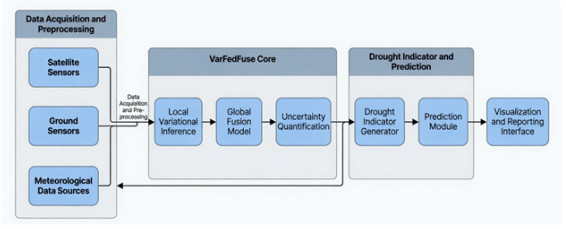
System architecture of VarFedFuse for multi-sensor drought prediction
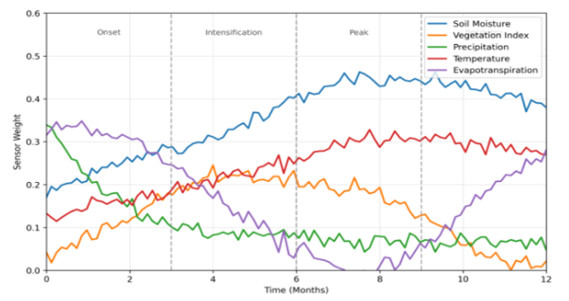
Evolution of sensor weights over time during the drought event
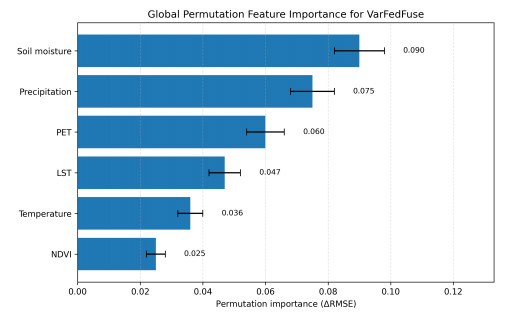
Global permutation feature importance for VarFedFuse
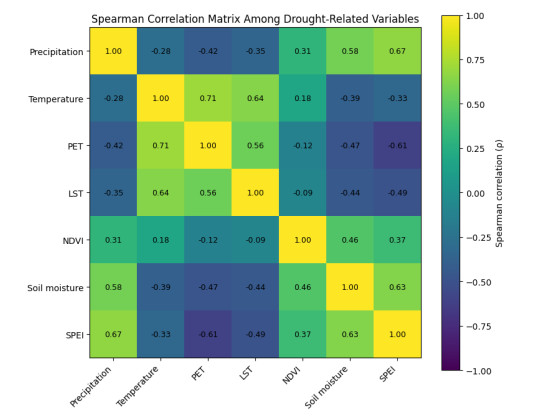
Spearman correlation matrix among drought-related variables
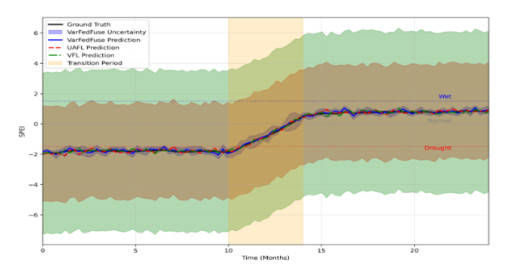
Comparison of prediction intervals during the transition period between drought conditions
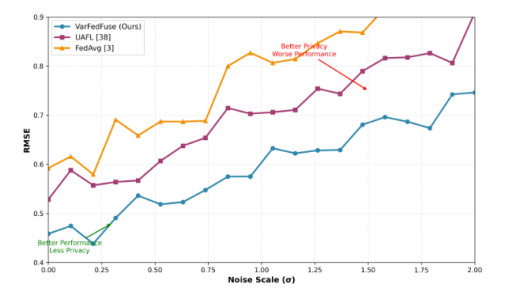
Privacy-utility trade-off across different noise scales
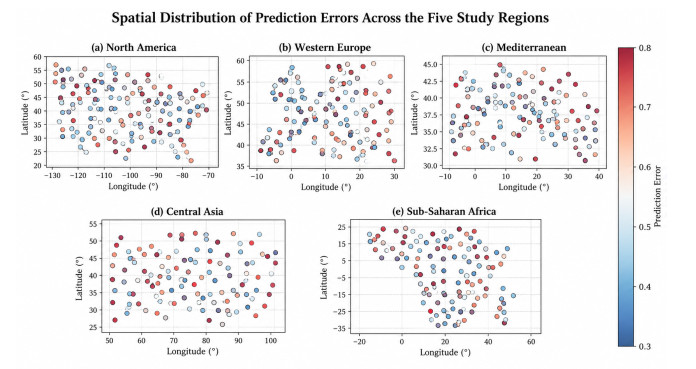
Spatial distribution of prediction errors across the study region
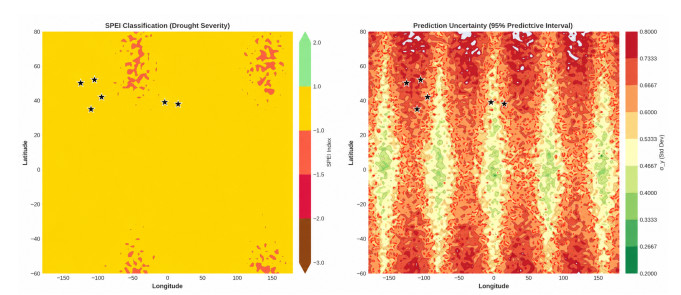
Spatial variation in SPEI categories and prediction uncertainty
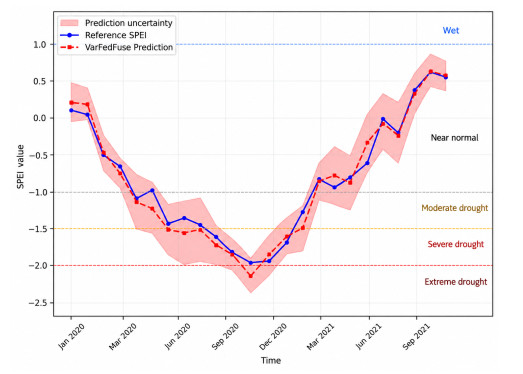
Temporal comparison between reference SPEI values and VarFedFuse predictions over the evaluation period
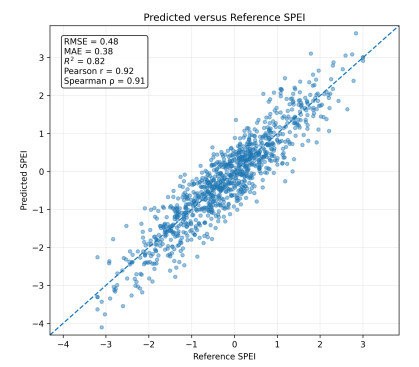
Predicted versus reference SPEI values for the held-out test observations. The dashed $1{:}1$ line represents perfect agreement between the model predictions and reference SPEI values
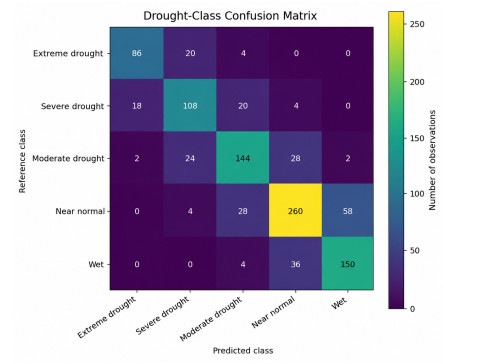
Confusion matrix comparing reference and VarFedFuse-predicted drought-severity classes on the held-out test data




 DownLoad: