This work developed an event-triggered sparse anchor-assisted residual-cancellation neurodynamic method for tracking the moving Karush–Kuhn–Tucker (KKT) path of time-varying strongly convex optimization problems with product second-order cone (SOC) constraints. The resulting continuous-time architecture is a zeroing neural network (ZNN)-type computational-intelligence framework for online conic optimization in time-varying engineering environments. The model was motivated by three-finger contact-force allocation, where quasi-static wrench balance and exact Coulomb friction constraints yield a strongly convex SOC program. A smoothed natural-residual (NR) KKT system was constructed to regularize cone complementarity and define a differentiable moving primal–dual path. A feedforward residual-cancellation law compensates for explicit temporal variation. An anchor tracks the residual-zero path, while replicated solver units exchange delayed state information and receive event-triggered Top-$ p $ sparse corrections. The Top-$ p $ rule gives an explicit coverage ratio without an additional sparse-coverage assumption. Under uniform residual regularity on a forward-invariant domain, bounded communication delays and implementation disturbances, and a computable impulsive-delay condition, local exponential anchor tracking and disturbance-dependent synchronization were established. The complete estimate separates delay-induced mismatch, implementation disturbance, anchor residual error, and smoothing bias. Experiments on three-finger grasping and four-contact force allocation demonstrated accurate moving-path tracking, a lower aggregate squared correction magnitude relative to matched periodic updates, and finite-horizon recovery across multiple solver-fault amplitudes, directions, and disturbance scenarios.
Citation: Xu Wu, Juhe Sun, Li Wang, Yunlai Zhong. Event-triggered sparse anchor-assisted residual-cancellation neurodynamics for moving KKT-path tracking in time-varying second-order cone optimization[J]. AIMS Mathematics, 2026, 11(10): 35200-35237. doi: 10.3934/math.20261368
This work developed an event-triggered sparse anchor-assisted residual-cancellation neurodynamic method for tracking the moving Karush–Kuhn–Tucker (KKT) path of time-varying strongly convex optimization problems with product second-order cone (SOC) constraints. The resulting continuous-time architecture is a zeroing neural network (ZNN)-type computational-intelligence framework for online conic optimization in time-varying engineering environments. The model was motivated by three-finger contact-force allocation, where quasi-static wrench balance and exact Coulomb friction constraints yield a strongly convex SOC program. A smoothed natural-residual (NR) KKT system was constructed to regularize cone complementarity and define a differentiable moving primal–dual path. A feedforward residual-cancellation law compensates for explicit temporal variation. An anchor tracks the residual-zero path, while replicated solver units exchange delayed state information and receive event-triggered Top-$ p $ sparse corrections. The Top-$ p $ rule gives an explicit coverage ratio without an additional sparse-coverage assumption. Under uniform residual regularity on a forward-invariant domain, bounded communication delays and implementation disturbances, and a computable impulsive-delay condition, local exponential anchor tracking and disturbance-dependent synchronization were established. The complete estimate separates delay-induced mismatch, implementation disturbance, anchor residual error, and smoothing bias. Experiments on three-finger grasping and four-contact force allocation demonstrated accurate moving-path tracking, a lower aggregate squared correction magnitude relative to matched periodic updates, and finite-horizon recovery across multiple solver-fault amplitudes, directions, and disturbance scenarios.

| [1] |
F. Alizadeh, D. Goldfarb, Second-order cone programming, Math. Program., 95 (2003), 3–51. https://doi.org/10.1007/s10107-002-0339-5 doi: 10.1007/s10107-002-0339-5
|
| [2] |
F. W. Alsaade, M. S. Al-Zahrani, F. E. Alsaadi, Event-driven bi-fidelity control for efficient and reliable robotic manipulation, Results Eng., 26 (2025), 105374. https://doi.org/10.1016/j.rineng.2025.105374 doi: 10.1016/j.rineng.2025.105374
|
| [3] |
A. Bicchi, On the closure properties of robotic grasping, Int. J. Robot. Res., 14 (1995), 319–334. |
| [4] |
J. F. Bonnans, H. Ramírez C., Perturbation analysis of second-order cone programming problems, Math. Program., 104 (2005), 205–227. https://doi.org/10.1007/s10107-005-0613-4 doi: 10.1007/s10107-005-0613-4
|
| [5] |
J. S. Chen, SOC functions and their applications, Singapore: Springer, 2019. https://doi.org/10.1007/978-981-13-4077-2 |
| [6] |
J. S. Chen, S. Pan, A survey on SOC complementarity functions and solution methods for SOCPs and SOCCPs, Pac. J. Optim., 8 (2012), 33–74. |
| [7] |
J. S. Chen, P. Tseng, An unconstrained smooth minimization reformulation of the second-order cone complementarity problem, Math. Program., 104 (2005), 293–327. https://doi.org/10.1007/s10107-005-0617-0 doi: 10.1007/s10107-005-0617-0
|
| [8] |
F. Facchinei, J. S. Pang, Finite-dimensional variational inequalities and complementarity problems, New York: Springer, 2003. https://doi.org/10.1007/b97543 |
| [9] |
C. Ferrari, J. Canny, Planning optimal grasps, In: Proceedings 1992 IEEE international conference on robotics and automation, France: IEEE, 1992, 2290–2295. https://doi.org/10.1109/ROBOT.1992.219918 |
| [10] |
M. Fukushima, Z. Q. Luo, P. Tseng, Smoothing functions for second-order-cone complementarity problems, SIAM J. Optim., 12 (2002), 436–460. https://doi.org/10.1137/S1052623400380365 doi: 10.1137/S1052623400380365
|
| [11] |
D. Gerontitis, R. Behera, Y. Shi, P. S. Stanimirović, A robust noise-tolerant zeroing neural network for solving time-varying linear matrix equations, Neurocomputing, 508 (2022), 254–274. https://doi.org/10.1016/j.neucom.2022.08.036 doi: 10.1016/j.neucom.2022.08.036
|
| [12] |
P. T. Harker, J. S. Pang, Finite-dimensional variational inequality and nonlinear complementarity problems: A survey of theory, algorithms and applications, Math. Program., 48 (1990), 161–220. https://doi.org/10.1007/BF01582255 doi: 10.1007/BF01582255
|
| [13] |
L. He, H. Cheng, Y. Zhang, Event-triggered discrete-time ZNN algorithm for distributed optimization with time-varying objective functions, Electronics, 14 (2025), 1359. https://doi.org/10.3390/electronics14071359 doi: 10.3390/electronics14071359
|
| [14] |
J. J. Hopfield, D. W. Tank, "Neural" computation of decisions in optimization problems, Biol. Cybern., 52 (1985), 141–152. https://doi.org/10.1007/BF00339943 doi: 10.1007/BF00339943
|
| [15] |
C. H. Ko, J. S. Chen, C. Y. Yang, Recurrent neural networks for solving second-order cone programs, Neurocomputing, 74 (2011), 3646–3653. https://doi.org/10.1016/j.neucom.2011.07.009 doi: 10.1016/j.neucom.2011.07.009
|
| [16] |
H. Li, X. Cheng, P. van Heijster, S. Qin, Event-triggered control for distributed time-varying optimization, ISA Trans., 167 (2025), 1078–1084. https://doi.org/10.1016/j.isatra.2025.09.025 doi: 10.1016/j.isatra.2025.09.025
|
| [17] |
J. Li, Y. Rong, Z. Li, S. Li, L. Qu, A high-order integration-enhanced zeroing neural network for time-varying convex quadratic program against nonlinear noise, IEEE Access, 12 (2024), 22098–22109. https://doi.org/10.1109/ACCESS.2024.3364377 doi: 10.1109/ACCESS.2024.3364377
|
| [18] |
M. Li, H. Zhang, A. Song, Neural dynamics models for time-varying algebraic equations and optimizations with robotic applications: A survey, Neurocomputing, 696 (2026), 134059. https://doi.org/10.1016/j.neucom.2026.134059 doi: 10.1016/j.neucom.2026.134059
|
| [19] |
Z. Li, S. Sastry, Task-oriented optimal grasping by multifingered robot hands, IEEE J. Robot. Autom., 4 (1988), 32–44. https://doi.org/10.1109/56.769 doi: 10.1109/56.769
|
| [20] |
H. Liu, D. Tong, Q. Chen, W. Zhou, Adaptive predefined-time intralayer and interlayer synchronization of multilayer networks, IEEE Trans. Syst. Man Cybern. Syst., 2026, 1–12. https://doi.org/10.1109/TSMC.2026.3713217 |
| [21] |
L. Liu, H. Bao, Event-triggered impulsive synchronization of coupled delayed memristive neural networks under dynamic and static conditions, Neurocomputing, 504 (2022), 109–122. https://doi.org/10.1016/j.neucom.2022.06.098 doi: 10.1016/j.neucom.2022.06.098
|
| [22] |
X. Liu, K. Zhang, W. C. Xie, Pinning impulsive synchronization of reaction–diffusion neural networks with time-varying delays, IEEE Trans. Neural Netw. Learn. Syst., 28 (2017), 1055–1067. https://doi.org/10.1109/TNNLS.2016.2518479 doi: 10.1109/TNNLS.2016.2518479
|
| [23] |
M. S. Lobo, L. Vandenberghe, S. Boyd, H. Lebret, Applications of second-order cone programming, Linear Algebra Appl., 284 (1998), 193–228. https://doi.org/10.1016/S0024-3795(98)10032-0 doi: 10.1016/S0024-3795(98)10032-0
|
| [24] |
J. Lu, D. W. C. Ho, J. Cao, A unified synchronization criterion for impulsive dynamical networks, Automatica, 46 (2010), 1215–1221. https://doi.org/10.1016/j.automatica.2010.04.005 doi: 10.1016/j.automatica.2010.04.005
|
| [25] |
X. Miao, J. S. Chen, C. H. Ko, A smoothed NR neural network for solving nonlinear convex programs with second-order cone constraints, Inf. Sci., 268 (2014), 255–270. https://doi.org/10.1016/j.ins.2013.10.017 doi: 10.1016/j.ins.2013.10.017
|
| [26] |
R. M. Murray, Z. Li, S. S. Sastry, A mathematical introduction to robotic manipulation, CRC Press, 1994. |
| [27] |
A. Simonetto, E. Dall'Anese, S. Paternain, G. Leus, G. B. Giannakis, Time-varying convex optimization: Time-structured algorithms and applications, Proc. IEEE, 108 (2020), 2032–2048. https://doi.org/10.1109/JPROC.2020.3003156 doi: 10.1109/JPROC.2020.3003156
|
| [28] |
J. Sun, J. S. Chen, C. H. Ko, Neural networks for solving second-order cone constrained variational inequality problem, Comput. Optim. Appl., 51 (2012), 623–648. https://doi.org/10.1007/s10589-010-9359-x doi: 10.1007/s10589-010-9359-x
|
| [29] |
J. Sun, W. Fu, J. H. Alcantara, J. S. Chen, A neural network based on the metric projector for solving SOCCVI problem, IEEE Trans. Neural Netw. Learn. Syst., 32 (2021), 2886–2900. https://doi.org/10.1109/TNNLS.2020.3008661 doi: 10.1109/TNNLS.2020.3008661
|
| [30] |
H. Wahballa, A. Ahmed, J. Duan, X. Chen, L. Weining, Force tracking in robotic control systems using an online work object stiffness hybrid impedance PI control approach, Results Eng., 26 (2025), 105520. https://doi.org/10.1016/j.rineng.2025.105520 doi: 10.1016/j.rineng.2025.105520
|
| [31] |
Q. Wu, H. Zhang, L. Xiang, J. Zhou, A generalized Halanay inequality on impulsive delayed dynamical systems and its applications, Chaos Solitons Fract., 45 (2012), 56–62. https://doi.org/10.1016/j.chaos.2011.09.010 doi: 10.1016/j.chaos.2011.09.010
|
| [32] |
Y. Xia, J. Wang, A general projection neural network for solving monotone variational inequalities and related optimization problems, IEEE Trans. Neural Netw., 15 (2004), 318–328. https://doi.org/10.1109/TNN.2004.824252 doi: 10.1109/TNN.2004.824252
|
| [33] |
Y. Xia, J. Wang, L. M. Fok, Grasping-force optimization for multifingered robotic hands using a recurrent neural network, IEEE Trans. Robot. Autom., 20 (2004), 549–554. https://doi.org/10.1109/TRA.2004.824946 doi: 10.1109/TRA.2004.824946
|
| [34] |
Y. Xia, J. Wang, A recurrent neural network for solving nonlinear convex programs subject to linear constraints, IEEE Trans. Neural Netw., 16 (2005), 379–386. https://doi.org/10.1109/TNN.2004.841779 doi: 10.1109/TNN.2004.841779
|
| [35] |
Y. Xia, Q. Liu, J. Wang, A. Cichocki, A survey of neurodynamic optimization, IEEE Trans. Emerg. Top. Comput. Intell., 8 (2024), 2677–2696. https://doi.org/10.1109/TETCI.2024.3369667 doi: 10.1109/TETCI.2024.3369667
|
| [36] |
D. Xu, Z. Yang, Impulsive delay differential inequality and stability of neural networks, J. Math. Anal. Appl., 305 (2005), 107–120. https://doi.org/10.1016/j.jmaa.2004.10.040 doi: 10.1016/j.jmaa.2004.10.040
|
| [37] |
X. Yang, J. Cao, J. Lu, Stochastic synchronization of complex networks with nonidentical nodes via hybrid adaptive and impulsive control, IEEE Trans. Circuits Syst. I Regul. Pap., 59 (2012), 371–384. https://doi.org/10.1109/TCSI.2011.2163969 doi: 10.1109/TCSI.2011.2163969
|
| [38] |
X. Yang, J. Cao, Z. Yang, Synchronization of coupled reaction–diffusion neural networks with time-varying delays via pinning-impulsive controller, SIAM J. Control Optim., 51 (2013), 3486–3510. https://doi.org/10.1137/120897341 doi: 10.1137/120897341
|
| [39] |
X. Ye, Q. Chen, D. Tong, Event-triggered exponential synchronization for delayed multi-agent systems with privacy-preserving, Commun. Nonlinear Sci. Numer. Simul., 162 (2026), 110444. https://doi.org/10.1016/j.cnsns.2026.110444 doi: 10.1016/j.cnsns.2026.110444
|
| [40] |
K. Zhang, E. Braverman, Event-triggered impulsive control for nonlinear systems with actuation delays, IEEE Trans. Autom. Control, 68 (2023), 540–547. https://doi.org/10.1109/TAC.2022.3142127 doi: 10.1109/TAC.2022.3142127
|
| [41] |
Y. Zhang, S. S. Ge, Design and analysis of a general recurrent neural network model for time-varying matrix inversion, IEEE Trans. Neural Netw., 16 (2005), 1477–1490. https://doi.org/10.1109/TNN.2005.857946 doi: 10.1109/TNN.2005.857946
|
Figures(5) / Tables(12)

Xu Wu, Juhe Sun, Li Wang, Yunlai Zhong. Event-triggered sparse anchor-assisted residual-cancellation neurodynamics for moving KKT-path tracking in time-varying second-order cone optimization[J]. AIMS Mathematics, 2026, 11(10): 35200-35237. doi: 10.3934/math.20261368

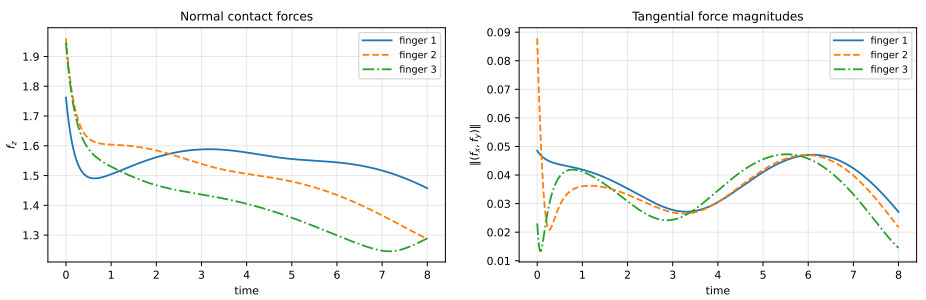
Three-finger contact-force evolution: Normal forces and tangential-force magnitudes
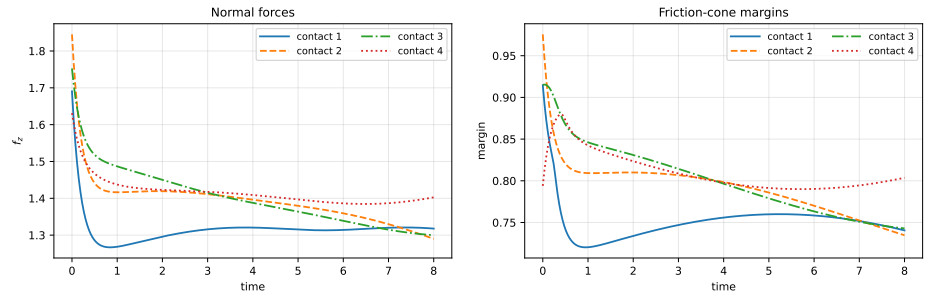
Four-contact force redistribution: Normal forces and friction-cone margins
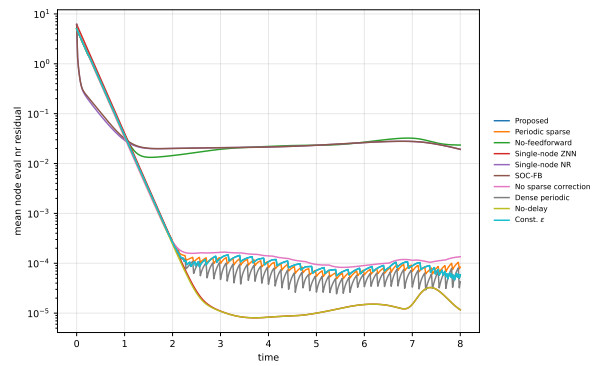
Common NR-residual trajectories for principal ablation variants
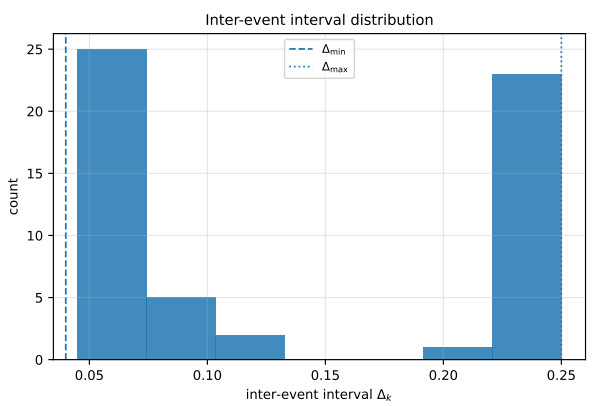
Distribution of nominal inter-event intervals; vertical lines indicate $ \Delta_{\min} $ and $ \Delta_{\max} $.
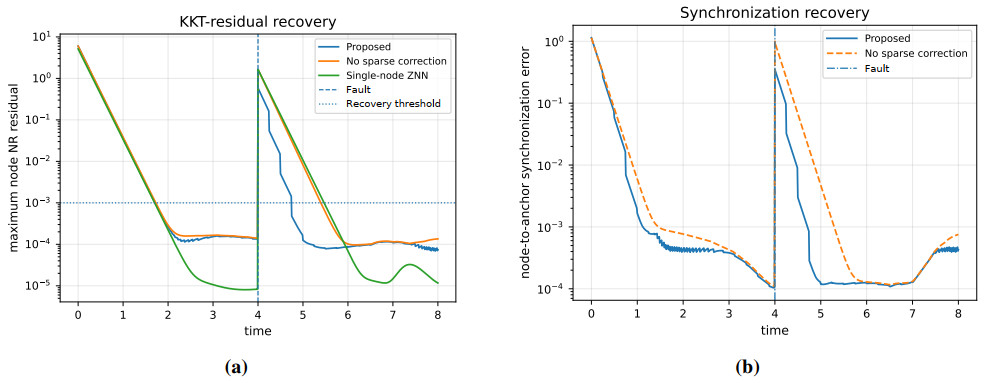
Representative response to a single solver-state fault at $ t_f = 4 $: (a) maximum-node NR residual and (b) node-to-anchor synchronization error




 DownLoad: