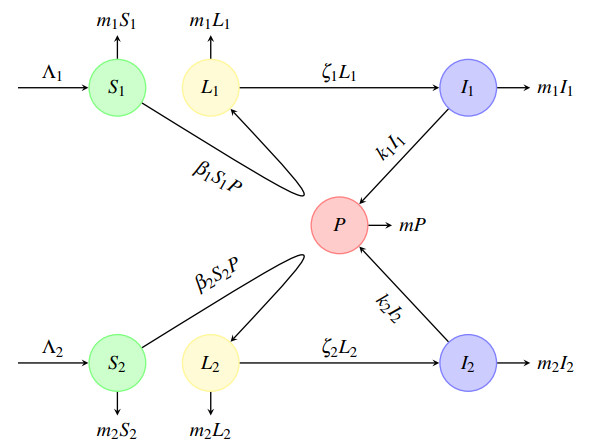
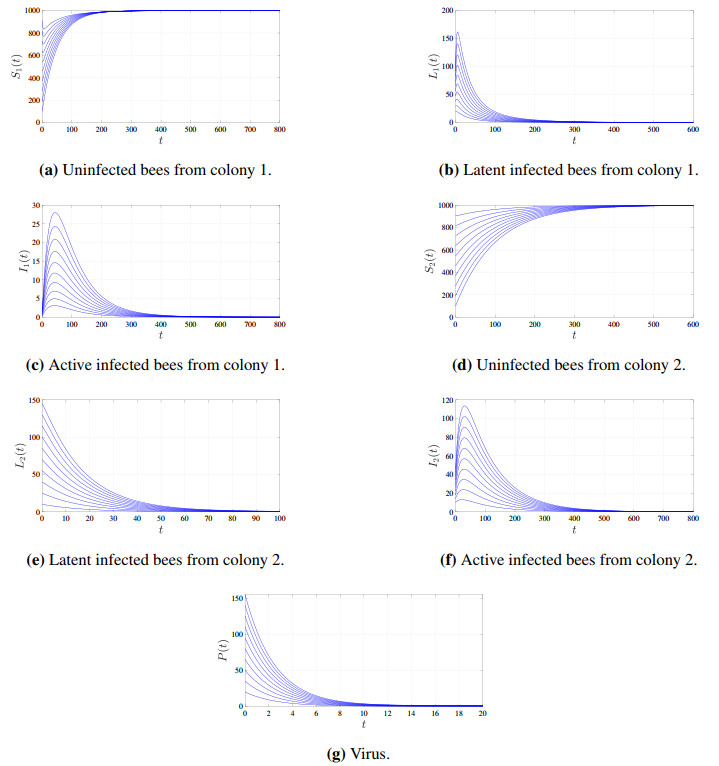
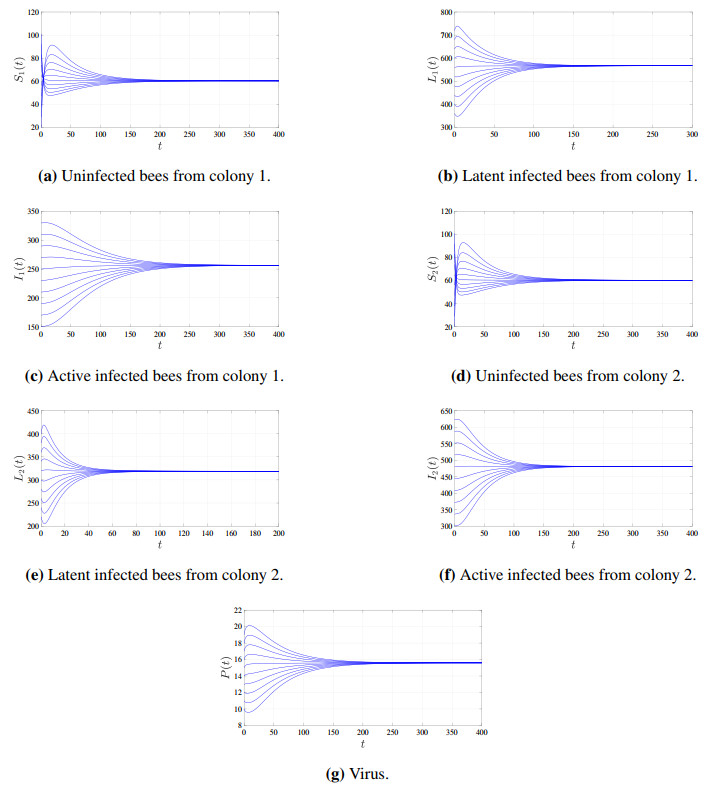
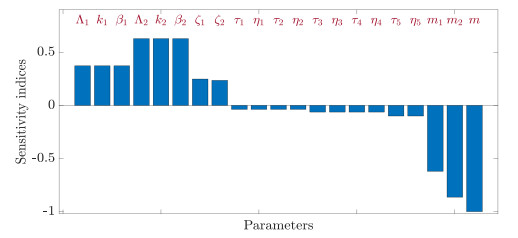
In this paper, we develop a comprehensive mathematical model to investigate the transmission dynamics of dual Nosema infections (Nosema apis and Nosema ceranae) in two interacting honeybee colonies. The model incorporates distributed time delays to capture biological realism in latency, incubation, and parasite maturation periods, and includes an environmental pathogen compartment to account for indirect, environment-mediated transmission. First, we analyze a simplified ordinary differential equation (ODE) version of the model, thereby deriving the basic reproduction number $\mathscr{R}_0$ and establishing the global asymptotic stability of both disease-free and endemic equilibria using Lyapunov functions. Then, the analysis is extended to the full distributed-delay system, where we derive the delayed basic reproduction number $\mathscr{R}_0^d$ and prove the global stability of its equilibria via carefully constructed Lyapunov functionals. A sensitivity analysis identifies key parameters—most notably transmission rates, spore shedding rates, and natural mortality—that dominate the infection dynamics. Furthermore, we introduce an antiviral treatment term to quantify the efficacy required to drive $\mathscr{R}_0^d$ below unity and achieve disease eradication. Numerical simulations validate the analytical results and illustrate how distributed delays and treatment interventions critically influence the long-term disease outcomes. The study provides a robust theoretical framework to understand Nosema spread in multi-colony settings. Its key contributions are as follows: (1) The derivation of an additive basic reproduction number reveals the necessity of apiary-wide management; (2) provides rigorous global stability proofs for the delayed system; and (3) provides actionable quantitative insights to design effective apiary management, identify critical intervention targets, and establish treatment efficacy thresholds for disease eradication.
Citation: Miled El Hajji, Yousef A. Al-Faidi, Mohammed H. Alharbi. Modeling dual-colony Nosema transmission in honeybees: The role of distributed delays and antiviral treatment[J]. AIMS Mathematics, 2026, 11(1): 2645-2681. doi: 10.3934/math.2026107
In this paper, we develop a comprehensive mathematical model to investigate the transmission dynamics of dual Nosema infections (Nosema apis and Nosema ceranae) in two interacting honeybee colonies. The model incorporates distributed time delays to capture biological realism in latency, incubation, and parasite maturation periods, and includes an environmental pathogen compartment to account for indirect, environment-mediated transmission. First, we analyze a simplified ordinary differential equation (ODE) version of the model, thereby deriving the basic reproduction number $\mathscr{R}_0$ and establishing the global asymptotic stability of both disease-free and endemic equilibria using Lyapunov functions. Then, the analysis is extended to the full distributed-delay system, where we derive the delayed basic reproduction number $\mathscr{R}_0^d$ and prove the global stability of its equilibria via carefully constructed Lyapunov functionals. A sensitivity analysis identifies key parameters—most notably transmission rates, spore shedding rates, and natural mortality—that dominate the infection dynamics. Furthermore, we introduce an antiviral treatment term to quantify the efficacy required to drive $\mathscr{R}_0^d$ below unity and achieve disease eradication. Numerical simulations validate the analytical results and illustrate how distributed delays and treatment interventions critically influence the long-term disease outcomes. The study provides a robust theoretical framework to understand Nosema spread in multi-colony settings. Its key contributions are as follows: (1) The derivation of an additive basic reproduction number reveals the necessity of apiary-wide management; (2) provides rigorous global stability proofs for the delayed system; and (3) provides actionable quantitative insights to design effective apiary management, identify critical intervention targets, and establish treatment efficacy thresholds for disease eradication.

| [1] |
M. Higes, R. Martín, A. Meana, Nosema ceranae, a new microsporidian parasite in honeybees in Europe, J. Invertebr. Pathol., 92 (2006), 93–95. https://doi.org/10.1016/j.jip.2006.02.005 doi: 10.1016/j.jip.2006.02.005

|
| [2] | Y. P. Chen, R. Siede, Honey bee viruses, Adv. Virus Res., 70 (2007), 33–80. https://doi.org/10.1016/S0065-3527(07)70002-7 |
| [3] |
Y. Chen, J. D. Evans, I. B. Smith, J. S. Pettis, Nosema ceranae is a long-present and wide-spread microsporidian infection of the European honey bee (Apis mellifera) in the United States, J. Invertebr. Pathol., 97 (2008), 186–188. https://doi.org/10.1016/j.jip.2007.07.010 doi: 10.1016/j.jip.2007.07.010
|
| [4] | J. Chen, K. Messan, M. R. Messan, G. D. Hoffman, D. Bai, Y. Kang, How to model honeybee population dynamics: Stage structure and seasonality, arXiv Preprint, 2020. https://doi.org/10.48550/arXiv.2003.09796 |
| [5] |
J. Chen, J. Rincon, G. D. Hoffman, J. Fewell, J. Harrison, Y. Kang, Impacts of seasonality and parasitism on honey bee population dynamics, J Math. Biol., 87 (2023), 19. https://doi.org/10.1007/s00285-023-01952-2 doi: 10.1007/s00285-023-01952-2
|
| [6] |
I. Fries, Nosema apis—a parasite in the honey bee colony, Bee World, 74 (1993), 5–19. https://doi.org/10.1080/0005772X.1993.11099149 doi: 10.1080/0005772X.1993.11099149
|
| [7] |
C. Mayack, D. Naug, Energetic stress in the honeybee Apis mellifera from Nosema ceranae infection, J. Invertebr. Pathol., 100 (2009), 185–188. https://doi.org/10.1016/j.jip.2008.12.001 doi: 10.1016/j.jip.2008.12.001
|
| [8] |
S. J. Martin, A. C. Highfield, L. Brettell, E. M. Villalobos, G. E. Budge, M. Powell, et al., Global honey bee viral landscape altered by a parasitic mite, Science, 336 (2012), 1304–1306. https://doi.org/10.1126/science.1220941 doi: 10.1126/science.1220941
|
| [9] |
M. Goblirsch, Z. Y. Huang, M. Spivak, Physiological and behavioral changes in honey bees (Apis mellifera) induced by Nosema ceranae infection, PLoS One, 8 (2013), e58165. https://doi.org/10.1371/journal.pone.0058165 doi: 10.1371/journal.pone.0058165
|
| [10] |
M. Goblirsch, Nosema ceranae disease of the honey bee (Apis mellifera), Apidologie, 49 (2018), 131–150. https://doi.org/10.1007/s13592-017-0535-1 doi: 10.1007/s13592-017-0535-1
|
| [11] |
L. Paris, H. El Alaoui, F. Delbac, M. Diogon, Effects of the gut parasite Nosema ceranae on honey bee physiology and behavior, Curr. Opin. Insect Sci., 26 (2018), 149–154. https://doi.org/10.1016/j.cois.2018.02.017 doi: 10.1016/j.cois.2018.02.017
|
| [12] |
D. S. Khoury, M. R. Myerscough, A. B. Barron, A quantitative model of honey bee colony population dynamics, PloS One, 6 (2011), e18491. https://doi.org/10.1371/journal.pone.0018491 doi: 10.1371/journal.pone.0018491
|
| [13] |
D. S. Khoury, A. B. Barron, M. R. Myerscough, Modelling food and population dynamics in honey bee colonies, PloS One, 8 (2013), e59084. https://doi.org/10.1371/journal.pone.0059084 doi: 10.1371/journal.pone.0059084
|
| [14] |
M. I. Betti, L. M. Wahl, M. Zamir, Effects of infection on honey bee population dynamics: A model, PLOS One, 9 (2014), 1–12. https://doi.org/10.1371/journal.pone.0110237 doi: 10.1371/journal.pone.0110237
|
| [15] |
M. Betti, L. Wahl, M. Zamir, Age structure is critical to the population dynamics and survival of honeybee colonies, Roy. Soc. Open Sci., 3 (2016), 160444. https://doi.org/10.1098/rsos.160444 doi: 10.1098/rsos.160444
|
| [16] |
A. Dénes, M. A. Ibrahim, Global dynamics of a mathematical model for a honeybee colony infested by virus-carrying Varroa mites, J. Appl. Math. Comput., 61 (2019), 349–371. https://doi.org/10.1007/s12190-019-01250-5 doi: 10.1007/s12190-019-01250-5
|
| [17] |
M. El Hajji, F. A. S. Alzahrani, M. H. Alharbi, Mathematical analysis for Honeybee dynamics under the influence of seasonality, Mathematics, 12 (2024), 3496. https://doi.org/10.3390/math12223496 doi: 10.3390/math12223496
|
| [18] |
M. El Hajji, F. A. S. Alzahrani, R. Mdimagh, Impact of infection on Honeybee population dynamics in a seasonal environment, Int. J. Anal. Appl., 22 (2024), 75. https://doi.org/10.28924/2291-8639-22-2024-75 doi: 10.28924/2291-8639-22-2024-75
|
| [19] |
J. K. Hale, A. S. Somolinos, Competition for a fluctuating nutrient, J. Math. Biol., 18 (1983), 255–280. https://doi.org/10.1007/BF00276091 doi: 10.1007/BF00276091
|
| [20] |
A. Korobeinikov, Global properties of basic virus dynamics models, B. Math. Biol., 66 (2004), 879–883. https://doi.org/10.1016/j.bulm.2004.02.001 doi: 10.1016/j.bulm.2004.02.001
|
| [21] |
S. K. Sasmal, I. Ghosh, A. Huppert, J. Chattopadhyay, Modeling the spread of Zika virus in a stage-structured population: Effect of sexual transmission, B. Math. Biol., 80 (2016), 3038–3067. https://doi.org/10.1007/s11538-018-0510-7 doi: 10.1007/s11538-018-0510-7
|
| [22] |
N. Chitnis, J. M. Hyman, J. M. Cushing, Determining important parameters in the spread of malaria through the sensitivity analysis of a mathematical model, B. Math. Biol., 70 (2008), 1272–1296. https://doi.org/10.1007/s11538-008-9299-0 doi: 10.1007/s11538-008-9299-0
|
| [23] | J. K. Hale, S. M. V. Lunel, Introduction to functional differential equations, New York: Springer-Verlag, 1993. https://doi.org/10.1007/978-1-4612-4342-7 |
| [24] |
P. V. den Driessche, J. Watmough, Reproduction numbers and sub-threshold endemic equilibria for compartmental models of disease transmission, Math. Biosci., 180 (2002), 29–48. https://doi.org/10.1016/S0025-5564(02)00108-6 doi: 10.1016/S0025-5564(02)00108-6
|
| [25] | J. P. LaSalle, The stability of dynamical systems, SIAM: Philadelphia, 1976. |
| [26] | H. Khalil, Nonlinear systems, 2Eds, Prentice Hall, 1996. |
| [27] | H. H. Almuashi, M. El Hajji, Global dynamics of a dual-target HIV model with time delays and treatment implications, Mathematics, 14 (2026). https://doi.org/10.3390/math14010006 |
| [28] | N. A. Almuallem, M. El Hajji, Global dynamics of a multi-population water pollutant model with distributed delays, Mathematics, 14 (2026). https://doi.org/10.3390/math14010020 |
| [29] |
S. Marino, I. B. Hogue, I. B. Ray, D. E. Kirschner, A methodology for performing global uncertainty and sensitivity analysis in systems biology, J. Theor. Biol., 254 (2008), 178–196. https://doi.org/10.1016/j.jtbi.2008.04.011 doi: 10.1016/j.jtbi.2008.04.011
|
Figures(6) / Tables(5)

Miled El Hajji, Yousef A. Al-Faidi, Mohammed H. Alharbi. Modeling dual-colony Nosema transmission in honeybees: The role of distributed delays and antiviral treatment[J]. AIMS Mathematics, 2026, 11(1): 2645-2681. doi: 10.3934/math.2026107





 DownLoad: