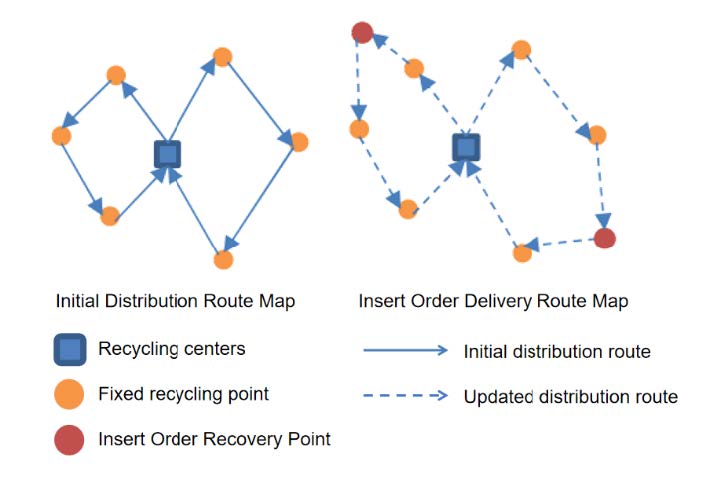
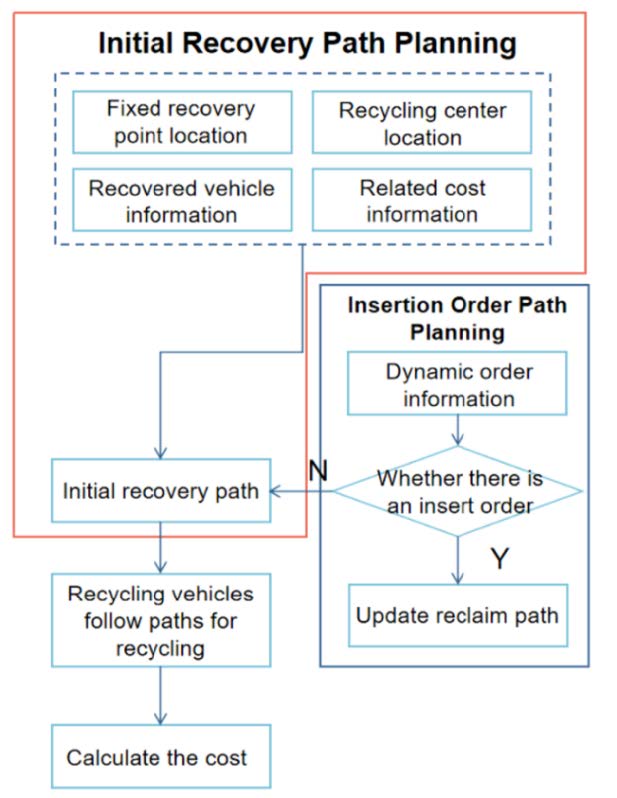
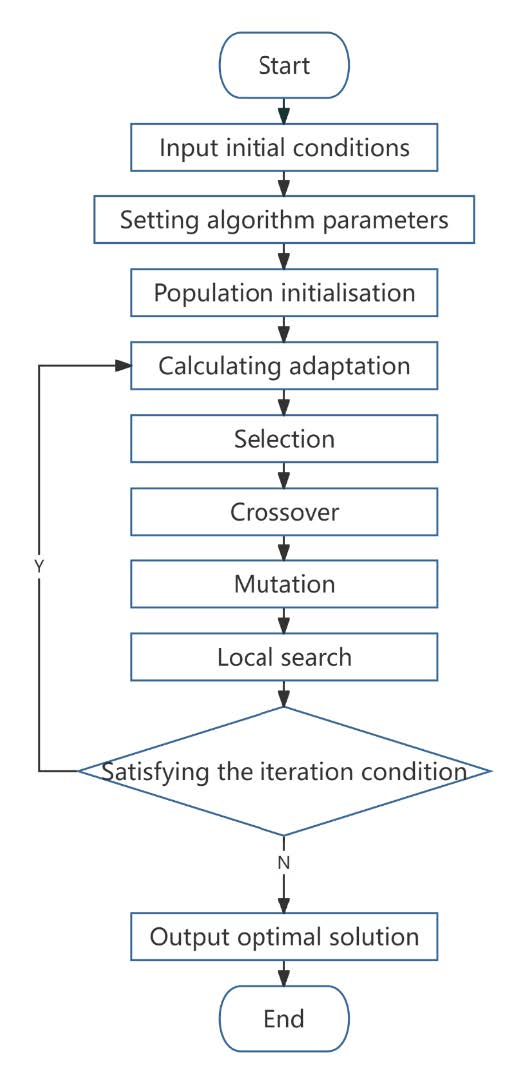
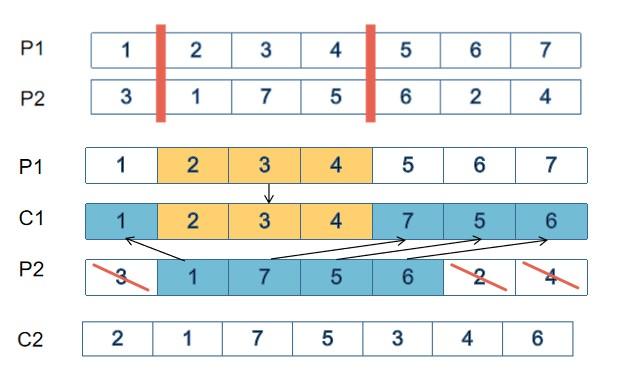
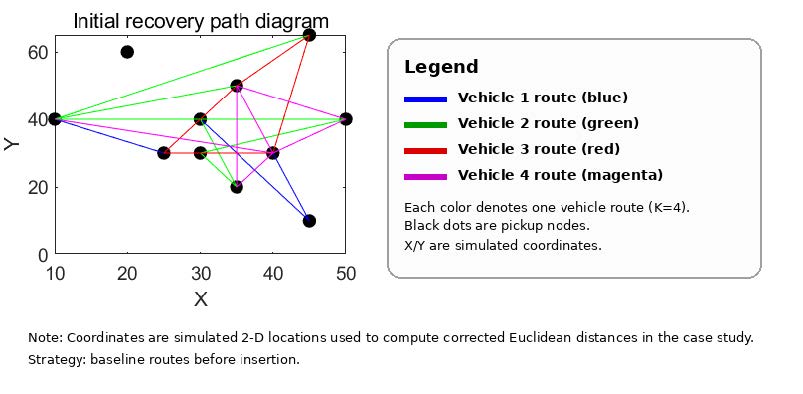
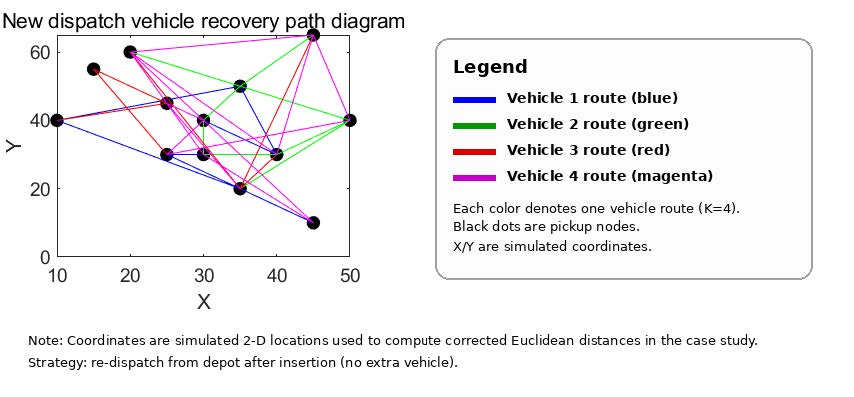
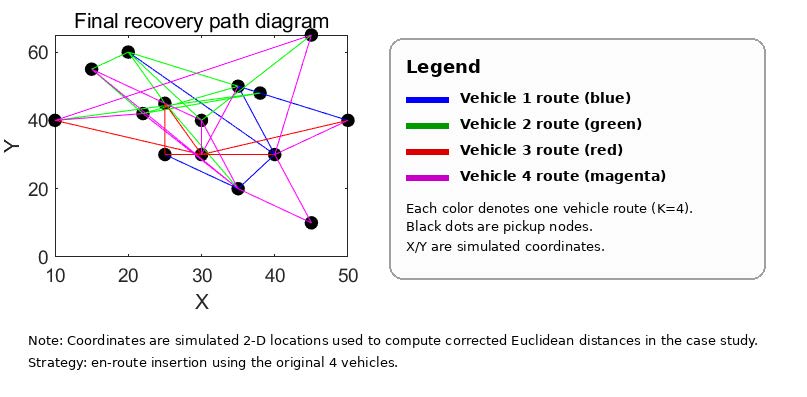
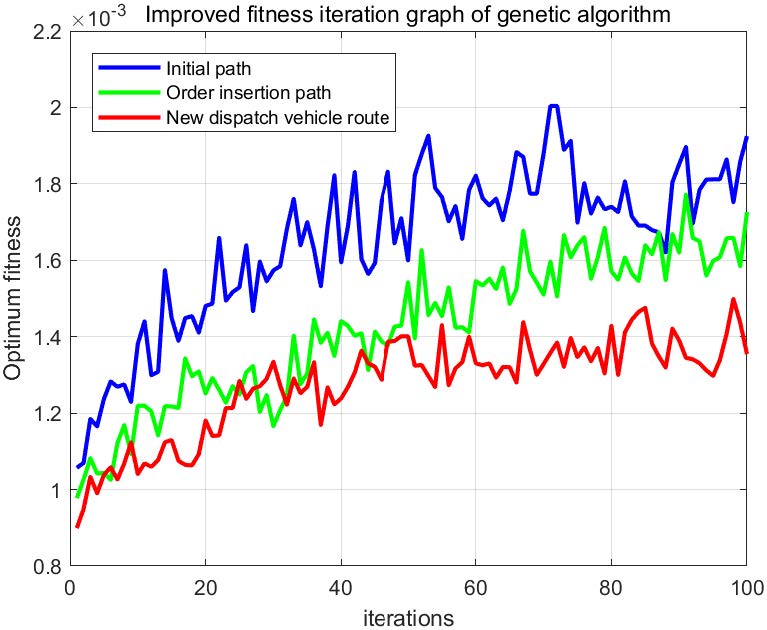
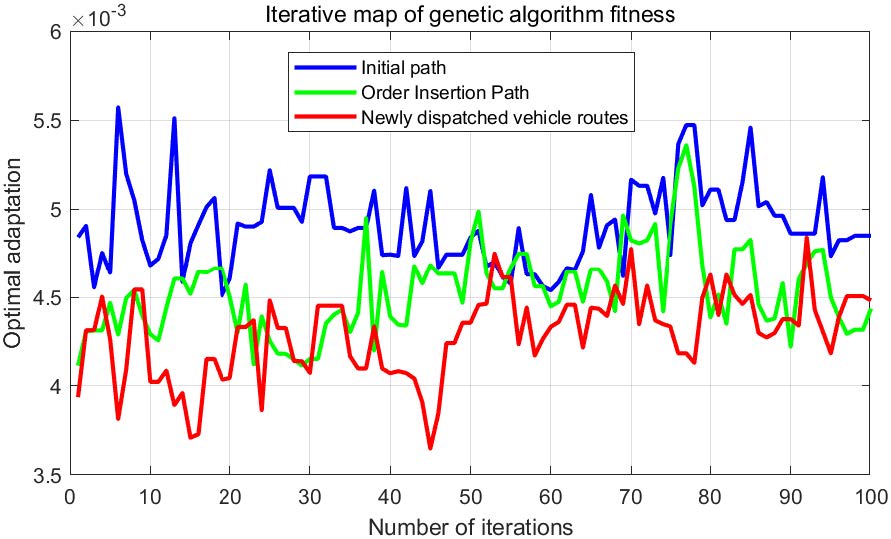
China's booming food-delivery industry produces massive disposable-tableware waste, demanding efficient and low-carbon reverse logistics. Here, we studied a dynamic tableware collection routing problem with real-time order insertion: a recycling center serves preset recycling points, while new door-to-door requests appear during route execution. The objective is to minimize total cost, including vehicle dispatch fixed cost, distance-based depreciation, cleaning cost (including incremental cleaning for inserted orders), waiting and lateness penalties under soft time windows, and fuel plus carbon-emission costs. Routes must satisfy depot start/end, single-service requirements, vehicle capacity limits, feasible service-time propagation, and a minimum satisfaction threshold derived from the soft time-window function. To solve this NP-hard problem, we designed an improved genetic algorithm with time-window-based grouped initialization, natural-number encoding with depot separators, OX crossover, two-point mutation, and a destruction-repair local search using farthest insertion for reinsertion. Experiments indicated faster and more stable convergence than a basic GA. In an order-insertion case, inserting new orders into en-route tours significantly outperforms dispatching an additional vehicle (total cost about 75.7% higher). The proposed method offers implementable decision support for platforms and municipalities to run time-sensitive, low-carbon tableware recovery.
Citation: Chenghan He, Dexin Huang, Chengyin Wang. Optimization of takeaway tableware recycling route considering order insertion[J]. AIMS Mathematics, 2026, 11(1): 2613-2644. doi: 10.3934/math.2026106
China's booming food-delivery industry produces massive disposable-tableware waste, demanding efficient and low-carbon reverse logistics. Here, we studied a dynamic tableware collection routing problem with real-time order insertion: a recycling center serves preset recycling points, while new door-to-door requests appear during route execution. The objective is to minimize total cost, including vehicle dispatch fixed cost, distance-based depreciation, cleaning cost (including incremental cleaning for inserted orders), waiting and lateness penalties under soft time windows, and fuel plus carbon-emission costs. Routes must satisfy depot start/end, single-service requirements, vehicle capacity limits, feasible service-time propagation, and a minimum satisfaction threshold derived from the soft time-window function. To solve this NP-hard problem, we designed an improved genetic algorithm with time-window-based grouped initialization, natural-number encoding with depot separators, OX crossover, two-point mutation, and a destruction-repair local search using farthest insertion for reinsertion. Experiments indicated faster and more stable convergence than a basic GA. In an order-insertion case, inserting new orders into en-route tours significantly outperforms dispatching an additional vehicle (total cost about 75.7% higher). The proposed method offers implementable decision support for platforms and municipalities to run time-sensitive, low-carbon tableware recovery.

| [1] |
Y. Q. Mo, L. X. Li, Gig economy and entrepreneurship: Evidence from the entry of food delivery platforms, (Chinese), Journal of Management World, 38 (2022), 31–45. https://doi.org/10.19744/j.cnki.11-1235/f.2022.0018 doi: 10.19744/j.cnki.11-1235/f.2022.0018

|
| [2] |
B. Yang, X. J. Xia, Y. Y. Cheng, Catering industry during the COVID-19 pandemic: Impact and differentiation, (Chinese), Journal of Hohai University (Philosophy and Socail Sciences), 23 (2021), 31–40. https://doi.org/10.3876/j.issn.1671-4970.2021.01.005 doi: 10.3876/j.issn.1671-4970.2021.01.005
|
| [3] |
G. Blanca-Alcubilla, A. Bala, N. de Castro, R. Colomé, P. Fullana-i-Palmer, Is the reusable tableware the best option? Analysis of the aviation catering sector with a life cycle approach, Sci. Total Environ., 708 (2020), 135121. https://doi.org/10.1016/j.scitotenv.2019.135121 doi: 10.1016/j.scitotenv.2019.135121
|
| [4] |
V. Linderhof, F. H. Oosterhuis, P. J. H. van Beukering, H. Bartelings, Effectiveness of deposit-refund systems for household waste in the Netherlands: applying a partial equilibrium model, J. Environ. Manage., 232 (2019), 842–850. https://doi.org/10.1016/j.jenvman.2018.11.102 doi: 10.1016/j.jenvman.2018.11.102
|
| [5] |
Q. Y. Xu, Z. Shao, Y. He, Optimal delivery strategies for packing box recycling in online platforms, J. Clean. Prod., 276 (2020), 124273. https://doi.org/10.1016/j.jclepro.2020.124273 doi: 10.1016/j.jclepro.2020.124273
|
| [6] |
K. Govindan, M. Palaniappan, Q. H. Zhu, D. Kannan, Analysis of third-party reverse logistics provider using interpretive structural modeling, Int. J. Prod. Econ., 140 (2012), 204–211. https://doi.org/10.1016/j.ijpe.2012.01.043 doi: 10.1016/j.ijpe.2012.01.043
|
| [7] |
D. Pamucar, K. Chatterjee, E. K. Zavadskas, Assessment of third-party logistics provider using multi-criteria decision-making approach based on interval rough numbers, Comput. Ind. Eng., 127 (2019), 383–407. https://doi.org/10.1016/j.cie.2018.10.023 doi: 10.1016/j.cie.2018.10.023
|
| [8] |
N. Zarbakhshnia, Y. Wu, K. Govindan, H. Soleimani, A novel hybrid multiple-attribute decision-making approach for outsourcing sustainable reverse logistics, J. Clean. Prod., 242 (2020), 118461. https://doi.org/10.1016/j.jclepro.2019.118461 doi: 10.1016/j.jclepro.2019.118461
|
| [9] |
Z.-S. Chen, X. Zhang, K. Govindan, X.-J. Wang, K.-S. Chin, Third-party reverse logistics provider selection: a computational semantic analysis-based multi-perspective multi-attribute decision-making approach, Expert Syst. Appl., 166 (2021), 114051. https://doi.org/10.1016/j.eswa.2020.114051 doi: 10.1016/j.eswa.2020.114051
|
| [10] |
M. Agovino, M. D'Uva, A. Garofalo, K. Marchesano, Waste management performance in Italian provinces: efficiency and spatial effects of local governments and citizen action, Ecol. Indic., 89 (2018), 680–695. https://doi.org/10.1016/j.ecolind.2018.02.045 doi: 10.1016/j.ecolind.2018.02.045
|
| [11] |
P. Rathore, S. P. Sarmah, Modeling and identification of suitable motivational mechanism in the collection system of municipal solid waste supply chain, Waste Manag., 129 (2021), 76–84. https://doi.org/10.1016/j.wasman.2021.05.011 doi: 10.1016/j.wasman.2021.05.011
|
| [12] |
A. Taweesan, T. Koottatep, C. Polprasert, Effective measures for municipal solid waste management for cities in some Asian countries, Expo. Health, 9 (2017), 125–133. https://doi.org/10.1007/s12403-016-0227-5 doi: 10.1007/s12403-016-0227-5
|
| [13] |
J. Heydari, K. Govindan, A. Jafari, Reverse and closed-loop supply chain coordination by considering government role, Transp. Res. D: Transp. Environ., 52 (2017), 379–398. https://doi.org/10.1016/j.trd.2017.03.008 doi: 10.1016/j.trd.2017.03.008
|
| [14] |
J. H. Yang, R. Y. Long, H. Chen, Q. Q. Sun, A comparative analysis of express packaging waste recycling models based on the differential game theory, Resour. Conserv. Recy., 168 (2021), 105449. https://doi.org/10.1016/j.resconrec.2021.105449 doi: 10.1016/j.resconrec.2021.105449
|
| [15] |
X. Tong, D. Y. Tao, The rise and fall of a "waste city" in the construction of an "urban circular economic system": The changing landscape of waste in Beijing, Resour. Conserv. Recy., 107 (2016), 10–17. https://doi.org/10.1016/j.resconrec.2015.12.003 doi: 10.1016/j.resconrec.2015.12.003
|
| [16] |
G.-E.-K. Berthomé, A. Thomas, A context-based procedure for assessing participatory schemes in environmental planning, Ecol. Econ., 132 (2017), 113–123. https://doi.org/10.1016/j.ecolecon.2016.10.014 doi: 10.1016/j.ecolecon.2016.10.014
|
| [17] | Q. Song, Application of an optimized beam-PSO algorithm in multi-trip vehicle routing problem, (Chinese), Computer Engineering & Science, 41 (2019), 1882–1891. |
| [18] |
C. Wang, C. Liu, D. Mu, Y. Gao, VRPSPDTW problem solving by discrete cuckoo search, (Chinese), Computer Integrated Manufacturing Systems, 24 (2018), 570–582. https://doi.org/10.13196/j.cims.2018.03.004 doi: 10.13196/j.cims.2018.03.004
|
| [19] | H. M. Fan, J. X. Wu, J. Geng, Y. Li, Hybrid genetic algorithm for solving fuzzy demand and time windows vehicle routing problem, (Chinese), Journal of Systems & Management, 29 (2020), 107–118. |
| [20] | G. W. Huang, Y. G. Cai, Y. H. Qi, H. R. Chen, S. H. Wang, Adaptive genetic grey wolf optimizer algorithm for capacitated vehicle routing, (Chinese), Acta Electronica Sinica, 47 (2019), 2602–2610. |
| [21] |
S. Majidi, S.-M. Hosseini-Motlagh, J. Ignatius, Adaptive large neighborhood search heuristic for pollution-routing problem with simultaneous pickup and delivery, Soft Comput., 22 (2018), 2851–2865. https://doi.org/10.1007/s00500-017-2535-5 doi: 10.1007/s00500-017-2535-5
|
| [22] | T. Zhang, P. Z. Lai, Q. F. He, Z. H. Jin, Optimization of dynamic vehicle routing of urban distribution based on real-time information, (Chinese), Systems Engineering, 33 (2015), 58–64. |
| [23] |
J. L. Zhang, Y. W. Zhao, H. Y. Wang, J. Jie, W. L. Wang, Modeling and algorithms for a dynamic multi-vehicle routing problem with customers' dynamic requests, (Chinese), Computer Integrated Manufacturing Systems, 16 (2010), 543–550. https://doi.org/10.13196/j.cims.2010.03.97.zhangjl.026 doi: 10.13196/j.cims.2010.03.97.zhangjl.026
|
| [24] |
J. L. Shi, J. Zhang, Optimization on simultaneous pick-up and delivery vehicle routing problem with split delivery and stochastic travel and service time, (Chinese), Control and Decision, 33 (2018), 657–670. https://doi.org/10.13195/j.kzyjc.2017.0317 doi: 10.13195/j.kzyjc.2017.0317
|
| [25] |
L. Y. Zhang, J. Zhang, B. Xiao, Multi-objective O2O take-out instant delivery routing optimization considering customer priority, (Chinese), Industrial Engineering and Management, 26 (2021), 196–204. https://doi.org/10.19495/j.cnki.1007-5429.2021.02.024 doi: 10.19495/j.cnki.1007-5429.2021.02.024
|
| [26] | X. M. Zhang, J. M. Chen, J. Xiao, Stochastic dynamic multi-vehicles pick-up and delivery problem with heavy traffic and its solution policy, (Chinese), Journal of Systems Engineering, 27 (2012), 61–68. |
| [27] |
H. T. Lei, G. Laporte, B. Guo, The vehicle routing problem with stochastic demands and split deliveries, INFOR: Information Systems and Operational Research, 50 (2012), 59–71. https://doi.org/10.3138/infor.50.2.059 doi: 10.3138/infor.50.2.059
|
Figures(9) / Tables(15)

Chenghan He, Dexin Huang, Chengyin Wang. Optimization of takeaway tableware recycling route considering order insertion[J]. AIMS Mathematics, 2026, 11(1): 2613-2644. doi: 10.3934/math.2026106





 DownLoad: