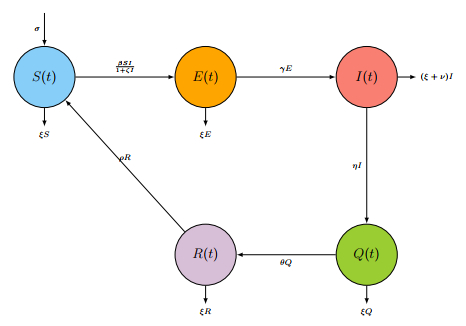
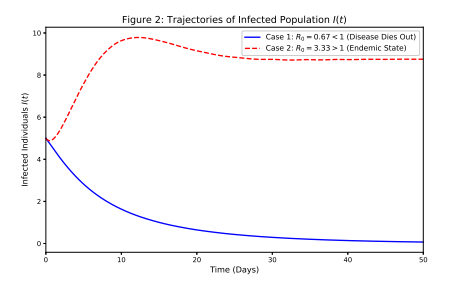
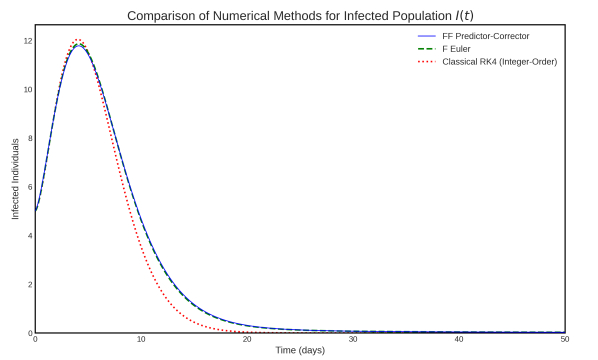
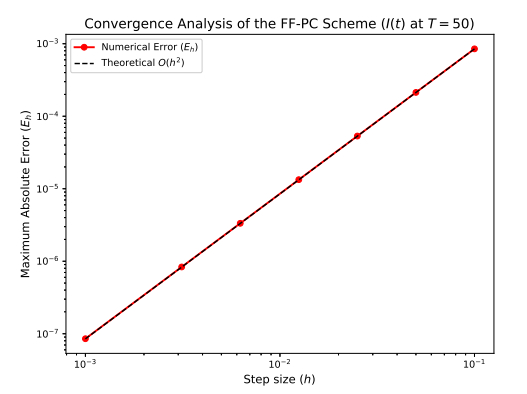
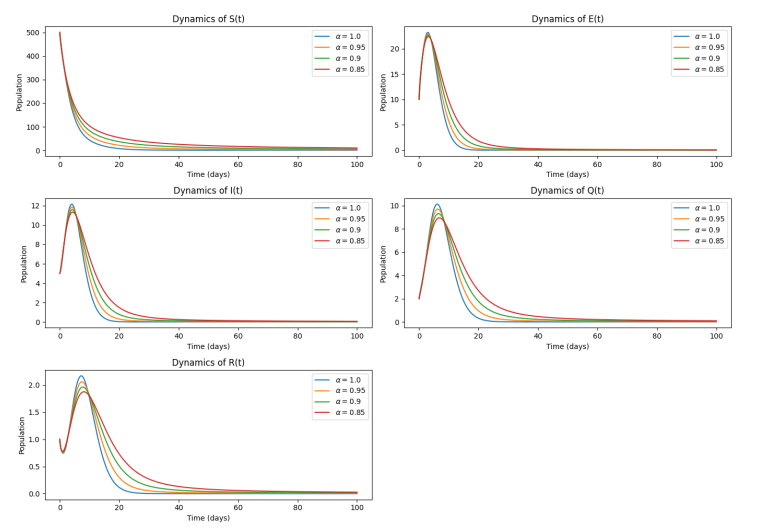
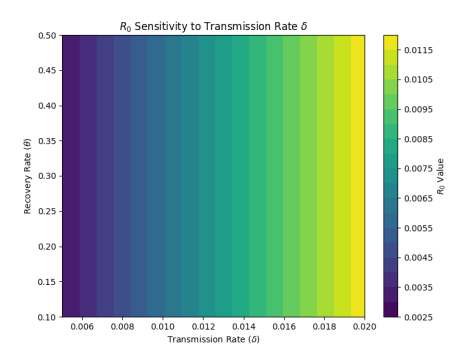
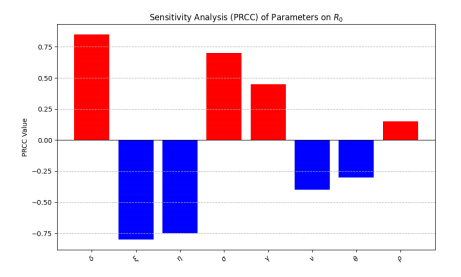
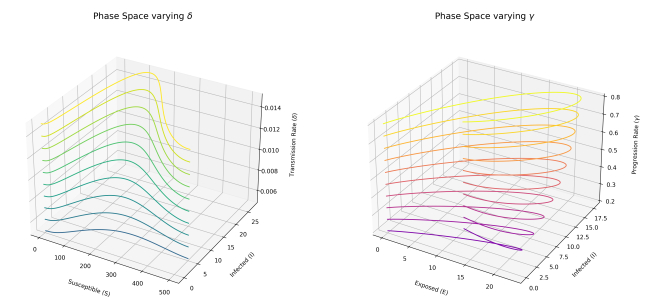
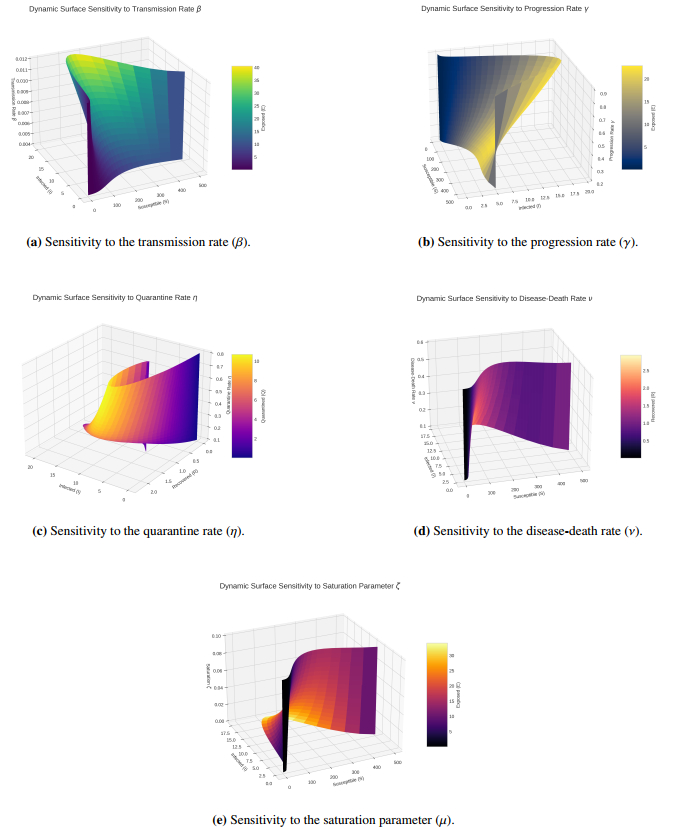
This paper presents a comprehensive investigation into the transmission dynamics of Lassa fever through a sophisticated mathematical model formulated with a fractal-fractional operator in the Atangana-Baleanu sense. The model's architecture is an SEIQR (susceptible-exposed-infected-quarantined-recovered) framework that incorporates crucial real-world epidemiological features, including a saturated incidence rate to account for behavioral changes at high infection levels and a relapse mechanism for recovered individuals. A rigorous qualitative analysis is conducted to establish the fundamental properties of the model, wherein we prove the existence, uniqueness, positivity, and boundedness of the solutions, ensuring the biological viability of the system. The stability of the model's equilibria is thoroughly examined. We derive the basic reproduction number ($ R_0 $) using a next-generation matrix method, which serves as the critical threshold for disease persistence. We prove that the disease-free equilibrium is both locally and globally asymptotically stable when $ R_0 < 1 $. For the numerical investigation, we implement and validate a robust predictor-corrector scheme tailored for fractional-order systems, comparing its accuracy and convergence against the fractional Euler method and the classical Runge-Kutta scheme. Extensive numerical simulations are performed to visualize the system's dynamics. The results demonstrate that the fractional order provides enhanced flexibility in capturing memory effects, often leading to a more realistic, delayed epidemic peak. Furthermore, a series of novel three-dimensional dynamic surface plots reveals the geometric sensitivity of the solution manifold to key infection parameters, visually confirming that the transmission rate ($ \beta $) and quarantine rate ($ \eta $) are the most powerful levers in shaping the epidemic landscape. These findings offer a deeper understanding of Lassa fever's dynamics and highlight critical points for effective public health interventions.
Citation: Sagar R. Khirsariya, Saud Fahad Aldosary. A fractal-fractional perspective on Lassa fever dynamics with saturated incidence and relapse[J]. AIMS Mathematics, 2026, 11(1): 2547-2577. doi: 10.3934/math.2026103
This paper presents a comprehensive investigation into the transmission dynamics of Lassa fever through a sophisticated mathematical model formulated with a fractal-fractional operator in the Atangana-Baleanu sense. The model's architecture is an SEIQR (susceptible-exposed-infected-quarantined-recovered) framework that incorporates crucial real-world epidemiological features, including a saturated incidence rate to account for behavioral changes at high infection levels and a relapse mechanism for recovered individuals. A rigorous qualitative analysis is conducted to establish the fundamental properties of the model, wherein we prove the existence, uniqueness, positivity, and boundedness of the solutions, ensuring the biological viability of the system. The stability of the model's equilibria is thoroughly examined. We derive the basic reproduction number ($ R_0 $) using a next-generation matrix method, which serves as the critical threshold for disease persistence. We prove that the disease-free equilibrium is both locally and globally asymptotically stable when $ R_0 < 1 $. For the numerical investigation, we implement and validate a robust predictor-corrector scheme tailored for fractional-order systems, comparing its accuracy and convergence against the fractional Euler method and the classical Runge-Kutta scheme. Extensive numerical simulations are performed to visualize the system's dynamics. The results demonstrate that the fractional order provides enhanced flexibility in capturing memory effects, often leading to a more realistic, delayed epidemic peak. Furthermore, a series of novel three-dimensional dynamic surface plots reveals the geometric sensitivity of the solution manifold to key infection parameters, visually confirming that the transmission rate ($ \beta $) and quarantine rate ($ \eta $) are the most powerful levers in shaping the epidemic landscape. These findings offer a deeper understanding of Lassa fever's dynamics and highlight critical points for effective public health interventions.

| [1] | W. H. Organization, Lassa fever, WHO Fact Sheets, Available from: https://www.who.int/news-room/fact-sheets/detail/lassa-fever. |
| [2] |
I. O. Abiola, A. S. Oyewole, T. T. Yusuf, Mathematical modelling of Lassa-fever transmission dynamics with optimal control of selected control measures, Model. Earth Syst. Env., 10 (2024), 7443–7458. https://doi.org/10.1007/s40808-024-02168-z doi: 10.1007/s40808-024-02168-z

|
| [3] |
A. Aslam, T. Hussain, M. Ozair, A. Hafeez, W. Albalawi, N. Omer, Mathematical analysis of Lassa fever epidemic with real data, Alex. Eng. J., 85 (2024), 111–121. https://doi.org/10.1016/j.aej.2024.01.110 doi: 10.1016/j.aej.2024.01.110
|
| [4] |
J. Ndenda, J. Njagarah, S. Shaw, Influence of environmental viral load, interpersonal contact and infected rodents on Lassa fever transmission dynamics: Perspectives from fractional-order dynamic modelling, AIMS Math., 7 (2022), 8975–9002. http://dx.doi.org/10.3934/math.2022500 doi: 10.3934/math.2022500
|
| [5] |
M. M. Al-Shomrani, A. Yusuf, Optimal control and dynamics of human-to-human Lassa fever with early tracing of contacts and proper burial, AIMS Math., 10 (2025), 13755–13794. http://dx.doi.org/10.3934/math.2025620 doi: 10.3934/math.2025620
|
| [6] |
O. J. Peter, A. I. Abioye, F. A. Oguntolu, T. A. Owolabi, M. O. Ajisope, A. G. Zakari, et al., Modelling and optimal control analysis of Lassa fever disease, Inform. Med. Unlock., 20 (2020), 100419. https://doi.org/10.1016/j.imu.2020.100419 doi: 10.1016/j.imu.2020.100419
|
| [7] |
D. Kumar, D. Baleanu, Fractional calculus and its applications in physics, Front. Phys., 7 (2019). https://doi.org/10.3389/fphy.2019.00081 doi: 10.3389/fphy.2019.00081
|
| [8] |
K. S. Nisar, M. Farman, M. Abdel-Aty, C. Ravichandran, A review of fractional order epidemic models for life sciences problems: Past, present and future, Alex. Eng. J., 95 (2024), 283–305. https://doi.org/10.1016/j.aej.2024.03.059 doi: 10.1016/j.aej.2024.03.059
|
| [9] |
S. Murtaza, E. A. Ismail, F. A. Awwad, E. Bonyah, A. M. Hassan, M. S. Khan, et al., Parametric simulations of fractal-fractional non-linear viscoelastic fluid model with finite difference scheme, AIP Adv., 14 (2024). https://doi.org/10.1063/5.0180414 doi: 10.1063/5.0180414
|
| [10] |
K. A. Aldwoah, M. A. Almalahi, K. Shah, M. Awadalla, R. H. Egami, Dynamics analysis of dengue fever model with harmonic mean type under fractal-fractional derivative, AIMS Math., 9 (2024), 13894–13926. http://dx.doi.org/10.3934/math.2024676 doi: 10.3934/math.2024676
|
| [11] |
A. Atangana, D. Baleanu, New fractional derivatives with nonlocal and non-singular kernel: Theory and application to heat transfer model, Therm. Sci., 20 (2016), 763–769, https://doi.org/10.2298/TSCI160111018A doi: 10.2298/TSCI160111018A
|
| [12] |
J. K. K. Asamoah, I. K. Adu, F. A. Wireko, S. B. Lassong, F. Fatmawati, Modeling the effect of memory on the spread of query fever considering humans, animals and the environment, Model. Earth Syst. Env., 11 (2025), 249. https://doi.org/10.1007/s40808-025-02354-7 doi: 10.1007/s40808-025-02354-7
|
| [13] |
K. Aldwoah, S. Ahmed, S. Jahan, A. Touati, N. EIjaneid, T. AIjaaidi, Fractal-fractional modeling and stability analysis of pine wilt disease dynamics, PloS One, 20 (2025), e0318534. https://doi.org/10.1371/journal.pone.0318534 doi: 10.1371/journal.pone.0318534
|
| [14] |
S. Saber, E. Solouma, Advanced fractional modeling of diabetes: Bifurcation analysis, chaos control, and a comparative study of numerical methods Adams-Bashforth-Moulton and Laplace-Adomian-Padé method, Indian J. Phys., 99 (2025), 5151–5169. https://doi.org/10.1007/s12648-025-03712-y doi: 10.1007/s12648-025-03712-y
|
| [15] |
M. Alhazmi, S. M. Mirgani, A. Aljohani, S. Saber, Numerical simulation of a fractional glucose-insulin model via successive approximation and ABM schemes, AIMS Math., 10 (2025), 22817–22849. https://dx.doi.org/10.3934/math.20251014 doi: 10.3934/math.20251014
|
| [16] |
S. Saber, E. Solouma, M. Alsulami, Modeling computer virus spread using ABC fractional derivatives with Mittag-Leffler kernels: Symmetry, invariance, and memory effects in a four-compartment network model, Symmetry, 17 (2025), 1891. https://doi.org/10.3390/sym17111891 doi: 10.3390/sym17111891
|
| [17] |
M. Alhazmi, S. M. Mirgani, A. Alahmari, S. Saber, Application of LAPM and ABM methods to a fractional SCIR model of pneumonia diseases, AIMS Math., 10 (2025), 25667–25707. https://doi.org/10.3934/math.20251137 doi: 10.3934/math.20251137
|
| [18] |
M. Alhazmi, S. M. Mirgani, A. Alahmari, S. Saber, Hybrid multi-step fractional numerical schemes for human-wildlife zoonotic disease dynamics, AIMS Math., 10 (2025), 21126–21158. https://doi.org/10.3934/math.2025944 doi: 10.3934/math.2025944
|
| [19] |
A. Ahmad, U. Atta, M. Farman, K. S. Nisar, H. Ahmad, E. Hincal, Investigation of Lassa fever with relapse and saturated incidence rate: Mathematical modeling and control, Model. Earth Syst. Env., 11 (2025), 1–28. https://doi.org/10.1007/s40808-025-02370-7 doi: 10.1007/s40808-025-02370-7
|
| [20] |
C. E. Madubueze, S. Ajao, J. O. Akanni, Z. Chazuka, S. C. Madubueze, Mathematical modelling of the impact of environmental contamination on lassa fever: Optimal control and economic analysis, Eur. Phys. J. Plus, 140 (2025), 699. https://doi.org/10.1140/epjp/s13360-025-06639-9 doi: 10.1140/epjp/s13360-025-06639-9
|
| [21] |
A. A. Ayoade, O. Aliu, O. Taiye, The effect of treatment compliance on the dynamics and control of Lassa fever: An insight from mathematical modeling, SeMA J., 82 (2025), 89–108. https://doi.org/10.1007/s40324-024-00353-9 doi: 10.1007/s40324-024-00353-9
|
| [22] | D. Baleanu, K. Diethelm, E. Scalas, J. Trujillo, Fractional calculus: Models and numerical methods, World Scientific, 2012. |
| [23] |
Y. Luchko, Initial-boundary-value problems for the generalized multi-term time-fractional diffusion equation, J. Math. Anal. Appl., 374 (2011), 538–548. https://doi.org/10.1016/j.jmaa.2010.08.048 doi: 10.1016/j.jmaa.2010.08.048
|
| [24] |
P. Van den Driessche, J. Watmough, Reproduction numbers and sub-threshold endemic equilibria for compartmental models of disease transmission, Math. Biosci., 180 (2002), 29–48. https://doi.org/10.1016/S0025-5564(02)00108-6 doi: 10.1016/S0025-5564(02)00108-6
|
| [25] | D. Matignon, Stability results for fractional differential equations with applications to control processing, Computational Engineering in Systems Applications, IMACS, IEEE-SMC, 2 (1996), 963–968. |
| [26] | M. A. Khan, A. Atangana, Numerical methods for fractal-fractional differential equations and engineering: Simulations and modeling, CRC Press, 2023. |
| [27] |
M. Tavazoei, M. H. Asemani, Fractional-order–dependent global stability analysis and observer-based synthesis for a class of nonlinear fractional-order systems, Int. J. Robust Nonlin., 28 (2018), 4549–4564. https://doi.org/10.1002/rnc.4250 doi: 10.1002/rnc.4250
|
Figures(10) / Tables(4)

Sagar R. Khirsariya, Saud Fahad Aldosary. A fractal-fractional perspective on Lassa fever dynamics with saturated incidence and relapse[J]. AIMS Mathematics, 2026, 11(1): 2547-2577. doi: 10.3934/math.2026103





 DownLoad: