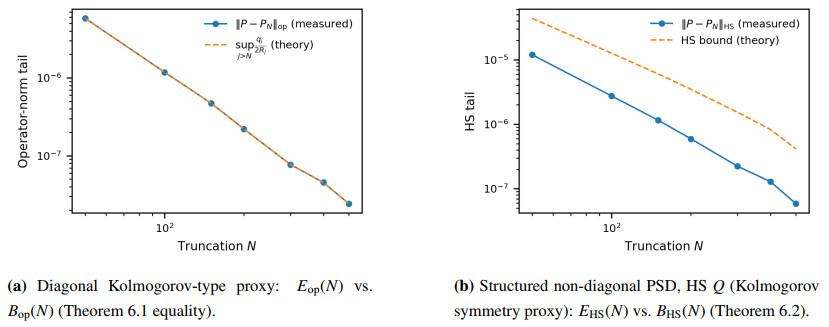
Starting from a steady-state energy–balance law for noisy, linearly damped fields, we derive an operator covariance equation in Lyapunov–Sylvester form. On the unit disk with self-adjoint boundary conditions, the corresponding generator is diagonalized by the Zernike polynomials, and finite-mode projection yields a matrix Lyapunov equation for modal covariances. We prove explicit a priori truncation-error bounds tailored to Zernike systems: in the diagonal (or diagonally dominant) case the operator-norm tail admits a closed-form expression and, for Kolmogorov-type spectra, decays at a rate $ \mathcal{O}(N^{-7/3}) $; for general Hilbert–Schmidt noise covariances we obtain Hilbert–Schmidt tail bounds with explicit dependence on system parameters and dissipation rates. We further extend the formulation to exponentially correlated (Ornstein-Uhlenbeck) forcing via an augmented-state Lyapunov/Sylvester construction, yielding closed-form denominator shifts and a covariance-based inversion for the OU correlation time $ \tau $. Numerical examples validate the Lyapunov solves, the derived error bounds, and the $ \tau $ recovery procedure.
Citation: Netzer Moriya. Energy balancing integrals, orthogonal polynomial systems, and matrix Lyapunov equations[J]. AIMS Mathematics, 2026, 11(1): 2406-2429. doi: 10.3934/math.2026098
Starting from a steady-state energy–balance law for noisy, linearly damped fields, we derive an operator covariance equation in Lyapunov–Sylvester form. On the unit disk with self-adjoint boundary conditions, the corresponding generator is diagonalized by the Zernike polynomials, and finite-mode projection yields a matrix Lyapunov equation for modal covariances. We prove explicit a priori truncation-error bounds tailored to Zernike systems: in the diagonal (or diagonally dominant) case the operator-norm tail admits a closed-form expression and, for Kolmogorov-type spectra, decays at a rate $ \mathcal{O}(N^{-7/3}) $; for general Hilbert–Schmidt noise covariances we obtain Hilbert–Schmidt tail bounds with explicit dependence on system parameters and dissipation rates. We further extend the formulation to exponentially correlated (Ornstein-Uhlenbeck) forcing via an augmented-state Lyapunov/Sylvester construction, yielding closed-form denominator shifts and a covariance-based inversion for the OU correlation time $ \tau $. Numerical examples validate the Lyapunov solves, the derived error bounds, and the $ \tau $ recovery procedure.

| [1] | M. Born, E. Wolf, Principles of optics, 7 Eds., Cambridge: Cambridge University Press, 1999. |
| [2] | G. Da Prato, J. Zabczyk, Stochastic equations in infinite dimensions, Cambridge: Cambridge University Press, 2010. https://doi.org/10.1017/CBO9780511666223 |
| [3] | R. F. Curtain, H. Zwart, An introduction to infinite-dimensional linear systems theory, New York: Springer, 1995. https://doi.org/10.1007/978-1-4612-4224-6 |
| [4] |
L. Clarotto, D. Allard, T. Romary, N. Desassis, The SPDE approach for spatio-temporal datasets with advection and diffusion, Spat. Stat., 62 (2024), 100847. https://doi.org/10.1016/j.spasta.2024.100847 doi: 10.1016/j.spasta.2024.100847

|
| [5] |
D. Bolin, A. B. Simas, Z. Xiong, Covariance-based rational approximations of fractional SPDEs for computationally efficient Bayesian inference, J. Comput. Graph. Stat., 33 (2024), 64–74. https://doi.org/10.1080/10618600.2023.2231051 doi: 10.1080/10618600.2023.2231051
|
| [6] |
P. Bossert, Parameter estimation for second-order SPDEs in multiple space dimensions, Stat. Inference Stoch. Process., 27 (2024), 485–583. https://doi.org/10.1007/s11203-024-09318-1 doi: 10.1007/s11203-024-09318-1
|
| [7] |
A. Chauhan, B. R. Boruah, Study on the orthogonality property of Zernike modes in light beams undergoing free space propagation, J. Opt. Soc. Am. A, 40 (2023), 961–968. https://doi.org/10.1364/JOSAA.481741 doi: 10.1364/JOSAA.481741
|
| [8] |
D. Bachmann, M. Isoard, V. Shatokhin, G. Sorelli, A. Buchleitner, Accurate Zernike-corrected phase screens for arbitrary power spectra, Opt. Eng., 64 (2025), 058102. https://doi.org/10.1117/1.OE.64.5.058102 doi: 10.1117/1.OE.64.5.058102
|
| [9] |
E. Goi, S. Schoenhardt, M. Gu, Direct retrieval of Zernike-based pupil functions using integrated diffractive deep neural networks, Nat. Commun., 13 (2022), 2531. https://doi.org/10.1038/s41467-022-35349-4 doi: 10.1038/s41467-022-35349-4
|
| [10] |
A. B. Siddik, S. Sandoval, D. Voelz, L. E. Boucheron, L. Varela, Estimation of modified Zernike coefficients from turbulence-degraded multispectral imagery using deep learning, Appl. Opt., 63 (2024), E28–E39. https://doi.org/10.1364/AO.521072 doi: 10.1364/AO.521072
|
| [11] |
P. Benner, D. Palitta, J. Saak, On an integrated Krylov-ADI solver for large-scale Lyapunov equations, Numer. Algor., 92 (2023), 35–63. https://doi.org/10.1007/s11075-022-01409-5 doi: 10.1007/s11075-022-01409-5
|
| [12] |
L. Bao, Y. Lin, Y. Wei, A new projection method for solving large Sylvester equations, Appl. Numer. Math., 57 (2007), 521–532. https://doi.org/10.1016/j.apnum.2006.07.005 doi: 10.1016/j.apnum.2006.07.005
|
| [13] |
Y. Lin, Low-rank methods for solving discrete-time projected Lyapunov equations, Mathematics, 12 (2024), 1166. https://doi.org/10.3390/math12081166 doi: 10.3390/math12081166
|
| [14] |
D. Palitta, V. Simoncini, Numerical methods for large-scale Lyapunov equations with symmetric banded data, SIAM J. Sci. Comput., 40 (2018), A3581–A3608. https://doi.org/10.1137/17M1156575 doi: 10.1137/17M1156575
|
| [15] |
A. Andersson, A. Lang, A. Petersson, L. Schroer, Finite element approximation of Lyapunov equations related to parabolic stochastic PDEs, Appl. Math. Optim., 91 (2025), 66. https://doi.org/10.1007/s00245-025-10260-8 doi: 10.1007/s00245-025-10260-8
|
| [16] |
R. J. Noll, Zernike polynomials and atmospheric turbulence, J. Opt. Soc. Am., 66 (1976), 207–211. https://doi.org/10.1364/JOSA.66.000207 doi: 10.1364/JOSA.66.000207
|
| [17] | N. M. Atakishiyev, G. S. Pogosyan, C. Salto-Alegre, K. B. Wolf, A. Yakhno, The superintegrable Zernike system, In: Springer proceedings in mathematics & statistics, Singapore: Springer, 263 (2017), 263–273. https://doi.org/10.1007/978-981-13-2715-5_16 |
| [18] |
D. Zhang, Statistical inference for Ornstein-Uhlenbeck processes based on low-frequency observations, Stat. Probab. Lett., 216 (2025), 110286. https://doi.org/10.1016/j.spl.2024.110286 doi: 10.1016/j.spl.2024.110286
|
| [19] |
S. Gaïffas, G. Matulewicz, Sparse inference of the drift of a high-dimensional Ornstein-Uhlenbeck process, J. Multivar. Anal., 169 (2019), 1–20. https://doi.org/10.1016/j.jmva.2018.08.005 doi: 10.1016/j.jmva.2018.08.005
|
| [20] |
N. Dexheimer, C. Strauch, On Lasso and Slope drift estimators for Lévy-driven Ornstein-Uhlenbeck processes, Bernoulli, 30 (2024), 88–116. https://doi.org/10.3150/22-BEJ1574 doi: 10.3150/22-BEJ1574
|
| [21] | L. Sadek, H. T. Alaoui, The extended nonsymmetric block Lanczos methods for solving large-scale differential Lyapunov equations, Math. Model. Comput., 8 (2021), 526–536. |
| [22] |
L. Sadek, The methods of fractional backward differentiation formulas for solving two-term fractional differential Sylvester matrix equations, Appl. Set-Valued Anal. Optim., 6 (2024), 137–155. https://doi.org/10.23952/asvao.6.2024.2.02 doi: 10.23952/asvao.6.2024.2.02
|
| [23] |
L. Sadek, Control theory for fractional differential Sylvester matrix equations with Caputo fractional derivative, J. Vib. Control, 31 (2024), 1586–1602. https://doi.org/10.1177/10775463241246430 doi: 10.1177/10775463241246430
|


Figures(3) / Tables(1)

Netzer Moriya. Energy balancing integrals, orthogonal polynomial systems, and matrix Lyapunov equations[J]. AIMS Mathematics, 2026, 11(1): 2406-2429. doi: 10.3934/math.2026098





 DownLoad: