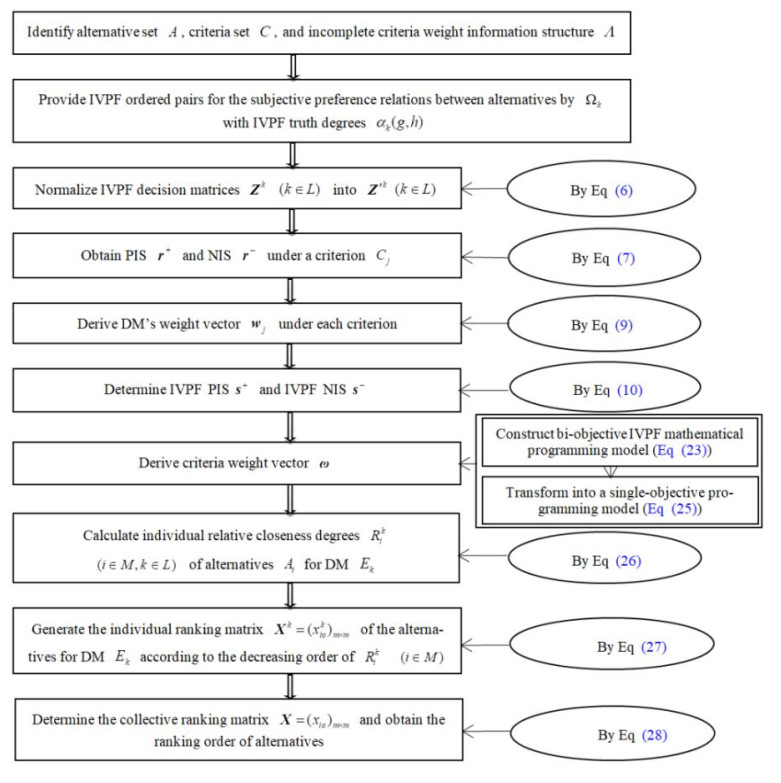
The interval-valued Pythagorean fuzzy set possesses a strong capability to characterize uncertainty and fuzziness, and has been widely applied to multi-criteria group decision-making. However, extant studies seldom consider the fuzzy truth degrees in pairwise comparisons of alternatives and often overlook incomplete information regarding criteria weights. Therefore, this paper investigated interval-valued Pythagorean fuzzy multi-criteria group decision-making, incorporating both interval-valued Pythagorean fuzzy truth degrees for pairwise comparisons and incomplete information on criterion weights. First, recognizing that decision-makers may have different weights under different criteria, their weights with respect to each criterion were determined based on the relative closeness of each alternative to the positive ideal solution and the negative ideal solution under that criterion. To derive the criteria weights, this paper defined the interval-valued Pythagorean fuzzy positive ideal solution and the interval-valued Pythagorean fuzzy negative ideal solution, and established the interval-valued Pythagorean fuzzy group consistency index and inconsistency index. By minimizing the group inconsistency index, a bi-objective interval-valued Pythagorean fuzzy programming model was constructed and skillfully transformed into a linear programming model to compute the criteria weights. Subsequently, the relative closeness degree of each alternative for each decision-maker was calculated and used to generate individual rankings of the alternatives. To obtain a collective ranking, a multi-objective allocation model was established and then converted into a single-objective programming model for the solution. Finally, a wireless network selection example was provided to demonstrate the effectiveness of the proposed method.
Citation: Zhen Jin, Xiaofang Deng, Gaili Xu. A novel mathematical programming method for interval-valued Pythagorean fuzzy MCGDM with incomplete weight information[J]. AIMS Mathematics, 2026, 11(1): 2131-2187. doi: 10.3934/math.2026088
The interval-valued Pythagorean fuzzy set possesses a strong capability to characterize uncertainty and fuzziness, and has been widely applied to multi-criteria group decision-making. However, extant studies seldom consider the fuzzy truth degrees in pairwise comparisons of alternatives and often overlook incomplete information regarding criteria weights. Therefore, this paper investigated interval-valued Pythagorean fuzzy multi-criteria group decision-making, incorporating both interval-valued Pythagorean fuzzy truth degrees for pairwise comparisons and incomplete information on criterion weights. First, recognizing that decision-makers may have different weights under different criteria, their weights with respect to each criterion were determined based on the relative closeness of each alternative to the positive ideal solution and the negative ideal solution under that criterion. To derive the criteria weights, this paper defined the interval-valued Pythagorean fuzzy positive ideal solution and the interval-valued Pythagorean fuzzy negative ideal solution, and established the interval-valued Pythagorean fuzzy group consistency index and inconsistency index. By minimizing the group inconsistency index, a bi-objective interval-valued Pythagorean fuzzy programming model was constructed and skillfully transformed into a linear programming model to compute the criteria weights. Subsequently, the relative closeness degree of each alternative for each decision-maker was calculated and used to generate individual rankings of the alternatives. To obtain a collective ranking, a multi-objective allocation model was established and then converted into a single-objective programming model for the solution. Finally, a wireless network selection example was provided to demonstrate the effectiveness of the proposed method.

| [1] |
L. A. Zadeh, Fuzzy sets, Inf. Control, 8 (1965), 338–353. https://doi.org/10.1016/S0019-9958(65)90241-X doi: 10.1016/S0019-9958(65)90241-X

|
| [2] | K. T. Atanassov, Intuitionistic fuzzy sets, Fuzzy Sets Syst., 20 (1986), 87–96. |
| [3] |
K. T. Atanassov, G. Gargov, Interval valued intuitionistic fuzzy sets, Fuzzy Sets Syst., 31 (1989), 343–349. https://doi.org/10.1016/0165-0114(89)90205-4 doi: 10.1016/0165-0114(89)90205-4
|
| [4] |
R. R. Yager, Pythagorean membership grades in multicriteria decision making, IEEE T. Fuzzy Syst., 22 (2014), 958–965. https://doi.org/10.1109/tfuzz.2013.2278989 doi: 10.1109/tfuzz.2013.2278989
|
| [5] |
X. Zhang, Z. Xu, Extension of TOPSIS to multiple criteria decision making with Pythagorean fuzzy sets, Int. J. Intell. Syst., 29 (2014), 1061–1078. https://doi.org/10.1002/int.21676 doi: 10.1002/int.21676
|
| [6] |
R. R. Yager, A. M. Abbasov, Pythagorean membership grades, complex numbers, and decision making, Int. J. Intell. Syst., 28 (2013), 436–452. https://doi.org/10.1002/int.21584 doi: 10.1002/int.21584
|
| [7] |
M. Asif, U. Ishtiaq, I. K. Argyros, Hamacher aggregation operators for Pythagorean fuzzy set and its application in multi-attribute decision-making problem, Spectr. Oper. Res., 2 (2025), 27–40. https://doi.org/10.31181/sor2120258 doi: 10.31181/sor2120258
|
| [8] |
M. Palanikumar, N. Kausar, Research on the redefined square root interval-valued normal Pythagorean fuzzy multi-attribute decision-making model based on aggregation operators, Spectr. Oper. Res., 4 (2025), 1–18. https://doi.org/10.31181/sor58 doi: 10.31181/sor58
|
| [9] |
M. Tahir, K. Kfueit, M. Rasheed, A. Hanan, M. Imran Shahid, Pythagorean soft sets and hypersoft sets: A comprehensive framework for advanced uncertainty modeling in decision making, Spectr. Decis. Mak. Appl., 4 (2025), 1–26. https://doi.org/10.31181/sdmap41202761 doi: 10.31181/sdmap41202761
|
| [10] |
S. A. Razak, Z. M. Rodzi, F. Al-Sharqi, N. Ramli, Revolutionizing decision-making in E-commerce and IT procurement: An IVPNS-COBRA linguistic variable framework for enhanced multi-criteria analysis, Int. J. Econ. Sci., 14 (2025), 1–31. https://doi.org/10.31181/ijes1412025176 doi: 10.31181/ijes1412025176
|
| [11] |
M. S. Mohammad Kamari, Z. Md Rodzi, Z. F. Zainuddin, N. H. Kamis, N. Ahmad, S. A. Razak, et al., Economic evaluation of digital suppliers for manufacturing SMEs using Pythagorean neutrosophic TOPSIS and VIKOR with a flexible distance metric, Int. J. Econ. Sci., 14 (2025), 351–384. https://doi.org/10.31181/ijes1412025187 doi: 10.31181/ijes1412025187
|
| [12] |
J. Jiang, X. Liu, Z. Wang, W. Ding, S. Zhang, H. Xu, Large group decision-making with a rough integrated asymmetric cloud model under multi-granularity linguistic environment, Inf. Sci., 678 (2024), 120994. https://doi.org/10.1016/j.ins.2024.120994 doi: 10.1016/j.ins.2024.120994
|
| [13] |
X. Liu, S. Zhang, Z. Wang, S. Zhang, Classification and identification of medical insurance fraud: a case-based reasoning approach, Technol. Econ. Dev. Econ., 31 (2025), 1345–1371. https://doi.org/10.3846/tede.2025.23597 doi: 10.3846/tede.2025.23597
|
| [14] |
S. Wan, J. Dong, S. Chen, A novel intuitionistic fuzzy best-worst method for group decision making with intuitionistic fuzzy preference relations, Inf. Sci., 666 (2024), 120404. https://doi.org/10.1016/j.ins.2024.120404 doi: 10.1016/j.ins.2024.120404
|
| [15] |
S. Wan, X. Chen, J. Dong, Y. Gao, Hesitant multiplicative best and worst method for multi-criteria group decision making, Inf. Sci., 715 (2025), 122214. https://doi.org/10.1016/j.ins.2025.122214 doi: 10.1016/j.ins.2025.122214
|
| [16] |
Z. Chen, D. Wu, W. Luo, X. Cheng, A hybrid heterogeneous framework for medical waste disposal evaluation by fusing group BWM and regret-rejoice MABAC, Expert Syst. Appl., 249 (2024), 123514. https://doi.org/10.1016/j.eswa.2024.123514 doi: 10.1016/j.eswa.2024.123514
|
| [17] |
W. Luo, Z. Chen, D. Wu, X. Lu, A heterogeneous data envelopment analysis for rescue route assessment incorporating best-worst method-based weight constraints, Inf. Sci., 727 (2026), 122792. https://doi.org/10.1016/j.ins.2025.122792 doi: 10.1016/j.ins.2025.122792
|
| [18] |
S. Wan, J. Dong, Z. Zhang, Two-stage consensus reaching process in social network large group decision-making with application to battery supplier selection, Inf. Sci., 668 (2024), 120526. https://doi.org/10.1016/j.ins.2024.120526 doi: 10.1016/j.ins.2024.120526
|
| [19] |
S. Wan, W. Zou, J. Dong, Y. Gao, Dual strategies consensus reaching process for ranking consensus based probabilistic linguistic multi-criteria group decision-making method, Expert Syst. Appl., 262 (2025), 125342. https://doi.org/10.1016/j.eswa.2024.125342 doi: 10.1016/j.eswa.2024.125342
|
| [20] |
S. Wan, J. Yan, J. Dong, Y. Gao, A dual-similarity based consensus reaching process in quality function deployment with heterogeneous linguistic preference relations, Eng. Appl. Artif. Intell., 163 (2026), 113051. https://doi.org/10.1016/j.engappai.2025.113051 doi: 10.1016/j.engappai.2025.113051
|
| [21] |
S. Wan, X. Chen, J. Dong, Y. Gao, Probabilistic linguistic group bi-matrix game and applications, Eng. Appl. Artif. Intell., 164 (2026), 113221. https://doi.org/10.1016/j.engappai.2025.113221 doi: 10.1016/j.engappai.2025.113221
|
| [22] |
V. Srinivasan, A. D. Shocker, Linear programming techniques for multidimensional analysis of preferences, Psychometrika, 38 (1973), 337–369. https://doi.org/10.1007/bf02291658 doi: 10.1007/bf02291658
|
| [23] |
W. Zou, S. Wan, S. Chen, A fairness-concern-based LINMAP method for heterogeneous multi-criteria group decision making with hesitant fuzzy linguistic truth degrees, Inf. Sci., 612 (2022), 1206–1225. https://doi.org/10.1016/j.ins.2022.08.111 doi: 10.1016/j.ins.2022.08.111
|
| [24] |
J. Wang, W. Jiang, X. Tao, B. Gong, S. Yang, Belief structure-based Pythagorean fuzzy LINMAP for multi-attribute group decision-making with spatial information, Int. J. Fuzzy Syst., 25 (2023), 1444–1464. https://doi.org/10.1007/s40815-022-01445-2 doi: 10.1007/s40815-022-01445-2
|
| [25] |
Z. Xu, R. R. Yager, Intuitionistic and interval-valued intutionistic fuzzy preference relations and their measures of similarity for the evaluation of agreement within a group, Fuzzy Optim. Decis. Mak., 8 (2009), 123–139. https://doi.org/10.1007/s10700-009-9056-3 doi: 10.1007/s10700-009-9056-3
|
| [26] |
X. Peng, Y. Yang, Fundamental properties of interval-valued Pythagorean fuzzy aggregation operators, Int. J. Intell. Syst., 31 (2016), 444–487. https://doi.org/10.1002/int.21790 doi: 10.1002/int.21790
|
| [27] |
S. Wan, D. Li, Fuzzy mathematical programming approach to heterogeneous multiattribute decision-making with interval-valued intuitionistic fuzzy truth degrees, Inf. Sci., 325 (2015), 484–503. https://doi.org/10.1016/j.ins.2015.07.014 doi: 10.1016/j.ins.2015.07.014
|
| [28] |
D. Li, Closeness coefficient based nonlinear programming method for interval-valued intuitionistic fuzzy multiattribute decision making with incomplete preference information, Appl. Soft Comput., 11 (2011), 3402–3418. https://doi.org/10.1016/j.asoc.2011.01.011 doi: 10.1016/j.asoc.2011.01.011
|
| [29] |
S. Wan, Z. Chen, J. Dong, Bi-objective trapezoidal fuzzy mixed integer linear program-based distribution center location decision for large-scale emergencies, Appl. Soft Comput., 110 (2021), 107757. https://doi.org/10.1016/j.asoc.2021.107757 doi: 10.1016/j.asoc.2021.107757
|
| [30] |
C. Zhu, X. Liu, W. Ding, S. Zhang, Cloud model-based multi-stage multi-attribute decision-making method under probabilistic interval-valued hesitant fuzzy environment, Expert Syst. Appl., 255 (2024), 124595. https://doi.org/10.1016/j.eswa.2024.124595 doi: 10.1016/j.eswa.2024.124595
|
| [31] |
C. Yu, Y. Shao, K. Wang, L. Zhang, A group decision making sustainable supplier selection approach using extended TOPSIS under interval-valued Pythagorean fuzzy environment, Expert Syst. Appl., 121 (2019), 1–17. https://doi.org/10.1016/j.eswa.2018.12.010 doi: 10.1016/j.eswa.2018.12.010
|
| [32] |
A. Biswas, B. Sarkar, Interval-valued Pythagorean fuzzy TODIM approach through point operator-based similarity measures for multicriteria group decision making, Kybernetes, 48 (2019), 496–519. https://doi.org/10.1108/k-12-2017-0490 doi: 10.1108/k-12-2017-0490
|
| [33] |
C. Parkan, M. Wu, Decision-making and performance measurement models with applications to robot selection, Comput. Ind. Eng., 36 (1999), 503–523. https://doi.org/10.1016/S0360-8352(99)00146-1 doi: 10.1016/S0360-8352(99)00146-1
|


Figures(6) / Tables(22)

Zhen Jin, Xiaofang Deng, Gaili Xu. A novel mathematical programming method for interval-valued Pythagorean fuzzy MCGDM with incomplete weight information[J]. AIMS Mathematics, 2026, 11(1): 2131-2187. doi: 10.3934/math.2026088





 DownLoad: