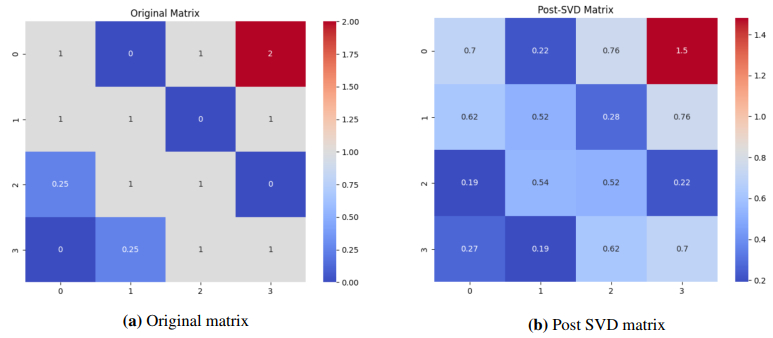
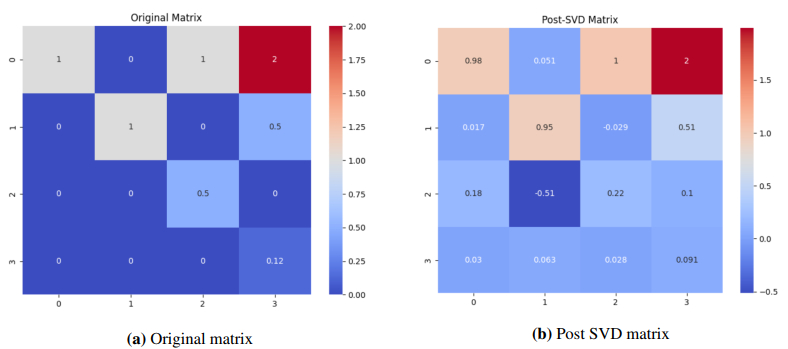
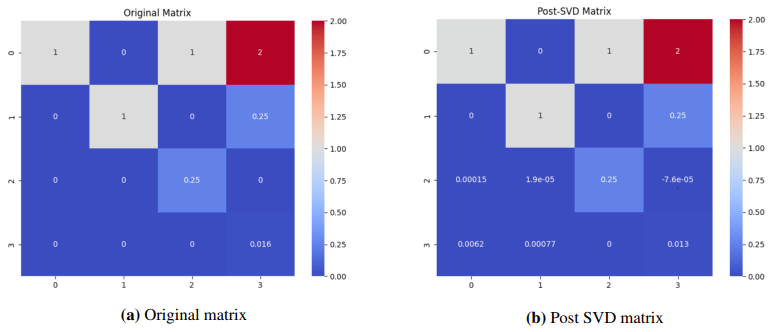
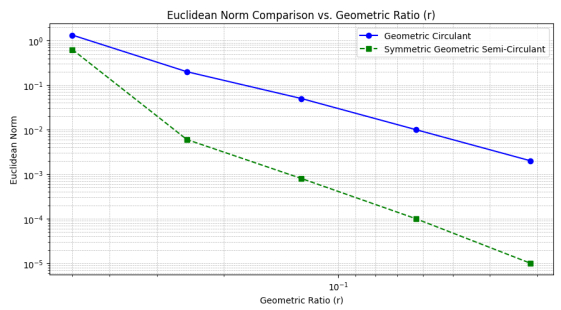
This study explores the mathematical and computational characteristics of geometrically weighted circulant and symmetric geometric semicirculant matrices with the aim of identifying their potential as efficient structural tools in artificial intelligence (AI) architectures and data compressions. At the preliminary stage, a comprehensive mathematical framework was established, including the derivation of various matrix norms (such as spectral and Frobenius norms), determinants, and matrix inverses. The construction of these matrices is guided by Fibonacci numbers, whose intrinsic link to the golden ratio introduces a natural geometric decay pattern. This biologically inspired structure contributes to the balance, regularity, and interpretability of the resulting matrices, which are particularly well-suited for low-complexity modeling in AI systems. Subsequently, singular value decomposition (SVD) was employed to perform low-rank approximations, with a focus on evaluating information loss through Frobenius norm differences between original and reconstructed matrices. Techniques such as soft-thresholding and selective singular value removal were applied to assess data compression performance. Results demonstrated that symmetric geometric semicirculant matrices yielded smaller norm deviations, indicating superior data retention. Moreover, by tuning the geometric ratio parameter $ r $, further improvements in matrix compactness and fidelity were achieved, especially when reducing $ r $ to values like $ \frac{1}{4} $. These outcomes were visually confirmed through heatmap representations, highlighting the robustness and compression potential of the proposed matrices.
Citation: Bahar Kuloğlu, Hasan Gökbaş, Engin Özkan. Fibonacci-based geometrically weighted circulant matrices: low-rank approximations and applications in data compression[J]. AIMS Mathematics, 2026, 11(1): 1968-1997. doi: 10.3934/math.2026082
This study explores the mathematical and computational characteristics of geometrically weighted circulant and symmetric geometric semicirculant matrices with the aim of identifying their potential as efficient structural tools in artificial intelligence (AI) architectures and data compressions. At the preliminary stage, a comprehensive mathematical framework was established, including the derivation of various matrix norms (such as spectral and Frobenius norms), determinants, and matrix inverses. The construction of these matrices is guided by Fibonacci numbers, whose intrinsic link to the golden ratio introduces a natural geometric decay pattern. This biologically inspired structure contributes to the balance, regularity, and interpretability of the resulting matrices, which are particularly well-suited for low-complexity modeling in AI systems. Subsequently, singular value decomposition (SVD) was employed to perform low-rank approximations, with a focus on evaluating information loss through Frobenius norm differences between original and reconstructed matrices. Techniques such as soft-thresholding and selective singular value removal were applied to assess data compression performance. Results demonstrated that symmetric geometric semicirculant matrices yielded smaller norm deviations, indicating superior data retention. Moreover, by tuning the geometric ratio parameter $ r $, further improvements in matrix compactness and fidelity were achieved, especially when reducing $ r $ to values like $ \frac{1}{4} $. These outcomes were visually confirmed through heatmap representations, highlighting the robustness and compression potential of the proposed matrices.

| [1] |
H. Akkuş, B. Kuloğlu, E. Özkan, Analytical characterization of self-similarity in $k$-Cullen sequences through generating functions and Fibonacci scaling, Fractal Fract., 9 (2025), 380. https://doi.org/10.3390/fractalfract9060380 doi: 10.3390/fractalfract9060380

|
| [2] |
F. Breuer, E. Lötter, B. van der Merwe, Ducci-sequences and cyclotomic polynomials, Finite Fields Appl., 13 (2007), 293–304. https://doi.org/10.1016/j.ffa.2005.11.003 doi: 10.1016/j.ffa.2005.11.003
|
| [3] | R. Brown, J. L. Merzel, The number of Ducci sequences with given period, Fibonacci Quart., 45 (2007), 115–121. |
| [4] | P. M. M. C. Catarino, A. Borges, On Leonardo numbers, Acta Math. Univ. Comenian., 89 (2019), 75–86. |
| [5] |
J. F. Cai, E. J. Candès, Z. W. Shen, A singular value thresholding algorithm for matrix completion, SIAM J. Optim., 20 (2010), 1956–1982. https://doi.org/10.1137/080738970 doi: 10.1137/080738970
|
| [6] |
N. J. Calkin, J. G. Stevens, D. M. Thomas, A characterization for the length of cycles of the $N$-number Ducci game, Fibonacci Quart., 43 (2005), 53–59. https://doi.org/10.1080/00150517.2005.12428392 doi: 10.1080/00150517.2005.12428392
|
| [7] |
E. J. Candès, B. Recht, Exact matrix completion via convex optimization, Found. Comput. Math., 9 (2009), 717–772. https://doi.org/10.1007/s10208-009-9045-5 doi: 10.1007/s10208-009-9045-5
|
| [8] |
E. J. Candès, T. Tao, The power of convex relaxation: near-optimal matrix completion, IEEE Trans. Inform. Theory, 56 (2010), 2053–2080. https://doi.org/10.1109/TIT.2010.2044061 doi: 10.1109/TIT.2010.2044061
|
| [9] | P. J. Davis, Circulant matrices, John Wiley & Sons, 1979. |
| [10] |
D. L. Donoho, I. M. Johnstone, Adapting to unknown smoothness via wavelet shrinkage, J. Amer. Statist. Assoc., 90 (1995), 1200–1224. https://doi.org/10.1080/01621459.1995.10476626 doi: 10.1080/01621459.1995.10476626
|
| [11] |
C. Eckart, G. Young, The approximation of one matrix by another of lower rank, Psychometrika, 1 (1936), 211–218. https://doi.org/10.1007/BF02288367 doi: 10.1007/BF02288367
|
| [12] |
M. Gavish, D. L. Donoho, The optimal hard threshold for singular values is $4/\sqrt{3}$, IEEE Trans. Inform. Theory, 60 (2014), 5040–5053. https://doi.org/10.1109/TIT.2014.2323359 doi: 10.1109/TIT.2014.2323359
|
| [13] |
H. Glaser, G. Schöffl, Ducci-sequences and Pascal's triangle, Fibonacci Quart., 33 (1995), 313–324. https://doi.org/10.1080/00150517.1995.12429121 doi: 10.1080/00150517.1995.12429121
|
| [14] |
H. Gökbaş, R. Türkmen, On the norms of $r$-Toeplitz matrices involving Fibonacci and Lucas numbers, Adv. Linear Algebra Matrix Theory, 6 (2016), 31–39. https://doi.org/10.4236/alamt.2016.62005 doi: 10.4236/alamt.2016.62005
|
| [15] | G. H. Golub, C. F. Van Loan, Matrix computations, 4 Eds., The Johns Hopkins University Press, 2013. |
| [16] |
S. Hamlomo, M. Atemkeng, Y. Brima, C. Nunhokee, J. Baxter, A systematic review of low-rank and local low-rank matrix approximation in big data medical imaging, Neural Comput. Appl., 37 (2025), 9481–9536. https://doi.org/10.1007/s00521-025-11055-2 doi: 10.1007/s00521-025-11055-2
|
| [17] | R. A. Horn, C. R. Johnson, Topics in matrix analysis, Cambridge University Press, 1991. https://doi.org/10.1017/CBO9780511840371 |
| [18] |
J. B. Hiriart-Urruty, H. Y. Le, From Eckart and Young approximation to Moreau envelopes and vice versa, RAIRO Oper. Res., 47 (2013), 299–310. https://doi.org/10.1051/ro/2013040 doi: 10.1051/ro/2013040
|
| [19] | B. Kuloğlu, Structural and closed-form analysis of Jacobsthal and Jacobsthal Lucas $p$-numbers, Proc. Indian Natl. Sci. Acad., 2025. https://doi.org10.1007/s43538-025-00502-2 |
| [20] |
P. Kittisuwan, P. Akkaraekthalin, Improved low-rank matrix approximation in multivariate case, Int. J. Comput. Methods, 22 (2025), 2450044. https://doi.org/10.1142/S0219876224500440 doi: 10.1142/S0219876224500440
|
| [21] |
Y. Koren, R. Bell, C. Volinsky, Matrix factorization techniques for recommender systems, Computer, 42 (2009), 30–37. https://doi.org/10.1109/MC.2009.263 doi: 10.1109/MC.2009.263
|
| [22] |
B. Kuloğlu, E. Özkan, On generalized $(k, r)$-Gauss Pell numbers, J. Sci. Arts, 3 (2021), 617–624. https://doi.org/10.46939/J.Sci.Arts-21.3-a02 doi: 10.46939/J.Sci.Arts-21.3-a02
|
| [23] | B. Kuloğlu, J. F. Peters, M. Uysal, E. Özkan, Investigation of higher order Horadam numbers, their associated transforms and self-similarity, Math. Montisnigri, LXIII (2025), 33–46. |
| [24] |
C. Kızılateş, N. Tuğlu, On the bounds for the spectral norms of geometric circulant matrices, J. Inequal. Appl., 2016 (2016), 312. https://doi.org/10.1186/s13660-016-1255-1 doi: 10.1186/s13660-016-1255-1
|
| [25] |
R. Mathias, The spectral norm of a nonnegative matrix, Linear Algebra Appl., 131 (1990), 269–284. https://doi.org/10.1016/0024-3795(90)90403-Y doi: 10.1016/0024-3795(90)90403-Y
|
| [26] | R. Mazumder, T. Hastie, R. Tibshirani, Spectral regularization algorithms for learning large incomplete matrices, J. Mach. Learn. Res., 11 (2010), 2287–2322. |
| [27] | J. S. Respondek, Fast matrix multiplication with applications, In: Studies in big data, Volume 166, Cham: Springer, 2025. https://doi.org/10.1007/978-3-031-76930-6 |
| [28] | B. Radičić, On $k$-circulant matrices involving geometric sequence, Hacet. J. Math. Stat., 48 (2019), 805–817. |
| [29] |
B. Radičić, On $k$-circulant matrices (with geometrik sequence), Quaest. Math., 39 (2016), 135–144. https://doi.org/10.2989/16073606.2015.1024185 doi: 10.2989/16073606.2015.1024185
|
| [30] |
N. Sreekanth, An enhanced low rank approximation SVD-based method for image denoising, Int. J. Eng. Adv. Technol., 8 (2019), 1832–1838. https://doi.org/10.35940/ijeat.F1349.0986S319 doi: 10.35940/ijeat.F1349.0986S319
|
| [31] |
S. Solak, M. Bahşi, Some properties of circulant matrices with Ducci sequences, Linear Algebra Appl., 542 (2018), 557–568. https://doi.org/10.1016/j.laa.2017.09.010 doi: 10.1016/j.laa.2017.09.010
|
| [32] |
Y. Soykan, E. Taşdemir, A note on $k$-circulant matrices with the generalized third-order Jacobsthal numbers, Adv. Stud. Euro Tbilisi Math. J., 17 (2024), 81–101. https://doi.org/10.32513/asetmj/1932200824041 doi: 10.32513/asetmj/1932200824041
|
| [33] |
R. Türkmen, H. Gökbaş, On the spectral norm of $r$-circulant matrices with the Pell and Pell-Lucas numbers, J. Inequal. Appl., 2016 (2016), 65. https://doi.org/10.1186/s13660-016-0997-0 doi: 10.1186/s13660-016-0997-0
|
| [34] |
Y. Z. Wang, H. X. Zhang, X. Fang, X. T. Cui, W. X. Ning, D. Z. Wang, et al., Hybrid threshold denoising framework using singular value decomposition for side-channel analysis preprocessing, Entropy, 25 (2023), 1133. https://doi.org/10.3390/e25081133 doi: 10.3390/e25081133
|
Figures(5)

Bahar Kuloğlu, Hasan Gökbaş, Engin Özkan. Fibonacci-based geometrically weighted circulant matrices: low-rank approximations and applications in data compression[J]. AIMS Mathematics, 2026, 11(1): 1968-1997. doi: 10.3934/math.2026082





 DownLoad: