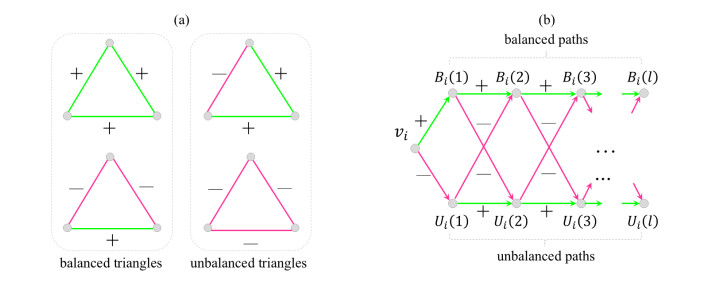
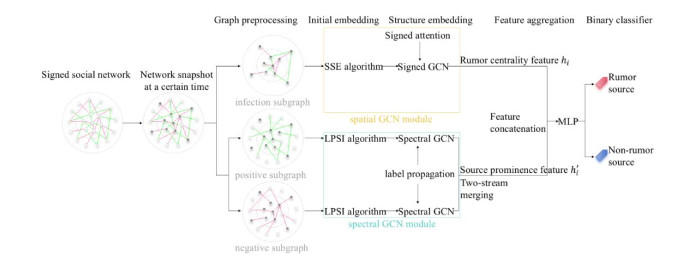
With the help of deepfake algorithms and social bots, the problems of consciousness penetration and cognitive manipulation caused by the outbreak of internet rumors have become prominent. Accurately locating the rumor sources and quickly cutting off the critical paths of rumor propagation will become an effective ways to curb the explosive spread of rumors and the sudden accumulation of negative emotions. In this paper, we combine the complementary advantages of signed graph convolutional networks in spatial and spectral domains, propose an improved multirumor source localization framework for signed social networks, and extend the rumor centrality principle and source prominence theory to the scope of signed networks. First, structural balance theory is used to accurately model positive and negative social relations. Second, a signed graph convolutional network based on signed attention mechanism is proposed to extract the rumor centrality feature from the infection subgraph. Then, a two-stream graph convolutional network based on a label propagation mechanism is proposed to extract the source prominence feature from the subgraph containing only positive edges and the subgraph containing only negative edges, respectively. Finally, the center feature of the infected structure and the position distribution feature of infected and uninfected nodes are integrated in a unified framework for multirumor source localization. Extensive experimental results on four real-world social network datasets show that compared with state-of-the-art algorithms, our proposed algorithm further improves the accuracy and robustness in the task of multiple rumor source localization.
Citation: Ying Guo, Yong-nan Li. Multiple rumor source localization in signed social networks driven by data intelligence[J]. AIMS Mathematics, 2026, 11(1): 1927-1953. doi: 10.3934/math.2026080
With the help of deepfake algorithms and social bots, the problems of consciousness penetration and cognitive manipulation caused by the outbreak of internet rumors have become prominent. Accurately locating the rumor sources and quickly cutting off the critical paths of rumor propagation will become an effective ways to curb the explosive spread of rumors and the sudden accumulation of negative emotions. In this paper, we combine the complementary advantages of signed graph convolutional networks in spatial and spectral domains, propose an improved multirumor source localization framework for signed social networks, and extend the rumor centrality principle and source prominence theory to the scope of signed networks. First, structural balance theory is used to accurately model positive and negative social relations. Second, a signed graph convolutional network based on signed attention mechanism is proposed to extract the rumor centrality feature from the infection subgraph. Then, a two-stream graph convolutional network based on a label propagation mechanism is proposed to extract the source prominence feature from the subgraph containing only positive edges and the subgraph containing only negative edges, respectively. Finally, the center feature of the infected structure and the position distribution feature of infected and uninfected nodes are integrated in a unified framework for multirumor source localization. Extensive experimental results on four real-world social network datasets show that compared with state-of-the-art algorithms, our proposed algorithm further improves the accuracy and robustness in the task of multiple rumor source localization.

| [1] |
Z. X. Jiang, Z. L. Hu, F. L. Huang, Source localization in signed networks based on dynamic message passing algorithm, Chaos Soliton. Fract., 188 (2024), 115532. https://doi.org/10.1016/j.chaos.2024.115532 doi: 10.1016/j.chaos.2024.115532

|
| [2] |
A. Zubiaga, A. Aker, K. Bontcheva, M. Liakata, R. Procter, Detection and resolution of rumours in social media: A survey, ACM Comput. Surv., 51 (2018), 32. https://doi.org/10.1145/3161603 doi: 10.1145/3161603
|
| [3] |
D. Shah, T. Zaman, Rumor centrality: A universal source detector, ACM SIGMETRICS Perform. Eval. Rev., 40 (2012), 199‒210. https://doi.org/10.1145/2318857.2254782 doi: 10.1145/2318857.2254782
|
| [4] |
S. S. Ali, T. Anwar, S. A. M. Rizvi, A revisit to the infection source identification problem under classical graph centrality measures, Online Soc. Netw. Media, 17 (2020), 100061. https://doi.org/10.1016/j.osnem.2020.100061 doi: 10.1016/j.osnem.2020.100061
|
| [5] |
M. Li, X. Wang, K. Gao, S. S. Zhang, A survey on information diffusion in online social networks: Models and methods, Information, 8 (2017), 118. https://doi.org/10.3390/info8040118 doi: 10.3390/info8040118
|
| [6] | J. Zhang, C. C. Aggarwal, P. S. Yu, Rumor initiator detection in infected signed networks, In: Proceedings of the 37th IEEE International Conference on Distributed Computing Systems, 2017, 1900‒1909. https://doi.org/10.1109/ICDCS.2017.72 |
| [7] |
H. J. Li, W. Xu, S. Song, W. X. Wang, M. Perc, The dynamics of epidemic spreading on signed networks, Chaos Soliton Fract., 151 (2021), 111294. https://doi.org/10.1016/j.chaos.2021.111294 doi: 10.1016/j.chaos.2021.111294
|
| [8] | Z. Wang, C. Wang, J. Pei, X. J. Ye, Multiple source detection without knowing the underlying propagation model, In: Proceedings of the 31st AAAI Conference on Artificial Intelligence, 2017. https://doi.org/10.1609/aaai.v31i1.10477 |
| [9] |
Z. W. Ma, H. J. Wang, Z. L. Hu, X. B. Zhu, Y. Z. Huang, F. Huang, DISLPSI: A framework for source localization in signed social networks with structural balance, Phys. Lett. A, 523 (2024), 129772. https://doi.org/10.1016/j.physleta.2024.129772 doi: 10.1016/j.physleta.2024.129772
|
| [10] |
L. Qiu, S. Sai, M. Wei, BPSL: A new rumor source location algorithm based on the time-stamp back propagation in social networks, Appl. Intell., 52 (2022), 8603‒8615. https://doi.org/10.1007/s10489-021-02919-w doi: 10.1007/s10489-021-02919-w
|
| [11] |
Z. W. Ma, L. Sun, Z. G. Ding, Y. Z. Huang, Z. L. Hu, Source localization in signed networks with effective distance, Chin. Phys. B, 33 (2024), 028902. https://doi.org/10.1088/1674-1056/ad1482 doi: 10.1088/1674-1056/ad1482
|
| [12] |
G. Baggio, D. S. Bassett, F. Pasqualetti, Data-driven control of complex networks, Nat. Commun., 12 (2021), 1429. https://doi.org/10.1038/s41467-021-21554-0 doi: 10.1038/s41467-021-21554-0
|
| [13] | K. Shenoy, R. Pasumarthy, V. Chellaboina, Online data-driven control of networks, In: Proceedings of the European Control Conference, 2024, 2985‒2990. https://doi.org/10.23919/ECC64448.2024.10591319 |
| [14] |
P. Ji, J. C. Ye, Y. Mu, W. Lin, Y. Tian, C. Hens, et al., Signal propagation in complex networks, Phys. Rep., 1017 (2023), 1‒96. https://doi.org/10.1016/j.physrep.2023.03.005 doi: 10.1016/j.physrep.2023.03.005
|
| [15] | X. L. Ru, J. M. Moore, X. Y. Zhang, Y. T. Zeng, G. Yan, Inferring patient zero on temporal networks via graph neural networks, In: Proceedings of the 37th AAAI Conference on Artificial Intelligence, 2023, 9632‒9640. https://doi.org/10.1609/aaai.v37i8.26152 |
| [16] |
W. Z. Zhang, Z. Y. Liu, The influence maximization algorithm for integrating attribute graph clustering and heterogeneous graph transformer, Heliyon, 10 (2024), e38916. https://doi.org/10.1016/j.heliyon.2024.e38916 doi: 10.1016/j.heliyon.2024.e38916
|
| [17] |
Y. D. Li, H. B. Gao, Y. X. Gao, J. X. Guo, W. L. Wu, A survey on influence maximization: From an ML-based combinatorial optimization, ACM Trans. Knowl. Discov. Data, 17 (2023), 133. https://doi.org/10.1145/3604559 doi: 10.1145/3604559
|
| [18] | M. Dong, B. Zheng, N. Q. V. Hung, H. Su, G. H. Li, Multiple rumor source detection with graph convolutional networks, In: Proceedings of the 28th ACM International Conference on Information and Knowledge Management, 2019,569‒578. https://doi.org/10.1145/3357384.3357994 |
| [19] | C. Ling, J. J. Jiang, J. X. Wang, Z. Liang, Source localization of graph diffusion via variational autoencoders for graph inverse problems, In: Proceedings of the 28th ACM SIGKDD Conference on Knowledge Discovery and Data Mining, 2022, 1010‒1020. https://doi.org/10.1145/3534678.3539288 |
| [20] |
X. Xu, T. J. Qian, Z. Xiao, N. Zhang, J. Wu, F. Zhou, PGSL: A probabilistic graph diffusion model for source localization, Expert Syst. Appl., 238 (2024), 122028. https://doi.org/10.1016/j.eswa.2023.122028 doi: 10.1016/j.eswa.2023.122028
|
| [21] | X. Yan, H. Fang, Q. He, Diffusion model for graph inverse problems: towards effective source localization on complex networks, In: Proceedings of the 37th International Conference on Neural Information Processing Systems, 2023, 22326‒22350. |
| [22] |
D. Yan, Y. Zhang, W. Xie, Y. Jin, Y. Zhang, MUSE: Multi-faceted attention for signed network embedding, Neurocomputing, 519 (2023), 36‒43. https://doi.org/10.1016/j.neucom.2022.11.021 doi: 10.1016/j.neucom.2022.11.021
|
| [23] |
J. Chen, Z. Wu, M. Umar, J. Yan, X. Liao, B. Tian, Learning embedding for signed network in social media with global information, IEEE Trans. Comput. Soc. Syst., 11 (2024), 871‒879. https://doi.org/10.1109/TCSS.2022.3217840 doi: 10.1109/TCSS.2022.3217840
|
| [24] |
A. Gallo, D. Garlaschelli, R. Lambiotte, F. Saracco, T. Squartini, Testing structural balance theories in heterogeneous signed networks, Commun. Phys., 7 (2024), 154. https://doi.org/10.1038/s42005-024-01640-7 doi: 10.1038/s42005-024-01640-7
|
| [25] |
M. Mueller, S. Ramkumar, Signed networks-The role of negative links for the diffusion of innovation, Technol. Forecast. Soc. Change, 192 (2023), 122575. https://doi.org/10.1016/j.techfore.2023.122575 doi: 10.1016/j.techfore.2023.122575
|
| [26] | T. Bian, X. Xiao, T. Xu, P. L. Zhao, W. B. Huang, Y. Rong, et al., Rumor detection on social media with bi-directional graph convolutional networks, In: Proceedings of the 34th AAAI conference on artificial intelligence, 2020,549‒556. https://doi.org/10.1609/aaai.v34i01.5393 |
| [27] |
F. Heider, Attitudes and cognitive organization, J. Psychol., 21 (1946), 107‒112. https://doi.org/10.1080/00223980.1946.9917275 doi: 10.1080/00223980.1946.9917275
|
| [28] |
D. Cartwright, F. Harary, Structural balance: a generalization of Heider's theory, Psychol. Rev., 63 (1956), 277‒293. https://doi.org/10.1037/h0046049 doi: 10.1037/h0046049
|
| [29] | J. Kunegis, S. Schmidt, A. Lommatzsch, Spectral analysis of signed graphs for clustering, prediction and visualization, In: Proceedings of the SIAM International Conference on Data Mining, 2010,559‒570. https://doi.org/10.1137/1.9781611972801.49 |
| [30] | Y. Xiao, G. Kang, J. Liu, B. Q. Cao, L. H. Ding, WSGCN4SLP: Weighted signed graph convolutional network for service link prediction, In: Proceedings of the IEEE International Conference on Web Services, 2021,135‒144. https://doi.org/10.1109/ICWS53863.2021.00029 |
| [31] |
Y. Wu, L. Hu, Y. Wang, Signed attention based graph neural network for graphs with heterophily, Neurocomputing, 557 (2023), 126731. https://doi.org/10.1016/j.neucom.2023.126731 doi: 10.1016/j.neucom.2023.126731
|
| [32] | T. Derr, Y. Ma, J. L. Tang, Signed graph convolutional networks, In: Proceedings of the IEEE International Conference on Data Mining, 2018,929‒934. https://doi.org/10.1109/ICDM.2018.00113 |
| [33] | M. Schlichtkrull, T. N. Kipf, P. Bloem, R. V. D. Berg, I. Titov, M. Welling, Modeling relational data with graph convolutional networks, In: Proceedings of the European Semantic Web Conference, 2018,593‒607. https://doi.org/10.1007/978-3-319-93417-4_38 |
| [34] |
C. X. He, J. Y. Zeng, Y. Li, S. T. Liu, L. L. Liu, C. Xiao, Two-stream signed directed graph convolutional network for link prediction, Physica A, 605 (2022), 128036. https://doi.org/10.1016/j.physa.2022.128036 doi: 10.1016/j.physa.2022.128036
|
| [35] | T. N. Kipf, M. Welling, Semi-supervised classification with graph convolutional networks, In: Proceedings of the 5th International Conference on Learning Representations, 2017, 1‒14. |
| [36] | S. Kumar, F. Spezzano, V. Subrahmanian, C. Faloutsos, Edge weight prediction in weighted signed networks, In: Proceedings of the 16th IEEE International Conference on Data Mining, 2016,221‒230. https://doi.org/10.1109/ICDM.2016.0033 |
| [37] | J. Leskovec, D. Huttenlocher, J. Kleinberg, Signed networks in social media, In: Proceedings of the 28th ACM Conference on Human Factors in Computing Systems, 2010, 1361‒1370. https://doi.org/10.1145/1753326.1753532 |
| [38] | A. Paszke, S. Gross, S. Chintala, G. Chanan, E. Yang, Z. DeVito, et al., Automatic differentiation in pytorch, In: Proceedings of the 31st International Conference on Neural Information Processing Systems, 2017, 1‒4. https://openreview.net/forum?id = BJJsrmfCZ |
| [39] | M. Fey, J. E. Lenssen, Fast graph representation learning with PyTorch Geometric, 2019, arXiv: 1903.02428v3. https://doi.org/10.48550/arXiv.1903.02428 |
| [40] | P. Veličković, G. Cucurull, A. Casanova, A. Romero, P. Liò, Y. Bengio, Graph attention networks, 2018, arXiv: 1710.10903v3. https://doi.org/10.48550/arXiv.1710.10903 |
| [41] |
L. Zhu, T. Zheng, Pattern dynamics analysis and application of West Nile virus spa-tiotemporal models based on higher-order network topology, Bull. Math. Biol., 87 (2025), 121. https://doi.org/10.1007/s11538-025-01501-6 doi: 10.1007/s11538-025-01501-6
|
Figures(10) / Tables(6)

Ying Guo, Yong-nan Li. Multiple rumor source localization in signed social networks driven by data intelligence[J]. AIMS Mathematics, 2026, 11(1): 1927-1953. doi: 10.3934/math.2026080





 DownLoad: