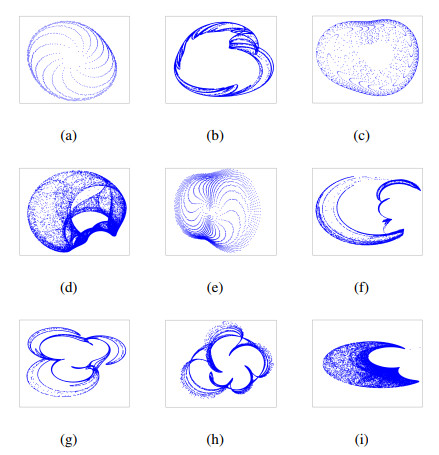
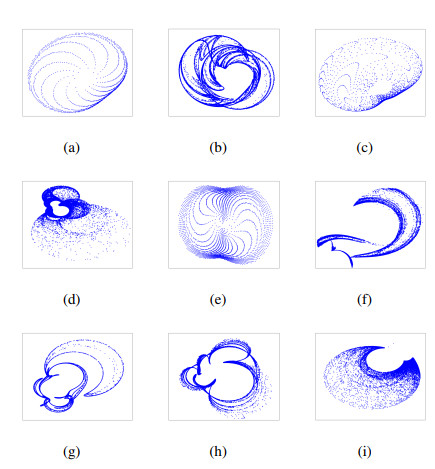
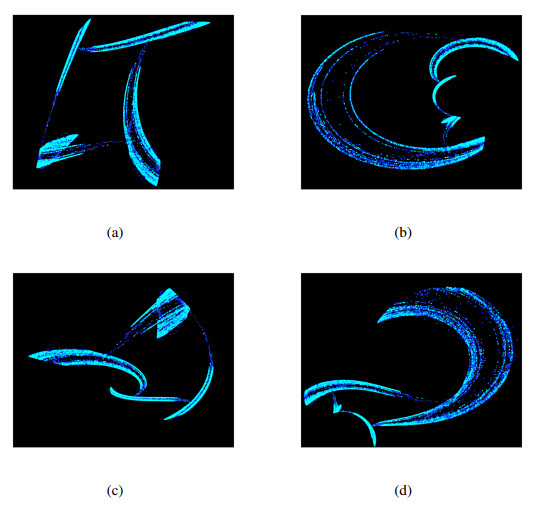
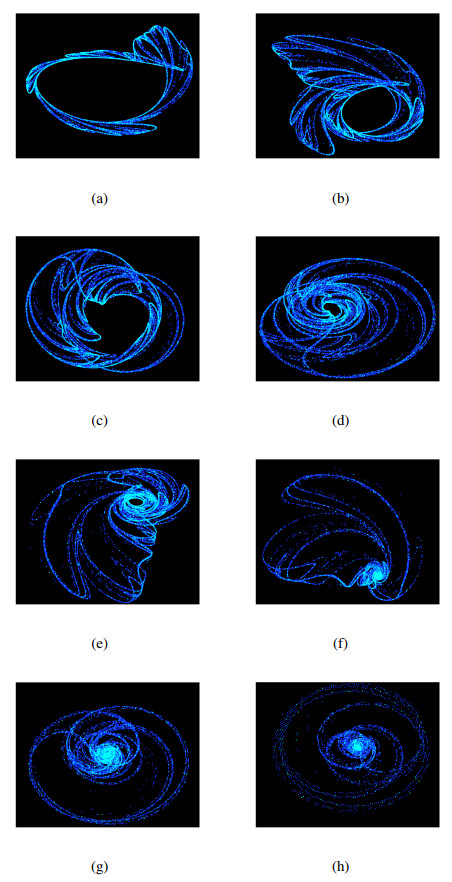
This paper discusses the effects of applying different non-linear transformations in combination to well-known fractal structures and aggregates, to obtain novel fractal images. Five different non-linear transformations are selected to be combined, and applied to existing aggregates, and the new fractal structures obtained are discussed. We show how different non-linear transformations effects (bending effects, diffusion effects, etc.) can be combined just by function composition processes, and their final results as new fractal images. We analyze the effects of the combination of non-linear transformations over classical fractals such as the Sierpinski triangle and Sierpinski carpet, in terms of the fractal dimension of the new structures created. Finally, we will also show the effect of the non-linear transformation on other fractal structures, such as diffusion limited aggregation and strange attractors.
Citation: Sancho Salcedo-Sanz, Pablo Álvarez-Couso, Luis Castelo-Sardina, Jorge Pérez-Aracil. Non-linear transformations combinations on fractal structures and aggregates[J]. AIMS Mathematics, 2026, 11(1): 1878-1899. doi: 10.3934/math.2026078
This paper discusses the effects of applying different non-linear transformations in combination to well-known fractal structures and aggregates, to obtain novel fractal images. Five different non-linear transformations are selected to be combined, and applied to existing aggregates, and the new fractal structures obtained are discussed. We show how different non-linear transformations effects (bending effects, diffusion effects, etc.) can be combined just by function composition processes, and their final results as new fractal images. We analyze the effects of the combination of non-linear transformations over classical fractals such as the Sierpinski triangle and Sierpinski carpet, in terms of the fractal dimension of the new structures created. Finally, we will also show the effect of the non-linear transformation on other fractal structures, such as diffusion limited aggregation and strange attractors.

| [1] |
C. J. Evertsz, B. B. Mandelbrot, Fractal aggregates, and the current lines of their electrostatic potentials, Physica A, 177 (1991), 589–592. https://doi.org/10.1016/0378-4371(91)90205-Q doi: 10.1016/0378-4371(91)90205-Q

|
| [2] | D. J. Aks, J. C. Sprott, Quantifying aesthetic preference for chaotic patterns, Empir. Stud. Arts, 14 (1996), 1–16. |
| [3] |
T. A. Witten, L. M. Sander, Diffusion-limited aggregation, Phys. Rev. B, 27 (1983), 5686. https://doi.org/10.1103/PhysRevB.27.5686 doi: 10.1103/PhysRevB.27.5686
|
| [4] |
P. Meakin, Formation of fractal clusters and networks by irreversible diffusion-limited aggregation, Phys. Rev. Lett., 51 (1983), 1119. https://doi.org/10.1103/PhysRevLett.51.1119 doi: 10.1103/PhysRevLett.51.1119
|
| [5] |
E. Guesnet, R. Dendievel, D. Jauffrès, C. Martin, B. Yrieix, A growth model for the generation of particle aggregates with tunable fractal dimension, Physica A, 513 (2019), 63–73. https://doi.org/10.1016/j.physa.2018.07.061 doi: 10.1016/j.physa.2018.07.061
|
| [6] |
J. C. Sprott, Automatic generation of iterated function systems, Comput. Graph., 18 (1994), 417–425. https://doi.org/10.1016/0097-8493(94)90042-6 doi: 10.1016/0097-8493(94)90042-6
|
| [7] |
M. Barnsley, J. Hutchinson, Ö. Stenflo, A fractal valued random iteration algorithm and fractal hierarchy, Fractals, 13 (2005), 111–146. https://doi.org/10.1142/S0218348X05002799 doi: 10.1142/S0218348X05002799
|
| [8] |
B. Zhang, Y. Zhang, Y. Xie, Generating irregular fractals based on iterated function systems, AIMS Math., 9 (2024), 13346–13357. https://doi.org/10.3934/math.2024651 doi: 10.3934/math.2024651
|
| [9] |
G. Williams, Using the fractal paintbrush, J. Math. Arts, 3 (2009), 85–96. https://doi.org/10.1080/17513470902953396 doi: 10.1080/17513470902953396
|
| [10] | L. Zhang, T. C. Chang, Y. M. Mao, A kind of IFS fractal image generation method based on Markov random process, In: 2019 IEEE International Conference on Computation, Communication and Engineering (ICCCE), IEEE, 2019, 1–4. https://doi.org/10.1109/ICCCE48422.2019.9010799 |
| [11] | X. Tao, S. Bai, C. Liu, H. Chen, Y. Yan, Algorithm of controllable fractal image based on ifs code, In: 2021 IEEE International Conference on Power Electronics, Computer Applications (ICPECA), IEEE, 2021,801–809. https://doi.org/10.1109/ICPECA51329.2021.9362569 |
| [12] |
M. D. Pham, Fractal approximation of chaos game representations using recurrent iterated function systems, AIMS Math., 5 (2019), 1824–1840. http://dx.doi.org/10.3934/math.2019.6.1824 doi: 10.3934/math.2019.6.1824
|
| [13] |
P. Grassberger, I. Procaccia, Measuring the strangeness of strange attractors, Physica D, 9 (1983), 189–208. https://doi.org/10.1016/0167-2789(83)90298-1 doi: 10.1016/0167-2789(83)90298-1
|
| [14] |
P. Grassberger, I. Procaccia, Characterization of strange attractors, Phys. Rev. Lett., 50 (1983), 346. https://doi.org/10.1103/PhysRevLett.50.346 doi: 10.1103/PhysRevLett.50.346
|
| [15] | J. C. Sprott, Strange attractors: Creating patterns in chaos, M & T Books, New York, 9 (1993). |
| [16] |
A. Lindenmayer, Mathematical models for cellular interactions in development Ⅰ. Filaments with one-sided inputs, J. Theor. Biol., 18 (1968), 280–299. https://doi.org/10.1016/0022-5193(68)90079-9 doi: 10.1016/0022-5193(68)90079-9
|
| [17] | J. Mishra, S. Mishra, L-system fractals, Elsevier, 209 (2007). |
| [18] | P. Prusinkiewicz, J. Hanan, Lindenmayer systems, fractals, and plants, Springer Science & Business Media, 79 (2013). https://doi.org/10.4324/9780203111581-10 |
| [19] |
M. Batchelor, B. Henry, Diffusion-limited aggregation with eden growth surface kinetics, Physica A, 203 (1994), 566–582. https://doi.org/10.1016/0378-4371(94)90015-9 doi: 10.1016/0378-4371(94)90015-9
|
| [20] |
S. Salcedo-Sanz, L. Cuadra, Hybrid L-systems-diffusion limited aggregation schemes, Physica A, 514 (2019), 592–605. https://doi.org/10.1016/j.physa.2018.09.127 doi: 10.1016/j.physa.2018.09.127
|
| [21] |
S. Salcedo-Sanz, L. Cuadra, Multi-fractal multi-resolution structures from DLA-strange attractors hybrids, Commun. Nonlinear Sci., 83 (2020), 105092. https://doi.org/10.1016/j.cnsns.2019.105092 doi: 10.1016/j.cnsns.2019.105092
|
| [22] |
Z. Xia, The growth simulation of pine-needle like structure with diffusion-limited aggregation and oriented attachment, RSC Adv., 12 (2022), 22946–22950. https://doi.org/10.1039/D2RA03649E doi: 10.1039/D2RA03649E
|
| [23] |
X. Tian, H. Xia, Crossover effects and dynamic scaling properties from Eden growth to diffusion-limited aggregation, Phys. Lett. A, 508 (2024), 129494. https://doi.org/10.1016/j.physleta.2024.129494 doi: 10.1016/j.physleta.2024.129494
|
| [24] |
K. Nakamura, Iterated inversion system: An algorithm for efficiently visualizing Kleinian groups and extending the possibilities of fractal art, J. Math. Arts, 15 (2021), 106–136. https://doi.org/10.1080/17513472.2021.1943998 doi: 10.1080/17513472.2021.1943998
|
| [25] |
P. V. Loocke, Non-linear iterated function systems and the creation of fractal patterns over regular polygons, Comput. Graph., 33 (2009), 698–704. https://doi.org/10.1016/j.cag.2009.05.003 doi: 10.1016/j.cag.2009.05.003
|
| [26] |
K. Gdawiec, Star-shaped set inversion fractals, Fractals, 22 (2014), 1450009. https://doi.org/10.1142/S0218348X14500091 doi: 10.1142/S0218348X14500091
|
| [27] |
K. Gdawiec, Inversion fractals and iteration processes in the generation of aesthetic patterns, Comput. Graph. Forum, 36 (2017), 35–45. https://doi.org/10.1111/cgf.12783 doi: 10.1111/cgf.12783
|
| [28] | G. Helt, Extending mandelbox fractals with shape inversions, arXiv preprint, 2018. https://doi.org/10.48550/arXiv.1809.01720 |
| [29] |
J. L. Ramirez, G. N. Rubiano, B. J. Zlobec, Generating fractal patterns by using p-circle inversion, Fractals, 23 (2015), 1550047. https://doi.org/10.1142/S0218348X15500474 doi: 10.1142/S0218348X15500474
|
| [30] |
P. Ouyang, K. W. Chung, A. Nicolas, K. Gdawiec, Self-similar fractal drawings inspired by mc escher's print square limit, ACM T. Graphic., 40 (2021), 1–34. https://doi.org/10.1145/3447647 doi: 10.1145/3447647
|
| [31] |
T. C. Halsey, Diffusion-limited aggregation: A model for pattern formation, Phys. Today, 53 (2000), 36–41. https://doi.org/10.1063/1.1333284 doi: 10.1063/1.1333284
|
| [32] |
H. Stanley, A. Coniglio, S. Havlin, J. Lee, S. Schwarzer, M. Wolf, Diffusion limited aggregation: A paradigm of disorderly cluster growth, Physica A, 205 (1994), 254–271. https://doi.org/10.1016/0378-4371(94)90503-7 doi: 10.1016/0378-4371(94)90503-7
|
| [33] |
S. Ferreira Jr, S. Alves, A. F. Brito, J. Moreira, Morphological transition between diffusion-limited and ballistic aggregation growth patterns, Phys. Rev. E, 71 (2005), 051402. https://doi.org/10.1103/PhysRevE.71.051402 doi: 10.1103/PhysRevE.71.051402
|
| [34] |
A. Ben-Mizrachi, I. Procaccia, P. Grassberger, Characterization of experimental (noisy) strange attractors, Phys. Rev. A, 29 (1984), 975. https://doi.org/10.1007/BF01312485 doi: 10.1007/BF01312485
|
| [35] | M. F. Barnsley, Superfractals, Cambridge University Press, 2006. |
| [36] |
M. F. Barnsley, Transformations between self-referential sets, Am. Math. Mon., 116 (2009), 291–304. https://doi.org/10.1080/00029890.2009.11920941 doi: 10.1080/00029890.2009.11920941
|
| [37] |
S. Salcedo-Sanz, Modern meta-heuristics based on nonlinear physics processes: A review of models and design procedures, Phys. Rep., 655 (2016), 1–70. https://doi.org/10.1016/j.physrep.2016.08.001 doi: 10.1016/j.physrep.2016.08.001
|
| [38] | P. Prusinkiewicz, Graphical applications of L-systems, In: Proceedings of Graphics Interface, 86 (1986), 247–253. |
| [39] |
G. Irving, H. Segerman, Developing fractal curves, J. Math. Arts, 7 (2013), 103–121. https://doi.org/10.1080/17513472.2013.852399 doi: 10.1080/17513472.2013.852399
|
| [40] | R. F. Voss, Random fractals: Characterization and measurement, In: Scaling phenomena in disordered systems, Springer, 1986, 1–11. |
| [41] |
A. Block, W. V. Bloh, H. Schellnhuber, Efficient box-counting determination of generalized fractal dimensions, Phys. Rev. A, 42 (1990), 1869. https://doi.org/10.1103/PhysRevA.42.1869 doi: 10.1103/PhysRevA.42.1869
|
| [42] |
U. Freiberg, S. Kohl, Box dimension of fractal attractors and their numerical computation, Commun. Nonlinear Sci., 95 (2021), 105615. https://doi.org/10.1016/j.cnsns.2020.105615 doi: 10.1016/j.cnsns.2020.105615
|
| [43] |
R. Wang, A. K. Singh, S. R. Kolan, E. Tsotsas, Investigation of the relationship between the 2D and 3D box-counting fractal properties and power law fractal properties of aggregates, Fractal Fract., 6 (2022), 728. https://doi.org/10.3390/fractalfract6120728 doi: 10.3390/fractalfract6120728
|
Figures(16) / Tables(2)

Sancho Salcedo-Sanz, Pablo Álvarez-Couso, Luis Castelo-Sardina, Jorge Pérez-Aracil. Non-linear transformations combinations on fractal structures and aggregates[J]. AIMS Mathematics, 2026, 11(1): 1878-1899. doi: 10.3934/math.2026078





 DownLoad: